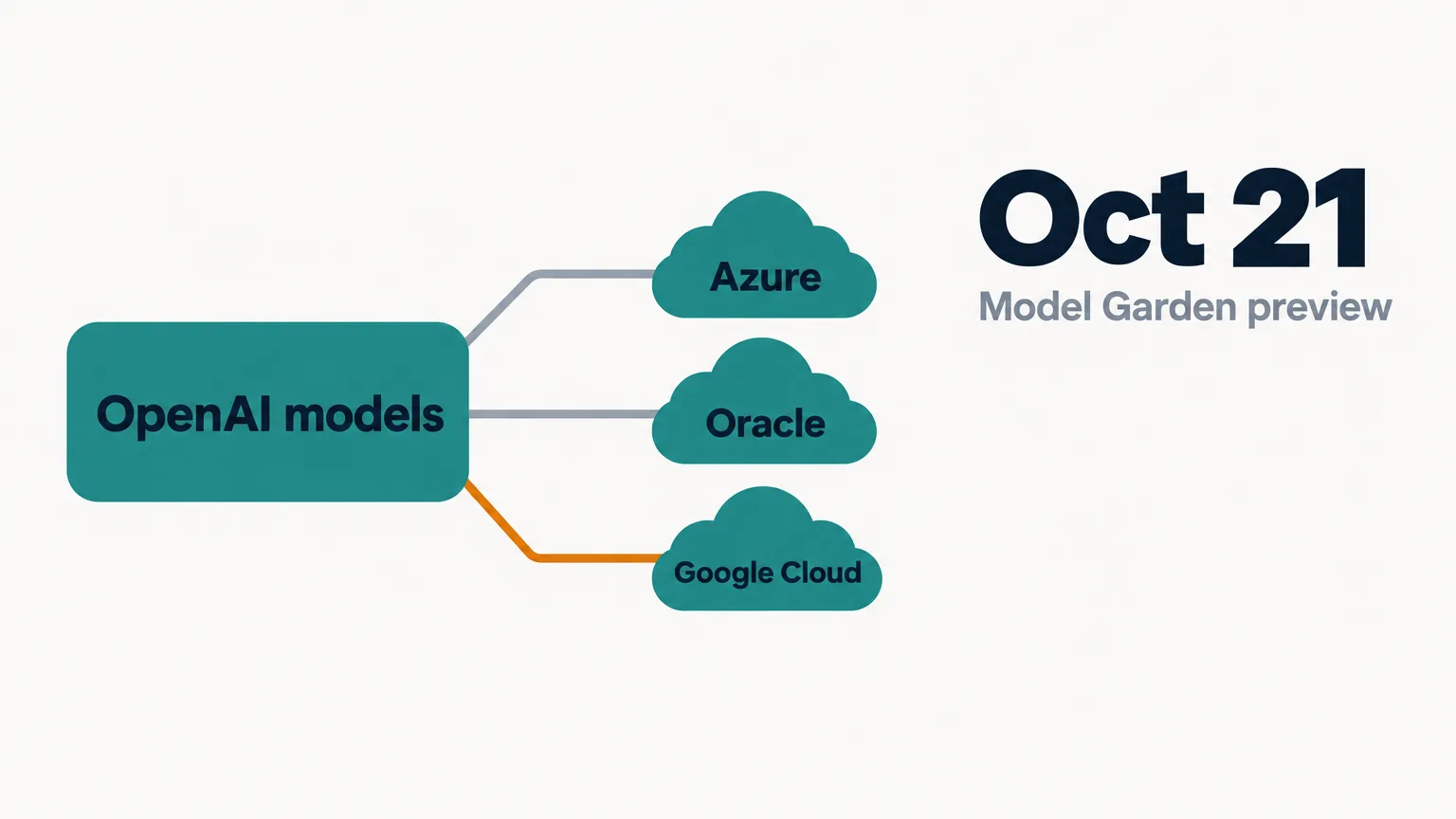
OpenAI’s newest models are coming to Google Cloud: GPT-6 Astra, GPT-6.1 Sol and GPT-6 Luna started rolling out in private preview in Google Cloud’s Model Garden on October 21, 2026, billed through Google Cloud Marketplace. OpenAI’s announcement says Codex comes too, general availability is planned in the coming weeks, and one line closes it: “Microsoft remains OpenAI’s primary cloud partner.”
This page reads OpenAI’s post, Google Cloud’s own announcement and OpenAI’s API price list.
 OpenAI and Google Cloud announced on October 21, 2026 that OpenAI’s frontier models and Codex are coming to Google Cloud’s Model Garden.
 GPT-6 Astra, GPT-6.1 Sol and GPT-6 Luna are rolling out in private preview to select enterprise customers; OpenAI plans general availability in the coming weeks.
 Usage is billed through Google Cloud Marketplace on one Google invoice and draws down existing Google Cloud commitments.
 Neither company published Google-side prices; OpenAI’s own API lists Sol at $2.00 input and $10.00 output per million tokens.
 OpenAI says Microsoft remains its primary cloud partner; Microsoft’s exclusive license ended in April 2026, and Oracle customers got access in June.
§ 01What is in the preview
| Model | Google’s description | Input | Cached input | Output |
|---|---|---|---|---|
| GPT-6 Astra | Demanding work: coding, computer use, science | $10.00 | $1.00 | $50.00 |
| GPT-6.1 Sol | Near-Astra intelligence at lower cost | $2.00 | $0.10 | $10.00 |
| GPT-6 Luna | Fast, cost-efficient everyday work | $0.10 | $0.01 | $0.50 |
The prices above are OpenAI’s direct API rates. Neither announcement lists what Google Cloud will charge per token, so treat parity as unconfirmed until Model Garden publishes rates. Google also says developers can point their local Codex CLI and Desktop workflows at its Gemini platform for inference.
§ 02How buying works
- One bill. Google says OpenAI usage appears on a single Google Cloud invoice.
- Commitments count. Purchases draw down existing Google Cloud spend commitments and count toward Flexible Savings Plans across model providers.
- Governance claims. Prompts and outputs stay inside the customer’s data perimeter and are not used for training; Zero Data Retention and Confidential Compute are both listed as coming soon, not shipped.
- More surfaces later. OpenAI says its models will soon be available in Google Antigravity and the Gemini Agent; Google’s post names Gemini for business. Neither gives a date.

Google’s headline claim is that it is “the only hyperscale cloud provider offering access to all three leading closed source LLMs,” meaning OpenAI’s models now sit beside Gemini and Claude in one catalog.
§ 03How OpenAI got here
| Date | Event | Source |
|---|---|---|
| April 27 | Microsoft’s license to OpenAI’s technology becomes non-exclusive | Microsoft blog |
| June 10 | Oracle customers can buy OpenAI models and Codex with Oracle credits | OpenAI |
| October 21 | Astra, Sol and Luna in private preview on Google Cloud | OpenAI, Google Cloud |
Microsoft’s April announcement is what made this possible. Today’s post keeps Microsoft as primary partner while OpenAI adds distribution where enterprise budgets already sit. Greg Brockman put the aim plainly: making “our most capable models and Codex available where customers are already building.”

§ 04What it means for teams choosing models
For a company already committed to Google Cloud, the change is procurement more than technology: OpenAI models become something you can buy without a new vendor contract. For everyone else, it is one more sign that frontier models are becoming interchangeable parts across clouds, and that the choice that matters is the system you put around them. CellCog makes that choice for you: every tier runs on Claude Opus 5.5, and each AI employee works on its own secure VM and file system.
§ 05What to watch
- Google Cloud’s per-token rates for the three models, and whether they match OpenAI’s.
- General availability, which OpenAI puts in the coming weeks.
- The Antigravity and Gemini Agent integrations, and when Zero Data Retention ships.
Q1Which OpenAI models are on Google Cloud?
GPT-6 Astra, GPT-6.1 Sol and GPT-6 Luna, rolling out in private preview in Google Cloud’s Model Garden from October 21, 2026, per Google’s announcement.
Q2How are OpenAI models billed on Google Cloud?
Through Google Cloud Marketplace. Usage appears on one Google Cloud invoice, draws down existing cloud commitments and counts toward Flexible Savings Plans.
Q3Is Microsoft still OpenAI's cloud partner?
Yes. OpenAI’s announcement says Microsoft remains its primary cloud partner. Microsoft’s license became non-exclusive in April 2026, which opened the door to other clouds.
Q4Will OpenAI models appear in Antigravity and the Gemini Agent?
OpenAI says soon, without a date. Google’s post names Antigravity and Gemini for business.
Q5Does CellCog use OpenAI models?
No. Every CellCog tier runs on Claude Opus 5.5, with each AI employee on its own secure VM and file system.