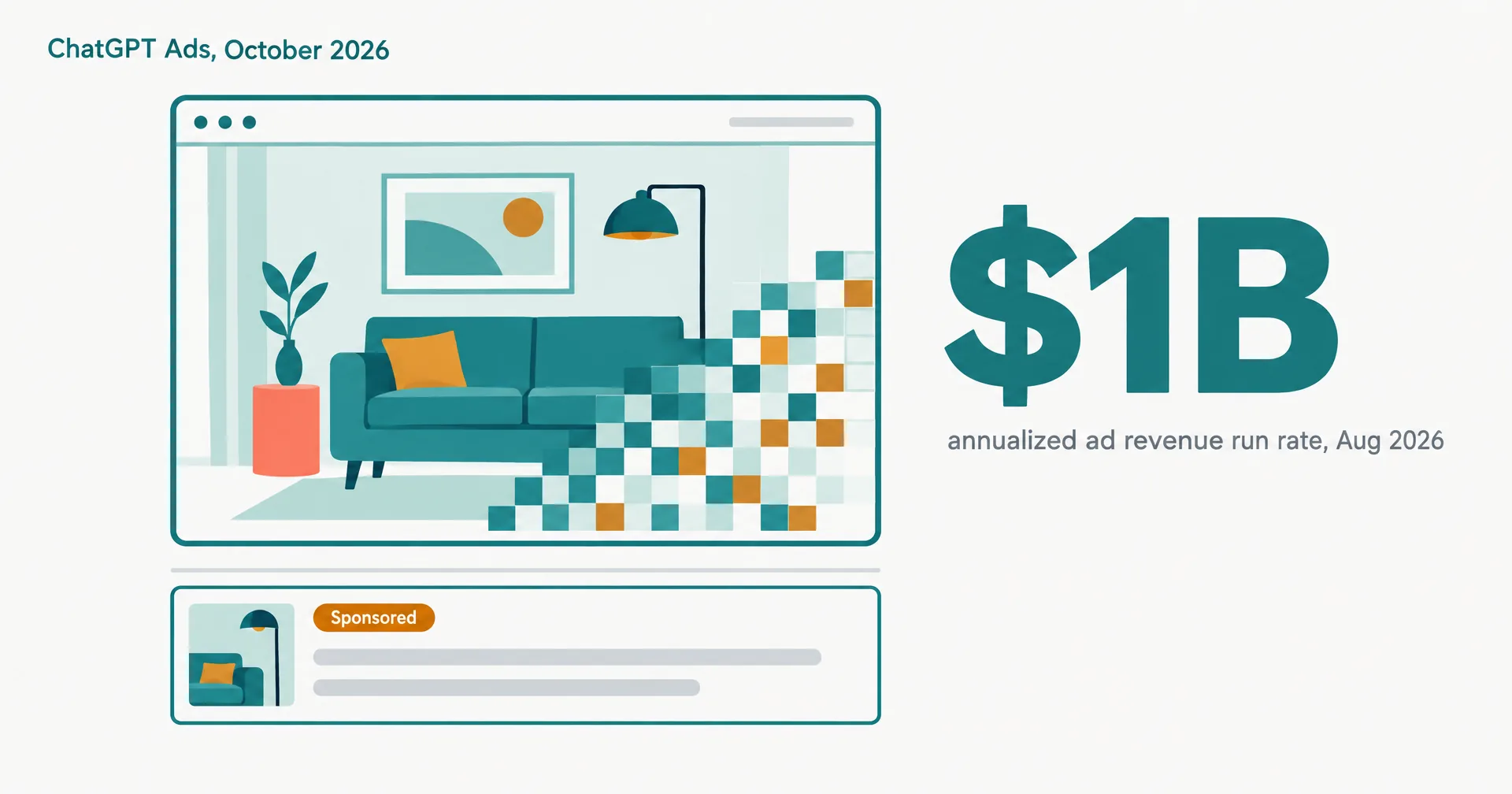
OpenAI said on October 5, 2026 that it will test a new visual ad format in ChatGPT during image generation, starting later this month in the US with an initial group of advertisers. The same announcement widened ChatGPT Ads measurement: conversion-data integrations, ten attribution partners, geo-lift and brand-lift tests, and brand-safety pilots with DoubleVerify and Integral Ad Science. This page reads OpenAI’s announcement, its Ads blog post and its help center as of October 5, 2026.
On this page · 8 sectionsOpen
- OpenAI said on October 5, 2026 that it will test a new visual ad format during image generation in ChatGPT, starting later in October in the US with an initial group of advertisers.
- The image ads are labeled and kept separate from the picture being generated; OpenAI repeats that ads do not influence ChatGPT’s answers.
- Measurement widened the same day: conversion-data integrations with Hightouch, Tealium and LiveRamp, ten attribution partners, geo-lift tests with Haus, Measured and WorkMagic, and brand-lift tests with Kantar and Cint.
- OpenAI published four partner-reported results, including a 15.3% lower cost per acquisition than paid search for WeightWatchers; none came with a public methodology.
- ChatGPT Ads went from a US test on February 9 to more than 60 countries by September 23, and OpenAI put the business at a $1 billion annualized run rate on August 31.
- Ads show only on the Free and Go plans; Plus, Pro, Business, Enterprise and Edu accounts see none.
§ 01What OpenAI announced on October 5
The headline is the format. OpenAI’s words: “Initially, we’ll test this new ad format during image generation in ChatGPT.” The ads, it says, “will be clearly labeled, and remain separate from the image being created,” and “Testing will begin later this month in the US with an initial group of advertisers.” Until now every ChatGPT ad has been one card below a response, with an advertiser name, favicon, headline, copy, landing page and an image asset.
| Change | What it is | Status |
|---|---|---|
| Visual ad format | Image ads shown during image generation, labeled, separate from the generated image | US test from later in October, initial advertisers |
| Conversion data | Integrations with Hightouch, Tealium and LiveRamp to send conversions to ChatGPT Ads | Available |
| Attribution | AppsFlyer, Triple Whale, Adjust, DV Rockerbox, Northbeam, Branch, Singular, Kochava, Airbridge, Tenjin | Supported |
| Incrementality | Geo-based experiments with Haus, Measured and WorkMagic | Early stage |
| Brand lift | Kantar and Cint, measuring brand resonance | Early-stage testing |
| Brand suitability | DoubleVerify and IAS pilots in a controlled test environment, no access to private conversations | Pilots in development |
| Negative Phrases | Brand-specific placement exclusions | Qualifying advertisers |
| Reporting | Optional one-day view-through window; Event Quality Score for pixel and Conversions API signals | Available |
The timing is not an accident. Digiday reported that the update lands at the start of Advertising Week New York, and that advertisers’ three standing complaints have been measurement, too few formats and too little inventory. October 5 answers the first two.
§ 02The early results OpenAI published
OpenAI and its partners released four numbers. Each is partner-reported, each was chosen by OpenAI to publish, and none came with a public methodology, so read them as the best cases rather than the average.
| Advertiser | Measured by | Result |
|---|---|---|
| WeightWatchers | DV Rockerbox | Attributed cost per acquisition 15.3% below its blended paid-search benchmark |
| Dose (wellness) | WorkMagic geo-lift | 67% of incremental purchases from net-new customers; 2.3x more incremental orders than last-click attribution captured |
| Portland Leather | Triple Whale | 93% of visitors from ChatGPT Ads were new |
| Global campaigns | OpenAI | “52.7% of eligible one-day view-through conversions occurred within an hour of the matched ad impression.” |
The last row explains why OpenAI added the view-through window. People often read an ad, keep working in the chat and buy later without clicking, so click-only reports undercount. That is a real effect on every channel, and it is also the argument every ad platform makes for crediting itself with more conversions. The geo-lift tests with Haus, Measured and WorkMagic are the part that could settle it, and OpenAI calls that work “still in its early stages.”
§ 03Eight months of ChatGPT Ads
| Date | What happened |
|---|---|
| February 9, 2026 | Test begins in the US for logged-in adults on Free and Go (OpenAI) |
| March 26, 2026 | Pilot passes $100 million annualized revenue in six weeks, 600+ advertisers (Reuters); Canada, Australia, New Zealand announced next |
| April 17, 2026 | CPMs reported down from $60 at launch to as low as $25; minimum spend from $250,000 to $50,000 (Digiday) |
| May 5, 2026 | Beta self-serve Ads Manager and CPC bidding (OpenAI) |
| August 11, 2026 | Live in the UK, Mexico, Brazil, Japan and South Korea |
| August 31, 2026 | $1 billion annualized run rate, tens of thousands of advertisers, self-serve across India, Europe, the Middle East and North Africa (OpenAI) |
| September 16, 2026 | Sponsored Agents test; HubSpot and Shopify integrations (OpenAI) |
| September 23, 2026 | Southeast Asia and Taiwan; “more than 60 countries” (OpenAI) |
| October 5, 2026 | Visual ad format test announced; measurement partners expanded |
The August 11 figure counts the US, the three April markets and the five August markets; the last two bars are OpenAI’s “over 40” and “more than 60”, so treat them as floors.
§ 04What ChatGPT Ads cost
There is no public rate card. OpenAI’s help center describes three ways to buy, all in what it calls “a relevance-weighted, second-price auction”:
| Objective | You pay for | Notes |
|---|---|---|
| Views | Every 1,000 impressions (CPM) | Set a maximum CPM bid |
| Clicks | Each valid click (CPC) | OpenAI recommends starting at a maximum of $3 to $5 per click |
| Conversions | Valid clicks (oCPC) or impressions (oCPM) | Optimizes toward a conversion event; you never pay per conversion |
Budgets can be daily or campaign-total, and the minimum daily budget depends on the account’s billing currency. For reference points, Digiday reported a $60 CPM at launch and $25 to $45 by April; those were pilot-era prices before the self-serve auction opened, so expect today’s numbers to depend on your category.
§ 05Who sees the ads
- Free and Go only. Plus, Pro, Business, Enterprise and Edu accounts have no ads, and OpenAI says it does not show ads to accounts it identifies as under 18.
- Below the answer. “Ads appear below ChatGPT responses,” per the help center; the image-generation test adds the first placement outside that slot.
- Not in Atlas yet. “During this test, ads do not appear in the ChatGPT Atlas browser.”
§ 06What it means if you run ads for a small business
- Inventory is still thin. Zeno Group’s Shamsul Chowdhury told Digiday: “There are about 2.5 billion prompts globally happening each day on ChatGPT,” against roughly 15 billion Google searches, with one ad slot per answer. Budgets that need scale will not move wholesale this quarter.
- The image placement suits visual products. Furniture, fashion, travel and food fit a moment when someone is already picturing something; a B2B service mostly does not.
- Measurement is the work. The new partners only help if your conversions reach the platform. Set up the pixel or Conversions API first and check the Event Quality Score before judging results. We buy search ads at CellCog ourselves, and the first problem was always whether signups reached the ad platform at all, not the bid.
- Run your own lift test before trusting attributed numbers. The four published results are a ceiling, not a forecast.
§ 07What we are watching
- The image-ad test. Which advertisers are in it, how it looks inside image generation, and when it leaves the US.
- Independent lift results. Geo-experiment outcomes from Haus, Measured or WorkMagic that OpenAI did not select.
- The DoubleVerify and IAS pilots. Whether an outside view of where ads appear gets published.
§ 08Sources
- OpenAI, “Building advertising for the way people use AI”, October 5, 2026
- OpenAI Ads blog, “More ways to measure ChatGPT Ads”, October 5, 2026
- OpenAI Help Center, “Ads in ChatGPT: The Basics” and “Ads in ChatGPT”, read October 5, 2026
- OpenAI, “A milestone in expanding access to AI”, August 31, 2026
- Reuters, ad pilot passes $100 million, March 26, 2026
- Digiday, “ChatGPT ads are getting cheaper”, April 17, 2026, and October 5 report
Q1Where do ads appear in ChatGPT today?
Below ChatGPT responses, labeled as sponsored. The new visual format adds a test placement during image generation, kept separate from the generated image.
Q2Who sees ads in ChatGPT?
People on the Free and Go plans in the countries where ads run (logged-out visitors can see ads suitable for all audiences). Plus, Pro, Business, Enterprise and Edu accounts have no ads, and OpenAI says it does not show ads to accounts it identifies as under 18.
Q3How much do ChatGPT Ads cost?
There is no rate card. Advertisers bid in an auction; OpenAI’s help center recommends starting CPC campaigns at a maximum bid of 3 to 5 US dollars per click, and Digiday reported CPMs falling from 60 dollars at launch to as low as 25 dollars by April.
Q4Do ads change ChatGPT's answers?
OpenAI says no: ads run on separate systems from the chat model and advertisers cannot shape or rank responses. That is OpenAI’s own statement; no outside audit of it has been published.
Q5Does CellCog show ads?
No. CellCog has no ad tier; you pay for the work you assign your AI employees. We cover ad platforms because many of our readers run their own marketing.