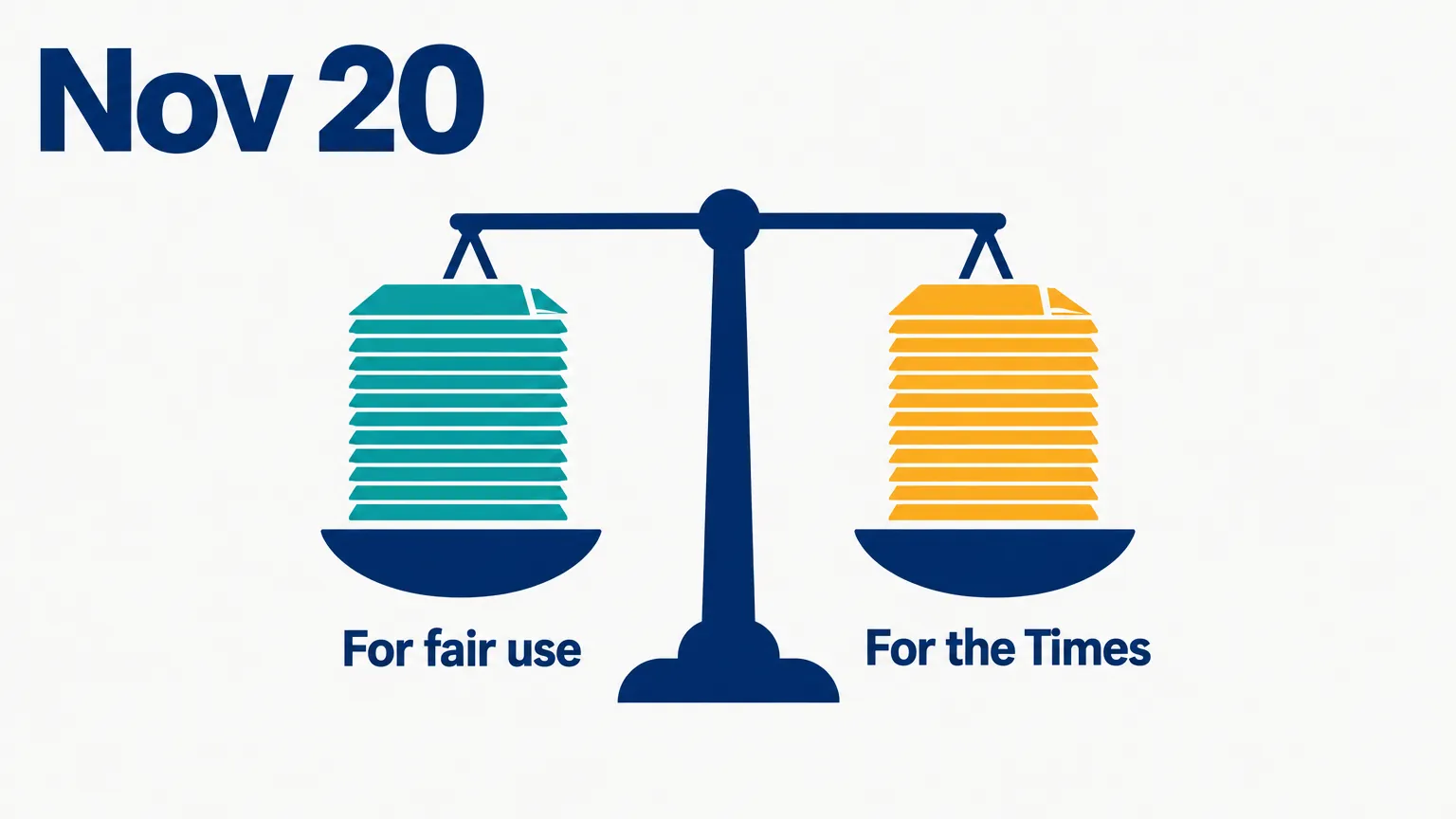
OpenAI published a roundup on October 30, 2026 of the court briefs filed on its side in the New York Times copyright case. The post, titled Fair use benefits everyone, quotes twelve filers, from library and disability groups to law professors and the United States government, all arguing that training AI models on copyrighted text is fair use. It also takes a swipe at the Times, saying its lawsuit asks the court to “toss aside the longstanding principle of fair use in their own narrow pursuit of an undeserved payday”.
The timing is the court’s, not OpenAI’s. October 30 was the deadline for amicus briefs in the consolidated case before Judge Sidney Stein in New York, and the other side filed too: publishers, news groups and Hollywood unions asked the judge to reject fair use. Replies are due November 20, and no ruling date has been set.
On this page · 6 sectionsOpen
 October 30, 2026 was the amicus deadline in the consolidated OpenAI copyright case before Judge Sidney Stein in New York.
 OpenAI posted excerpts from twelve filers arguing that training AI on copyrighted text is fair use.
 The US government filed a Statement of Interest on September 1 saying limits on AI training threaten national security.
 News groups, publishers and Hollywood unions filed briefs asking the judge to reject OpenAI’s fair use defense.
 Summary judgment replies are due November 20, 2026; no hearing or ruling date has been set.
§ 01What OpenAI posted
The post is a set of excerpts, one per filer, with the full filings left on the public court docket. Its framing line: “Experts and leaders across a wide range of fields have recognized that fair use is a win-win that benefits everyone”. The filers it names are AI Progress; a joint brief from the American Council of the Blind, library associations, the Consumer Technology Association and the Business Software Alliance; Authors Alliance; Engine and the Developers Alliance; the Foundation for American Innovation; economist Joshua Gans; author Kevin Kelly; law professor Matthew Sag; musician Michael Wall and comedian Sarah Rose Siskind; Public Knowledge; journalist Ron Suskind with law professor Brian Frye; and the United States government.
The government’s piece is the heaviest. The Justice Department filed a Statement of Interest on September 1, 2026, arguing that rules making AI development harder “threaten national security and give a competitive advantage to foreign adversaries who are not so encumbered.” A Statement of Interest states the government’s view; it is not a ruling, and the news plaintiffs asked the judge to give it little weight.
§ 02Who filed on each side
OpenAI’s post shows one side. The briefs filed for the Times and the other plaintiffs this week make the opposite case, and several of them are on the public docket.

| Side | Filer | Core argument |
|---|---|---|
| For fair use | United States government | Limits on AI training threaten national security |
| For fair use | Library, disability and tech groups | Training restrictions hurt the people who use AI |
| For fair use | Authors Alliance | Competition from new works is not copyright harm |
| For the Times | News/Media Alliance, ProPublica and others | AI output competes with the news it copies |
| For the Times | Digital Content Next | AI summaries cut traffic publishers live on |
| For the Times | SAG-AFTRA, AFM, WGA | Companies this size can afford licenses |
| For the Times | Publishers (AAP and others) | Licensing markets for text already exist |
The News/Media Alliance brief, joined by ProPublica, puts it bluntly: “Common sense tells us this is not fair. And so does copyright law.” It leans on a September 29, 2026 Third Circuit decision in Thomson Reuters v. ROSS Intelligence, which rejected a fair use defense for a competing AI legal research tool. Digital Content Next says AI summaries pose “an existential threat to the publishing industry”. The actors and writers unions point to OpenAI’s size: “Companies of that size can afford to license the works they use.”
§ 03The schedule
Judge Stein moved the summary judgment calendar in a September 24 order: oppositions on October 23, amicus briefs on October 30, replies on November 20. Several of the filings above are proposed briefs that still need the court’s leave to be filed.
§ 04What is confirmed, and what is not
| Claim | Status |
|---|---|
| OpenAI posted excerpts from twelve filers | Confirmed: its October 30 post |
| The US government backs fair use for training | Confirmed: Statement of Interest, September 1 |
| News, publisher and union groups filed against | Confirmed: briefs on the docket |
| Replies are due November 20, 2026 | Confirmed: September 24 order |
| A hearing date is set | Not found |
| The court has ruled on fair use | No ruling yet |
§ 05What it means if you build with AI
- Nothing changes today. Summary judgment briefing ends November 20; a ruling comes after that, on no announced date.
- Training and outputs are being argued separately. OpenAI’s side argues training is fair use; the publishers focus on outputs that compete with their articles.
- Website owners have a new lever either way. OpenAI also said on October 30 it will honor a shared robots.txt signal for AI training, covered in our post on that rule.
§ 06Where CellCog stands
Our conflict, declared: CellCog builds AI employees on Claude Opus 5.5 through Anthropic’s API and is not a party to this case. A ruling on how models were trained would reach the labs that train them, not the work our customers’ employees do with their own files and sources.
Q1What case is this?
The consolidated In re OpenAI copyright litigation in federal court in New York, which includes the New York Times lawsuit against OpenAI and Microsoft.
Q2Is the US government a party?
No. The Justice Department filed a Statement of Interest stating its view that training is fair use; it is not a ruling.
Q3What is the strongest argument against OpenAI?
The publishers argue AI outputs compete with the articles they copy, and cite a September 2026 Third Circuit ruling against a competing AI legal tool.
Q4Has the judge ruled on fair use?
No. Summary judgment briefing ends November 20, 2026, and no ruling or hearing date has been announced.
Q5Does this affect CellCog?
Not directly. CellCog builds AI employees on Claude Opus 5.5 through Anthropic’s API and is not a party to the case.