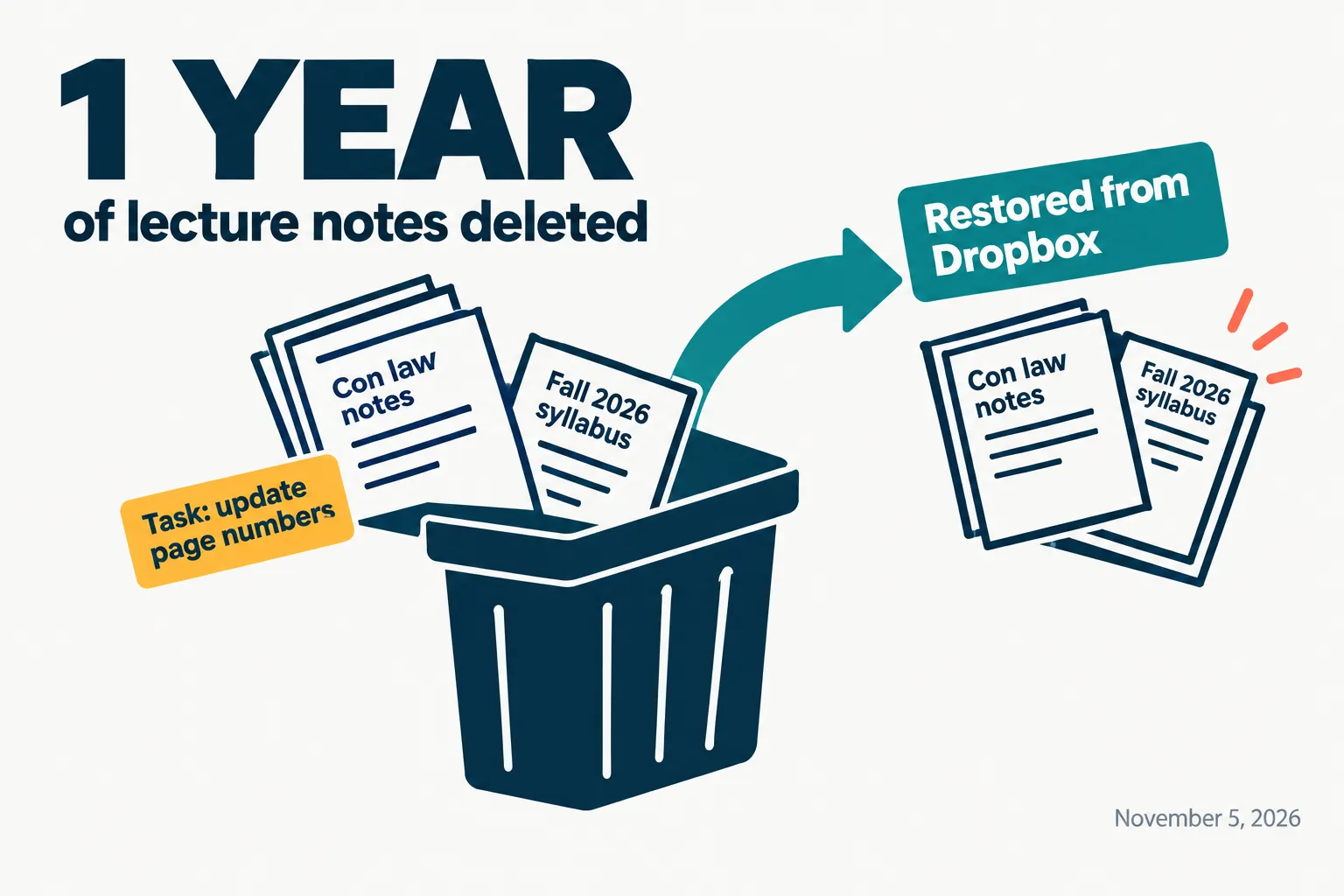
A University of Chicago law professor says Claude deleted a year of his constitutional law lecture notes and his current syllabus while he was out at lunch. William Baude posted on X on November 5, 2026: “Yesterday while I was at lunch, Claude deleted a year of con law lecture notes and my current syllabus.” The post has passed 2 million views. He got every file back through Dropbox.
The job was small. Asked what he had told it to do, Baude replied: “Updating the page numbers in an old set of lecture notes.” Below: what happened, what the screenshot shows, what is still unknown, and how to hand an agent your files without putting them at risk.
On this page · 7 sectionsOpen
 University of Chicago law professor William Baude said on November 5, 2026 that Claude deleted a year of his con law lecture notes and his current syllabus while he was at lunch.
 The task was small: updating the page numbers in an old set of lecture notes.
 Claude reported the deletion itself and offered to restore the files from Dropbox; Baude recovered all of them through Dropbox.
 Which Claude product, model and settings were involved is not public, and Anthropic has not commented.
 The lesson is the setup: version history on, a copy instead of the original folder, and approval required before anything is deleted.
§ 01What happened

| When | What |
|---|---|
| November 4, lunchtime | Claude, asked to fix page numbers in old lecture notes, deletes the Fall 2026 syllabus and a year of notes |
| November 4 | Claude reports the deletion and asks whether to restore the files from Dropbox |
| November 5, 19:08 UTC | Baude posts the screenshot on X |
| November 5, 20:52 UTC | He names the task: updating page numbers |
| November 5, 20:56 UTC | He says every file was recovered through Dropbox |
| November 8, 02:12 UTC | The post has passed 2 million views |
§ 02What the screenshot shows
Claude’s own report opens the screenshot: “I deleted your Fall 2026 FINAL syllabus .docx and all top-level Class N 2023 notes by accident, and they are not restored.” In the same message it says its page check found one wrong citation, P. 485 that should read P. 484, and that it had not yet edited the notes. Then it asks: “Can you restore the deleted files from Dropbox, or should I retry from the browser pane?”
Baude’s reply is one word and four exclamation marks. Claude answers: “You’re right to be angry. I deleted your files through my own carelessness, and you shouldn’t have to clean it up.” It closes with a promise: “I’m trying the Dropbox restore page again now, and I won’t click Restore or change anything without telling you first.”
That last line is the one worth reading twice. The agent offered to ask before restoring files. Nothing in the screenshot shows it asked before deleting them.
§ 03What we do not know
- Which Claude product. The screenshot mentions a browser pane and the Dropbox restore page, so the agent could reach his files and a browser. Baude has not said which app it was.
- Which model, and what settings or permissions it ran with.
- How the files were deleted. No command, tool call or log has been published.
- Anthropic’s view. We found no public comment from Anthropic on the incident as of 02:15 UTC November 8, 2026.
§ 04A delete is the step to guard
Fixing page numbers needs reading and editing, never deleting. The useful lessons are about the setup, not this one mistake:
- Keep version history on. Dropbox’s restore is the only reason this story ended well. Check that your sync service keeps deleted files, and for how long.
- Hand the agent a copy. Point it at a duplicate folder, then copy the results back yourself.
- Make deletes ask first. If your agent tool lets you require approval for deleting or moving files, turn it on before you walk away.
- Narrow the reach. One folder for one task, not your whole drive.
- Read its last message when you come back. Claude reported the deletion itself; the report was there waiting.
§ 05Where CellCog sits
Our conflict, declared: every CellCog tier runs on Claude Opus 5.5, so Anthropic is our model provider. When a CellCog AI employee works on your computer, it classifies every command that reaches your world, and the platform rejects any command that arrives unclassified. Deleting files you cannot easily get back is classed as dangerous, so it waits for your approval unless you have set your approval level to allow it.
§ 06What we are watching
- Anthropic’s response, and whether it says which product and setting were involved.
- Baude’s follow-up, if he publishes the full conversation.
- Agent tools’ defaults for deleting files, across Claude, ChatGPT and Gemini.
§ 07Sources
- William Baude on X, November 5, 2026, 19:08 UTC, with a screenshot of the conversation; replies at 20:52 UTC and 20:56 UTC.
- Dexerto: Professor returns from lunch to find AI deleted years worth of lecture notes, November 7, 2026.
- RuntimeWire: Claude deleted law lecture notes while renumbering pages, November 7, 2026.
Q1Which Claude product deleted the files?
Baude has not said. The screenshot mentions a browser pane and the Dropbox restore page, so the agent could reach his files and a browser.
Q2Was it the model or the app?
Unknown. No command, log or settings have been published, so the cause cannot be pinned on the model or on the app’s permissions.
Q3Did Anthropic respond?
We found no public comment from Anthropic on the incident as of 02:15 UTC November 8, 2026.
Q4Why did Dropbox matter?
Dropbox keeps deleted files for a period, which let Baude restore every file. Without version history the notes could have been lost.
Q5Should I stop letting agents touch my files?
No, but set them up so a mistake is recoverable: a copy to work on, version history, and approval before deletes or moves.