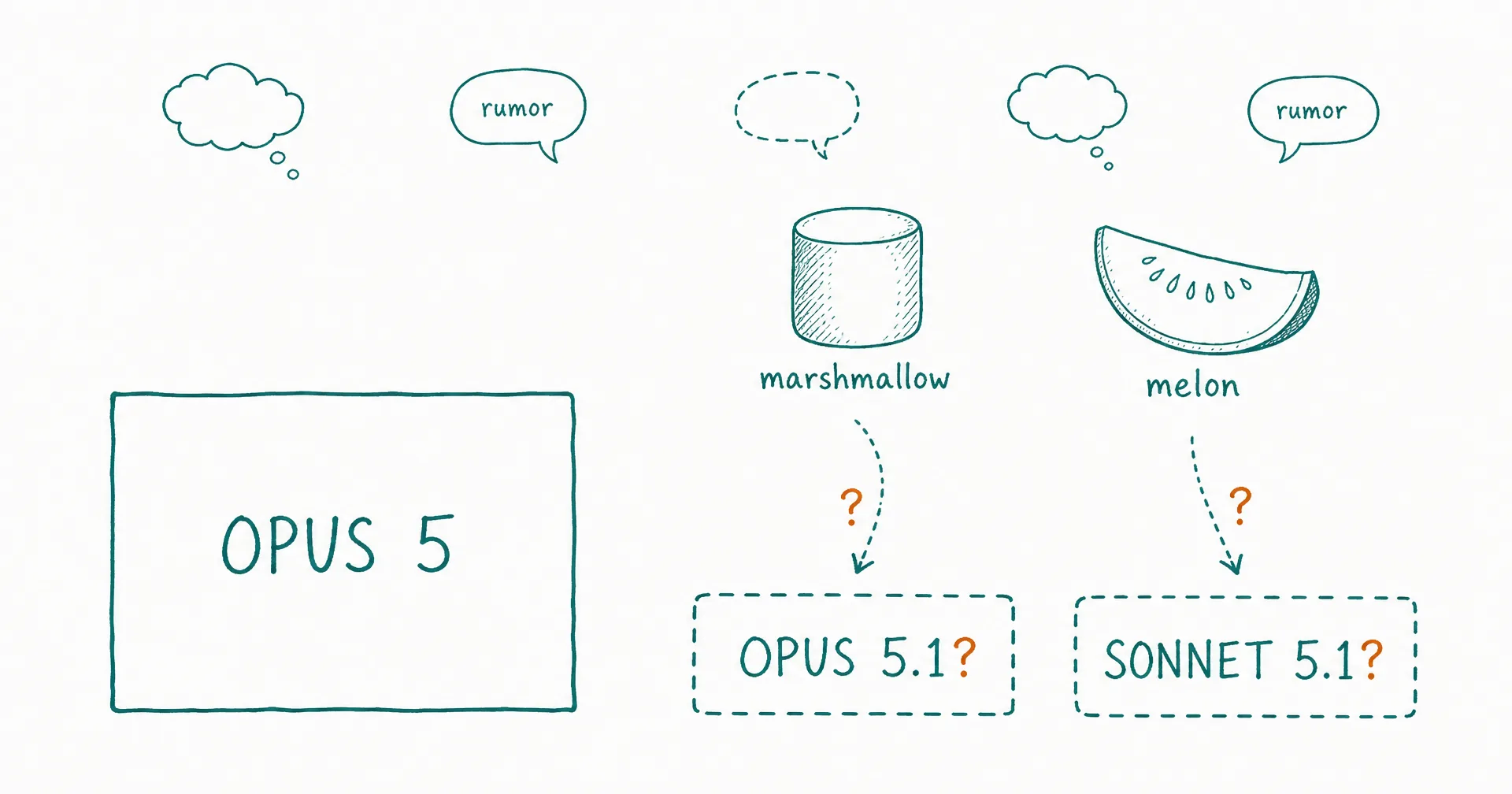
Opus 5.1 does not exist. Neither does Sonnet 5.1. Not as announced models, not as API identifiers, and, strictly speaking, not even as leaks: the two names people are searching for are community labels applied to a pair of food-themed test strings, and that distinction is the most useful thing anyone can tell you about them right now.
As of August 30, 2026, Anthropic has announced nothing. We pulled the company’s news index and model documentation directly this morning: the current models are claude-opus-5, claude-sonnet-5, and claude-fable-5, and no page anywhere in Anthropic’s public materials contains a 5.1. There is no model card, no pricing entry, no benchmark, and no functioning API name for a successor to either tier.
What does exist is a genuinely interesting rumor chain, moving fast enough that most of what ranks for these queries is out of date within days. So this page does what our Fable 5.1 tracker and Astra tracker do: every claim dated, official statements separated from reporting and both separated from rumor, updated the same day the story moves.
On this page · 7 sectionsOpen
- Opus 5.1 and Sonnet 5.1 have NOT been announced, released, or teased as of August 30, 2026. Anthropic’s documentation still lists claude-opus-5 and claude-sonnet-5 as the current models in their tiers.
- The names are community labels, not leaks: the underlying sighting is a pair of test strings, claude-marshmallow-eap and claude-melon-eap, circulated in screenshots around August 21 to 24. No string containing ‘opus’, ‘sonnet’, or ‘5.1’ has surfaced.
- The codename map is contested. Marshmallow is most often read as an Opus successor; Melon is read as Sonnet by some and as a new Haiku by others; a minority reads Marshmallow as Fable-class. Testers who claim access say neither reaches Fable 5.
- From August 27, Reddit threads with hundreds of votes reported a sudden improvement in Opus 5 and speculated about stealth A/B testing. A checkpoint swap is one explanation; system-prompt, routing, or harness changes explain it equally well.
- No pricing, benchmarks, or model card exists. Current official pricing: Opus 5 at $5 input and $25 output per million tokens, Sonnet 5 at $2 and $10.
- The one precedent worth knowing: a test string called claude-honeycomb-eap reportedly surfaced about two weeks before Opus 5 shipped on July 24. The marshmallow strings were first seen August 21. One precedent is arithmetic, not a pattern.
- This page is a living tracker: when either model becomes real, the confirmed specs and our own read land here the same day.
§ 01What we actually know
| Claim | Status |
|---|---|
| Official announcement or teaser | None exists |
| API identifiers (claude-opus-5-1, claude-sonnet-5-1) | Never sighted; the circulating strings contain neither name |
| Test strings claude-marshmallow-eap and claude-melon-eap | Circulated in screenshots and third-party model lists, August 21 to 24; unconfirmed |
| Reported API traffic from claude-marshmallow-ht-eap | Reported August 21, with fallback to Opus 4.8 on some requests; unconfirmed |
| The names “Opus 5.1” and “Sonnet 5.1” | Community inference layered on the codenames, first widely circulated August 24 |
| Stealth A/B testing behind Opus 5 | User anecdotes from August 27; multiple mundane explanations fit |
| Rumored release window | “Late August”, already slipped; early September speculated |
| Pricing, benchmarks, model card | Nothing exists |
| Anthropic’s current models | claude-opus-5 and claude-sonnet-5, per its own docs |
§ 02Where the names actually came from
The chain is short, and it is worth walking in order, because the order is the story.
August 21. The first reported sighting: a string called claude-marshmallow-ht-eap allegedly produced observable API traffic, including fallback to Opus 4.8 on some safety-sensitive requests. The “eap” suffix matches the naming shape of Anthropic’s early-access previews, which is what gave the sighting its initial credibility.
August 21 to 24. Screenshots and third-party model lists circulated two cleaner strings: claude-marshmallow-eap and claude-melon-eap. On August 24 the sighting was widely amplified on X, with commentators reading the pair as an Opus update plus a smaller model.
August 24. The product names arrive, from outside Anthropic. Social posts and rumor blogs headlined the pair as “Opus 5.1 and Sonnet 5.1 leaks”, reasoning from tester impressions: Marshmallow seemed stronger than Melon and stronger than the current Opus 5, while neither seemed Fable-level, so Marshmallow was probably Opus and Melon probably Sonnet. That inference is the entire origin of both search terms. The strings themselves never contained “opus”, “sonnet”, or “5.1”.
Also worth knowing: a developer who investigated the sightings reportedly found the plain marshmallow and melon strings produced no verifiable first-party output at all, which would leave the ht-eap traffic as the only observable evidence. Even the leak, in other words, is thinner than the headlines built on it.
August 27 onward. The A/B thread. Claude users reported that Opus 5 suddenly felt sharper, more persistent, and less wasteful with tokens, and speculated they had been silently routed into a 5.1 test bucket. The threads drew hundreds of upvotes. Nobody produced a backend identifier: the interface still said Opus 5.
§ 03The contested map
Here is the part most coverage flattens: even among people who believe the sightings, there is no agreement on what Marshmallow and Melon actually are.
- The majority reading: Marshmallow is an Opus 5 successor, Melon a Sonnet 5 successor. This is the reading that created the search terms.
- The Haiku reading: Marshmallow is the Opus refresh, but Melon is a new small model, a Haiku 5 rather than a Sonnet 5.1. The original August 24 amplification itself floated “possibly Haiku”.
- The Fable reading: a minority maps Marshmallow to the Fable tier instead, which would make it the Fable 5.1 that a separate rumor stream has predicted since July. The tester claim that neither model feels Fable-level cuts against this, for whatever informal impressions are worth.
The disagreement matters practically. If you are watching for “Sonnet 5.1”, you may be watching for a model that ships as something else entirely, or never ships at all. Codenamed test routes get renamed, merged, and abandoned; an EAP string is evidence that Anthropic is testing something, not a commitment to a product.
§ 04Why the rumor is credible anyway
The strongest argument is not the leak. It is product-line logic, and it is the same logic that made the Fable 5.1 rumor durable.
Anthropic shipped Claude Opus 5 on July 24, 2026, and the loudest public feedback since has been specific: heavily upvoted threads complaining about verbosity, jargon, and constraint-following. That is exactly the profile a point release exists to smooth, which is why “5.1 fixes the annoying parts” sounds instantly plausible with or without a source. Frustration this specific writes its own rumors.
There is also one piece of cadence arithmetic. A test string called claude-honeycomb-eap reportedly surfaced about two weeks before Opus 5 launched. The marshmallow strings were first seen August 21; two weeks lands in early September. That is one precedent doing a lot of work, and prerelease branches die or get renamed all the time, but it is the entire quantitative basis of every “early September” prediction you will read, so you should at least know how small it is.
What the rumor is not backed by: any benchmark, any run configuration, any reproducible endpoint, any named Anthropic source, or any document. Tester impressions of long thinking times and better one-shot coding are subjective prerelease anecdotes, not measurements.
§ 05What we are watching for
We run standing AI employees on Claude models daily, so our watchlist for a point release is an operator’s, not a spectator’s.
- An API identifier. The moment a claude-opus-5-1 or claude-sonnet-5-1 string, or a shipped model under the Marshmallow or Melon names, appears in Anthropic’s docs or model list, this stops being a rumor page.
- Instruction-following and verbosity deltas. The publicly requested fixes. For agent work, a model that follows constraints tightly and spends fewer tokens saying so changes the daily economics directly.
- Token efficiency at long horizons. The tester anecdotes describe long thinking and heavy token use. Whether a shipped 5.1 spends tokens better or merely spends more is the difference between an upgrade and a price increase in disguise.
- What Melon actually is. Sonnet 5.1, Haiku 5, or nothing. The small-model tier matters for high-volume agent steps, where per-token price dominates.
- The Opus 5.2 routing claim (September 14). One X account says Opus 5 in Claude Code is being served by a newer model it calls Opus 5.2, on the evidence of answers that feel different and a knowledge-probe prompt. No identifier, no string, no traffic report this time. It has its own page, Opus 5.2 release date; an artifact of the August kind would move both pages.
- Pricing. Point releases have historically held tier pricing. If that breaks in either direction, it is news for everyone pricing agent work on top.
§ 06The tracker
This page updates when facts change, not when rumors get louder. As of August 30, 2026: no announcement, no API identifier, no benchmarks, no pricing, no model card. The verifiable core is a pair of test strings and one reported traffic sighting; the product names, the codename map, and the date are all inference. When either model becomes real, the confirmed specs, the deltas that matter for agent work, and our own adoption read land here the same day.
§ 07Update log
This is a living page; when the story moves, the update lands here.
September 14, 2026. The name moved on without the strings. A new rumor says Opus 5 in Claude Code is being routed to an Opus 5.2, based on one account’s sessions and a test prompt, with no early-access identifier or traffic report behind it. Nothing here is resolved by it: Marshmallow and Melon remain unattributed, and Anthropic’s documentation still lists claude-opus-5 as the current Opus. We track the new claim on its own page, Opus 5.2 release date.
September 1, 2026. Anthropic shipped Claude Fable 5.1 (with the restricted Mythos 5.1 variant). Relevant here: the release did NOT resolve the Marshmallow and Melon strings. Anthropic attributed neither string to Fable 5.1, no claude-opus-5-1 or claude-sonnet-5-1 identifier appeared alongside the launch, and the Opus and Sonnet successor question stays open. The minority reading of Marshmallow as a Fable-class checkpoint loses some plausibility now that the Fable slot is filled, but nothing is confirmed either way. One cadence note: Fable 5.1 shipping makes point releases for the rest of the family more likely, not less.
As of August 30, 2026: page opened. No official movement to log.
Q1Has Anthropic announced Opus 5.1 or Sonnet 5.1?
No. As of August 30, 2026 there is no announcement, documentation entry, system card, pricing page, or API identifier for either model. We pulled Anthropic’s news index and model documentation directly today: every Opus, Sonnet, and Fable reference resolves to the current generation, claude-opus-5, claude-sonnet-5, and claude-fable-5.
Q2What are claude-marshmallow-eap and claude-melon-eap?
Test strings that circulated in screenshots and third-party model lists around August 21 to 24, 2026, in the naming shape Anthropic uses for early-access previews. A related string, claude-marshmallow-ht-eap, reportedly produced observable API traffic on August 21, including fallback to Opus 4.8 on some safety-sensitive requests. None of this is confirmed by Anthropic, and one developer who investigated reportedly found the plain marshmallow and melon strings produced no verifiable first-party output at all.
Q3Is my Claude already running Opus 5.1?
Unknown, and the honest answer is that you cannot tell from the outside. From August 27, users reported that Opus 5 suddenly felt sharper and speculated they had been routed into a 5.1 test bucket. The interface still said Opus 5, and no backend identifier surfaced. A new checkpoint is one explanation; a system-prompt change, different routing or effort settings, an A/B harness experiment, or ordinary variance explain the same observation.
Q4What is Opus 5.1 rumored to improve?
Tester impressions, all unverified: stronger than the current Opus 5 in some interactions, long thinking times, heavy token use, and a more natural conversational register. The louder signal is what users are asking to be fixed: Opus 5’s verbosity, jargon, and constraint-following have drawn heavily upvoted complaints, which is exactly the profile a point release exists to smooth.
Q5What will Opus 5.1 and Sonnet 5.1 cost?
Nothing is known. No pricing exists for either name. Current official pricing is $5 per million input tokens and $25 per million output for Opus 5, and $2 and $10 for Sonnet 5. Prior point releases have often held their tier’s price, but assuming that for 5.1 is planning, not fact.
Q6Should I wait for Opus 5.1 before building on today's models?
No. Waiting for an unannounced checkpoint is how teams lose quarters, and everything built on the current generation inherits the successor when it ships. We run our whole company on Claude models today: a CellCog AI employee packages the model, memory, inbox, and task board, plans start at $8 a month; you pay for the work, not the hire, and the cost depends purely on how much work you assign.