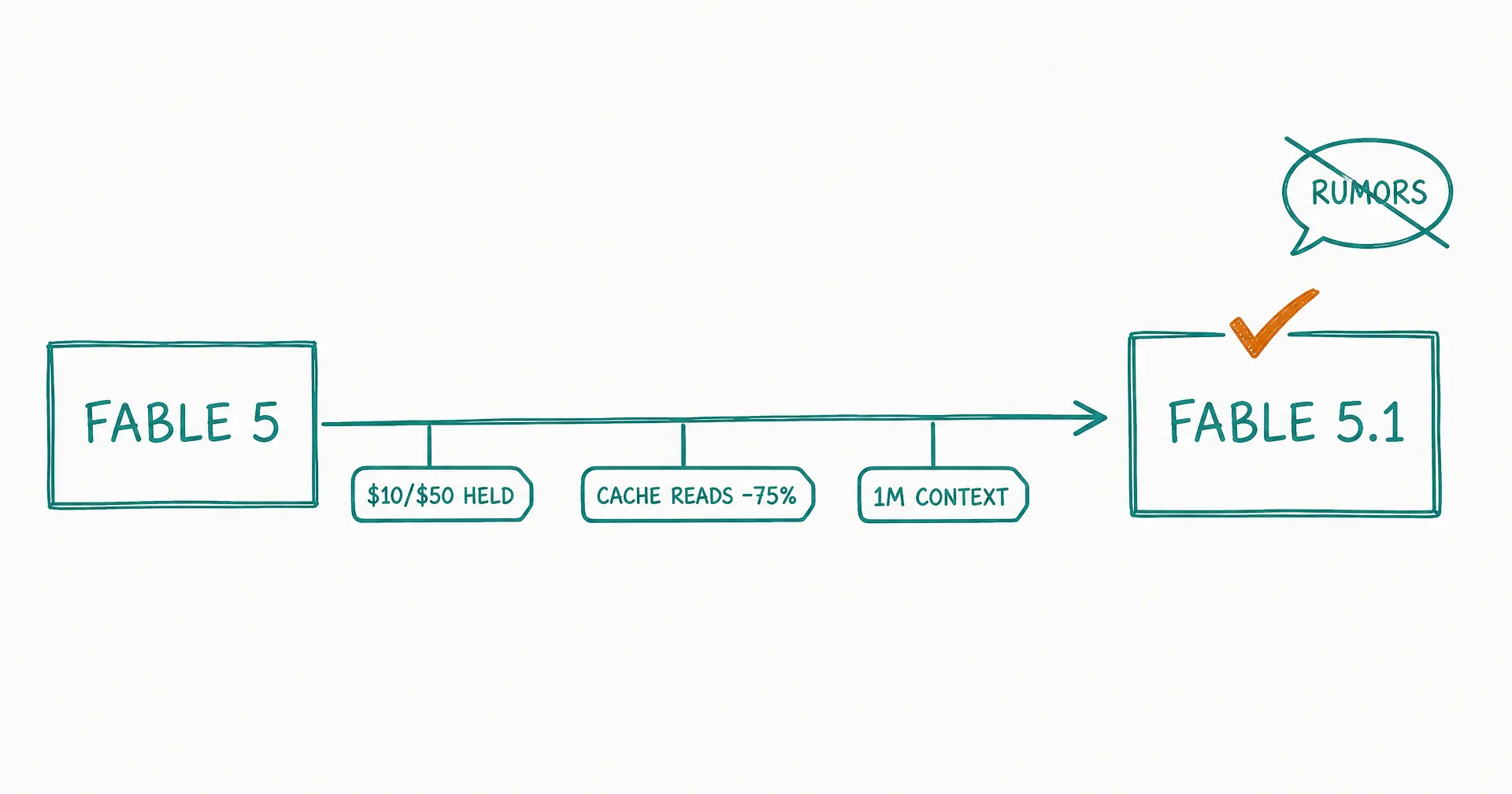
Fable 5.1 exists now. Anthropic announced Claude Fable 5.1 on September 1, 2026, alongside a restricted-access sibling called Claude Mythos 5.1, and the API identifier claude-fable-5-1 went live the same day. This page spent two weeks separating rumor from fact; today it trades the rumor table for a spec table.
The short version: the rumors were mostly right. Pricing held exactly at Fable 5’s $10 per million input tokens and $50 per million output tokens. The focus landed exactly where the community guessed: long-running, ambitious agent work. And the one thing nobody leaked turns out to be the line that matters most to anyone running agents at scale: cache reads dropped 75%, which changes the economics of agentic workloads more than any headline price could.
We run our whole company on the Fable line, so after the confirmed record comes the operator’s read.
On this page · 6 sectionsOpen
- Claude Fable 5.1 shipped September 1, 2026, alongside Claude Mythos 5.1, a restricted-access variant for vetted cyberdefense and life-science organizations. Anthropic calls Fable 5.1 a Mythos-level model with general-use safeguards.
- Pricing held exactly where the rumors said: $10 per million input tokens and $50 per million output tokens, unchanged from Fable 5. The surprise is cache reads, now $0.25 per million tokens, 75% less than Fable 5.
- Anthropic estimates the cache-read cut reduces typical workload costs by about 25% and highly agentic workloads by up to about 45%. For standing agents, that line matters more than the headline price.
- The API identifier claude-fable-5-1 is live, with a 1M-token context window, 128K max output, always-on adaptive thinking, and a June 2026 knowledge cutoff, per Anthropic’s model docs.
- Anthropic’s headline numbers: 55.8% on Terminal-Bench 4.0 versus 42.0% for Fable 5, and 52.6% on Terminal-Bench-Science 0.1, which it describes as more than double Fable 5.
- Available everywhere day one: the Claude API, Amazon Web Services, Google Cloud, Microsoft Foundry, and the Claude apps for Pro, Max, Team, and Enterprise plans.
- We run our whole company on the Fable line: CellCog’s AI employees completed over 200 tasks a week on Fable 5 in August 2026, and everything built on it inherits 5.1 as the model swaps under the platform.
§ 01What shipped: the confirmed record
| Fact | Status |
|---|---|
| Announcement | September 1, 2026, official (Anthropic’s product page and X account) |
| API identifier | claude-fable-5-1, live |
| Input / output pricing | $10 / $50 per million tokens, unchanged from Fable 5 |
| Cache reads | $0.25 per million tokens, 75% less than Fable 5 |
| Estimated cost effect | About 25% cheaper typical workloads, up to about 45% cheaper highly agentic workloads (Anthropic’s estimate) |
| Context window | 1M tokens, 128K max output, per Anthropic’s model docs |
| Thinking | Adaptive, always on; default effort high |
| Knowledge cutoff | June 2026 |
| Benchmarks (Anthropic’s numbers) | Terminal-Bench 4.0: 55.8% vs 42.0% for Fable 5; Terminal-Bench-Science 0.1: 52.6%, described as more than double Fable 5 |
| Availability | Claude API, Amazon Web Services, Google Cloud, Microsoft Foundry; Claude apps for Pro, Max, Team, Enterprise |
| US-only inference | 1.1x pricing for input and output tokens |
| Claude Mythos 5.1 | Separate restricted variant for vetted cyberdefense and life-science organizations; not generally available |
Everything in that table comes from Anthropic’s own product page, model documentation, and announcement, pulled the day of release. Anthropic’s framing is worth quoting because it is unusually specific about behavior rather than benchmarks: Fable 5.1 is “a Mythos-level model built for your most ambitious, long-running projects” that “avoids easy-seeming shortcuts, fixes the root causes of problems rather than the symptoms, and keeps you updated as it works.”
§ 02The rumor scorecard
A living tracker earns its keep on release day, when you can grade the rumor chain against reality.
- Pricing: confirmed to the dollar. The July 26 social posts said $10/$50 holds. It held.
- Release window: off by one day. The rumored window was August 2026. Anthropic shipped September 1.
- Focus: confirmed. Long-horizon reasoning and agent work was the rumored profile, and it is exactly how Anthropic positions the model.
- The Axios report: consistent. The August 19 report of limited-account testing of a likely Fable 5 successor preceded the release by 13 days.
- Marshmallow and melon: still unattributed. Anthropic has not connected either test string to Fable 5.1, and testers who claimed access said neither felt Fable-level. The Opus and Sonnet successor question stays open on our Opus 5.1 and Sonnet 5.1 tracker.
What no rumor caught: the 75% cache-read cut. That is a useful reminder about how leaks work. They surface the things enthusiasts ask about (dates, benchmarks, headline prices) and miss the things that actually move production economics.
§ 03What changed for agent operators
The cache-read line is the release. A standing agent re-reads enormous amounts of context all day: its instructions, its memory, its tools, the conversation so far. That is exactly the traffic cache reads carry, which is why Anthropic’s estimate splits the way it does: about 25% savings for typical workloads, up to about 45% for highly agentic ones. The more agent-shaped your usage, the bigger the cut. For platforms running standing agents on the Fable line, the same work just got meaningfully cheaper without anyone changing a line of code.
The capability story is long-horizon trust. Anthropic’s benchmarks lead with terminal work (55.8% on Terminal-Bench 4.0 against Fable 5’s 42.0%), and its positioning language is about the failure modes operators actually complain about: shortcut-taking, symptom-patching, and going dark mid-task. Those are the exact items we listed on this page’s watchlist while it was still a rumor tracker. Whether the model delivers on them is a question for independent replication over the coming weeks, not launch-day marketing, and we will note here what holds up.
The Mythos split is new structure. Fable 5.1 is described as a Mythos-level model with general-use safeguards; the unrestricted Mythos 5.1 goes only to vetted cyberdefense and life-science organizations, and sensitive biology or cybersecurity queries on regular Claude fall back to Opus models. Practically, most builders will only ever touch Fable 5.1, and the fallback behavior is worth knowing about if your workloads brush those domains.
§ 04What Fable 5 already changed, from where we sit
Here is our stake in this, stated plainly. CellCog builds AI employees, and we paused our own employees before Fable 5 existed because the output quality was not worth shipping. Fable 5, released June 9, 2026, was the model that crossed the employee bar: it could run in a harness for days, plan across stages, delegate to sub-agents, and check its own work.
We have been building Cellular Multi-Agents since October 2025, and the difference after Fable 5 was not incremental. Our own company now runs on the result. In August 2026, CellCog’s AI employees completed over 200 tasks a week across growth, engineering, sales, and marketing: real board-tracked tasks with owners and outcomes, not demo runs. One employee, our sales lead, started solo and now manages five reps. Another produced our podcast end to end: script, voices, cover art, episode page, and distribution. The research agent underneath, CellCog Max, ranked #1 on the Deep Research Bench leaderboard as of July 2026. The scores behind that claim are laid out on our benchmarks page.
That is what “Fable 5 made AI employees viable” means in receipts rather than adjectives, and it is why 5.1 arrives here as an operational event rather than news. Everything built on Fable 5 inherits its successor: the model swaps under the platform, and the memory, roles, and org structure stay. The teams that get the most out of Fable 5.1 this month will be the ones who were already running real work on Fable 5 last month. Our full account of the adoption is in CellCog runs on Fable 5.
§ 05What we are watching now
The tracker’s job changes from “is it real” to “does it hold up.” Three questions, all checkable within weeks:
- Independent replication. Launch benchmarks are the vendor’s numbers. The score that matters is what third-party harnesses and leaderboards measure once they run it.
- Real-bill economics. Anthropic’s 25% and 45% savings figures are estimates. Standing-agent operators will know within one billing cycle whether cache-read reality matches the estimate.
- The rest of the family. Fable 5.1 shipping makes successors for Opus and Sonnet more likely, not less. That watch continues on the Opus 5.1 tracker.
§ 06The tracker
Update, September 1: released. Anthropic announced Claude Fable 5.1 and Claude Mythos 5.1. Confirmed same-day: pricing held at $10/$50 per million tokens, cache reads down 75% to $0.25 per million, 1M-token context window, API id claude-fable-5-1, day-one availability across the Claude API, AWS, Google Cloud, and Microsoft Foundry. The rumor table this page carried since August 19 has been replaced by the confirmed record above; the original rumor chain and its grading are preserved in the scorecard section.
Update, August 30. An adjacent rumor stream overlapped this one: test strings called claude-marshmallow-eap and claude-melon-eap circulated between August 21 and 24, with a minority reading Marshmallow as a Fable-class checkpoint. Anthropic has not attributed either string, before or after the Fable 5.1 release. We track that leak on our Opus 5.1 and Sonnet 5.1 tracker.
This page updates when facts change. As of September 1, 2026: Fable 5.1 is real, priced, documented, and available. What lands here next: independent benchmark results, observed cache-read economics, and any movement on the rest of the Claude 5.1 family.
Q1Has Anthropic released Fable 5.1?
Yes. Anthropic announced Claude Fable 5.1 and Claude Mythos 5.1 on September 1, 2026, describing them as its most advanced models for coding and knowledge work. Fable 5.1 is generally available with the API identifier claude-fable-5-1; Mythos 5.1 is restricted to vetted organizations through trusted-access programs.
Q2What does Fable 5.1 cost?
The headline price is unchanged from Fable 5: $10 per million input tokens and $50 per million output tokens. Cache reads dropped to $0.25 per million tokens, 75% less than Fable 5, which Anthropic estimates cuts typical workload costs by about 25% and highly agentic workloads by up to about 45%. US-only inference is available at 1.1x pricing.
Q3What are the confirmed specs?
Per Anthropic’s model documentation on release day: a 1M-token context window, 128K-token max output, adaptive thinking that is always on with default effort high, and a reliable knowledge cutoff of June 2026. The model ID is claude-fable-5-1, live day one on the Claude API, Amazon Web Services, Google Cloud, and Microsoft Foundry, plus the Claude apps for Pro, Max, Team, and Enterprise.
Q4What is Claude Mythos 5.1 and who can use it?
A restricted-access variant aimed at cyberdefenders and life scientists, available to vetted organizations through Anthropic’s trusted-access programs. Anthropic describes Fable 5.1 itself as a Mythos-level model with safeguards for general use: many queries on topics like biology and cybersecurity fall back to Opus models instead.
Q5How accurate were the rumors this page tracked?
Better than most rumor cycles. Pricing was confirmed to the dollar ($10/$50 held). The rumored August window slipped by exactly one day. The rumored focus, long-horizon reasoning and agent work, matches Anthropic’s own positioning. What no rumor caught was the 75% cache-read cut, arguably the most consequential line for agent builders. The marshmallow and melon test strings remain unattributed; the Opus and Sonnet successor question stays open.
Q6How does Fable 5.1 pricing compare with running an AI employee?
Fable 5.1’s API costs $10 per million input tokens and $50 per million output tokens, which you assemble into an agent yourself. A CellCog AI employee packages the model, memory, inbox, and task board: plans start at $8 a month; you pay for the work, not the hire, and the cost depends purely on how much work you assign.