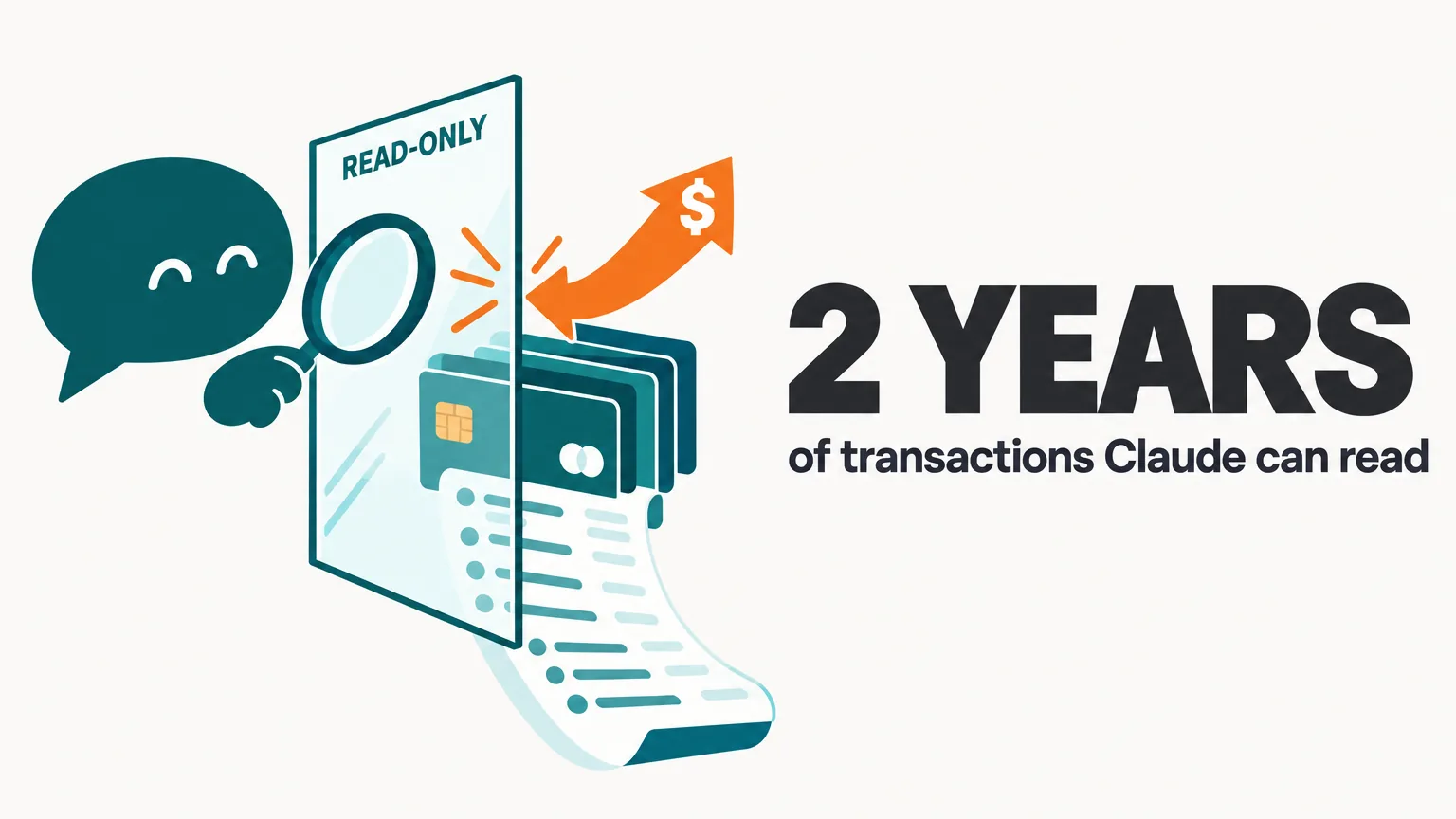
Anthropic has put Claude inside your bank statements without handing it the keys. Personal Finance in Claude, announced on November 5, 2026, connects your bank and card accounts through Plaid and answers money questions from your real balances and transactions. Access is read-only: in Anthropic’s words, “Claude can’t move, manage, or invest your money.”
It starts rolling out in beta this week on the Pro, Max and Ultra plans in the US. Claude is the last of the big assistants to get here. ChatGPT, Perplexity and Gemini already read bank data, and all three draw the same line Claude does: they read your money and never move it.
On this page · 8 sectionsOpen
 Anthropic launched Personal Finance in Claude on November 5, 2026, in beta for Pro, Max and Ultra subscribers in the US, rolling out this week.
 You connect bank and card accounts through Plaid by signing in to your bank yourself, so Claude never asks for or sees your bank password.
 Access is read-only: Claude answers questions about your balances and transactions but cannot move, manage or invest your money.
 For each account you connect, Claude sees the bank, the account name, type and last four digits, balances, credit limits and up to two years of transactions.
 Conversations in the Personal Finance hub are not used to train Anthropic’s models, and the feature carries no ads or sponsored recommendations.
 Claude arrives last: ChatGPT, Perplexity and Gemini already read bank data, and all four stop at reading rather than moving money.
§ 01What Personal Finance does

You open Personal Finance from Claude’s sidebar, connect an account, and ask in your own words. Anthropic’s launch post walks through one late-month conversation, with payday still ten days away.
| You ask | What Claude answers |
|---|---|
| “Where did my money go this month?” | $4,309.37 spent across connected accounts, sorted by category: more than half on rent and utilities, $1,024.51 on food and drink |
| “Is that more than usual?” | Checks the previous months and points to a membership renewal |
| “So what’s left before payday?” | Four payments still due from checking before payday, leaving $1,393.22 |
Beyond the summary, Claude reads across every connected account for things that are easy to miss: charges that hit twice, unexpected fees, or a bill that has crept up all year. It takes bigger questions too, such as whether you spend more than you earn, and it will explain a term like APR and then add up the interest you were actually charged. Ask for a weekly spending chart, a calendar of bills, or a dashboard of the numbers you choose, and Claude builds one you can keep adjusting.
§ 02What Claude can see, and what it cannot do
Accounts connect only when you sign in to your bank yourself through Plaid, a service that links apps to banks. You approve Claude’s access there, so Claude never asks for or sees your bank password. For the accounts you choose, and only those, Claude sees:
- the bank’s name
- each account’s name, type and last four digits
- balances and credit limits
- up to two years of transactions
The limits matter as much as the reach:
- Read-only. Claude cannot move, manage or invest money, and Anthropic says the feature “isn’t designed to give investment advice.”
- Training. Conversations inside the Personal Finance hub are not used to train Anthropic’s models. Anything you share with Claude outside the hub follows your normal privacy settings.
- No ads. Like the rest of Claude, it carries “no ads or sponsored recommendations,” and Anthropic sells no cards, loans or savings accounts of its own.
- Unlinking. Disconnect an account and Claude can no longer see its data.
Anthropic is also direct about accuracy: “Claude can make mistakes in its answers, so ask which transactions are behind a number, and check important figures with your bank.”
§ 03How it compares
Read against each maker’s own pages, the four assistants now look alike at the core. Each connects through Plaid or a Plaid-backed wallet, and each stops at reading.
| Claude Personal Finance | ChatGPT Finances | Perplexity | Gemini with Google Wallet | |
|---|---|---|---|---|
| Arrived | November 5, 2026, beta | May 15, 2026, Pro preview | April 9, 2026 | Rolling out gradually |
| Who gets it | Pro, Max and Ultra, US | Free, Go, Plus and Pro, US | Signed-in users in the US and Canada, desktop; advanced tools on Pro and Max | Adults in the US with a personal Google Account |
| Connection | Plaid | Plaid, plus Experian for credit reports | Plaid | Accounts linked to Google Wallet with services like Plaid |
| Can it move money? | No, read-only | No, it cannot move money, pay bills or make trades | No, read-only | No, it cannot make transactions or change linked accounts |
| Beyond answers | Charts, a bill calendar, dashboards | A dashboard with net worth, portfolio and credit score | Computer builds trackers, forecasts and net-worth dashboards | Spending insights, budgeting tips, Wallet rewards |
The differences sit at the edges. ChatGPT reaches furthest, adding investments and an Experian credit report, and is open to its Free plan. Perplexity says the integration “provides read-only access, and user data never touches Perplexity’s servers.” Claude’s pitch is narrower and leans on trust: paid plans only, no ads, and a promise that hub conversations stay out of training. OpenAI’s help page puts the shared rule plainly: ChatGPT “cannot take financial actions for you.”
§ 04Why read-only is the design, not a limit
Reading your transactions is an analysis problem. Moving money is where fraud, liability and regulation live, and no consumer assistant has crossed that line yet. Anthropic says what comes next will run through the people already licensed to cross it: “Personal Finance is a first step.” For bigger decisions, it wants Claude working alongside licensed professionals and regulated firms, and it is asking banks, wealth managers and financial companies to help shape that. For the bank side of the story, see our record on US banks blocking AI agents.
§ 05Where CellCog fits
CellCog is our product, an AI employee platform, not a consumer money app, so we read this launch for the line it draws. Our answer to the same question is approval rather than a wall. A CellCog AI employee classifies everything it does, and anything above the approval level you set waits for you. When an employee needs to buy something, it requests the exact amount through Stripe’s Link, you approve that one purchase in Link, and it pays with a one-time card locked to that merchant and amount; our Spend record has the details. Read-only answers are a sensible first step for a chatbot. An employee that can act, but only with your yes on each consequential step, is the next one.
§ 06What is not established yet
- Retention. The announcement points to Anthropic’s Help Center for how linked data is kept; it states no period.
- Rollout pace. Beta “this week” on three paid plans in the US; no word on other plans or countries.
- Which institutions. Anthropic names no bank list; coverage depends on what Plaid connects.
- Accuracy in practice. Anthropic’s own caveat says to check figures with your bank, and no independent test exists yet.
§ 07Where to watch
- Whether Personal Finance reaches Claude’s Free plan, as ChatGPT Finances did on October 2.
- The licensed-professional layer Anthropic says it is exploring.
- Whether any assistant moves from reading accounts to acting on them, and under what approvals.
§ 08Sources
- Anthropic, Introducing Personal Finance in Claude, November 5, 2026, read 18:36 UTC.
- Claude on X, announcement, November 5, 2026, 18:00 UTC.
- OpenAI Help Center, Finances in ChatGPT, read November 5, 2026.
- Plaid, What ChatGPT’s new experience signals for digital finance, May 15, 2026.
- Perplexity, Computer is now your personal CFO, April 9, 2026.
- Google, Get info and personalized insights from Google Wallet with Gemini Apps, read November 5, 2026.
- TechCrunch, Claude can now analyze your spending with its new Personal Finance tool, and The Verge, Claude AI can plug directly into your bank account, both November 5, 2026.
Q1When did Anthropic launch Personal Finance in Claude?
On November 5, 2026. Claude posted the announcement on X at 18:00 UTC with a launch post on claude.com the same day; the beta rolls out over that week.
Q2What can Claude see in my accounts?
For each account you connect: the bank name, the account name, type and last four digits, balances and credit limits, and up to two years of transactions. It never sees your bank password.
Q3Are my finance conversations used to train Claude?
Not inside the Personal Finance hub. Anthropic says hub conversations are not used to train its models; anything shared outside the hub follows your normal privacy settings.
Q4How is it different from ChatGPT Finances?
Both connect through Plaid and both are read-only. ChatGPT Finances reaches further, with investments and an Experian credit report, and is open to its Free plan; Claude’s is on paid plans only.
Q5Where does CellCog fit?
CellCog is our product, an AI employee platform, not a money app. Our employees can act, but anything consequential waits for the owner’s approval, and purchases need the owner’s yes in Stripe’s Link.