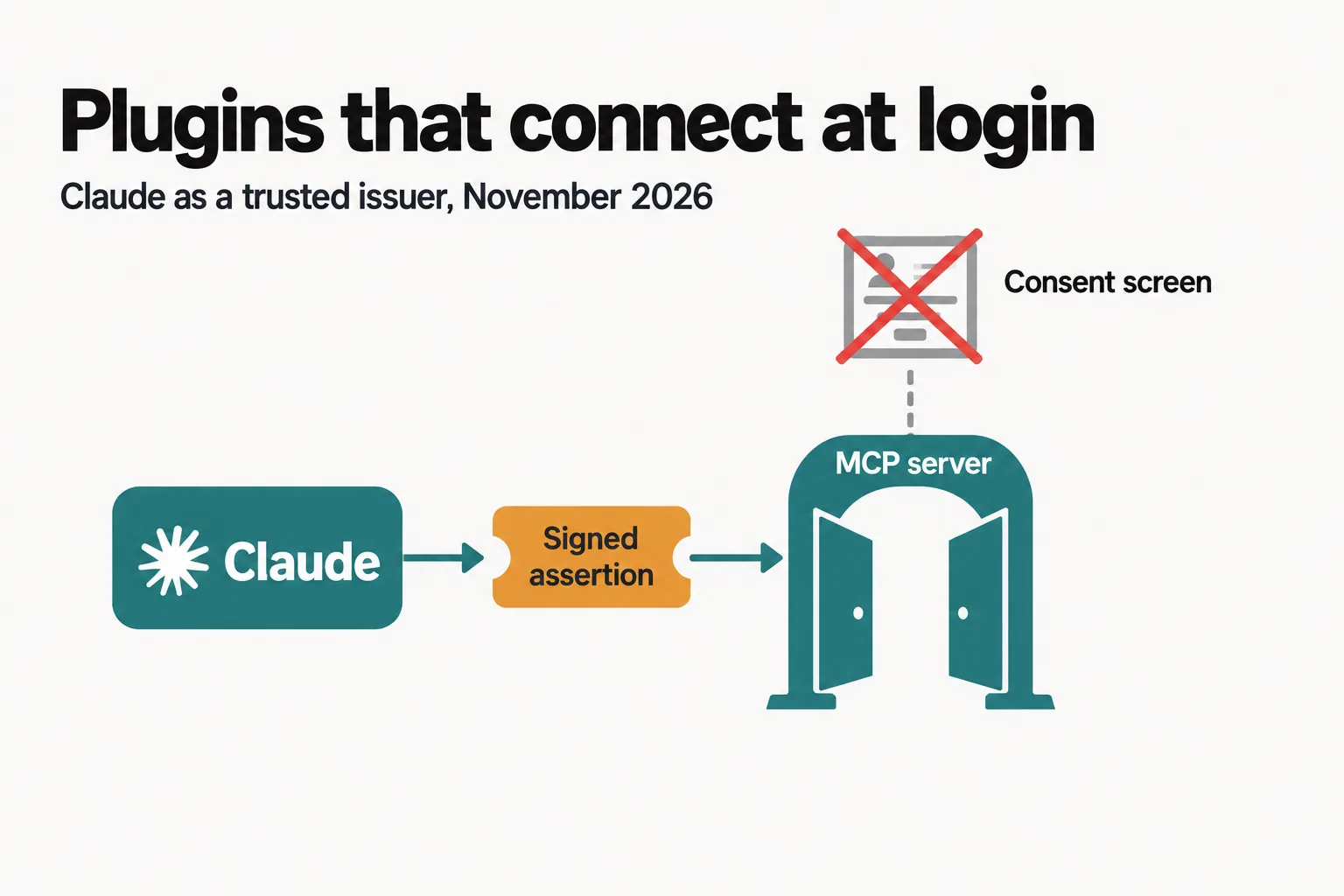
Anthropic’s developer account put the change in one line on November 3, 2026: “Users can now auto-connect plugins when they log in to Claude, with MCP servers that accept Claude as a trusted issuer.” For plugin builders, the ask was just as short: “add support so users get started faster and stay connected without re-authorizing.”
Underneath is a flow Anthropic calls Enterprise Managed Auth, for Claude Team and Enterprise plans. Here is how it works, what is new today, and what a server has to support.
 Anthropic said on November 3, 2026 that users can now auto-connect plugins when they log in to Claude, on MCP servers that accept Claude as a trusted issuer.
 It runs on Enterprise Managed Auth, for Claude Team and Enterprise plans: Claude presents a signed identity assertion, and the server swaps it for an access token with no browser redirect or consent page.
 The assertion is signed either by the company’s identity provider or, new and in beta, by Claude itself, so organizations without a supported identity provider can use it too.
 Server builders must accept the JWT bearer grant, register Claude in advance (no dynamic client registration), trust each customer’s exact issuer URL and match Claude-signed users by verified email.
 Removing someone from the Claude organization stops new assertions, but access tokens already issued stay valid until they expire, so token lifetime sets how long access lingers.
§ 01How a plugin connects without a consent screen
Today a user adds a plugin, gets redirected to its sign-in page, approves access and comes back. Enterprise Managed Auth removes that loop. In Anthropic’s documentation: “Claude presents your authorization server with an identity assertion instead: a signed JSON Web Token (JWT) that vouches for the user’s identity.” The server checks it and “returns an access token in a single back-channel request. There is no browser redirect and no per-connector consent page.”

From the user’s side, the plugin is simply there once the administrator turns it on. Admins connect plugins “for their entire organization through their identity provider, so members don’t have to search for, sign in to, and authorize each plugin themselves”, and Anthropic says it is “built on an open extension to MCP.”
§ 02What is new: Claude can sign for you
The assertion has two possible signers. Until now it came from the company’s identity provider. The new part is the second mode, which Anthropic’s post describes this way: “If an organization’s identity provider doesn’t support EMA, Claude can vouch for each signed-in member directly.”
| IdP-managed | Claude-issued | |
|---|---|---|
| Who signs | The customer’s identity provider | Claude, under the customer organization’s issuer URL |
| Issuer URL | The identity provider’s | identity.anthropic.com/issuers/ plus a per-organization id |
| User matched by | The subject claim | Verified email address |
| How it stays connected | A long-lived refresh token from the identity provider | Claude signs each new assertion while the user stays a member |
| Status | Available | Beta; not offered to organizations that sign in through Okta |
The documentation is blunt about what the Claude-issued mode does not prove. It vouches that someone is a member of the customer’s Claude organization, identified by email; it does not say they passed the company’s single sign-on or multi-factor check. Anthropic adds that “A Claude issuer URL isn’t a secret”, which is why servers must sign a user in only from an email address they or the workspace have verified.
§ 03What a server has to support
| Requirement | Detail |
|---|---|
| Grant type | Accept the OAuth JWT bearer grant at the token endpoint and advertise it in metadata |
| Client registration | Register Claude ahead of time; dynamic client registration is not supported |
| Trusted issuer | Register each customer’s exact issuer URL per workspace, never match by prefix |
| Checks | Verify issuer, signature (ES256 or RS256 only), type, audience, client id, expiry and replay |
| Token response | Return a normal access token with an expiry, and no refresh token |
| Listing | Email Anthropic’s MCP review team to have the directory listing marked as supporting it |
One line deserves attention from anyone running a server. When a user is removed from the customer’s Claude organization, Claude stops signing assertions for them, but “Access tokens you already issued stay valid, so your access token lifetime bounds how long a removed user keeps access.” Short token lifetimes are the lever.
Anthropic’s own testing note is practical: a Team organization created only for testing can use the Claude-issued mode as it is, with no identity provider, single sign-on or verified domain.
§ 04What it means
For companies on Claude Team and Enterprise, this removes the slowest step in rolling out plugins: asking every employee to find, sign in to and approve each one. For plugin builders, it adds work on the authorization server and a new set of security choices, chiefly how long tokens live and how strictly email is verified.
Our conflict, declared: CellCog runs its own MCP connector at cellcog.ai/mcp, which today uses the standard per-user OAuth sign-in. That is how we read this change: as builders of a server on the other side of it.
§ 05Sources
- Anthropic, Enterprise Managed Auth for connectors, documentation.
- Claude Help Center, Authorize MCP connectors for your entire organization.
- ClaudeDevs on X, November 3, 2026.
Q1What is Claude plugin auto-connect?
An Anthropic change announced November 3, 2026: on MCP servers that accept Claude as a trusted issuer, members of a Claude Team or Enterprise organization get plugins connected when they log in, without signing in to each one.
Q2What is Enterprise Managed Auth?
Anthropic’s name for the flow behind it: Claude presents a signed identity assertion and the plugin’s authorization server exchanges it for an access token in one back-channel request, with no consent screen.
Q3What does Claude as a trusted issuer mean?
Claude itself signs the assertion under an issuer URL that belongs to the customer’s Claude organization, for companies whose identity provider does not support the flow. Anthropic marks this mode as beta.
Q4Which plans get it?
Claude Team and Enterprise, per Anthropic’s documentation. Claude-issued assertions are not available in organizations that sign in to Claude through Okta.
Q5What happens when someone leaves the company?
Claude stops signing new assertions for them, but access tokens the server already issued stay valid until they expire, so the server’s token lifetime decides how long access lasts.