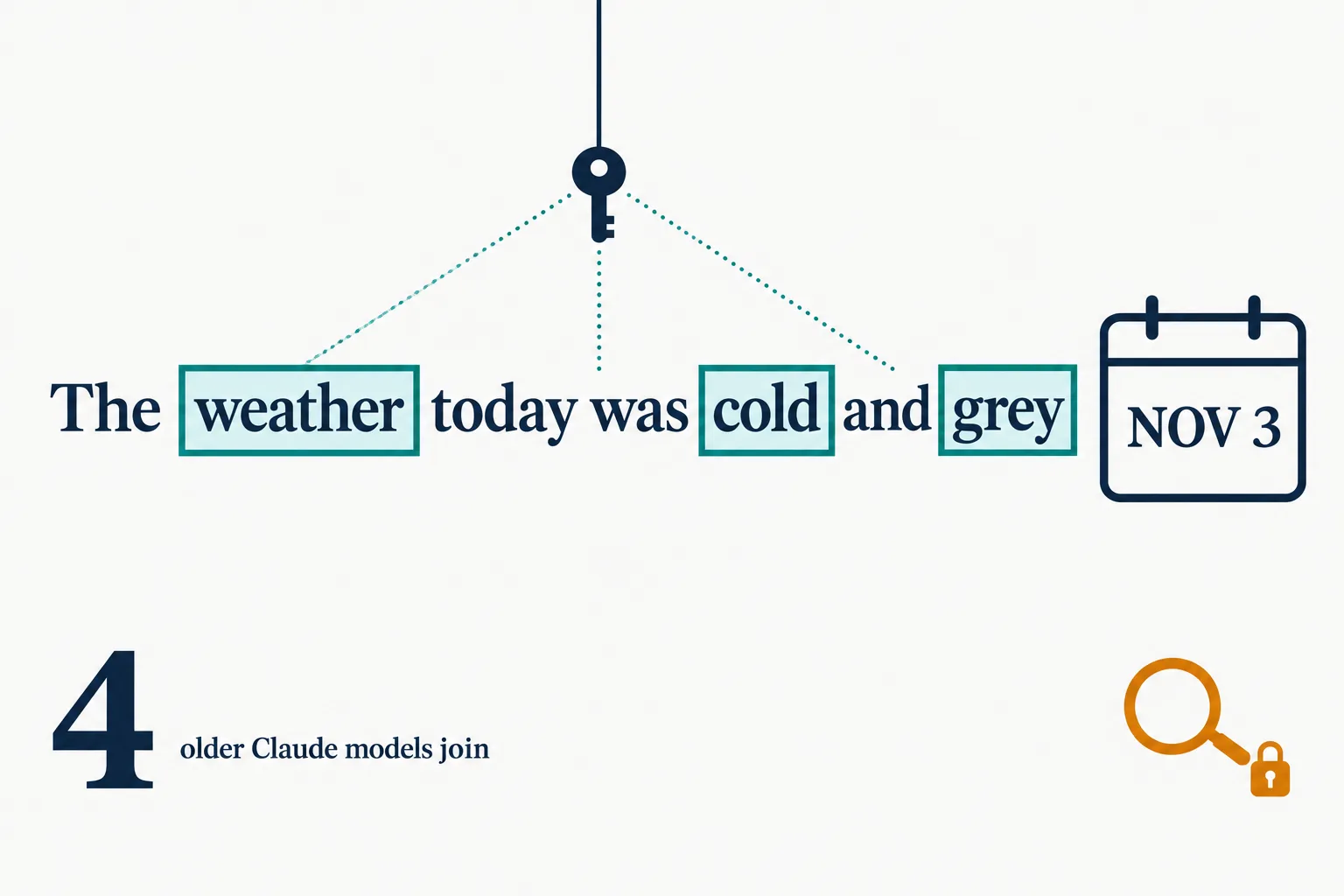
Anthropic will start adding its invisible text watermark to four older Claude models on November 3, 2026. An email to Claude Platform customers names Claude Mythos 5, Claude Opus 4.7, Claude Opus 4.6 and Claude Sonnet 4.6, and adds that “rollout on Amazon Bedrock may take a few additional days.” Newer models already carry the mark, Claude Opus 5.5 among them.
The email reached X on October 30, when a screenshot of it passed 439,000 views in Pete Sena’s post. The watermark itself is not new: Anthropic explained the method on August 14, and models launched since August 2 have carried it from day one. What changes on Tuesday is coverage. Models that predate the EU deadline join, on every Claude surface and in every country.
Below is what the mark is, what it can and cannot show, and who can check for it, taken from the email, Anthropic’s help center page (updated this week) and its explainer.
On this page · 8 sectionsOpen
 Anthropic emailed Claude Platform customers that on November 3, 2026 it begins watermarking text from Claude Mythos 5, Opus 4.7, Opus 4.6 and Sonnet 4.6; Amazon Bedrock may take a few more days.
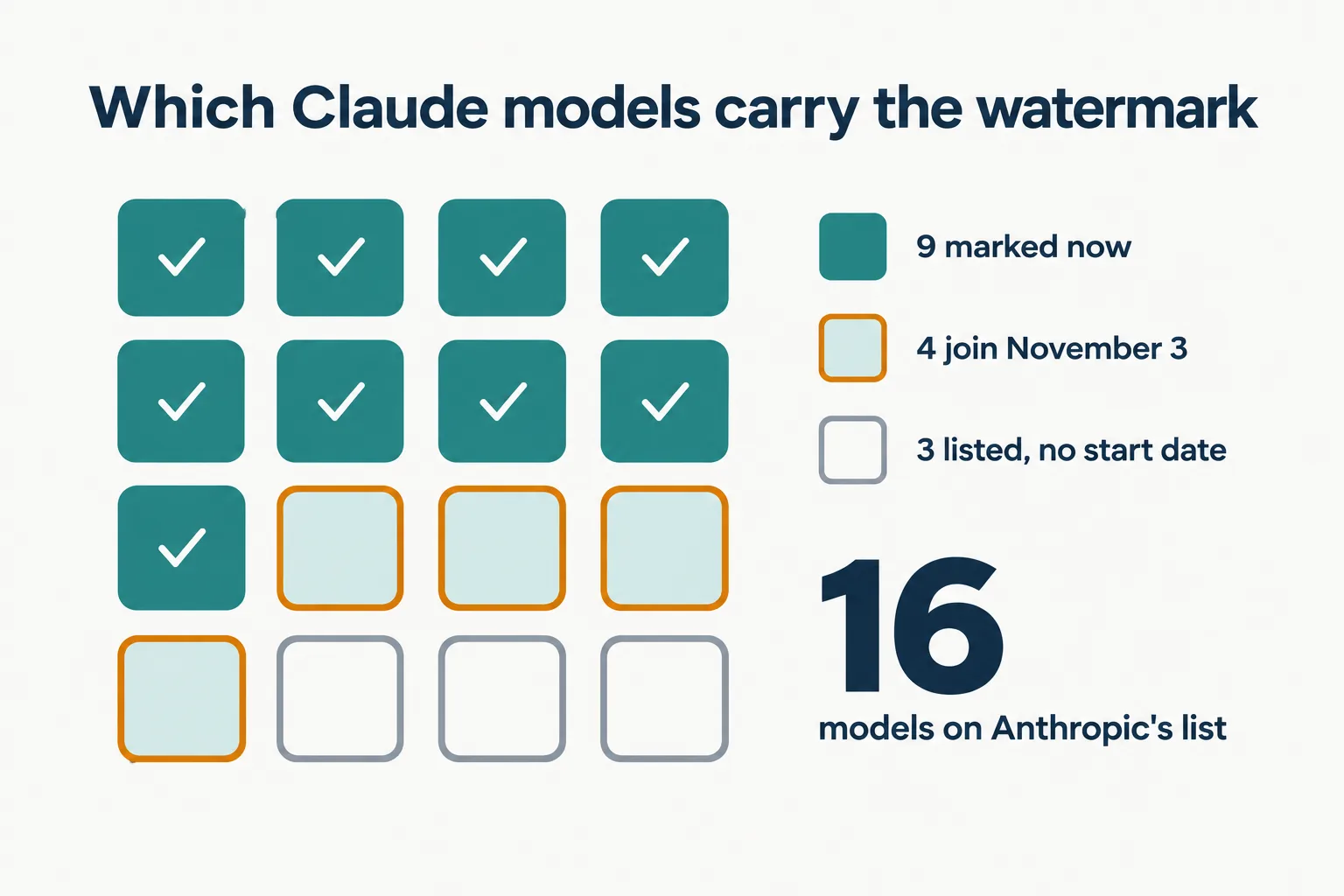
 Newer models, including Claude Opus 5.5, already carry the same mark; Anthropic’s help center lists 16 models on its own surfaces.
 The mark is a pattern in word choice settled by a secret key: no added characters, no extra tokens, no price change and no user or organization data.
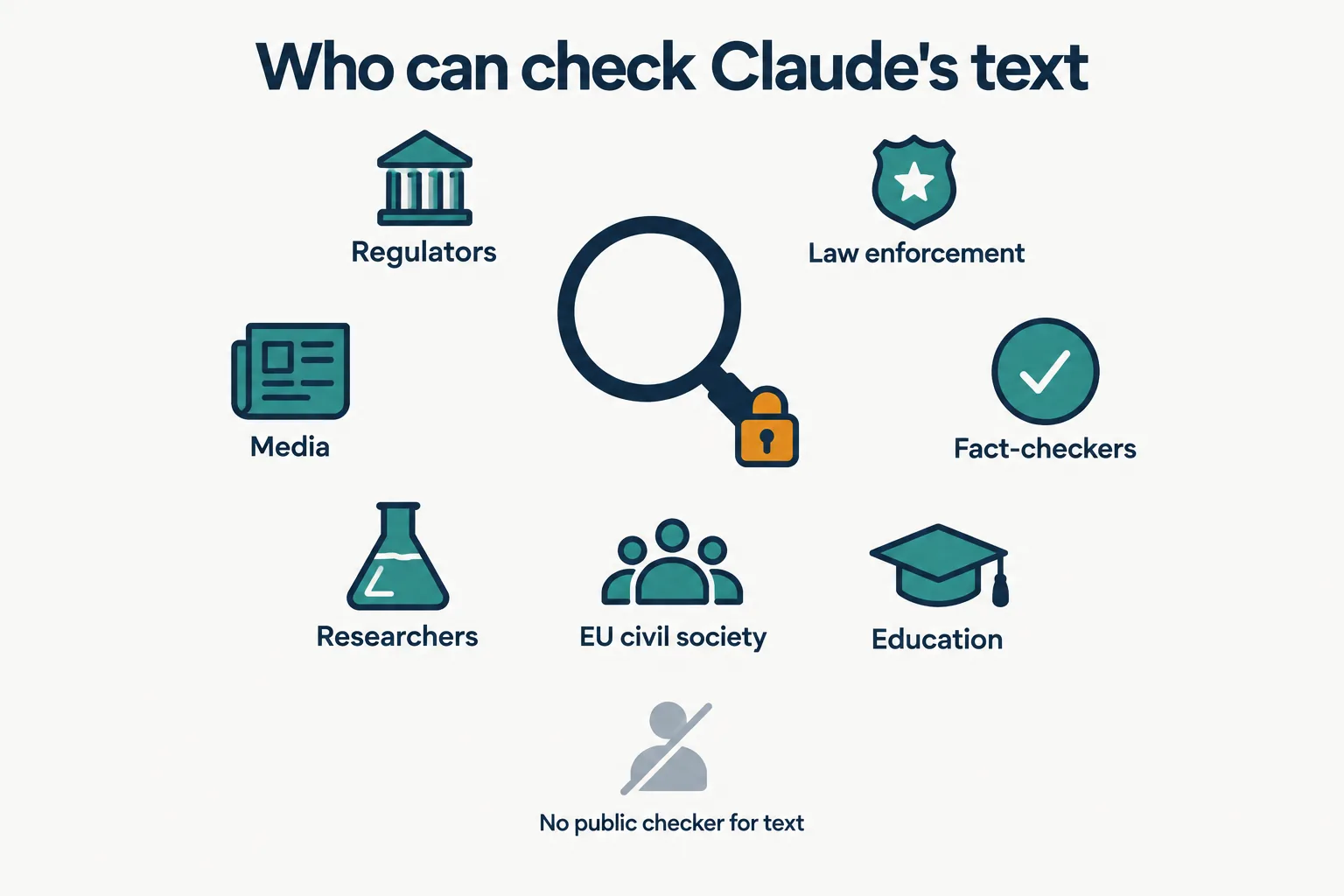
 Only vetted groups can check text today, among them regulators, media, fact-checkers, researchers and educational organizations, through a private-preview API.
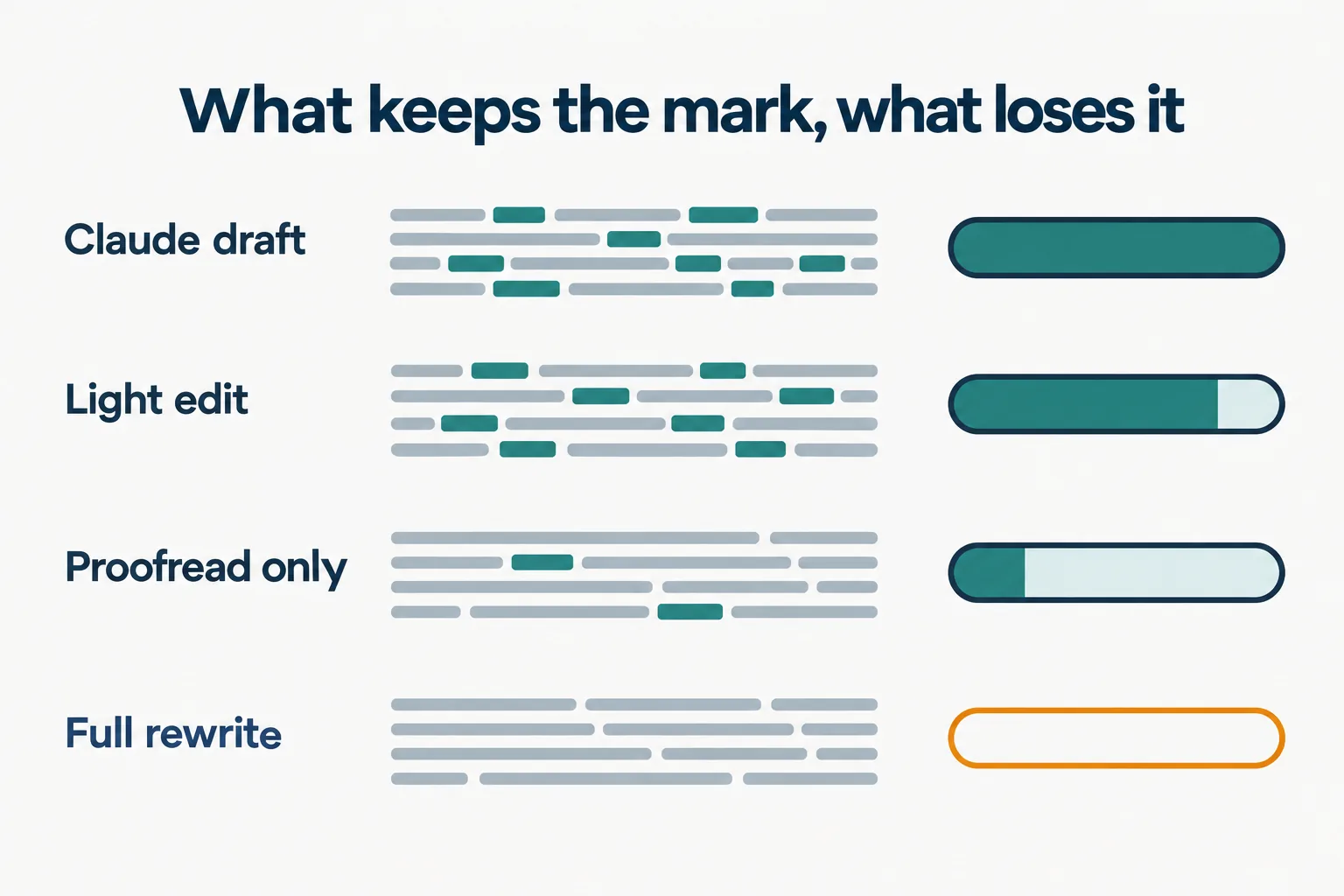
 Copy and paste keeps the mark and light edits probably do too; a full rewrite removes it, and proofreading or short passages leave too little to detect.
 The trigger is the EU AI Act’s Article 50; Anthropic applies the mark worldwide because it has no durable way to limit it by region.
§ 01What changes on November 3
“On November 3, 2026, Anthropic will begin applying its text watermark to outputs from these four models,” the email says. “This is the same watermark our newer models, including Claude Opus 5.5, already carry.” The help center table already lists all four as supported on Anthropic’s own surfaces. It lists no tick for them under the cloud partners (AWS, Google Cloud, Microsoft Foundry), and the email gives Bedrock only as “a few additional days.”
| Models | Anthropic’s own surfaces | Cloud partners (AWS, Google Cloud, Foundry) |
|---|---|---|
| Fable 5.1, Fable 5, Mythos 5.1 | Yes | Yes |
| Opus 5.5, Opus 5, Opus 4.8 | Yes | Yes |
| Sonnet 5.5, Sonnet 5, Haiku 5.5 | Yes | Yes |
| Mythos 5, Opus 4.7, Opus 4.6, Sonnet 4.6 | Yes, from November 3 per the email | No tick; Bedrock a few days later |
| Opus 4.5, Sonnet 4.5, Haiku 4.5 | Listed, no start date given | No tick |
That makes 16 models on Anthropic’s list. The surfaces named are the Claude Platform (API), the Claude apps, Claude Code, Claude Cowork and Claude Tag. In the help center’s words, “Marking will apply to output from supported models wherever Claude is offered, worldwide.”
§ 02How the watermark works
A language model writes one word at a time, choosing among likely candidates. Anthropic’s example is “The weather today was cold and”, where “overcast” and “grey” are both sensible next words. Normally a random number settles that kind of low-stakes choice. With watermarking, a secret key plus the few words before it settle the choice instead.
The words are still effectively random to a reader. But someone holding the key can check whether a passage keeps making the choices the key predicts, and put a probability on it. Anthropic describes the question the key answers as “What is the likelihood this was partly written by Claude?”

The method is a version of SynthID-Text, which Google DeepMind published in Nature in 2024, and belongs to a family that goes back to a 2022 proposal by Scott Aaronson. Anthropic says the mark adds no characters and no tokens, does not change price, and carries nothing about the user, their organization or their chats. The email repeats each point and says it has “a negligible effect on output speed.”
§ 03What survives editing, and what does not
The mark lives in word choices, so it is strongest where Claude made many free choices and weakest where it made few. The help center says it travels with copied text and “may persist through some editing.” Anthropic’s explainer adds that a complete rewrite where every word is replaced will remove it.
| Situation | What Anthropic says |
|---|---|
| Copied and pasted elsewhere | The mark travels with the text |
| Lightly edited by a person | Probably still detectable |
| Fully rewritten, every word replaced | Removed |
| Claude only fixed grammar | Usually too few changed words to register |
| A short passage | Detection does not work well |
| Code | Less marking; exact tokens are untouched, comments can carry it |
| A translation by Claude | Carries the mark, every word is Claude’s |
| Factual sentences | Sparser, few free choices |

Two limits matter for anyone reading a result. A positive check says Claude was likely involved at some point; it cannot tell “Claude wrote this” from “Claude heavily edited this.” And a negative check proves nothing: text from an unmarked model, a heavy edit or a short reply can carry no detectable mark. The help center puts it plainly: “A detected mark provides a signal that content was processed by Claude, but is not fully conclusive.”
§ 04Who can check for it
There is no public checker for text. Detection runs through an API in private preview, open to regulators, law enforcement, media, fact-checkers, independent researchers, educational organizations and EU civil society groups, plus enterprises that must verify marks for their own compliance with the AI Act. Anthropic says it plans to widen access and takes requests through a Claude Watermark Detector Access Request Form.
Files are different. When Claude makes a supported file such as a PNG or JPEG, it attaches a signed C2PA Content Credential in the metadata, and anyone can read that with Anthropic’s free Claude Content Checker or any C2PA tool. A screenshot or a re-save can strip it.
So the viral framing that Claude will start snitching is half right. The mark names no one and only vetted groups can read it. But educational organizations are on that list, and a probability can still land on a student’s essay or a job application.
§ 05Why now: the EU AI Act deadline
The trigger is Article 50 of the EU AI Act, which requires providers to mark AI-generated content from August 2, 2026, with a transition to December 2, 2026 for systems already on the market. Anthropic signed the EU Code of Practice on Transparency of AI-Generated Content in July 2026, one of around 190 signatories. The Commission’s Article 50 FAQ sets out the two dates. It applies the mark worldwide because, its explainer says, it has no durable way yet to limit it by region. OpenAI took a narrower route on October 5, watermarking ChatGPT and Codex text in the EU and letting API customers opt in; our OpenAI watermark record has the detail.
| Date | Event |
|---|---|
| July 2026 | Anthropic signs the EU Code of Practice |
| Aug 2, 2026 | Article 50 marking rules apply in the EU |
| Aug 14, 2026 | Anthropic publishes its watermark explainer |
| Sep 1, 2026 | Fable 5.1 and Mythos 5.1 ship watermarked (release notes) |
| Oct 5, 2026 | OpenAI announces its EU ChatGPT watermark |
| Nov 3, 2026 | Four older Claude models join |
| Dec 2, 2026 | EU deadline for systems already on sale |
§ 06What it means if you write with Claude
For most users nothing changes on screen, and the email says customers need not change anything. It names one exception that it explains further down the email, a part the screenshot cuts off: customers who rely on the watermark for their own compliance and use non-default sampling settings. If you sample at unusual settings for a compliance reason, read Anthropic’s full notice.
If you publish with Claude, assume certain organizations can now test your text, and decide your disclosure policy on that basis rather than on detection. If you use Claude to polish a CV, the explainer’s own logic helps you: proofreading leaves Claude very few choices to mark, while a CV Claude drafts from scratch carries many. And if you build a product on the API, the help center says you should assess your own Article 50 duties; the mark on Claude’s output does not settle them for you.
§ 07What CellCog runs on
Every CellCog tier runs on Claude Opus 5.5, which Anthropic lists as carrying its text watermark, so the text our AI employees write carries Anthropic’s mark. CellCog adds no watermark of its own and has no access to Anthropic’s detector.
§ 08What we are watching
- The Amazon Bedrock date for the four older models, and whether Google Cloud and Microsoft Foundry follow for them.
- Start dates for Opus 4.5, Sonnet 4.5 and Haiku 4.5, which the help center lists without one.
- Wider access to the detection API, or a public text checker.
- A Claude Platform release note for the November 3 change; today the email and the help center are the only first-party records.
Q1Does the Claude watermark identify me?
No. Anthropic says the watermark and its key carry no information about the user, their organization or their chats.
Q2Can I turn the Claude watermark off?
Anthropic’s pages describe no setting for it. Marking is applied at the model level on every surface for supported models.
Q3Does editing remove the Claude watermark?
Light editing probably will not remove it completely; a rewrite that replaces every word will. Short passages and proofread text often carry too few marked choices to detect.
Q4Who can check if text was written by Claude?
Regulators, law enforcement, media, fact-checkers, independent researchers, educational organizations, EU civil society groups and enterprises with matching compliance duties, through a private-preview API.
Q5Is CellCog output watermarked?
Every CellCog tier runs on Claude Opus 5.5, which Anthropic lists as carrying its text watermark. CellCog adds no watermark of its own.