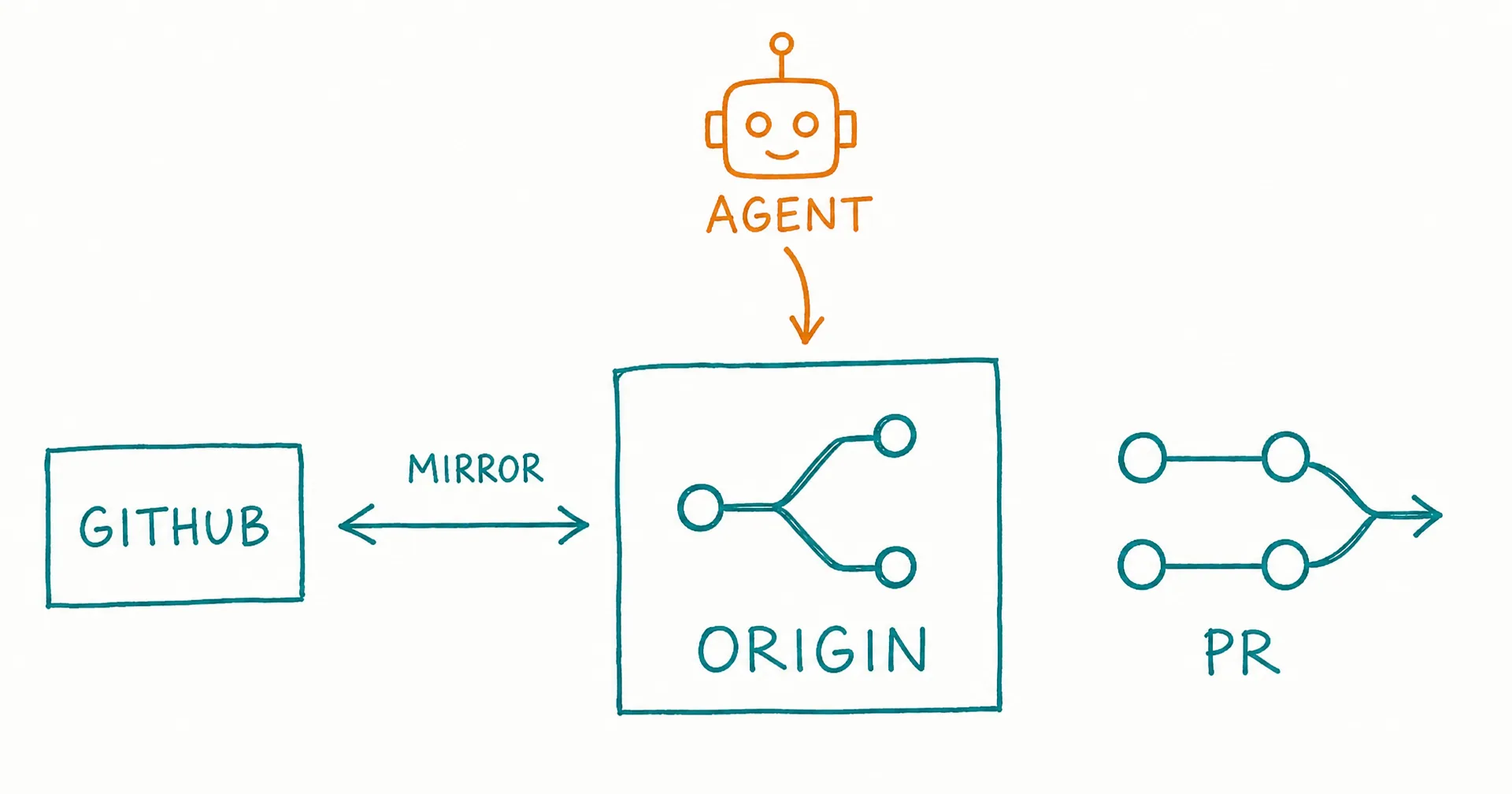
Cursor Origin is a Git hosting and code review platform from Cursor (Anysphere), launched in early beta on August 17, 2026. Cursor’s own description is the best one-liner available: “a git forge for the agentic era.” It is a real Git host, with repositories, pull requests, branch protections, and a CLI, and its reason for existing is that Cursor’s coding agents are wired in as first-class actors.
Our read: Origin is a real Git host built for one customer, Cursor’s own agents, and it is not a GitHub replacement yet. The launch landed loudly among developers, helped by an unfortunate GitHub outage the same week, but what shipped is deliberately modest (core repository and PR workflows first), the mirror keeps GitHub as the source of truth, and the agent loop (open a PR, watch its checks, keep working until they pass) is the part that matters. This explainer is sourced from Cursor’s own documentation and changelog as of August 19, 2026: what shipped, how the GitHub mirror works, what the agents can actually do, and what is honestly missing.
- Cursor Origin is a Git hosting and code review platform from Cursor (Anysphere), launched in early beta on August 17, 2026. Cursor calls it ‘a git forge for the agentic era.’
- It is a real Git host, not a UI over GitHub: repositories live at origin.cursor.com remotes, with standard push and pull, branch protections, permissions, a CLI, and an API.
- The beta ships core workflows: repositories, pull requests with inline review, code browsing and search, GitHub mirroring, and three integrations (Vercel, Depot, Buildkite).
- GitHub mirroring is deliberately conservative: GitHub stays the source of truth, history and PRs sync both ways, and a repository can be detached later to make Origin authoritative.
- The strategic point is agents: Cursor’s cloud agents can clone, branch, commit, push, and open PRs on Origin, Automations react to repository events, and since August 19 agents subscribe to their own PRs and keep working until checks pass.
- What is missing is equally clear: no Issues, no public repositories, no package registry or native CI runner, no published limits or SLA, and a namespace that cannot be renamed during the beta.
§ 01What shipped in the beta
| In the beta | Not in the beta |
|---|---|
| Repository hosting, standard Git over HTTPS | GitHub Issues (do not sync) |
| Pull requests with inline review and merge protections | Public repositories |
| Code browsing, search, commit history | Package registry, releases |
| GitHub mirroring with two-way PR sync | Native Actions-style CI runner |
| Origin CLI, API, webhooks | Security scanning, Dependabot equivalents |
| Vercel, Depot, and Buildkite integrations | Published limits, SLA, post-beta pricing |
A native repository lives under a claimed namespace, with a Git remote at origin.cursor.com. You push and pull with standard Git; the Origin CLI handles authentication and repository management. Visibility options are Internal (anyone with access to the team’s codebase) and Private. There is no Public option, which says a lot about what Origin is not trying to be yet: this is a private working forge, not an open-source home.
Pull requests are conventional and complete: activity timeline, commits, checks, files changed, line comments, reviews, and merge once requirements pass. CI arrives through partners rather than a native runner: Depot and Buildkite can run existing GitHub Actions workflows against Origin-hosted repositories, and Vercel deploys previews from PRs and production from merges.
§ 02Does Origin replace GitHub? How the mirror works
Cursor clearly expects most teams to arrive from GitHub, and the migration design is conservative in a good way. Mirroring a repository copies full history, branches, and tags into Origin and keeps them synced, with pull request comments and reviews flowing in both directions. The important sentence in the docs: GitHub remains the source of truth. Pushes made through the Origin remote pass back to GitHub, and review actions taken in Cursor propagate to GitHub.
What does not travel: GitHub Issues, and GitHub Actions secrets and runtime configuration. Mirrored repositories keep their CI on GitHub. The workflow files exist in the mirrored history, but the Actions machinery stays where it was.
When a team decides Origin should be authoritative, it detaches the mirror: sync stops, the Origin copy becomes independent, and the original GitHub repository is left untouched. That one-way door is the actual migration moment, and everything before it is a free trial of the workflow.
§ 03Agents as first-class actors
The feature set above could describe any young forge. The strategy shows in the agent wiring.
Cursor’s cloud agents can create an Origin repository end to end, clone it, branch, commit, push, and open pull requests. Automations attach agents to repository events: a push to main, a PR opened or updated, or a schedule. And the August 19, 2026 changelog added the piece that makes the loop visible: cloud agents automatically subscribe to the PRs they create. A subscribed agent monitors CI, fixes failed checks, responds to review feedback, and wakes when the PR changes, pursuing a goal until the work is actually done.
Put together, that is a closed loop that no third-party forge can offer Cursor: repository event, agent run in an isolated VM, code change, PR update, CI result, agent wakes again. Owning the forge means owning every hop. That is why a company whose product is an editor is suddenly hosting Git: the repository is where agent work becomes real, reviewable, and mergeable.
It is worth being precise about what this is not, yet. The PR review model itself is conventional human review; Cursor has not documented agent-native review primitives that could not be built on GitHub Apps today. The bet is on where the loop gets tighter from here.
§ 04The honest limitations
Cursor’s own documentation is candid, and the gaps matter for anyone evaluating a move.
- No Issues, projects, discussions, or wiki. Work tracking stays wherever it lives today, and Issues do not even mirror.
- No public repositories. Open-source projects have nothing to move to yet.
- No native CI, packages, or security tooling. CI is partner-provided, and there is no documented equivalent of dependency alerts, secret scanning, or code scanning.
- No published limits, SLA, or post-beta price. Storage, bandwidth, retention, and uptime commitments are all unwritten as of August 19, 2026 (our pricing guide covers what that means for planning).
- The namespace cannot be renamed during the beta. It appears in every repository URL; choose it carefully.
- Rollout is staged and admin-gated. Paid subscribers may wait, legacy privacy mode blocks the product, and team admins can disable it.
None of this is a criticism of a two-day-old beta. It is the honest map of where the edges are.
§ 05What Origin signals
Zoom out and Origin is part of a clear 2026 pattern: the tools are reorganizing themselves around persistent agents rather than sessions. Cursor now ships agents that subscribe to pull requests and keep working until checks pass. SpaceXAI ships always-on Bots on a cloud computer. The common bet is that the unit of AI work is becoming a standing worker with state, not a chat window.
That is the same bet CellCog has been building on since October 2025 with AI employees: standing workers that own a whole role rather than a repository, each with its own inbox, task board, shifts, and memory that carries from one shift to the next, in an isolated workspace per employee. The underlying research agent, CellCog Max, ranked #1 on the Deep Research Bench leaderboard as of July 2026. Plans start at $8 a month; you pay for the work, not the hire, and the cost depends purely on how much work you assign. Different layer of the stack than a forge, same direction of travel: software you delegate to, not software you operate.
For a developer already inside Cursor, the practical advice is simple: mirror a repository, let an agent open a PR against it, and watch the subscription loop run. The beta costs nothing you are not already paying, and it is the clearest preview available of how agent-era development infrastructure is going to feel.
Q1What exactly shipped in the Origin beta?
Repository hosting with standard Git over HTTPS, internal and private visibility, branch rules and merge protections, pull requests with inline comments and reviews, code browsing and search, commit history, an Origin CLI and API with webhooks, GitHub mirroring, and integrations with Vercel, Depot, and Buildkite as of August 19, 2026.
Q2How does the GitHub mirror work?
Mirroring copies full history, branches, and tags into Origin and keeps them updated, with pull request activity syncing in both directions. GitHub remains the source of truth: pushes through Origin pass back to GitHub. GitHub Issues and Actions secrets do not sync. A mirrored repository can later be detached, which makes the Origin copy independent and authoritative.
Q3What can Cursor's agents do with Origin?
Cloud agents can create repositories, clone, branch, commit, push, and open pull requests. Automations trigger agents on pushes, PR events, or schedules. And since August 19, 2026, cloud agents automatically subscribe to PRs they create: they monitor CI, fix failed checks, respond to feedback, and wake when the PR changes.
Q4What does Origin cost?
There is no standalone price. Origin is included with paid Cursor plans (Pro $20/mo and up, Teams from $40/user/mo) during the early beta, with no published storage limits and no committed post-beta price. Our Cursor Origin pricing guide has the full breakdown.
Q5What is missing compared to GitHub?
As of the August 2026 beta: no Issues or project boards, no public repositories, no package registry, no native Actions-style CI runner, no documented security scanning, no published uptime SLA or storage limits, and only three external integrations. Cursor says more agent-native features are coming.
Q6Should I move my repositories now?
The low-risk path is the designed path: mirror selected repositories while GitHub stays authoritative, use Origin for browsing, review, and agent workflows, and consider detaching only after validating CI, access controls, and the missing collaboration features against your needs.