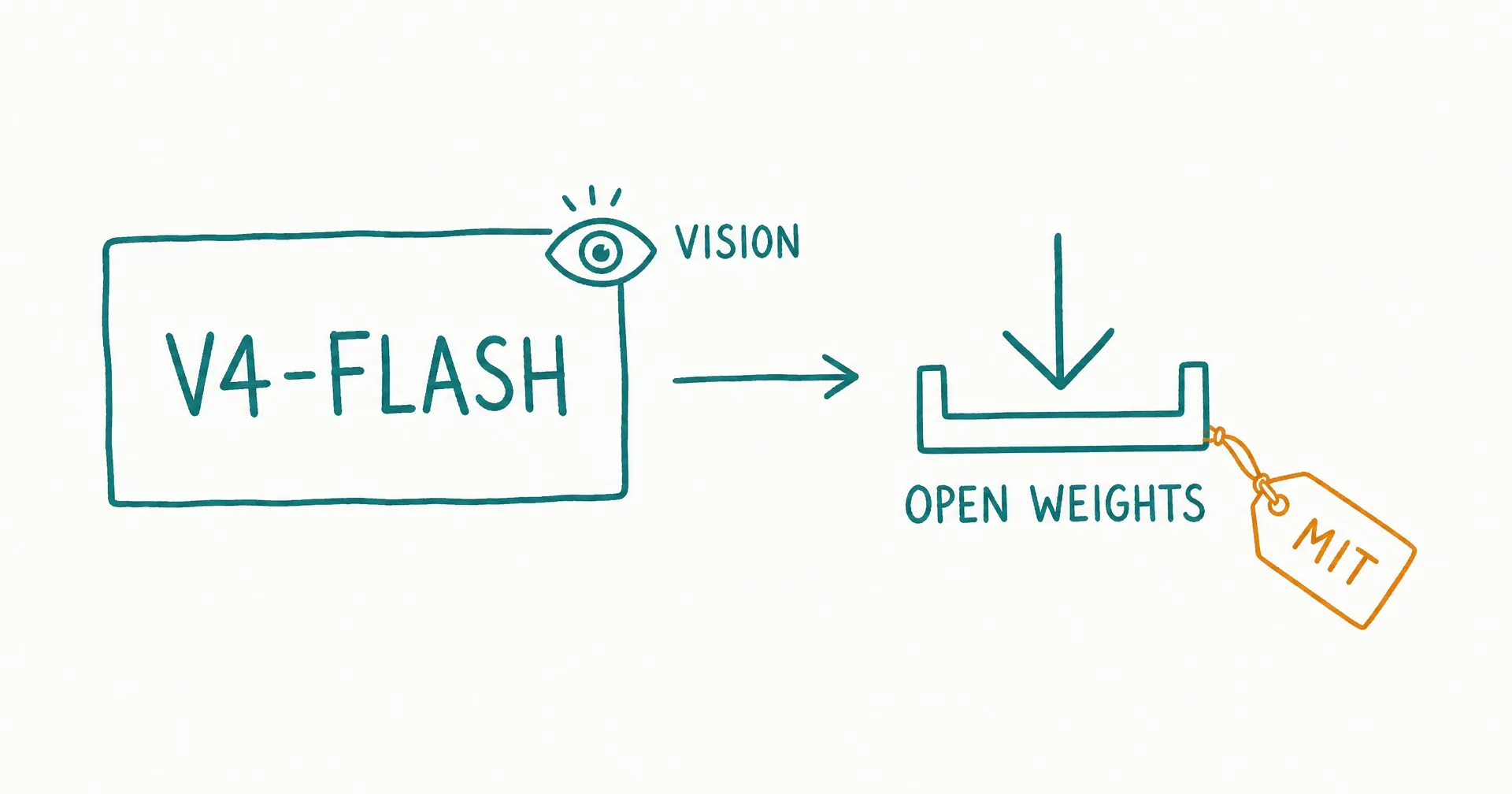
DeepSeek closed out August with its first multimodal model in the V4 family, and it did it in the most DeepSeek way possible: quietly, on a Sunday, with a Hugging Face upload and an MIT license. V4-Flash-Vision-Exp went open-weight on August 31, 2026, ten days after the same model went live on DeepSeek’s API. The weights are the news. The license is the story.
- DeepSeek published open weights for V4-Flash-Vision-Exp on Hugging Face on August 31, 2026, under the MIT license: its first multimodal model in the DeepSeek-V4 family.
- The model builds on DeepSeek-V4-Flash (284B total parameters, 13B activated, 1M-token context) by adding a vision encoder and aligner, then continuing training for visual understanding.
- The API version has been live since August 21: images are tokenized at up to 384 tokens each and billed at standard V4-Flash rates. The August 31 news is the weights and the license, not the model’s availability.
- On DeepSeek’s own card, the multimodal agent numbers are the story: ApexBench jumps from 26.2 to 36.5 versus text-only V4-Flash, and on Agents’ Last Exam and ZeroBench the card shows it edging past Anthropic’s Opus-4.8.
- Text-agent performance holds or improves versus V4-Flash-0731 (DeepSWE 59.3 vs 54.4, Toolathlon-Verified 75.9 vs 70.3), so the vision capability did not cost the model its text agent skills.
- The MIT license is the sharpest contrast in the current open-weight wave: Qwen3.8-Flash-Next shipped five days earlier under a community license that specifically names AI-worker businesses as needing separate terms. DeepSeek attached no such strings.
§ 01What shipped on August 31
The Hugging Face repository, published under deepseek-ai/DeepSeek-V4-Flash-Vision-Exp, contains the full model weights in DeepSeek’s mixed FP8/FP4 format (roughly 168GB on disk), a tokenizer, a prompt-encoding reference that maps OpenAI-style messages to model prompts, and a minimal PyTorch inference implementation covering the vision encoder, aligner, and the DSpark speculative-decoding forward path. SGLang supports it day one. The license file says MIT and means it.
DeepSeek’s own framing, from the model card: this is “our first experimental multimodal model in the DeepSeek-V4 family,” built on the V4-Flash architecture “by incorporating visual modules and undergoing continued training to unlock visual understanding capabilities.”
| Date | What happened |
|---|---|
| August 21, 2026 | Model goes live on the DeepSeek API (deepseek-v4-flash-vision-exp), with image input via base64, URL, or the new Files API; images tokenized at up to 384 tokens each at standard V4-Flash pricing |
| August 31, 2026 | Open weights published on Hugging Face under MIT, with tokenizer, encoding reference, and minimal PyTorch inference code |
If you only track Hugging Face, the release looks brand new. It is not: the hosted model has been in production use for ten days. What changed on August 31 is who is allowed to run it, which is everyone, for anything.
§ 02The confirmed specs
The base recipe is DeepSeek-V4-Flash, the efficiency half of the V4 preview family DeepSeek has been shipping since April. The published config and the V4 technical materials pin the details:
| Item | Confirmed detail |
|---|---|
| Base architecture | DeepSeek-V4-Flash: 284B total parameters, 13B activated per token |
| What Vision-Exp adds | Vision encoder + aligner, then continued training for visual understanding |
| MoE layout | 256 routed experts, 6 active per token + 1 shared, 43 layers |
| Context | 1,048,576 tokens native (1M) |
| Checkpoint | Mixed precision: FP4 expert weights, FP8 elsewhere; ~168GB on disk |
| Input | Text + images (charts, screenshots, documents, photos) |
| Inference | SGLang with DSpark speculative decoding; minimal PyTorch reference in the repo |
| License | MIT |
Two engineering notes worth pulling out. First, the vision capability is additive: DeepSeek reports the model “maintains comparable performance on text-only agent tasks” versus the text-only V4-Flash, and its card backs that with side-by-side numbers rather than hand-waving. Second, the 1M-token context carries over from the V4 family’s hybrid attention work, which means long multimodal agent sessions, not just single-image Q&A.
§ 03The benchmarks lead with agents, again
Vendor-run numbers, as always, but the table DeepSeek chose to publish says as much as the numbers in it. The card’s two sections are text agent capabilities and multimodal agent capabilities. Not captioning. Not VQA. Agents.
| Benchmark | Vision-Exp | V4-Flash-0731 (text-only) | Opus-4.8 |
|---|---|---|---|
| Terminal Bench 2.1 | 83.9 | 82.7 | 85.0 |
| DeepSWE | 59.3 | 54.4 | 58.0 |
| Toolathlon-Verified | 75.9 | 70.3 | 76.2 |
| NL2Repo | 57.7 | 54.2 | 69.7 |
| ApexBench (Pass@1) | 36.5 | 26.2 | 39.4 |
| Agents’ Last Exam | 27.3 | 25.2 | 25.7 |
| Chartography | 64.3 | not run | 65.0 |
| ZeroBench (Pass@5) | 35.0 | not run | 34.0 |
Three honest readings. First, the multimodal jump is real on DeepSeek’s own terms: on ApexBench, the text-only model scored 26.2 while ignoring the images entirely; the vision model reaches 36.5 actually looking at them. Second, the Opus-4.8 comparison cuts both ways, and DeepSeek printed it anyway: Vision-Exp edges past Anthropic’s model on Agents’ Last Exam and ZeroBench, trails it on ApexBench, Chartography, and most text rows. A card that shows its model losing rows is more credible than one that does not. Third, the text-agent rows improved alongside the vision work (DeepSWE up five points, Toolathlon up five and a half), which suggests continued training helped across the board rather than trading text skill for sight.
The caveat that applies to every launch table this year applies here: these are the vendor’s runs, at the vendor’s settings, and independent replication is pending.
§ 04The license is the sharpest move
Here is the context that makes MIT interesting rather than routine. In the past week alone, the open-weight frontier has been crowded: GLM-5.3-Flash shipped under its own permissive terms, and Qwen3.8-Flash-Next arrived under the Qwen Community License, which requires products above 100 million monthly active users or 20 million dollars in monthly revenue to display the model name, and, more pointedly, requires a separate license from Qwen for any “Model-as-a-Service or AI Work Assistant business.”
DeepSeek attached none of that. MIT means any company, at any scale, can build any product on these weights, including commercial agent platforms, hosted inference businesses, and AI-worker products, without asking, attributing in the UI, or negotiating separate terms. For teams choosing an open-weight base for agentic products, that difference is not academic: one license names your business category, the other does not know you exist.
The pattern across all three releases is the same one we keep flagging: the labs are benchmarking on agent work, licensing around agent businesses, and shipping efficiency-first architectures that make always-on agents affordable to run. The model layer is telling you where it thinks the value is.
§ 05What to watch
Update, September 7, 2026: upstream vLLM merged support for V4-Flash-Vision-Exp on September 2 (PR 54566), and the model card now carries a vLLM recipe alongside the SGLang path. Hugging Face downloads passed 209,000 by September 7, one week after the weights went up. The benchmark numbers on the card are still DeepSeek’s own; no independent reproduction of the headline scores has been published that we can point to.
This is a living record for the Vision-Exp story. Three things would earn a same-day update on this URL: independent benchmark replications landing materially different from the vendor card, a production (non-experimental) multimodal V4 release superseding this checkpoint, and any pricing change on the API side, where images currently bill at up to 384 tokens each at standard V4-Flash rates. As of August 31, 2026: weights live, MIT, ten days of hosted production use already behind it.
Q1When did DeepSeek-V4-Flash-Vision-Exp come out?
In two steps. The model went live on the DeepSeek API on August 21, 2026. The open weights followed on Hugging Face on August 31, 2026, under the MIT license, alongside a tokenizer, a prompt-encoding reference, and a minimal PyTorch inference implementation.
Q2How is it different from DeepSeek-V4-Flash?
It adds a vision encoder and aligner to the V4-Flash architecture and continues training to unlock visual understanding: images, charts, screenshots, and mixed text-plus-image agent work. On DeepSeek’s card it matches or beats the text-only V4-Flash-0731 on text agent benchmarks while adding the multimodal capability.
Q3How good are the multimodal benchmarks really?
The card is vendor-run, so treat it as a claim with receipts pending. That said, the shape is notable: ApexBench Pass@1 rises from 26.2 (text-only, ignoring images) to 36.5, and the card shows the model above Opus-4.8 on Agents’ Last Exam (27.3 vs 25.7) and ZeroBench Pass@5 (35.0 vs 34.0), while trailing it on ApexBench and Chartography. Independent replication is the watch item.
Q4Can I run it locally?
The checkpoint is roughly 168GB in DeepSeek’s mixed FP8/FP4 format, with 13B parameters active per token. That is multi-GPU server territory rather than a consumer machine, but meaningfully lighter than the 1.6T-parameter V4-Pro. SGLang supports it with DSpark speculative decoding out of the box, and the repository ships a minimal PyTorch reference implementation.
Q5Why does the MIT license matter here?
Because the rest of the current open-weight wave attaches strings. Qwen3.8-Flash-Next shipped under the Qwen Community License, which requires separate terms for model-as-a-service and AI Work Assistant businesses and imposes naming requirements above certain scale thresholds. MIT has none of that: any company can build any product on these weights, including commercial AI-agent products, without asking DeepSeek.