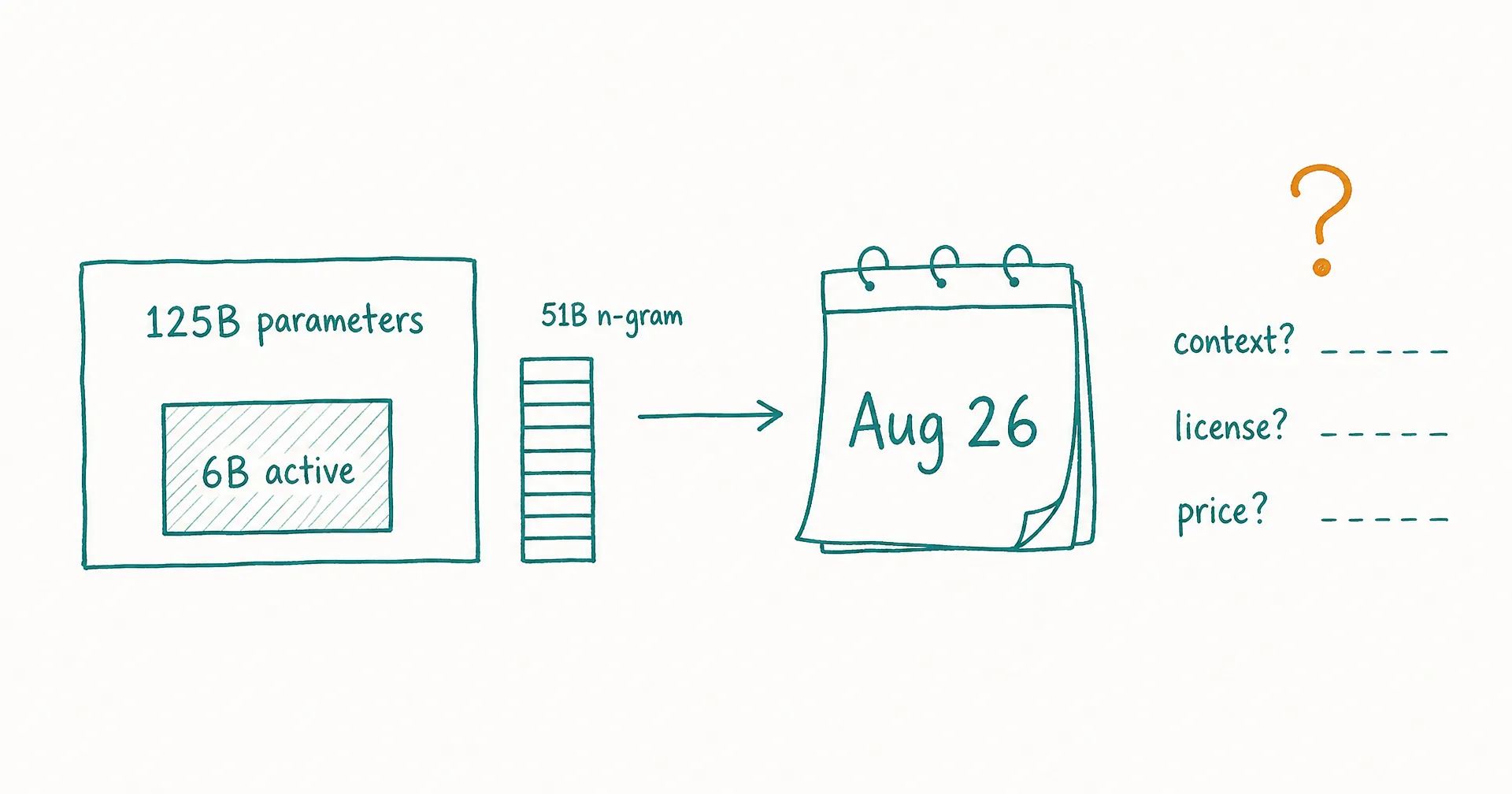
Qwen3.8-Flash-Next shipped on August 26, 2026, exactly on the promised day, and the most interesting thing about the release is how little it corrected. The specs that leaked through a hastily edited ModelScope teaser the day before turned out to be the specs. This page was a pre-release tracker; it has now been updated, same day, with the shipped record, the same job our Fable 5.1 tracker does for that model.
On this page · 6 sectionsOpen
- Qwen3.8-Flash-Next shipped August 26, 2026, on schedule: weights on Hugging Face and ModelScope, an official blog post, and a technical report. It is officially an experimental preview of the Qwen4 architecture.
- Confirmed accounting: 125B main parameters with 6B activated, plus a separate 51B n-gram embedding table and a 4B MTP head. Natively multimodal (vision encoder), 262,144-token native context, extensible to 1M via YaRN.
- Every captured pre-release claim survived contact with the release: 125B/6B, the 51B n-gram table, the Qwen4 architecture, and the roughly 1/9-the-training-cost-of-Qwen3.7-Plus claim all appear in the official materials.
- The license is NOT Apache-2.0: it is the Qwen Community License 1.0 - free to use and deploy commercially, but products over 100M MAU or $20M monthly revenue must display the model name, and Model-as-a-Service or AI Work Assistant businesses need a separate Qwen license.
- Qwen’s own benchmark table leads with agent work: DeepSWE 58.7, SWE-bench Pro 62.5, Toolathlon 73.5, and two office-work benchmarks (CoWorkBench 73.9, JobBench 55.7) where it beats every listed rival including Claude Opus 4.6 Max.
- The local-run question has its answer: the n-gram table is designed for host-memory offload with async prefetch, but the full repository is ~360GB. Managed pricing: $0.16/$0.47 per million tokens as Qwen3.8-Flash on QwenCloud; the API went live around August 27.
§ 01What shipped
Weights on Hugging Face and ModelScope (full precision, roughly 360GB, plus an official FP8 variant), an official blog post, and a technical report on GitHub. Qwen’s framing is the strategic headline confirmed: this is “an experimental preview of the architecture that will underpin Qwen4,” shipped early so runtimes, quantizers, and tool vendors can build support before the Qwen4 family proper arrives.
| Item | Confirmed detail |
|---|---|
| Type | Causal LM with vision encoder (natively multimodal) |
| Main parameters | 125B, with 6B activated per token |
| Extra parameter blocks | 51B n-gram embeddings + 4B MTP head (~180B stored) |
| Architecture | 48 layers: Gated DeltaNet + Qwen Sparse Attention hybrid, Gated Residual, 512 experts (10 routed + 1 shared active) |
| Context | 262,144 natively; extensible to 1,000,000 via YaRN |
| License | Qwen Community License 1.0 (see below - not Apache) |
| Weights | Hugging Face + ModelScope; FP8 variant official |
| Day-one runtimes | vLLM, SGLang, TokenSpeed; Transformers-compatible |
| Managed version | Qwen3.8-Flash on QwenCloud: 1M context default, built-in tools, $0.16/$0.47 per 1M tokens, API live as of Aug 27 |
§ 02The leak scorecard
This launch had an unusual property: its specs were published by accident before they were published on purpose. Here is how every captured claim fared against the shipped model card:
| Captured claim (Aug 25) | Verdict (Aug 26) |
|---|---|
| 125B main parameters, 6B active | Confirmed exactly |
| Additional 51B n-gram embeddings | Confirmed exactly (20M bigram/trigram entries at layer 2) |
| GDN hybrid layers + Qwen Sparse Attention | Confirmed (12 x (3 x GDN-MoE + 1 x QSA-MoE) layout) |
| ~1/9 training cost of Qwen3.7-Plus | Confirmed as Qwen’s official claim |
| Built on the Qwen4 architecture | Confirmed: “experimental preview” of Qwen4 |
| Apache-2.0 plausible (our guess) | Wrong: Qwen Community License 1.0 |
The one honest miss on this page was ours: we called Apache-2.0 “plausible, unconfirmed,” and the release shipped under the Qwen Community License 1.0 instead. It is a permissive license with two teeth worth knowing about. First, products exceeding 100 million monthly active users or US$20 million in monthly revenue must prominently display the model name in their UI. Second, and more consequential for this audience: running a Model-as-a-Service or “AI Work Assistant” business on the model requires a separate license from Qwen, with internal use exempt. If your business is selling AI workers powered by open weights, this license names you specifically.
§ 03The benchmarks lead with agent work
Qwen’s published table is vendor-run, but its footnotes are unusually specific (harnesses, temperatures, context windows, re-evaluated baselines), and its shape says more than any single number: the first two sections are agentic coding and agent work, not chat.
| Benchmark | Flash-Next | Qwen3.8-27B | Qwen3.7-Plus | DeepSeek-V4-Flash | Claude Opus 4.6 (Max) |
|---|---|---|---|---|---|
| DeepSWE 1.1 | 58.7 | 42.2 | 16.5 | 54.4 | not shown |
| SWE-bench Pro | 62.5 | 61.7 | 55.8 | 56.0 | 53.4 |
| SWE-bench Multilingual | 81.0 | 73.8 | 75.8 | not shown | 77.5 |
| NL2Repo-Bench | 48.1 | 42.3 | 41.1 | 54.2 | 47.6 |
| CoWorkBench (office agents) | 73.9 | 70.7 | 65.1 | 45.1 | 68.2 |
| JobBench (professional tasks) | 55.7 | 33.4 | 27.6 | 41.3 | 36.6 |
| Toolathlon Verified | 73.5 | 67.1 | 50.6 | 70.3 | not shown |
| GPQA Diamond | 91.7 | 89.2 | 90.3 | 90.8 | 91.3 |
| HLE | 35.9 | 30.8 | 34.7 | 33.8 | 40.0 |
| LiveCodeBench v6 | 91.9 | 90.3 | 89.6 | 90.6 | 88.8 |
Two readings worth taking away. First, against its own family the efficiency claim looks real: it beats Qwen3.7-Plus (397B parameters, 17B active) nearly everywhere while activating a third of the parameters at a claimed ninth of the training cost. Second, look at what Qwen chose to benchmark: CoWorkBench is an in-house benchmark for “long-horizon office and productivity agent tasks,” and JobBench covers “professional job tasks” - and Flash-Next’s largest margins over every listed rival, Claude Opus 4.6 Max included, land on exactly those two rows. Model vendors are now benchmarking on employee-shaped work, which tells you where they believe the demand is. The usual caveats hold: vendor runs, one in-house benchmark, independent replication pending.
§ 04The local-run question, answered
The dominant pre-release question was whether the 51B n-gram table must sit in fast memory. The model card answers it directly: n-gram embeddings are designed to be “more amenable to offloading,” indexed by short bigrams and trigrams, and placeable in host memory with asynchronous prefetch. So the table streams; your VRAM budget is for the 125B expert weights, of which 6B are active per token. In practice: the full repo is ~360GB (FP8 official), vLLM/SGLang/TokenSpeed support landed day one, and this is multi-GPU workstation or server territory. The 6B activation buys you speed once it fits, not a smaller checkpoint.
§ 05Where this sits for buyers
Two frontier-adjacent open-weight releases landed within hours of each other on August 26: this one, and GLM-5.3-Flash, revealed as the stealth model Ox Alpha. Both are efficiency-first MoEs, both natively multimodal, both aimed squarely at agentic work, and both priced (or licensed) to undercut the closed frontier. The model layer is rotating faster than at any point this year, and the pattern we keep flagging holds: the models rotate, the work does not. That layer above the models is where we live, so discount accordingly: CellCog is the employee layer, and when a model vendor’s own launch table leads with an office-work benchmark, it is telling you the same thing we are - the unit of value is the job, not the token. Our harness ranking covers how the layers fit together.
§ 06The tracker, closed out
As of August 26, 2026: released on schedule, leak claims confirmed, license named, benchmarks published, managed pricing announced at $0.16/$0.47 with the API marked coming soon. This page now tracks the aftermath rather than the release: if the QwenCloud API pricing changes when it goes fully live, or independent benchmark replications land materially different from the vendor table, the update happens here, same day.
Update, August 28, 2026: the “coming soon” cleared in under 48 hours. Alibaba Cloud’s Model Studio documentation now lists qwen3.8-flash as a live, callable model: a 983,616-token context window, a 131,072-token output cap, text-and-image input, and reasoning enabled by default at xhigh effort. Pricing stands at the announced $0.16/$0.47 per million tokens. The remaining watch item is independent benchmark replication.
Q1When did Qwen3.8-Flash-Next come out?
August 26, 2026, matching the ModelScope teaser’s promised date. The official GitHub repository records the release, and the weights (BF16-style and FP8) went live on Hugging Face and ModelScope the same day.
Q2Did the removed ModelScope text turn out to be accurate?
Almost entirely. The captured claims - 125B main parameters with 6B active, an additional 51B n-gram embedding table, GDN hybrid layers with Qwen Sparse Attention, and roughly 1/9 the training cost of Qwen3.7-Plus - all appear in the official release materials. The one nuance: ‘125B total’ undersells the stored size, since the n-gram table and MTP head bring the repository to roughly 180B stored parameters.
Q3Is Flash-Next the same as Qwen4?
No, it previews it. Qwen’s own words: an ‘experimental preview of the architecture that will underpin Qwen4.’ The product name stays in the Qwen3.8 line, and the release exists so inference runtimes and tool vendors can build support before the Qwen4 family arrives.
Q4What license is Qwen3.8-Flash-Next under?
The Qwen Community License 1.0, not Apache-2.0. It permits commercial use, modification, distribution, and hosting, with two conditions worth reading: products exceeding 100 million monthly active users or US$20 million monthly revenue must prominently display the model name, and running a Model-as-a-Service or AI Work Assistant business on it requires a separate license from Qwen. Internal use is exempt from the separate-license requirement.
Q5What is the difference between Qwen3.8-Flash-Next and Qwen3.8-Flash?
Flash-Next is the open-weight release: 262,144-token native context, extensible to 1M via YaRN. Qwen3.8-Flash is the managed production version on QwenCloud based on it, with 1M context by default and built-in tools, priced at $0.16/$0.47 per million tokens. The API is now live: Alibaba Cloud’s docs list qwen3.8-flash with a 983,616-token context, a 131,072-token output cap, text-and-image input, and reasoning enabled.
Q6What hardware does it need to run locally?
The full-precision repository is roughly 360GB, with an official FP8 variant available. The design helps more than the raw size suggests: 6B active parameters keeps per-token compute low, and the 51B n-gram embedding table is explicitly built to live in host memory with asynchronous prefetch instead of VRAM. vLLM, SGLang, and TokenSpeed list day-one support; this is workstation-or-server territory, not a single consumer GPU.