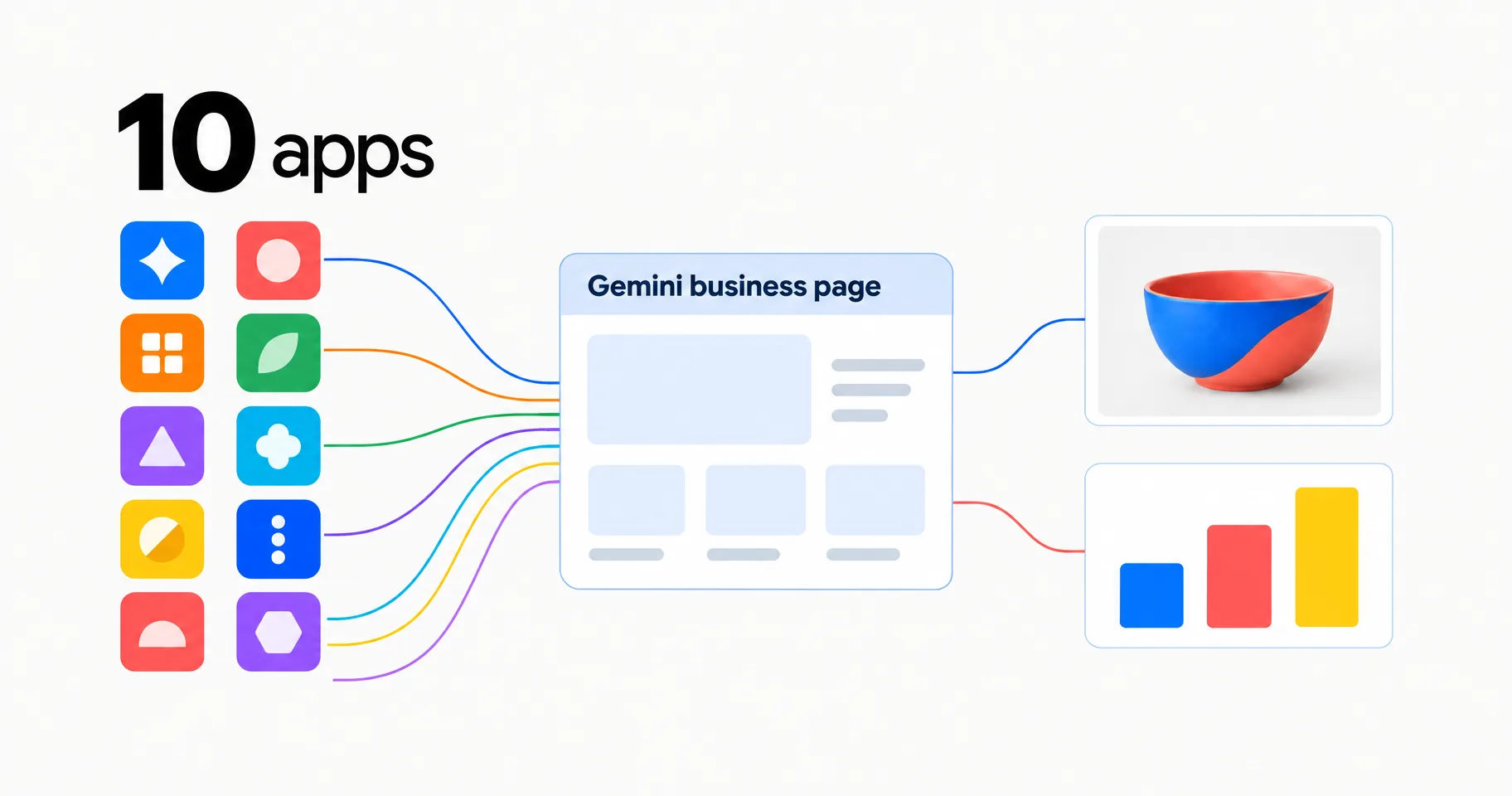
Google is turning the Gemini app into a workspace for small business owners: a business landing page, a saved brand style, finance charts and ten connected apps, rolling out to every Gemini user in the coming days. Vishnu Sivaji, Senior Director of the Gemini app, announced it on Google’s Keyword blog at 16:00 UTC on October 20, 2026.
Google’s opening number sets the scale: “Tens of millions of small business owners are using Gemini today to brainstorm future products, manage customer feedback, and analyze business performance.” This page reads Google’s announcement directly. It lands three weeks after Meta pointed its Muse agent at the same owners with Muse for Small Business.
On this page · 7 sectionsOpen
 Google announced new Gemini tools for small business owners on October 20, 2026: a business landing page, marketing and finance skills, and new connected apps.
 Gemini connects to Google Business Profile, Google Ads and Google Workspace, plus Adobe, Canva, Dropbox, Shopify, Wix, Zoho and Xero, ten apps named in all.
 Owners upload a website, brand kit, fonts or colors once, and Gemini keeps that style for later images made with Nano Banana 2.1.
 Gemini turns spreadsheets, receipts and purchase records into financial charts and interactive models.
 Google says the tools roll out globally to all Gemini app users in the coming days; the post names no price and no approval rules for actions.
§ 01What Google announced
| Item | What Google says |
|---|---|
| Business landing page | A central hub to build a brand, analyze finances, understand customer insights and more |
| Google connections | Google Business Profile, Google Ads, Google Workspace |
| Other connected apps | Adobe, Canva, Dropbox, Shopify, Wix, Zoho, Xero |
| Brand style | Upload a website, brand kit, fonts or color palettes; Gemini keeps the style |
| Images | Nano Banana 2.1, Google’s latest image model |
| Finance | Spreadsheets, receipts and purchase records into charts and interactive models |
| Availability | Rolling out globally to all Gemini app users in the coming days |
| Price | Not stated |

The brand piece is the most concrete. An owner defines a style once, and “Gemini retains this visual style, allowing owners to easily generate cohesive, on-brand assets without having to repeatedly upload their style guidelines.” The images come from Nano Banana 2.1, which Google launched earlier this month.

The finance piece is analysis, not bookkeeping: Gemini reads the records an owner hands it and returns charts and models. The post does not describe Gemini posting entries into Xero or Zoho, only connecting to them.
§ 02The owners in Google’s post
Google tells five stories. Morgane, a ceramicist in Bordeaux who runs Bleu Clémentine, uses Gemini for product descriptions, newsletters and social hooks and says it saves her two to three hours every day. Santosh Jadhav in Maharashtra used it to check soil, work out seed needs and draft a budget for a ginger farm. Patricia Morais, a personal organizer in Goiânia, uses it for customer service and content alongside her Business Profile.
Gumilang in Jakarta built a visual style and merchandise for Barelz Arena with it, and Josh in New Jersey uses a connected Business Profile to track local search and Maps performance for Burger & Butcher. These are testimonials. Only Morgane’s comes with a number, and none is a measured study.
§ 03What the announcement leaves out
- What each connection can do. The post names ten apps but not what Gemini can read or change in them. Shopify, by contrast, published an action-by-action page for its Muse connector, with refunds and cancellations blocked.
- Approval rules. Meta wrote down that Muse publishes, sends or spends nothing without the owner’s approval. Google’s post has no line on actions at all.
- Working on its own. Every example starts with the owner asking. Nothing describes Gemini doing work between visits.
- Price. The tools reach all Gemini app users, but the post names no plan; since October 9 the free plan runs on Flash-Lite.
§ 04How it compares
| Gemini business tools | Muse for Small Business | CellCog AI employee | |
|---|---|---|---|
| Launched | October 20, 2026, rolling out | September 29, 2026 | Available today |
| Where it works | Inside the Gemini app | Inside the Muse app | Its own secure computer, file system, browser and email |
| Named tools | 3 Google services plus 7 apps | 3 Meta services plus 15 partner tools | The apps the owner connects |
| Between conversations | Not described | Meta says it brings ideas on its own | Works on its own schedule and reports back |
| Memory | Keeps a brand style | Knows the business from connected Meta accounts | Keeps its own memory of the business and the role |
| Price | Not stated | Free for most use, paid plans for more | Pay for the work; try it free, no credit card needed |
Our conflict, declared: we build CellCog, so we are a party to this comparison. Every Gemini and Muse cell is quoted from Google’s and Meta’s own announcements.
§ 05Where each fits
If your business already runs on Google Workspace and a Business Profile, Gemini’s hub is the natural first try: it is already in the app you use, the images keep your brand, and the finance charts need nothing but a spreadsheet. The difference with an AI employee is who holds the work. Gemini answers when you open it; an AI employee takes a role, keeps track of your brand and customers, does the week’s work and tells you what it did.
§ 06What we are watching for
- The rollout itself, and whether any of it sits behind a paid Gemini plan.
- A page from Google listing what each connected app lets Gemini read or change.
- Independent tests of the brand style holding across many assets.
§ 07Sources
- Google, New Gemini tools for small business owners, Vishnu Sivaji, October 20, 2026, 16:00 UTC. Read directly.
- Meta, Introducing Muse for Small Business, September 29, 2026, for the approval line and the named partner tools.
- Shopify Help Center, Shopify connector for Muse, for the action-by-action connector list.
- Our records on Muse for Small Business, Nano Banana 2.1 and Gemini’s free tier changes.
Q1When did Google announce Gemini's small business tools?
October 20, 2026. The Keyword post by Vishnu Sivaji, Senior Director of the Gemini app, carries a publish time of 16:00 UTC.
Q2Which apps does Gemini connect to for small businesses?
Google Business Profile, Google Ads and Google Workspace, plus Adobe, Canva, Dropbox, Shopify, Wix, Zoho and Xero, the ten Google names in the post.
Q3Is it free?
Google says the tools roll out to all Gemini app users. The post names no price for them, and since October 9 the free plan runs on Flash-Lite, per Google’s help center.
Q4How is Gemini for small business different from an AI employee?
Gemini works when the owner opens it and asks. An AI employee holds a role, such as marketing, keeps its own memory and computer, and works on a schedule between conversations.
Q5Does CellCog use Gemini?
Not today. Every CellCog agent tier runs on Claude Opus 5.5; we follow Gemini because it competes for the same small business owners we serve.