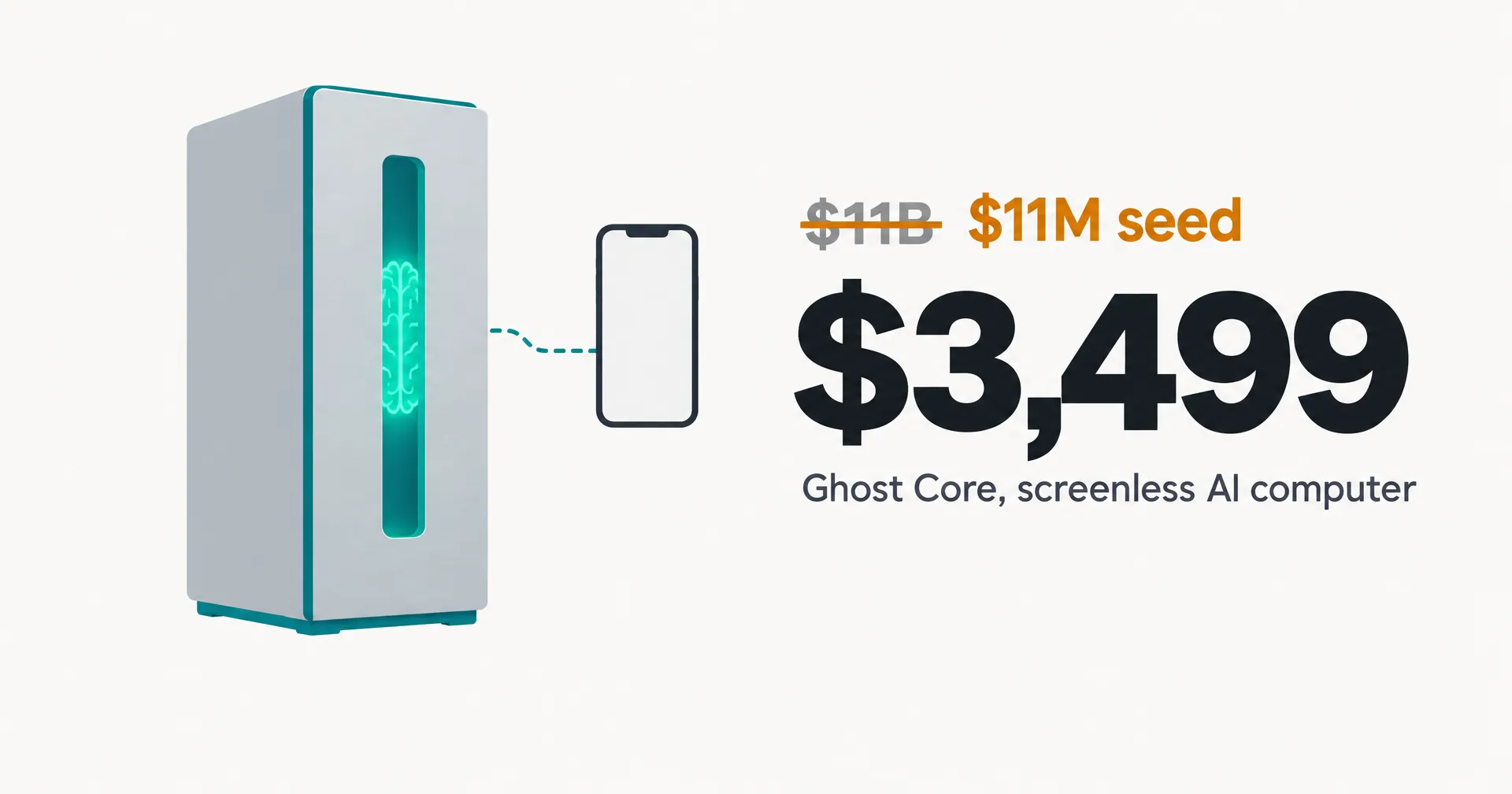
Ghost, a San Francisco startup founded by 19-year-old Zain Javaid, came out of stealth on October 5, 2026 with an $11 million seed round led by Andreessen Horowitz and its first product, Core: a $3,499 screenless computer built to run personal AI agents on your own hardware. A screenshot of TechCrunch’s first post on X read $11 billion; the TechCrunch article and the post now on X say $11 million, and Claire Diaz-Ortiz’s joke about the typo had more than 500 likes by that evening. This page reads TechCrunch’s report, Ghost’s product page and Javaid’s own posts on X as of October 5, 2026.
On this page · 8 sectionsOpen
 Ghost raised an $11 million seed round led by Andreessen Horowitz; an early TechCrunch post on X said $11 billion, but the article says $11 million.
 Core is a $3,499 screenless computer built to run personal AI agents, used from a phone or the Core app.
 It carries an Nvidia RTX Pro 4000 Blackwell GPU with 24 GB of memory, 64 GB of RAM and a 1 TB SSD, with the GPU included in the price.
 Four open-weight models come preinstalled, including Qwen 3.8-Next and Gemma 4-31B, and owners can add models from Hugging Face.
 Ghost says models, memory and personal data stay on the device, encrypted, and that Core keeps working if Ghost shuts down; a credential firewall is still being built.
 Batch 1 is sold out and ships October 31; Javaid says the GPU has doubled in price, so batch 2 will likely cost more.
§ 01What Ghost announced
Ghost spent a year building before the launch. TechCrunch lists Abstract, Audacious Ventures, SV Angel and Nova alongside Andreessen Horowitz in the round, and a founding team of Javaid (19), Nicholas Chua (19), Yifei Chen (24) and Gautam Sharda (23). The units are built at the company’s San Francisco facility.
Core is meant to pull a person’s data, from desktop files to apps to smart home devices, into one machine that runs AI agents all the time. Javaid describes it as a brain in a box: there is no screen, and you use it from a phone or the Core app, including a voice mode inside the app. His case for dedicated hardware, as he put it to TechCrunch: you can run models on existing hardware, but it is “a terrible experience on many levels.”
§ 02Core, by the numbers
| Item | Ghost Core |
|---|---|
| Price | $3,499, excluding VAT |
| GPU | Nvidia RTX Pro 4000 Blackwell SFF Edition, 24 GB GDDR7 ECC, 432 GB/s |
| CPU | AMD Ryzen 5 7600, 6 cores, 12 threads |
| Memory | 64 GB DDR5 |
| Storage | 1 TB NVMe SSD |
| AI compute | 770 AI TOPS (Ghost’s figure) |
| Screen | None; used from a phone or the Core app |
| Preinstalled models | Qwen 3.8-Next, Qwen 3.8-27B, Gemma 4-31B, Muse-Glimmer-30B |
| Warranty and returns | 1 year; 30-day return |
| Batch 1 | Sold out; ships October 31 |
TechCrunch’s report names three preinstalled models; Ghost’s page lists a fourth, Muse-Glimmer-30B. Owners can also install models from Hugging Face or load their own.
§ 03How it works
Javaid wrote on X that Ghost forked Ubuntu and runs its software as a layer on top, with the models configured and preinstalled, and that Core connects to your laptop and phone so you can control your agent from anywhere. TechCrunch adds that Core has its own browser and filing system and can keep working through tasks without constant prompting.
Models update over the air “similar to how Tesla works,” in Javaid’s words. When a new generation of a model arrives, Ghost asks owners whether to switch, or they can turn on auto-updates.
§ 04The privacy pitch, and what is still being built
Ghost’s central claim is ownership. “The user owns all of it,” Javaid told TechCrunch: models and personal memory run locally, personal information is encrypted, and Ghost says no cloud provider or third party, Ghost included, can meaningfully read it. “All of the source code, logic, and model weights live on the device, not the services,” he said, which is why Core is designed to keep running if the company shuts down.
One safeguard is not finished. The team is building a firewall to limit how the agent uses credentials such as logins and passwords; Javaid says it “monitors every outgoing network request on the computer” and blocks requests that look like unsanctioned actions or data leaving the machine, flagging them for review. Until it ships, owners decide how much autonomy to give their Core agents.
These are the founder’s descriptions. Nobody outside Ghost has reviewed a unit yet; the first batch ships October 31.
§ 05The price, and why batch 2 may cost more
The $3,499 includes the GPU. Javaid explained the number on X: Ghost locked down supply of the card when it sold for about $1,700, and “since then prices have doubled so for our next batch will likely need to raise prices,” as he wrote on October 5. Batch 1 shows as sold out on Ghost’s page; batch 2 is open for interest only, with no price.
§ 06A computer you own vs an AI employee you hire
Ghost and CellCog both start from the same idea: an AI agent needs its own computer. They put that computer in different places.
| Ghost Core | CellCog AI employee | |
|---|---|---|
| Where the computer is | A box in your home | A secure cloud computer per employee |
| Hardware upkeep | Yours | CellCog’s |
| Where data lives | On the device, encrypted (Ghost’s claim) | CellCog’s cloud; your own computer only if you connect it |
| Models | Open-weight models preinstalled, more from Hugging Face | Frontier models (Claude Opus 5.5) |
| Works offline | Yes, per Ghost | No |
| Browser and logins | Built-in browser | Its own browser identity and saved logins |
| Files | A filing system on the device | Its own file system |
| Cost | $3,499 hardware | No hardware; you pay for the work you assign |
We make CellCog, so read the right-hand column with that in mind; every claim in it comes from our own docs. If your data must never leave your home, or you want to run open-weight models with no internet connection, Core is the better fit. If you want an agent that runs frontier models and needs no box on your desk, an AI employee is the other route.
§ 07What we are watching
- First deliveries and independent reviews after October 31.
- The credential firewall, and whether it ships with batch 1 or later.
- Batch 2 pricing, which Javaid has said will likely rise.
§ 08Sources
- TechCrunch, “At 19, founder raises $11M for Ghost, maker of a $3,499 computer for personal AI”, October 5, 2026
- Ghost, Core product page, read October 5, 2026
- Zain Javaid on X, Ubuntu fork and GPU pricing, October 5, 2026
- TechCrunch on X, launch post, October 5, 2026
- Claire Diaz-Ortiz on X, post on the typo, October 5, 2026
Q1Did Ghost raise $11 billion?
No. TechCrunch’s article says Ghost raised $11 million in a seed round led by Andreessen Horowitz, with Abstract, Audacious Ventures, SV Angel and Nova also investing. An early TechCrunch post on X said $11 billion; the post now on X says $11 million.
Q2What does Ghost Core do?
It is a personal computer designed to run AI agents continuously. Ghost says it gathers context from your files, apps and smart home devices so agents can act as an assistant, perform tasks and reach out proactively. You use it from a phone or the Core app; it has no screen.
Q3Does Ghost Core work without the cloud?
Ghost says the models and personal memory run on the device and that all source code, logic and model weights live there, so Core is designed to keep working if Ghost shuts down. Over-the-air model updates still come from Ghost.
Q4How is Ghost Core different from a Mac Mini?
Javaid told TechCrunch that Core’s hardware and software were built specifically for running AI agents, with models already installed, while a Mac Mini is a general-purpose computer that can be configured for AI.
Q5How is Ghost Core different from a CellCog AI employee?
Core is hardware you buy and keep at home, running open-weight models locally. A CellCog AI employee runs in the cloud on its own secure computer with its own file system, browser identity and logins, on frontier models, with no hardware to buy. We make CellCog, so weigh that answer accordingly.