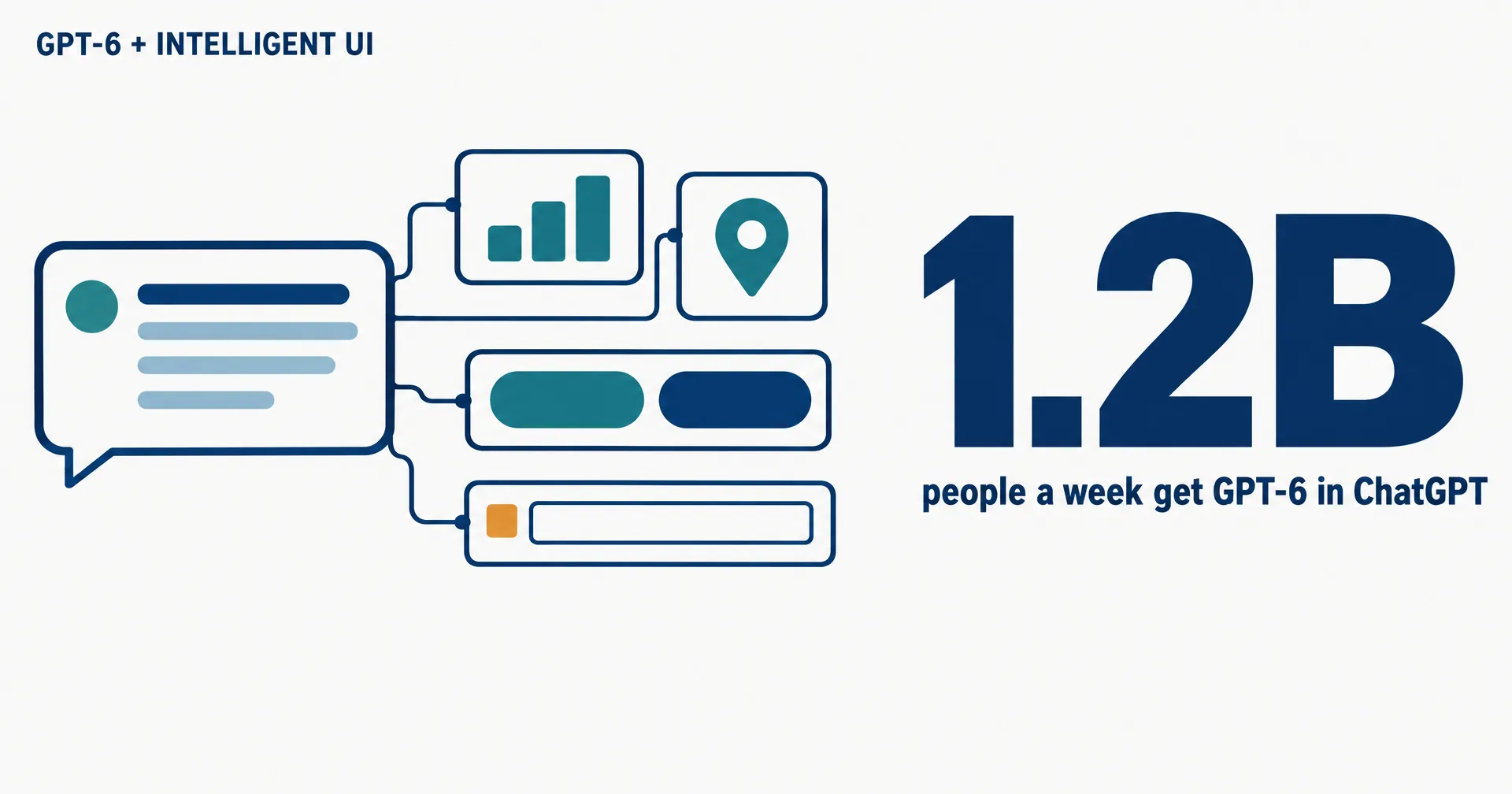
OpenAI started rolling out GPT-6 to everyone in ChatGPT on October 7, 2026, with a new capability called Intelligent UI. Answers can now include charts, graphics, tappable buttons, forms and small interactive tools, built on the spot. OpenAI’s announcement says Plus, Pro, Business and Enterprise users get it that day and Free and Go users from the next, and that more than 1.2 billion people use ChatGPT each week. OpenAI’s X posts about the rollout are timestamped 18:05 UTC. A disclosure up front: CellCog builds AI employees whose work includes interactive dashboards and apps, so we have a stake in how answer interfaces get described.
On this page · 7 sectionsOpen
 OpenAI began rolling out GPT-6 in ChatGPT on October 7, 2026 to Plus, Pro, Business and Enterprise, with Free and Go from the next day. OpenAI says more than 1.2 billion people use ChatGPT each week.
 Paid plans get GPT-6 Sol and Free and Go get GPT-6 Luna, both October versions tuned for conversation. The models behind ChatGPT Work and Codex do not change.
 Intelligent UI lets an answer include charts, graphics, tappable buttons, forms and small interactive tools. OpenAI built a library of streamable components and a compiler that renders them while the model is still writing.
 GPT-6 can start answering while it is still thinking. OpenAI says GPT-6 Instant starts answering 44% sooner than GPT-5.6 Instant on questions that need web search.
 The system card rates both models High capability in cybersecurity and biology, and scores indirect prompt-injection robustness at 97.13% for Sol and 95.80% for Luna. It also shows slightly lower multi-turn jailbreak scores than the September GPT-6 versions.
§ 01Who gets which model
| Surface | Model | From |
|---|---|---|
| ChatGPT Plus, Pro, Business, Enterprise | GPT-6 Sol (October) | October 7, 2026 |
| ChatGPT Free and Go | GPT-6 Luna (October) | October 8, 2026 |
| ChatGPT Work and Codex | Unchanged (September versions) | No change in this release |
| API | chat-latest snapshot updated | October 7, 2026 |
OpenAI says both models are “tuned for everyday conversation”, and Enterprise availability depends on workplace admin settings. The system card names the new versions by month: October for the models released now, September for the versions still serving Codex and Work. For developers, the API changelog updated the chat-latest snapshot the same day, while recommending the GPT-6 model family for production.
§ 02What Intelligent UI is
OpenAI describes it as answers composed from text, visuals and interactive pieces, chosen per question. A comparison can come side by side, a road trip can come on a map, and an explanation can come as a diagram you can tap through. When plain text is best, the answer stays plain text.
The mechanism is the useful part. OpenAI built a library of native, streamable components and a compiler that processes the interface while the model writes it, so the interface appears in pieces instead of all at the end. GPT-6 was then trained to pick layout, visuals and interactivity, with its interfaces graded for clarity, usefulness and completeness. OpenAI is candid that this is early: “There’s still work ahead to improve the model’s design judgment and expand what it can create.”
Its closing line states the bet: “Instead of people adapting to software, software will adapt to people.”
§ 03Answers that start while the model thinks
GPT-6 in ChatGPT can begin answering before it finishes thinking, building the answer across partial responses. OpenAI gives two numbers, both from its own internal evaluations:
- On questions that need web search, GPT-6 Instant starts answering 44% sooner, on average, than GPT-5.6 Instant.
- On everyday agentic tasks, GPT-6 Extra High starts answering in the same time as GPT-5.6 Medium and scores better overall than GPT-5.6 Extra High.
OpenAI published no standard benchmark table with this release, so there is nothing yet to check these against.
§ 04What the system card says
| Measure | GPT-6 Sol (October) | GPT-6 Luna (October) |
|---|---|---|
| Instruction hierarchy robustness | 99.99% | 99.79% |
| Indirect prompt-injection robustness | 97.13% | 95.80% |
| Preparedness: cybersecurity | High capability | High capability |
| Preparedness: biological and chemical | High capability | High capability |
| Preparedness: AI self-improvement | Below High | Below High |
The blog post and the system card describe jailbreak robustness against different baselines. The post says GPT-6 resists attempts to bypass its safety training better than GPT-5.6, especially attacks that adapt across several turns. The card compares the October versions with the September GPT-6 versions too: both have slightly lower point estimates on multi-turn jailbreak robustness than their September counterparts, with broadly overlapping 95% confidence intervals. Both October models still beat GPT-5.6 Sol at every attacker budget tested. Both statements are true; which one you read depends on whether your baseline is GPT-5.6 or last month’s GPT-6.
The card also notes that the safeguards are the same set described for GPT-5.6, and that safety evaluations run at the lowest reasoning setting while capability tests run at the highest.
§ 05How this compares to what CellCog builds
Intelligent UI renders inside a chat answer. CellCog’s AI employees produce work that lives outside the chat: research, code, dashboards and apps at their own URL, PDFs, spreadsheets, images and video. They keep that work current across days. CellCog runs on Claude Opus 5.5 at every chat tier and does not route to GPT-6 in chat.
§ 06What we are watching
- Whether Free and Go get the same Intelligent UI components as paid plans when Luna rolls out.
- Independent tests of the 44% faster start on web-search questions.
- Whether Intelligent UI reaches ChatGPT Work, Codex or the API beyond the chat-latest snapshot.
- The next system card update on multi-turn jailbreak robustness.
§ 07Sources
- OpenAI, GPT-6 and Intelligent UI for everyone, October 7, 2026.
- OpenAI, GPT-6 Sol and GPT-6 Luna: October 2026 update, system card, October 7, 2026.
- OpenAI, API changelog, October 7, 2026 entry.
- X: @OpenAI rollout post and availability post, October 7, 2026; times from the post ids.
Q1When did GPT-6 come to ChatGPT for everyone?
OpenAI announced it on October 7, 2026, with its X posts timestamped 18:05 UTC. Plus, Pro, Business and Enterprise users get it from that day, and Free and Go users from October 8.
Q2Which GPT-6 model does each ChatGPT plan use?
GPT-6 Sol powers Plus, Pro, Business and Enterprise, and GPT-6 Luna powers Free and Go. OpenAI’s system card calls these the October versions; Codex and ChatGPT Work keep the September versions.
Q3How does Intelligent UI work?
OpenAI says it built a library of native, streamable interface components and a compiler that processes the interface as the model generates it. GPT-6 was trained to choose layout, visuals and interactivity, and to fall back to plain text when that is most useful.
Q4Is GPT-6 in ChatGPT safer than GPT-5.6?
OpenAI says it resists jailbreaks better than GPT-5.6, including multi-turn attacks. Its system card also shows the October models with slightly lower multi-turn jailbreak point estimates than the September GPT-6 versions, with overlapping confidence intervals.
Q5Can developers use the new model in the API?
OpenAI’s API changelog updated the chat-latest snapshot on October 7, 2026, which points to the latest model in ChatGPT. OpenAI recommends the GPT-6 model family for production use and chat-latest for testing.