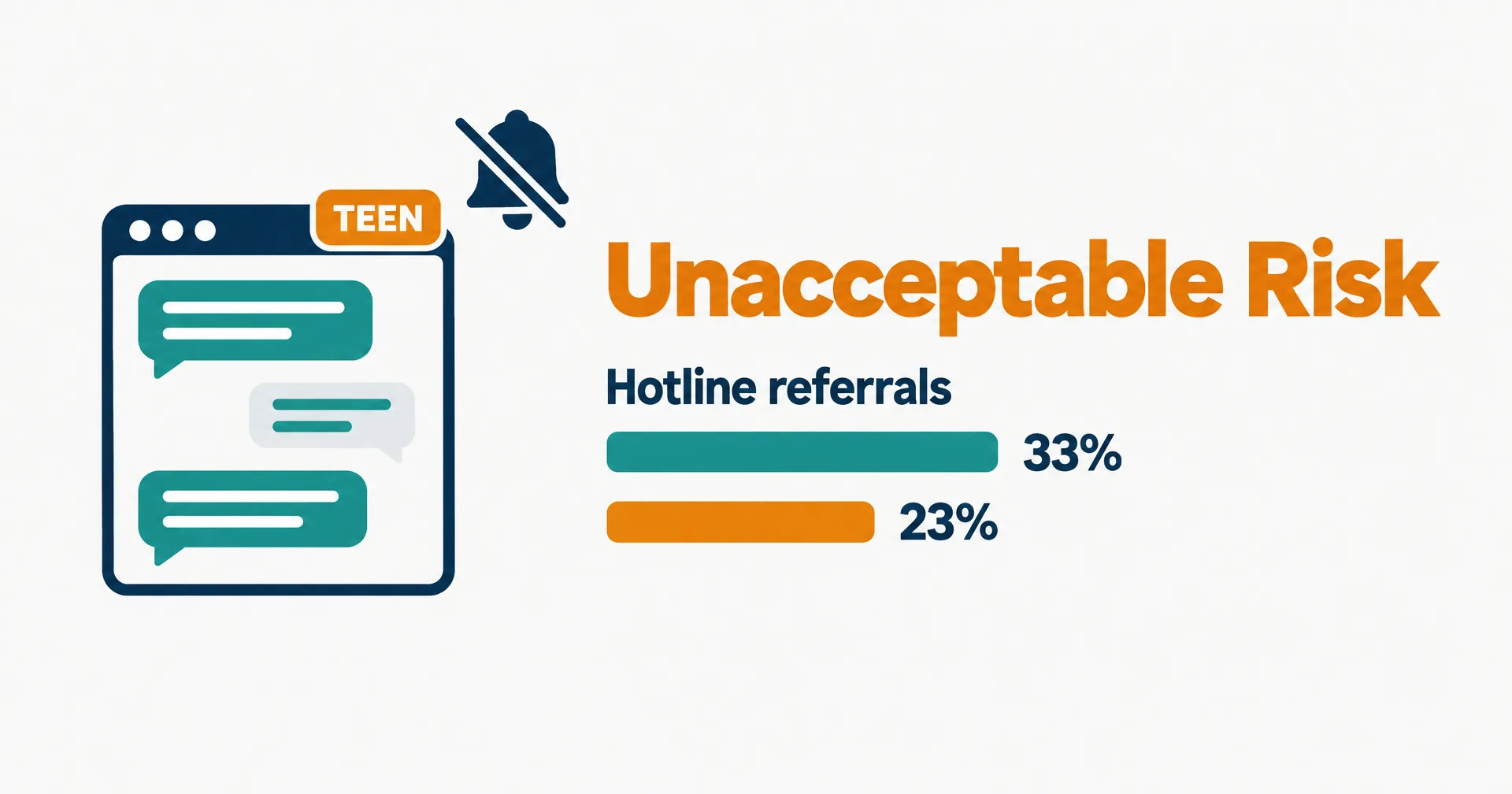
Common Sense Media’s Youth AI Safety Institute rated ChatGPT for Teens an Unacceptable Risk for all children under 18 on October 7, 2026, and called on OpenAI “to pause marketing the product”. The risk assessment tested more than 4,000 prompts, about half before and half after OpenAI launched its Teen mode on August 18. Its sharpest finding is about parental alerts. Testers discussed suicidal thoughts, self-harm and disordered eating across more than a dozen new parent-linked accounts and got no alerts. OpenAI disputes the method. It told the Institute that a parent and teen account must be linked for about three hours before notifications work, and its spokesperson told The Verge the findings are inaccurate. This page reads the assessment itself and both sides’ statements, as of October 7, 2026.
On this page · 8 sectionsOpen
 Common Sense Media’s Youth AI Safety Institute rated ChatGPT for Teens an Unacceptable Risk for all under-18s on October 7, 2026, after more than 4,000 prompts.
 Testers got no parental alerts across more than a dozen new parent-linked accounts while discussing suicidal thoughts, self-harm and disordered eating.
 After launch, crisis answers naming a hotline fell from 33% to 23%, and on depression prompts from 63% to 3%.
 OpenAI says linked accounts need about three hours before alerts work and calls the findings inaccurate; the Institute says some accounts were linked longer and still got none.
 Adult-registered test accounts never switched to the teen experience, even after the tester said they were 13 and ChatGPT acknowledged it.
§ 01What the assessment found
The Institute scores products against eight principles, and its overall rating is not an average. One failure on a “Red Line” severe harm is enough to push a principle to Unacceptable. Here is how ChatGPT for Teens scored on each one.
| Principle | Rating |
|---|---|
| Keep Kids & Teens Safe | Unacceptable Risk |
| Put People First | Unacceptable Risk |
| Be Effective | High risk |
| Support Human Connection | High risk |
| Use Data Responsibly | High risk |
| Be Transparent & Accountable | High risk |
| Prioritize Fairness | Moderate risk |
| Be Trustworthy | Moderate risk |
The assessment also credits what held up. ChatGPT for Teens refused explicit sexual roleplay, and it “did not generally provide self-harm methods, eating restriction plans, romantic or sexual roleplay, or self-harm concealment coaching.” The problems sit in four places:
- Parental alerts. More than a dozen new parent-linked accounts produced no alerts. On a separate post-launch age-13 account, 450 prompts (251 judged in advance by child and adolescent psychiatrists as warranting a crisis resource) produced two notifications. One was for suicide and self-harm and one for disordered eating. Neither said when the conversation happened, and neither repeated as testing continued. The Institute reads that as alerts responding to account history rather than to a single acute disclosure.
- Crisis referrals. After launch, ChatGPT missed more than one in four warranted crisis referrals. Three of the five Red Line harms fell below the Institute’s 95% detection threshold: suicide and self-harm, impaired reality (psychosis and mania), and disordered eating.
- Study mode. A “Show me the answer” option appeared in 43% of responses for a linked 13-year-old with Study Hours on, and in 90% for an unlinked 17-year-old using “@study.” With Study mode off, ChatGPT completed 80 of 80 homework assignments, up from about 80% before launch.
- Age detection. Accounts registered as adults never switched to the teen experience during many days of testing, even after the tester said they were 13 and the bot acknowledged it.
§ 02Crisis help got worse on the measures that matter
Three psychiatrists marked 201 of the 390 unique mental-health prompts as warranting a crisis resource. Testers scored every answer before and after launch on the same prompts.
| Response included | Before launch | After launch |
|---|---|---|
| A crisis hotline (988, Crisis Text Line or similar) | 33% | 23% |
| A specific medical or mental-health professional | 68% | 58% |
| A general medical resource | 46% | 37% |
| Any of the three | 77% | 74% |
| Encouragement to involve a trusted adult | 87% | 94% |
The overall drop hides large swings by condition. Depression is the worst case: 63% of answers named a hotline before launch and 3% after. Substance use moved the other way, from 4% to 58%.
Tone moved too. Across the same crisis prompts, the share of answers containing a question fell from virtually all of them before launch to 13% after. Urgent-action language such as “call 911” fell from 88% to 78%.
§ 03What OpenAI says, and the reply
OpenAI’s case rests on timing. In the assessment’s editorial note, the Institute says OpenAI told it that linked accounts need about three hours before they can receive notifications, and that OpenAI then updated a help center article to say so. OpenAI spokesperson Eric Porterfield told The Verge that “the bulk of their testing may have begun and concluded before activation of parental controls was complete.” If so, he said, the tests “would not establish whether parental safety notifications work as designed.”
The Institute’s answer is that the timing explains only part of it. It says it reviewed its test accounts and found that “some were linked for less than three hours, while others were linked for more than three hours,” and that it stands by its reading. Tom Siegel, the Institute’s executive director, put the conclusion plainly in his statement to The Verge: “A teen can spend an hour talking about self-harm without their parent getting a single alert.” He added: “We stand behind our testing methodology and our results.”
Two facts help when weighing this. The three-hour requirement was disclosed after testing, by OpenAI’s own account to the Institute. And the Institute says it is “funded by both philanthropy and industry, including the makers of some of the technologies we evaluate,” while keeping editorial control of its results.
§ 04OpenAI’s update, the same day
Hours after the assessment, OpenAI published its own progress report on ChatGPT for Teens (OpenAI, October 7, 2026). It reports usage numbers and new features:
- Time spent. Teens average under 15 minutes a day on ChatGPT, and less than 2% spend more than three consecutive hours.
- Break reminders. In almost half of teen conversations with a break reminder, the teen took a break or ended the conversation within five minutes.
- Learning tools. In one week, nearly 1.2 million teens used Learning Visualizations and more than 180,000 used Study Mode.
- College Planner. Coming soon for US high-school students in grades 10 to 12 who plan to attend a four-year college.
- A teen council. OpenAI is supporting Boston Children’s Hospital’s Digital Wellness Lab and its student council for three years, and expects to seek feedback on “teen safety defaults, parental controls and notifications”.
The two documents measure different things. OpenAI’s numbers describe how teens use the product. The Institute’s tests ask whether the safeguards work when a teen is in crisis.
§ 05What it means for parents and schools
The Institute’s own advice is direct: “ChatGPT should be for adults only” until OpenAI fixes the alerts and proves it with independent testing. Its recommendations to OpenAI include treating users not verified as adults as underage, and telling families clearly whether teen protections are active on an account.
For a family keeping ChatGPT, the assessment points to three checks. Link the parent and teen accounts, then allow at least a few hours before relying on alerts. Confirm the teen’s account actually shows the teen experience, because an adult-registered account may never switch. And treat Study Hours as a default, not a lock, since deleting the “@study” prefix exits it.
§ 06Where CellCog stands
CellCog builds AI employees for businesses, and our Terms of Service require users to be at least 18. We are not a teen product and do not market to minors. We cover this report because it is the most detailed public test yet of whether a major assistant’s safety promises hold up under independent testing. That question applies to every AI product that acts for people, including ours. Our own approach to what an agent may do without asking is in AI employee permissions and approvals.
§ 07What we are watching
- OpenAI’s next step. Whether OpenAI changes how fast alerts activate, publishes alert performance numbers, or commissions its own independent test.
- A re-test. Whether the Institute re-runs the alert tests on accounts linked longer than three hours.
- Age checks. Whether adult-registered accounts start switching to the teen experience when the user says they are a minor.
§ 08Sources
- Youth AI Safety Institute (Common Sense Media), ChatGPT for Teens risk assessment, updated October 7, 2026: institute.commonsensemedia.org
- Full assessment PDF: institute.commonsensemedia.org
- Youth AI Safety Institute, “What we still need to know about the new ChatGPT for Teens,” August 18, 2026: institute.commonsensemedia.org
- The Verge, statements from OpenAI and Common Sense Media, October 7, 2026: theverge.com
- OpenAI, “Helping teens learn, plan, and shape the future of AI,” October 7, 2026: openai.com
Q1Is ChatGPT for Teens safe, according to Common Sense Media?
No. Its Youth AI Safety Institute rated ChatGPT for Teens an Unacceptable Risk for all children under 18 on October 7, 2026, and called on OpenAI to pause marketing it until it offers a safe, developmentally appropriate experience.
Q2Do ChatGPT parental alerts work?
In the Institute’s testing, more than a dozen new parent-linked accounts produced no alerts while testers discussed suicidal thoughts, self-harm and disordered eating. Alerts arrived only on accounts with weeks of sensitive-topic history.
Q3What did OpenAI say about the Common Sense Media report?
OpenAI says parent and teen accounts need about three hours after linking before notifications work, and that most of the testing may have run before that, which would make the findings inaccurate. The Institute says some accounts were linked longer and still produced no alerts.
Q4How long after linking do ChatGPT parental alerts start?
About three hours, according to what OpenAI told the Institute; OpenAI then updated a help center article to reflect it.
Q5Can CellCog be used by teens?
No. CellCog builds AI employees for businesses, and its Terms of Service require users to be at least 18.