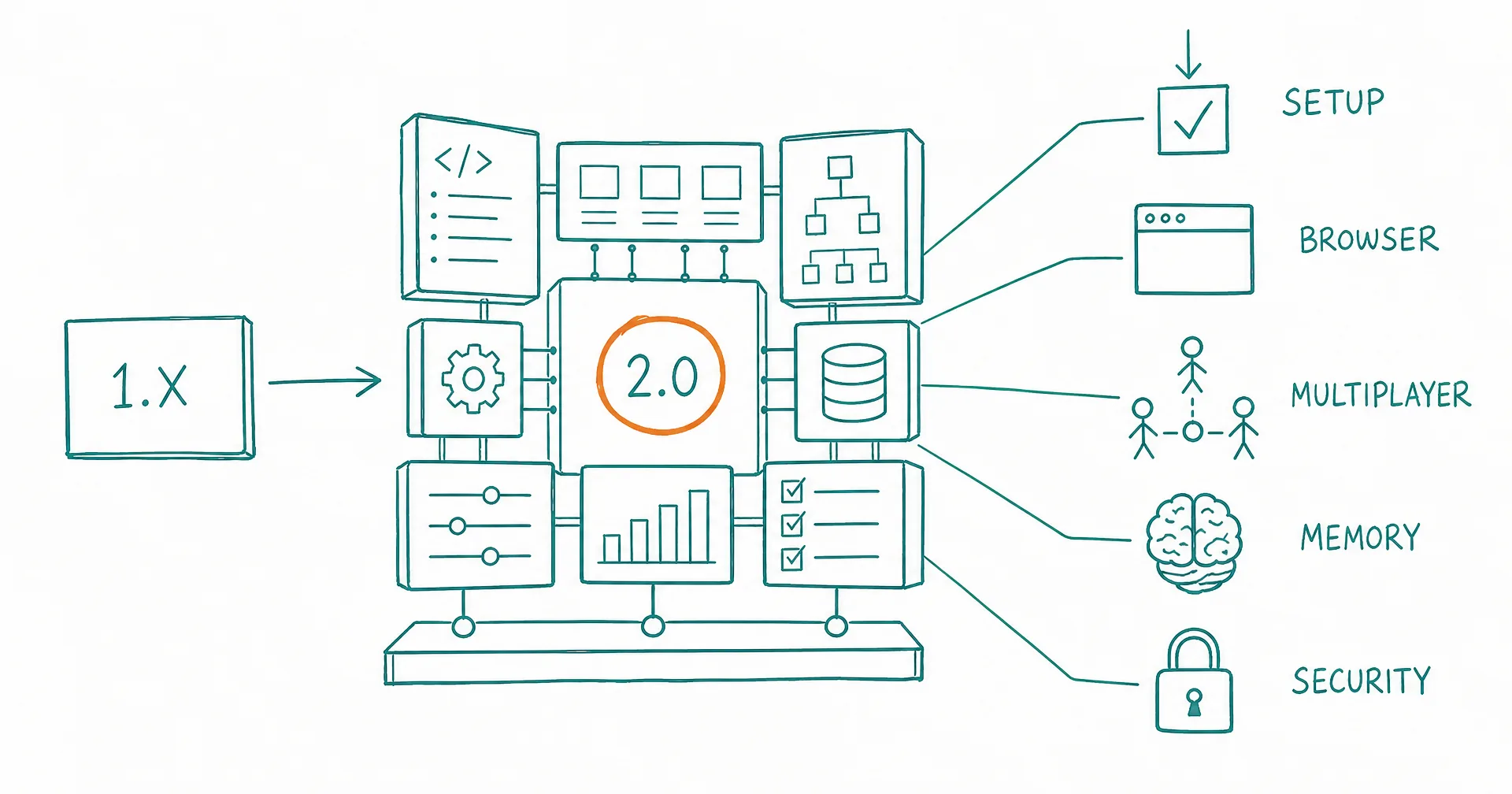
Late on August 30, 2026, OpenClaw shipped version 2026.8.1 and gave it a second name: OpenClaw 2.0. It is by far the largest update in the project’s history - over 16,000 merged pull requests from 933 contributors, which the team says is roughly half of all pull requests ever merged into OpenClaw. The announcement is four minutes long and the release notes are enormous, so this page is the digest in between: what actually changed, what breaks when you upgrade, and what the direction of the release says about where personal agents are heading.
This is a living page. Facts are verified against OpenClaw’s own release notes and announcement, and when the story changes, the update lands here same day.
On this page · 6 sectionsOpen
- OpenClaw v2026.8.1, published August 31, 2026 at 03:30 UTC (late August 30 US time) and billed by the team as OpenClaw 2.0, is the largest update in the project’s history: over 16,000 merged pull requests from 933 contributors.
- By the team’s own count, the release contains roughly 50% of all pull requests ever merged into OpenClaw, and 569 of the 933 contributors were first-timers.
- Setup got dramatically simpler: guided onboarding detects existing ChatGPT or Claude subscriptions, API keys, and local models, verifies the chosen model actually answers before saving it, and opens into a rebuilt browser app.
- Shared cloud sessions make OpenClaw multiplayer: team members join ongoing sessions and hand work over with context intact. The OpenClaw team says it now builds OpenClaw itself this way.
- Memory is consolidated: built-in Memory owns search and recall (QMD is retired), background consolidation promotes provenance-qualified material into long-term memory, and self-learning can turn strong lessons into proposed skills.
- Security got structural: approvals bind to the exact request, command, session, and person; sessions choose read-only, guarded, workspace, or full access; and a team credential store keeps secret values write-only.
- Three migrations to plan for: sessions move to SQLite (downgrading needs care), the OpenProse plugin is removed, and codex/ model routes migrate to openai/ via openclaw doctor –fix.
§ 01The release in numbers
| Fact | Detail |
|---|---|
| Version tag | v2026.8.1, published August 31, 2026 at 03:30 UTC (late August 30 US time) |
| Scale | 16,000+ merged pull requests from 933 contributors, 569 of them first-time |
| Share of the project | Roughly 50% of all pull requests ever merged into OpenClaw, per the team |
| The gap | Nearly seven weeks since the previous release, after 106 releases in the prior 230 days |
| Storage change | Sessions and transcripts move to SQLite; plan before downgrading |
| The story | The team started with simpler setup and a first-class browser app, and the cleanup grew into 2.0 |
The announcement’s own framing is worth keeping: this was not a planned major version. The project’s velocity outgrew its foundation and its release process at the same time, and the team reworked both rather than shipping around the problem.
§ 02What’s actually new
Setup that starts with what you already have. Guided onboarding now detects AI access already on your machine: active ChatGPT or Claude subscriptions, API keys, and qualifying local Ollama or LM Studio models. It verifies that the exact chosen model can answer before saving it, then hands off to the rebuilt browser app, which opens directly into a conversation. Most configuration moved out of initial setup entirely; you finish configuring your Claw by talking to it.
Multiplayer, for real. Shared cloud sessions are the headline: team members can join an ongoing agent session, continue work where it left off, assign tasks to teammates with full context, and collaborate live. The OpenClaw team says it now uses this multiplayer mode to build OpenClaw itself. New team operator roles limit which agents and sessions each verified person can reach, and the docs are refreshingly honest about scope: these are collaboration controls, “not hostile-tenant isolation.”
Memory grows up. Built-in Memory now owns the core search and recall path, with the QMD add-on retired via a supported migration. Two defaults are worth noticing: background memory consolidation promotes provenance-qualified material into long-term memory (with a Dream Diary and an explicit off switch), and automatic self-learning can capture strong reusable lessons and turn them into proposed skills. There is also plain conversation search at last: find past conversations by exact words and reopen the surrounding messages.
Skills become a workflow. Skill Workshop connects the whole path: create a skill down a guided route, validate it before anything is written, find or install skills, call them from a conversation, and review proposed changes with an applied history. Invalid skills are now reported individually instead of breaking the catalog around them.
Widgets and dashboards. Chat can now hold interactive widgets, pin them to session dashboards, grant them specific actions or network origins, and export rendered views as images. Combined with durable session progress cards, the browser app is now a real control surface rather than a log viewer.
A more structural security model. This is the deepest change for anyone running OpenClaw seriously. Approvals now stay attached to the exact request, command, session, and person that received them. Reusable command permissions bind to exact arguments and a working directory, and script-backed commands recheck the reviewed bytes before running. Each session can choose read-only, guarded, workspace, or full access. A shared credential store keeps team-scoped secret values write-only, agents can request credentials through masked prompts that never enter model-visible text, and plugin installs from arbitrary executable sources now require an explicit force flag. After July’s advisory batch, this is the follow-through release: the trust boundaries the project promised are now load-bearing features rather than policy statements.
§ 03What breaks
Three migrations, all documented, plus one date to diary:
| Change | What to do |
|---|---|
| Sessions and transcripts move to SQLite | Create a verified backup before upgrading; sessions created after the migration will not appear in older releases if you downgrade |
| OpenProse plugin and /prose removed | Run openclaw doctor –fix and follow the upstream Agent Skill migration; existing .prose files are kept |
| codex/ and openai-codex/ model refs | openclaw doctor –fix migrates routes, provider config, stored sessions, and automations to openai/* |
| Plugin SDK deprecation gates | September 1, 2026: several plugin-sdk subpaths move to focused imports; see the SDK migration guide |
The pattern across all four is the same: openclaw doctor --fix is the recovery tool, and the release notes flag conflicts for operator repair instead of silently guessing.
§ 04What the release signals
OpenClaw 2.0 is a strong release, and the honest read is that it validates the direction this whole category is moving. A year ago, “personal agent” meant a chat loop with tools. The features that earned 2.0 status are all continuity features: memory that consolidates in the background, skills that accumulate from real work, permissions that persist across sessions, and shared context that survives a handoff between people. Those are the properties of a colleague, not a chatbot - the distinction we mapped in AI agent vs AI employee.
The difference is who operates it. OpenClaw is open source and self-hosted: you own the Gateway, the credential store, the upgrade path, and the security perimeter, and 2.0 makes each of those meaningfully better while leaving them yours to run. The announcement is admirably direct that this is the point: no company to trust, software you can shape and actually own. For tinkerers and teams with an operator’s mindset, that is the draw, and 2.0 lowers the cost of entry more than any release before it.
CellCog sits on the other side of the same conviction, so read our position with that declared: we build AI employees where the platform owns the perimeter, the memory architecture, and the upgrade path, and the two worlds already cooperate - OpenClaw agents have used CellCog as an execution layer for heavy deliverables since early 2026, and that path is unchanged in 2.0.
§ 05If you run OpenClaw today
The upgrade checklist, condensed from the release notes:
- Create a verified backup before upgrading; review the SQLite downgrade notes if you might roll back.
- Run
openclaw doctor --fixafter upgrading to migrate OpenProse, QMD memory settings, and legacy codex/* routes. - Review the new per-session permission modes and set the narrowest that works; the least-privilege playbook applies directly.
- Check any external plugins against the September 1 SDK deprecation gates.
- Re-run your hardening pass: the July advisory checklist still applies, and 2.0’s new controls give it sharper teeth.
A release this size will shed follow-up fixes for weeks. When the notable ones land, this page gets the update, same day.
§ 06Update log
This is a living page; follow-up fixes and advisories land here.
August 31, 2026 - the first day-one regressions, all upgrade-path bugs. Within 24 hours of release, four notable issues were filed on the OpenClaw tracker, and the pattern is consistent: the new features hold up, the migration tooling is where it creaks.
doctor --fixsilently skips 2.0 migrations without a TTY (issue 134036, P1, filed and already closed with a fix). Run over ssh or from automation with no terminal attached,doctor --fixand--repairskipped the doctor-owned state migrations entirely, while every error message kept telling operators to run exactly those commands. Reported fallout included Gateway crash loops and blocked exec approvals. Until the fix ships in a patch release, the workaround is to run repair through a real or pseudo-TTY.- Memory sync aborts on Gemini embeddings (issue 134015, P1, open). The embedding path batches more than 100 requests per call, Google rejects the request, and the sync aborts instead of splitting the batch, which can leave agent memory stale.
- Plugin consent not persisted for legacy installs (issue 134076, P2, open).
plugins update --all --accept-capabilitiescan report success while leaving older plugins blocked pending per-plugin re-consent. - Dashboard readiness false positive (issue 133953, P2, maintainer-filed, closed). A raw WebSocket close could be read as a reachable Gateway, offering to start a second service on a busy port.
As of this update, no patch release has been published; a maintainer comment on the release thread points to one within roughly a day. The takeaway for operators matches our checklist above, with one sharpened line: run your upgrade from an interactive terminal, not from a script, until the TTY fix lands. Filed dates and statuses verified against the GitHub tracker on August 31.
September 1, 2026 - the patch release, v2026.8.2. Published September 1 at 16:00 UTC on GitHub (npm at 16:19 UTC), about 33 hours after 2.0. By the team’s count: 784 pull requests, 10 direct commits, 134 contributors. Here is where the four day-one issues stand against it, verified on the tracker and in the release notes on September 2:
| Issue | Day-one status | After v2026.8.2 |
|---|---|---|
| doctor –fix skips migrations without a TTY (134036) | Closed with a fix Aug 31 | Referenced in the release’s repair fixes; the interactive-terminal workaround is no longer needed once you are on 8.2 |
| Memory sync aborts on Gemini embeddings (134015) | Open | Still open, not in the release notes; the batch-size workaround stands |
| Plugin consent not persisted for legacy installs (134076) | Open | Closed on the tracker Sep 1, but not called out in the release notes; re-check plugin state after upgrading |
| Dashboard readiness false positive (133953) | Closed | Referenced in the Gateway setup fixes: setup now requires actual protocol readiness before declaring itself complete |
The release’s own headline for operators is the “Safer upgrades” line: preserve newer configuration, stop incomplete session migrations before claiming success, and recover a stopped Gateway after a failed update when the installed package or rollback is verified safe. That is the migration-tooling class the day-one reports pointed at, addressed structurally rather than issue by issue. Also in 8.2: a Home agent that opens in a dock beside your current page, a Linux desktop companion, background sessions started without switching pages, browser control that works without a running Gateway, and four new Control UI themes.
Two lines matter for anyone who read our security post. First, a default changed: unsandboxed sessions can now work with other sessions of the same agent by default, including retained cron sessions; the notes tell shared-agent operators to set tools.sessions.visibility to tree or self when they need narrower access, and sandbox and cross-agent restrictions stay enforced. Second, the managed Sharp dependency moved to 0.35.4 with libheif 1.23.2 to fix image-decoding vulnerabilities, with one known exposure left open: standalone @openclaw/memory-lancedb installs can still resolve an older Sharp through an optional dependency, which the team lists as a packaging follow-up. Plugin authors should also note that the deprecated Plugin SDK import paths remain available in 8.2 with a recorded removal target of September 1, per the notes, so the migration guide is now overdue reading. Verified against the GitHub release, the release notes at docs.openclaw.ai, and the tracker on September 2.
September 3, 2026 - the third release in four days, v2026.9.1. Published September 3 at 18:31 UTC on GitHub, two days after the 8.2 patch. By the team’s count: 1,186 pull requests, 28 direct commits, 281 contributors. This is not another patch; it is a full monthly-numbered release, and its center of gravity is the thing the day-one reports exposed: upgrades that leave you working.
| Release | Published | Pull requests | Contributors | Character |
|---|---|---|---|---|
| v2026.8.1 (OpenClaw 2.0) | Aug 31, 03:30 UTC | 16,000+ | 933 | The seven-week consolidation |
| v2026.8.2 | Sep 1, 16:00 UTC | 784 | 134 | Day-one patch, safer upgrades |
| v2026.9.1 | Sep 3, 18:31 UTC | 1,186 | 281 | Upgrade resilience, diagrams, quick-start, Android parity |
| v2026.9.2 | Sep 5, 20:00 UTC | 1,247 | not stated in the notes | GPT-6 Astra, Swarm on by default, restart-proof replies |
| v2026.9.3 | Sep 8, 14:15 UTC | 1,844 | 190 | Node 24.16+ required, rehearsed updates, persistent skills, shareable sessions |
| v2026.9.4 | Sep 11, 03:46 UTC | 1,174 | not stated in the notes | Rollback from failed updates, unified Plugins workspace, prepared cloud sessions |
What matters for operators, from the release notes:
openclaw updatenow rolls back the npm candidate when the post-update Doctor fails, preserves configuration and secret references across a failed upgrade, hands failures to a built-in triage agent, and waits for plugin readiness before restarting. One instruction for anyone who upgraded to 8.2 on a machine without a service manager: runopenclaw update --no-restartonce.- The Gateway stays up through bad state: malformed legacy cron rows are quarantined instead of blocking boot, migration warnings degrade the Gateway rather than refusing to start, and Windows Gateways survive an agent restart. Two new knobs land with it:
cron.skipMissedJobsskips missed recurring jobs at startup, andblockedHostnameson the SSRF policy blocks configured hosts for browser, web fetch and webhooks. - Approvals get durable and visible: “Allow Always” sticks for MCP tools on OpenClaw-configured servers, and when a delegated system agent proposes a config change or restart, the approval card reaches the channel that asked.
- Setup and surfaces: a one-prompt quick-start lane for fresh installs that detects existing Claude Code or Codex logins and API keys; Mermaid diagrams rendered in every chat across Control UI, macOS, iOS and Android; personal skill libraries on shared Gateways; Android brought up to the web UI. Models: Fable 5.1 support from shared metadata, SuperGrok usage shown, Codex managed installs moved to 0.152.1.
- Leaner installs: unused Sharp and ONNX dependency chains dropped, with Chromium or Chrome now required for meme PNG output.
Against the day-one list: the plugin-consent persistence issue (134076) is referenced in the plugin fixes; the Gemini-embeddings memory-sync abort (134015) is not named in the notes, so treat its batch-size workaround as still standing. The Plugin SDK deprecation removal is also not named, which means the deprecated import paths appear to survive another release past their September 1 target; check your plugins before assuming either way. Verified against the GitHub release and the release notes at docs.openclaw.ai on September 3.
September 5, 2026 - the fourth release in six days, v2026.9.2. Published September 5 at 20:00 UTC on GitHub, two days after 9.1. By the release’s own audited record: 1,247 merged pull requests since 9.1; the notes credit contributors by name but publish no total this time. The release-notes index at docs.openclaw.ai sums it up as “Reliability and recovery improvements, OpenAI GPT-6 Astra and Meta Muse Spark 1.3 support, and flexible task workspaces.” Three things stand out.
- GPT-6 Astra is a model option.
openai/gpt-6-astraworks with an OpenAI API-key profile or an eligible ChatGPT or Codex account, with text and image input, Responses tool calls, reasoning controls and a new/think ultralevel; on Platform API-key routes it also runs function tools asynchronously and steers active responses mid-turn. Subscription access “follows successful account discovery”, so whether your ChatGPT plan reaches it depends on OpenAI’s rollout, which our Astra tracker follows. That makes OpenClaw an Astra harness two days after launch; Cursor, by OpenAI’s own August 28 announcement, will not be one. - Two defaults widened, and both matter for anyone who read our security post. Swarm is enabled by default: concurrent sub-agents with structured results and live progress, with the existing opt-outs, tool restrictions and the separate Code Mode opt-in preserved. And session tools now default to all-session visibility with ordinary agent-to-agent access enabled; 8.2 had opened same-agent sessions, 9.2 opens the rest. The notes name the narrower settings,
tools.sessions.visibilityset toagentorself, and say tool and sandbox restrictions still hold. Shared-Gateway operators should set that before upgrading, not after. - The upgrade story continues. Automatic updates keep active settings, enabled skills and default-agent ownership; Gateway restarts are restored after Git updates; active, queued and delegated replies survive a Gateway restart; corrupt backup archives are rejected instead of accepted incomplete; and more settings apply without a restart, with the ones that still need one marked in the configuration reference.
Also in 9.2: faster chat and dashboards while long transcripts are processed, macOS browser sign-in through Cloudflare Access, an experimental plugin UI (Settings, Labs), standalone Talk on Apple Watch (experimental), personal connected accounts, dashboards browsed as a gallery, Discord meeting notes, and Owner profiles for single-user Gateways.
Against the day-one list: the Gemini-embeddings memory-sync abort (134015) is still open on the tracker, so the batch-size workaround stands for a fourth release; the plugin-consent issue (134076) was closed September 1. One deprecation now carries a date: the Plugin SDK’s untrusted-named prompt-context aliases become eligible for removal on or after September 8, 2026, so migrate to the channel-named context fields before then. The release verification block says ClawHub is still recovering failed staging records and the signed macOS assets await approval; if openclaw update cannot see 9.2 yet, that is why. Verified against the GitHub release, the release-notes index at docs.openclaw.ai and the tracker on September 5.
September 8, 2026 - the fifth release in nine days, v2026.9.3, and the first with a breaking runtime requirement. Published September 8 at 14:15 UTC on GitHub, three days after 9.2. By the team’s count: 1,844 pull requests, 40 direct commits, 190 contributors, the largest release since 2.0 itself. The release notes lead with recovery: updates that rehearse core and plugin changes in isolated candidate state before activating them, eligible 9.2 migrations supported, and abandoned update records recovered without stopping a healthy Gateway. That closes the arc the day-one reports opened on August 31.
Read the breaking section before you upgrade, because this one is not a plugin-author footnote:
- Node 24.16.0 or newer on 24.x, or Node 26.1.0 or newer, is now required, with Node 26 recommended. Node 22, Node 25 and earlier 24.x and 26.x builds are no longer supported, and the notes say to upgrade Node before OpenClaw to prevent SQLite text truncation. Node-based installs on macOS 11 to 13.4 and the official Linux ARMv7 path need a supported host. If your Gateway runs on a distro’s packaged Node, this is the release that makes you check.
- Plugin SDK helpers are retired outright: the execution-policy helpers move to
execPolicyon the agent-harness runtime, approval account-resolution moves toapproval-native-runtime, two aliases are replaced, and Find/Grep and directory-listing result callbacks read different fields. The SDK migration page is now mandatory reading for anyone shipping a plugin.
What is new for operators and agent builders: Skill Workshop keeps each agent’s learned skills in one persistent, agent-owned collection across workspaces, with full-instruction comparison and safe retirement of stale drafts through Doctor. That is the closest OpenClaw has come to the per-agent institutional memory we described as the category’s missing piece. Alongside it: warm prompt caches preserved across sessions and worker builds reused between them; browser automation you can watch repaint live, with external links opening in native Mac tabs that stay with their window; provider accounts and account priority managed in Models settings; shareable sessions (an explicitly published, revocable, read-only public view of a conversation, including future text); a searchable meeting library with full-transcript search and Markdown or JSONL export; optional Team Reports over GitHub activity and configured Discord discussion; and repository-backed cloud sessions created from a URL and ref, with checkpoints owned by the cloud node.
Against the day-one list: the Gemini-embeddings memory-sync abort (134015) is not named in the notes for a fifth release, so the batch-size workaround still stands; the plugin-consent issue (134076) remains closed since September 1. No new Astra or Fable model changes in this release. Verified against the GitHub release and the release notes at docs.openclaw.ai on September 8.
September 11, 2026 - the sixth release in twelve days, v2026.9.4. Published September 11 at 03:46 UTC on GitHub, three days after 9.3. By the release’s own audited record: 1,174 unique pull requests; the notes credit contributors line by line but publish no total. The release notes sum it up as a release that “makes plugins and skills easier to find, and lets you turn past conversations into reusable skills through a chat you can steer.” There is no breaking section this time, and the Node story moves from requirement to repair: the CLI now offers a Node.js update when it finds an incompatible runtime, and keeps its diagnostics and update commands available, instead of refusing to start.
Three things stand out:
- Rollback from a failed update. The Gateway retains the previous package and restores it, with its configuration and service, when schema and configuration checks prove the rollback safe; database migrations still require a verified pre-update backup, and a recovered update is still recorded as a failed one. This is the last step of the arc the day-one upgrade reports opened on August 31.
- Plugins in one workspace. Bundled and ClawHub plugins are discovered, installed and configured from a single Plugins workspace in the Control UI, with one search across installed and ClawHub skills.
- Prepared cloud sessions. Eligible Linux sessions start from prepared local projects or public GitHub repositories, with reusable snapshots built from the Control UI before a conversation begins. Read the reserve settings before turning it on: ready workers “incur provider running-machine charges until deleted”, with a default reserve of one per project and a cap of four Gateway-wide.
Also in: GPT Image 2.5’s Flare and Sunburst variants as image models through OpenAI or fal, keyboard-driven questions in the terminal, and an OPENCLAW_CONFIG_READONLY=1 switch for deployment-managed configuration. The release verification section is unusually candid: the Telegram and Parallels checks were “explicitly waived by the release owner, not passed”, Android native qualification failed, and ClawHub recovery is listed as pending. Against the day-one list: the Gemini-embeddings memory-sync abort (134015) is not named in the notes for a sixth release. No Astra or Fable model changes in this release. Verified against the GitHub release and the release notes at docs.openclaw.ai on September 11.
September 19, 2026 - the seventh release in three weeks, v2026.9.5. Published September 19 at 01:55 UTC on GitHub, eight days after 9.4. By the release’s own count: 4,179 pull requests and 64 direct commits; the release page credits 503 contributors, the changelog 502. The release notes lead with Atomic Updates: on supported update paths the next version is checked against a private copy of your setup while the current Gateway keeps running, then switched over and verified, with recovery restoring the previous version when data and configuration remain compatible. Read the caveat before trusting it: the notes say to keep a verified backup because rolling back the application cannot undo database migrations, and that “The private validation copy is not a rollback backup.” This release also changes the conversation database even with the new archiving off, so going back requires the matching older build and a backup.
Three things stand out for anyone running agents on it:
- Plugins without a restart. Supported plugins install or reload without taking the Gateway offline, from the command line or an authorized chat command, with the existing permission checks and consent still applying. The plugin-update path is also the one Plugin4Shell targeted this week across other coding agents, so a hot-reload path is one to read closely.
- A specialist team from setup. Guided setup can now create a four-agent team, a chief of staff, a researcher, a writer and a reviewer, or a single specialist, through a proposal you approve before anything is created; new agents can pick an avatar. Fresh OpenAI setups default to GPT-6 Astra. This is the closest OpenClaw has come to shipping an org rather than an agent, the direction we have argued the category is heading and the one we build for.
- Shareable conversations, archives and GPT Live. Selected conversations can be shared read-only; older inactive history can be compressed into cold storage (off by default, 30 days when on) and reopened later; and GPT Live reaches Talk, supported Meet, Teams and Zoom meetings, and phone calls, selected explicitly for those surfaces.
No breaking section this time, and no Node requirement change. Against the day-one list: the Gemini-embeddings memory-sync abort (134015) is not named in the notes for a seventh release, so the batch-size workaround still stands. Verified against the GitHub release API and the changelog on September 19.
September 24, 2026 - the eighth release, v2026.9.6. Published September 23 at 23:21 UTC on GitHub, four days after 9.5. By the release’s own count: 2,614 pull requests and 178 direct commits; the release page credits 351 contributors, the changelog 350. The release notes lead with “clearer managed-update outcomes, recovery for unfinished work after restarts, and complete 30-day Usage reporting.” One correction landed the next morning: the original macOS build crashed at launch and was replaced at 09:52 UTC on September 24 with a rebuilt, notarized 2026.9.6; the npm package is unchanged, and anyone whose earlier macOS build will not open should install the new DMG once.
Three things stand out for anyone running agents on it:
- Decision Models, off by default. A new optional role lets supporting plugins make structured choices separately from chat, with TypeSafe’s Jev as a hosted option and local ONNX models as a private one. The notes are explicit about scope: “Selecting a decision model does not start background work or give an agent new tools or permission to act.” Hosted Jev calls send the supplied information to TypeSafe and bill at its normal API rates; our Jev record covers the model itself.
- Work that lives on another machine. Remote workspaces now carry Files, Memory and Skills, a GitHub reader keeps public discussions and diffs beside the chat, and live meeting notes update while capture continues.
- Three new chat models: Claude Opus 5.5, GPT-6 Sol and Luna, and Grok 4.7, each “with their own account requirements, settings, and costs.”
One breaking change this time, and it is narrow: Code Mode now runs plain JavaScript only, so existing TypeScript cells need rewriting without TypeScript-only syntax and without the language and typecheck arguments; configuration migration does not rewrite your code. No Node requirement change. Against the day-one list: the Gemini-embeddings memory-sync abort (134015) is not named in the notes for an eighth release. Verified against the GitHub release API and the changelog on September 24.
September 30, 2026 - the ninth release, v2026.9.7. Published September 30 at 04:44 UTC on GitHub, six days after 9.6 and a day after v2026.8.33, a gateway-only extended-stable build the team offers as its long-term line. Three things stand out:
- Updates back up before they migrate. Every state and agent database is backed up before migrations and restored on rollback, snapshots stay consistent while the Gateway keeps writing, and an update stops before schema changes when snapshot cleanup fails. It also fixes upgrades from 9.5, where managed updates always rolled back with a stack overflow.
- OpenAI’s Agents API as a runtime. A new plugin runs agents on OpenAI-hosted or self-hosted environments with streamed replies, steering, live web search, OpenClaw tools and hosted files, and Sign in with ChatGPT (Beta) joins Codex login and API keys as a way to authenticate. Our Agents API record covers the API itself.
- Setup changes in chat. Owners can hand their agent an API key, a config change or an edit to a skill they own directly in chat, and approvals for OpenClaw changes now complete in the requesting chat with Allow once and Deny buttons. For readers of our security post: the notes say tool policy, sandboxing and approvals still decide what needs confirmation, and administrators can now give named operator roles a model policy.
Also in: chats that start in an isolated managed worktree so parallel sessions on one repository stop colliding, one shared agent context across Talk, Discord voice, FaceTime and Twilio calls, and a Gateway that moves transcript writes, file reads and history preparation off its main thread so one busy chat no longer stalls the rest.
No breaking section and no Node requirement change. Two known issues: on Windows, updating from 9.6 “can exit silently with code 13” (run openclaw update again), and Docker updates can still take several minutes. Plugin authors should read the deprecations: several Plugin SDK paths carry removal targets of September 30 and October 1, 2026. The release verification section says Telegram checks were waived by the release owner and the Android APK was skipped. Against the day-one list: the Gemini-embeddings memory-sync abort (134015) is not named in the notes for a ninth release. Verified against the GitHub release API on September 30.
October 3, 2026 - the tenth release, v2026.9.8. Published October 3 at 03:21 UTC on GitHub, three days after 9.7, and the smallest release since 2.0 by the team’s own count: 43 pull requests, 12 direct commits and 8 contributors. The release notes say it “adds GPT-6.1 Sol as a model choice through the OpenAI provider for accounts with access”, via an API key or a ChatGPT/Codex subscription that offers the model, with reasoning set to medium by default; your current model stays selected until you change it. (Our GPT-6 Sol record tracks the 6.1 update itself.) The rest is repair work:
- Delegated replies. Subagents and Control UI sessions now return a result or keep working instead of completing with
NO_REPLY, andsessions_senddelivers a settled reply once, to the original requester. - Windows updates. Package replacement retries temporary file locks up to 16 times and leaves the installed package in place if the retries run out. Anyone still recovering from Windows 2026.9.4 must still follow the manual, independent-shell recovery in the update guidance.
- Startup. Starting the Gateway directly or in a container now stops competing Gateways from using the same stored state.
The notes carry their own caveat: the update repairs “do not retroactively change an older running updater or guarantee every Windows, macOS or npm upgrade will succeed.” Verified against the GitHub release and the 2026.9.8 changelog on October 3.
October 8, 2026 - the eleventh release, v2026.9.9. Published October 8 at 10:23 UTC on GitHub. By the changelog: 112 pull requests, 69 direct commits and 91 contributors. In the team’s summary, it “adds GPT-6.1 Sol to the Codex model list and supports Claude Haiku 5.5 through Anthropic and Claude CLI”, improves recovery after failed updates and fixes missing iMessage replies. Creating an empty workspace on Windows no longer fails on the way OpenClaw calls Git. No breaking section.
October 10, 2026 - the twelfth release, v2026.10.1. Published October 10 at 23:54 UTC on GitHub, the first release numbered for October. Its audited contribution record counts 396 unique pull requests; the notes do not give a contributor total.
| Area | Change |
|---|---|
| Models | Claude Haiku 5.5 support |
| MCP | MCP Apps can call their tools while their views stay open, with forms, files and context kept in sync |
| Plugins | Every loaded plugin, local and linked installs included, gets its own isolated state and ingress queues; trust rules for privileged capabilities unchanged |
| Cloud workers | Support for enterprise repositories; the real failure is now surfaced instead of a generic one |
| Workboard | Sidebar navigation and personal board pinning |
| Installs | Sealed, immutable installation generations with activation and recovery |
| Sessions and memory | Usage preserved across registry changes; the selected memory plugin owns the pre-compaction memory flush |
The fixes list is long on subagents: finished subagent results are now delivered even while a grandchild’s delivery is pending, and follow-up messages no longer cut off a returning result. No breaking section and no Node requirement change; one deprecated SDK alias set has reached its removal date and stays removal-pending until plugin readers migrate. The docs-site page for 2026.10.1 was not up when we read the GitHub release at 00:00 UTC on October 11.
October 12, 2026 - the thirteenth release, v2026.10.2. Published October 12 at 05:34 UTC on GitHub, about 30 hours after 10.1, and a repair release: its contribution list names 85 pull requests. The notes lead with upgrades: “the first upgrade from stable 2026.10.1 now completes cleanly”, and in-place updates no longer end in errors. Four other changes stand out. OpenAI and Anthropic API-key routes now default to provider-native compaction. Credentials that cross a chunk boundary in long tool output are now masked. Anthropic conversation checkpoints stay byte-identical across follow-ups and restarts, so cached prefixes keep hitting. And subagent answers are no longer truncated or superseded by late receipts, the second release in a row with subagent delivery fixes. No breaking section; the Android app was not rebuilt for this release, per the release’s own verification notes.
Q1What is actually new in OpenClaw 2.0?
The big six: guided setup that reuses AI access you already have (subscriptions, API keys, local models), a rebuilt browser app that opens straight into a conversation, multiplayer shared cloud sessions, consolidated built-in memory with background consolidation and self-learning, a Skill Workshop for creating and reviewing reusable skills, and a reworked security model where approvals bind to exact requests and sessions carry explicit permission modes.
Q2Do I need to do anything before upgrading to OpenClaw 2.0?
Yes: create a verified backup first. The release moves sessions and transcripts into SQLite, and sessions created after the migration will not appear in older releases if you downgrade. After upgrading, run openclaw doctor –fix to clean retired configuration (OpenProse, QMD memory settings, legacy codex/* model routes).
Q3What breaks in OpenClaw 2.0?
Three things by design: the bundled OpenProse plugin and /prose command are removed (an upstream Agent Skill migration replaces them), shipped codex/ and openai-codex/ model refs migrate to openai/*, and several plugin SDK subpaths hit deprecation gates on September 1, 2026. All three have documented migration paths through openclaw doctor –fix and the SDK migration guide.
Q4Is OpenClaw 2.0 more secure than earlier versions?
The security model is more structural: approvals stay attached to the exact request, command, session, and person that received them; reusable command permissions bind to exact arguments and a working directory; sessions can run read-only, guarded, workspace, or full access; and a shared credential store keeps secret values write-only. Hardening your installation against the open internet remains your job as the operator, as OpenClaw’s own security policy has always said.
Q5What are shared cloud sessions in OpenClaw 2.0?
OpenClaw’s multiplayer mode: team members can join an ongoing agent session, continue work where it left off, assign tasks to teammates with full context, and collaborate in real time. The OpenClaw team says it now uses this to build OpenClaw itself. The docs are honest about scope: team operator roles are collaboration controls, not hostile-tenant isolation.
Q6Does OpenClaw 2.0 change how OpenClaw works with CellCog?
No. OpenClaw agents can keep using CellCog as an execution layer for heavy deliverables through the cellcog skill and SDK, exactly as before. The 2.0 skills pipeline (Skill Workshop, validation, ClawHub install flow) makes that path easier to discover and maintain, not harder.