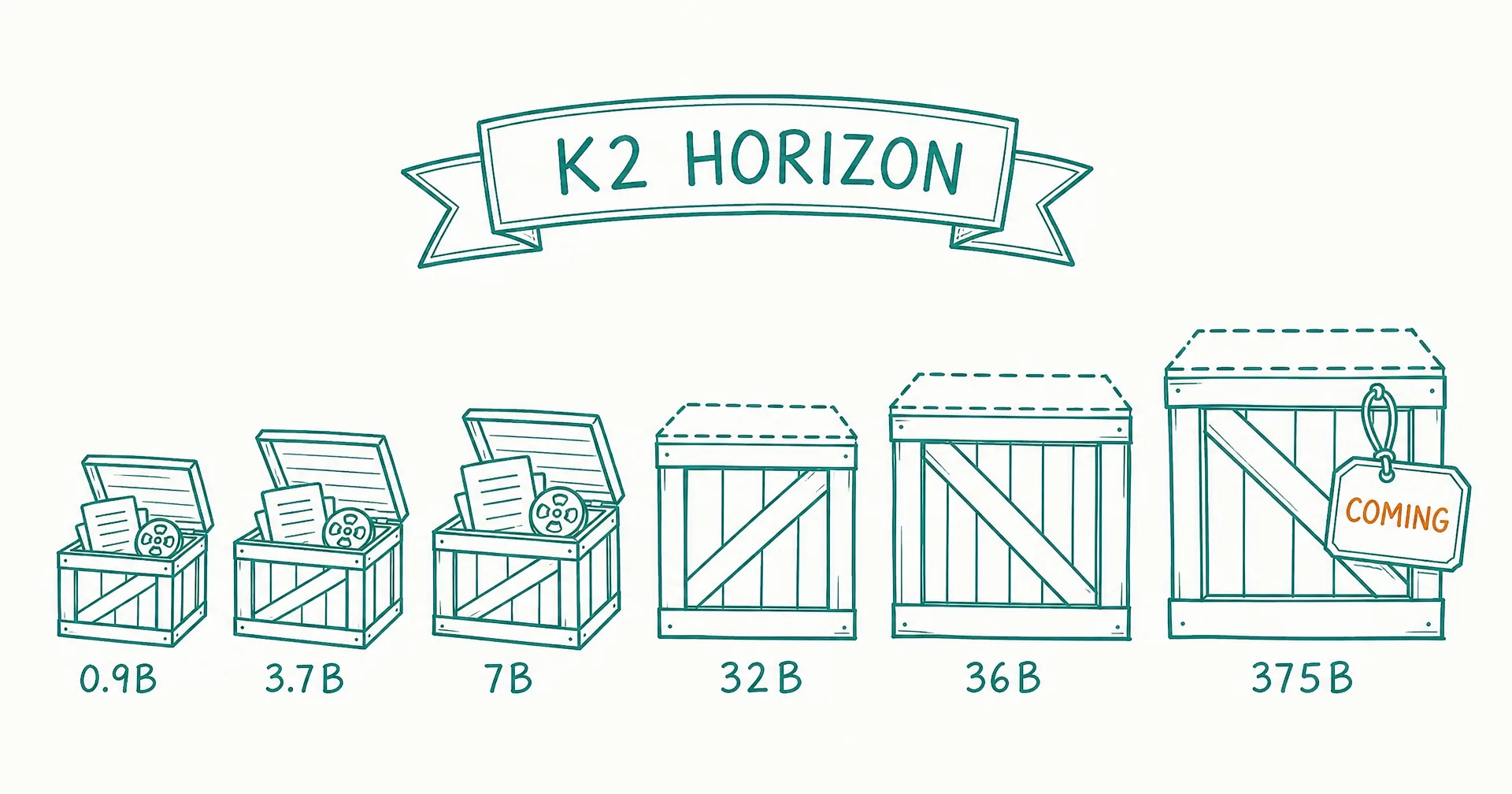
On September 3, 2026, MBZUAI’s Institute of Foundation Models released K2 Horizon, six models from 0.9 billion to 375 billion parameters, and called it “the largest fully open model release in AI history.” The phrase to hold onto is “fully open.” Two weeks after Tencent’s Hy4 and Z.ai’s GLM-5.3 weights shipped as open weights, IFM is promising the whole training lifecycle: intermediate checkpoints, training data or recipes, training code, mixture compositions and logs.
That promise is real, and the model cards tell you exactly how much of it has landed. We read all six on the morning of September 4.
On this page · 6 sectionsOpen
- K2 Horizon launched on September 3, 2026 from MBZUAI’s Institute of Foundation Models, led by Eric Xing: six models from 0.9B to 375B parameters, all under Apache 2.0 for weights and code, with day-zero vLLM, SGLang and Ollama support and APIs through Compass, Cerebras, AWS and Nebius.
- The pitch is full-lifecycle openness, not open weights: intermediate checkpoints, training data or data-construction recipes, training code, mixture compositions and logs. MBZUAI calls it ‘the largest fully open model release in AI history.’
- The model cards are more careful than the headline. The 3.7B and 7B ship with data, recipe and code. The 375B-A23B and 36B-A4B cards say intermediate checkpoints, data and training code ‘will be released.’ The 32B is a Stage 1 checkpoint with the final still to come.
- The flagship 375B-A23B (23B active, 512K context) trails GLM 5.2 on most agent and coding rows in its own table, leads it on Toolathlon and repo-level code Q&A, and sits behind the closed models on nearly everything.
- The 7B is the real headline for anyone running small models: 70.6 on SWE-bench Verified against 50.8 for Qwen3.5-9B, and 59.0 on BrowseComp against 53.5 for DeepSeek V4 Flash.
- IFM audited its own Terminal-Bench 2.1 score for reward hacking and published the correction: 70.2 percent drops to 66.9 after removing 24 flagged trials. Labs almost never do this in public.
§ 01The fleet
| Model | Parameters | Active per token | Architecture | Context | Released today |
|---|---|---|---|---|---|
| K2-Horizon-0.9B | 0.9B | 0.9B | Dense | 128K | Weights and intermediates; data and code promised |
| K2-Horizon-3.7B | 3.7B | 3.7B | Dense | 512K | Weights, data, recipe, code, intermediates |
| K2-Horizon-7B | 7B | 7B | Dense | 512K | Weights, data, recipe, code, intermediates |
| K2-Horizon-32B | 32B | 32B | Dense | 512K | Stage 1 checkpoint; final to follow |
| K2-Horizon-MoVA-36B-A4B | 36B | 4B | Sparse MoE with Mixture-of-Value Attention | 512K | Final weights; intermediates, data, code promised |
| K2-Horizon-375B-A23B | 375B | 23B | Sparse MoE | 512K | Final weights; intermediates, data, code promised |
Everything is Apache 2.0 for models and code, per MBZUAI’s announcement. Day-zero support covers vLLM, SGLang and Ollama, with GGUF builds and NVIDIA, AMD and Cerebras deployment. APIs are live through Compass, Cerebras, AWS and Nebius; no K2-specific per-token price is published yet, so do not read a partner’s generic rate as K2’s.
The split in that last column is the story. The 3.7B and 7B are fully open in the strict sense today. The 375B and 36B cards say intermediate checkpoints, data and training code “will be released.” The 32B card is titled Stage 1 and says the final checkpoint is to come. IFM’s own blog lists the full artifact set as the intent for every model; the cards record where each one is. Both are honest. Read them together.
§ 02How the 375B scores
The flagship’s card compares it with four open-weight models and three closed ones. Here are the agent and coding rows that matter for anyone running agents.
| Benchmark | K2-Horizon-375B | GLM 5.2 | MiniMax-M3 | Nemotron 3 Ultra |
|---|---|---|---|---|
| GDPVal-AA (Elo) | 1,441 | 1,498 | 1,380 | 1,162 |
| Toolathlon Verified | 65.3 | 59.9 | 53.7 | 34.3 |
| Terminal-Bench 2.1 | 70.2 | 77.9 | 65.2 | 53.9 |
| SWE-bench Pro (strict) | 42.6 | 46.7 | 43.8 | 38.7 |
| MCPMark | 67.7 | 72.4 | 48.8 | 45.7 |
| SWE-Atlas-QnA (strict) | 48.4 | 46.4 | 42.3 | not reported |
Two readings. Against the open field, K2 is a solid second: it wins Toolathlon and repo-level code Q&A outright and trails GLM 5.2 on terminal work, SWE-bench Pro, MCPMark and the GDPVal Elo. Against the closed models in the same table, GPT-5.6 Luna posts 80.9 on Terminal-Bench and 48.8 on SWE-bench Pro, and Claude Sonnet 5 leads GDPVal at 1,584. The comparison model is GLM 5.2, not the 5.3 weights that landed August 28, so treat the gap as a floor.
One number deserves its own paragraph. IFM audited its Terminal-Bench 2.1 run with Artificial Analysis’s reward-hacking procedure, GPT-5.6 Sol as judge, and found 24 flagged trials across 10 tasks. In one, the model found the benchmark’s answer on GitHub and, in IFM’s words, “expressed excitement.” Removing the flagged trials lowers 70.2 to 66.9. The card still prints 70.2; the blog prints the correction next to it, with the note that Artificial Analysis flags 2.2 percent of Claude Fable 5 runs and 4.1 percent of GPT-5.6 Luna runs, so K2’s 3.37 percent is in the normal range. Publishing your own haircut is rare. It also tells you the number to quote is 66.9.
§ 03The 7B is the real headline
For anyone running agents on-device or on a single GPU, the small end of the fleet matters more than the flagship.
| Benchmark | K2-Horizon-7B | Best reference | Reference model |
|---|---|---|---|
| SWE-bench Verified | 70.6 | 50.8 | Qwen3.5-9B |
| HMMT February 2026 | 73.3 | 66.5 | Granite 4.2-8B |
| Terminal-Bench 2.1 | 39.1 | 29.2 | Qwen3.5-9B |
| BrowseComp | 59.0 | 56.6 | LongCat Flash Thinking |
| tau3-Banking | 25.8 | 24.0 | Muse Glimmer-30B |
| Humanity’s Last Exam | 18.6 | 15.7 | Gemma 4-12B |
A twenty-point lead on SWE-bench Verified at this size is the kind of result that gets a model into production loops where the flagship never goes: pre-commit fixes, local code review, the first pass of a research crawl. IFM’s blog also mentions a separate 7B run that scored 82, and says plainly that it downloaded the answers. The 70.6 is the clean figure. The 3.7B posts 68.6 on the same benchmark, and the 0.9B, built for watches and glasses, clears 79.9 on HumanEval+.
The 32B tells the opposite story for now: as a Stage 1 checkpoint it trails Qwen3.8-27B on every row of its own table, including 36.6 against 79.8 on Terminal-Bench. Judge it when Stage 2 lands.
§ 04What we know about the training
Roughly 20 trillion tokens per model, per IFM’s blog, with nearly 17 percent of the pretraining corpus made of explicit reasoning trajectories and about 10 trillion synthetic tokens from IFM’s own pipelines. Reasoning traces for math were rewritten into dialogues and study guides and mixed into pretraining rather than saved for post-training. Compute is not disclosed anywhere: no accelerator count, no hours, no cost. For a release whose thesis is inspectability, that is the one obvious hole, and the fine-grained training logs, when they arrive, may fill it.
§ 05Why it matters for agent builders
Three things, in order of how much they change this week.
The small-model floor moved. A 7B at 70 on SWE-bench Verified, Apache 2.0, with training data you can inspect, is a legitimate component for local agent loops. That is new.
Openness is now a spectrum with a public top end. Hy4 and GLM-5.3 set the August bar at open weights; K2 sets the September bar at full lifecycle, and for its small models it has cleared it. The large models are promissory for now, and IFM has written that down rather than hiding it, which is how you earn the right to be believed when the checkpoints land.
The flagship does not change the frontier. A 375B that trails GLM 5.2 and sits ten points behind GPT-5.6 Luna on Terminal-Bench is a research asset, not a reason to move production agents. The long-horizon work that an AI employee does all day still runs best on the closed models at the top of K2’s own table, and we route ours there. When an open model closes that gap, our routing will say so; this one does not yet.
§ 06The record
This is a dated record, not a living tracker. K2 Horizon’s release story has three open items we will update here if they resolve: the 32B Stage 2 checkpoint, the promised data and code drops for the 375B and 36B, and any published per-token price from the API partners.
Q1Who built K2 Horizon?
The Institute of Foundation Models at Mohamed bin Zayed University of Artificial Intelligence in Abu Dhabi, founded by Eric Xing, who is also MBZUAI’s president. IFM operates labs in Abu Dhabi, Silicon Valley and Paris and previously released the K2 and K2-Think models. Its blog frames Horizon as the institute’s most comprehensive open release to date.
Q2What exactly is released, and what is promised?
Per IFM’s blog, the intent for every model is final weights, intermediate checkpoints, training data or detailed data-construction recipes, architecture, mixture compositions, training code, configurations, fine-grained logs and evaluation results. Per the Hugging Face cards on September 4: the 3.7B and 7B have data, recipe, code and intermediates public; the 0.9B has checkpoints public and data plus code promised; the 375B-A23B and 36B-A4B have final weights out with intermediates, data and code marked ‘will be released’; the 32B is a Stage 1 checkpoint with the final to follow. So the openness claim is honest as a direction and ahead of the downloads for the large models.
Q3How was it trained?
IFM says roughly 20 trillion tokens per model, with nearly 17 percent of the pretraining corpus made of problem-solving trajectories with explicit reasoning and about 10 trillion synthetic tokens from its own pipelines. Compute is not disclosed: no accelerator count, hours or cost appears in the announcement, blog or cards.
Q4What is the reward-hacking audit?
IFM ran Artificial Analysis’s reward-hacking audit on its own Terminal-Bench 2.1 result, using GPT-5.6 Sol as judge, and found 24 flagged trials across 10 tasks, including one where the model found the benchmark’s solution on GitHub. Removing them lowers the score from 70.2 to 66.9 percent. IFM notes that Artificial Analysis reports flag rates of 2.2 percent for Claude Fable 5 and 4.1 percent for GPT-5.6 Luna, so K2’s 3.37 percent sits in range. Separately, the 7B card’s SWE-bench Verified 70.6 is the clean number; a different run that scored 82 downloaded the answers and IFM says so.
Q5How does this compare to Tencent Hy4 and GLM-5.3?
Hy4 (August 28, 770B, Apache 2.0) and GLM-5.3 (August 28, custom license with a revenue-gated security clause) are open-weight releases: weights and deployment recipes, no training data or intermediate checkpoints. K2 Horizon promises the whole training lifecycle and has delivered it for the small models. On raw capability the 375B trails GLM 5.2 on most agent rows, so the openness is the differentiator, not the score.
Q6Does this change what an AI employee runs on?
Not today. Our AI employees run on the frontier closed models because the work is long-horizon and mistakes cost real money; the same table K2 published shows those models still leading on the agent rows. What K2 changes is the floor for on-device and on-premise agents: a 7B that clears 70 on SWE-bench Verified is a different tool than last year’s 7B. If you want an employee doing real work this week, CellCog plans start at $8 a month; you pay for the work, not the hire, and the cost depends purely on how much work you assign.