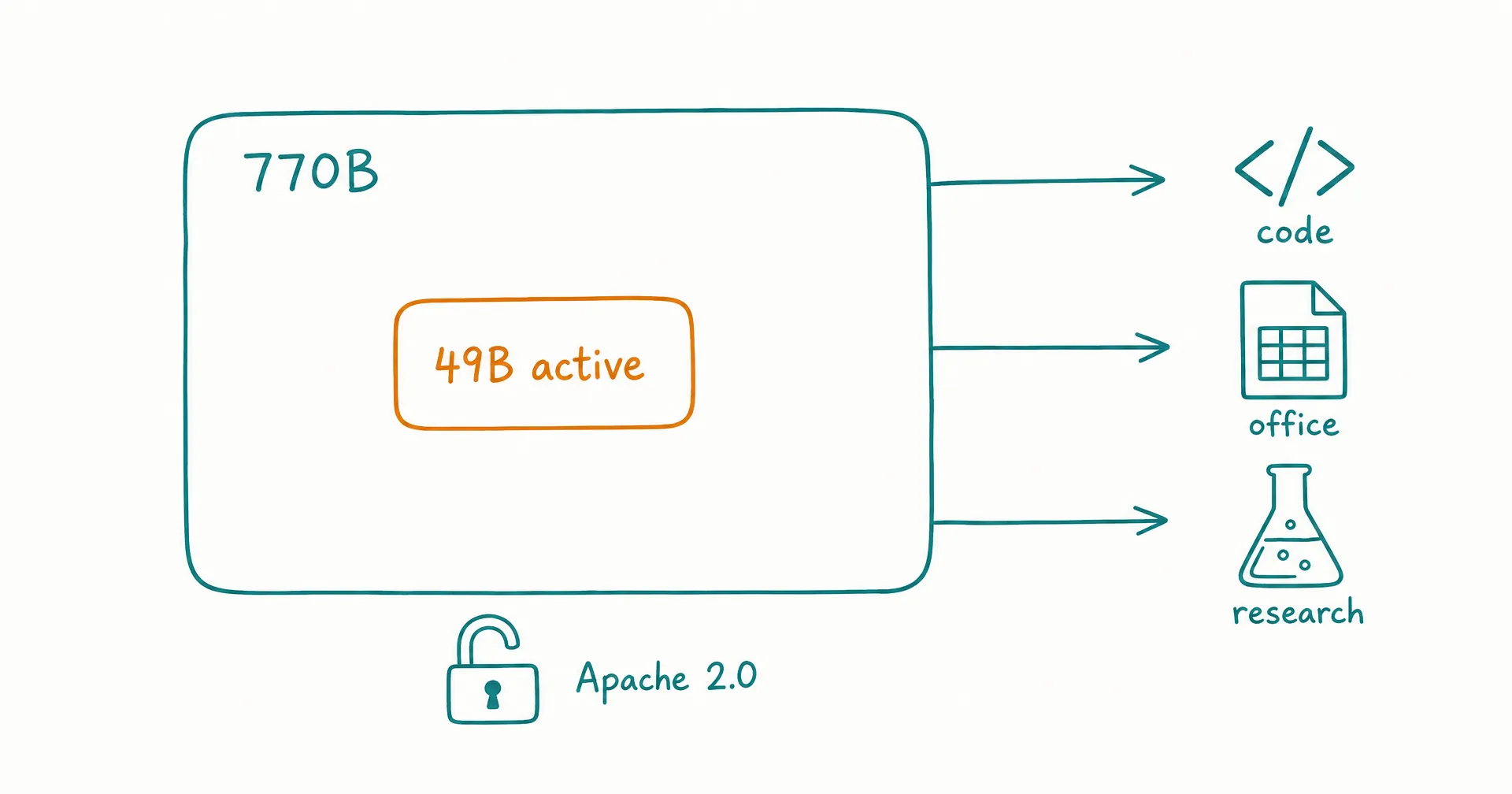
On August 28, 2026, Tencent released and open-sourced Hy4 preview: a 770B-parameter Mixture-of-Experts model that activates 49B parameters per token, reads more than a million tokens of context, and ships under Apache 2.0. Not a waitlist, not a teaser. The weights, roughly 1.56 TB of them, went onto Hugging Face the same day the press release went up, alongside an FP8 variant, a fine-tuning pipeline, and prebuilt vLLM and SGLang images.
It is the third serious open-weight release in three days, after GLM-5.3-Flash shed its Ox Alpha disguise and Qwen3.8-Flash-Next shipped on schedule. But Hy4 is not playing the same game as those two, and the difference is the most interesting thing about it.
On this page · 6 sectionsOpen
- Tencent released AND open-sourced Hy4 preview on August 28, 2026: a 770B-total, 49B-active Mixture-of-Experts model with a context window exceeding 1M tokens, under Apache 2.0, with weights on Hugging Face, ModelScope, GitCode, and CNB (plus an FP8 variant).
- Free for two weeks on WorkBuddy and CodeBuddy at launch; free access to the previous Hy3 on both platforms runs until September 30. API access via Tencent Cloud TokenHub and OpenRouter.
- OpenRouter listed tencent/hy4-preview on launch day at $0.834 per million input tokens and $2.501 per million output, with cached input at $0.042/M.
- It is positioned as a productivity model, not a chat model: coding, office and analysis work, game development, and scientific research. Tencent’s own blind evaluation (163 internal experts, 203 engineering tasks) scored it slightly ahead of GLM 5.3 and Kimi K3 - vendor numbers, not independent ones.
- Architecture: 78 layers, Gated DeepSeek Sparse Attention with IndexCache, 256 routed experts with top-8 routing plus one shared expert, and a native MTP layer for speculative decoding.
- Tencent ships it with named limitations: it spends longer than necessary reasoning through complex tasks and tends to over-verify its own work. Their words, not ours.
§ 01The confirmed record
Everything below comes from Tencent’s own release announcement and the official GitHub repository, as published on August 28.
| Item | Detail |
|---|---|
| Model | Hy4 preview (+ Hy4 preview-FP8 quantized variant) |
| Architecture | MoE: 770B total, 49B active per token |
| Experts | 256 routed + 1 shared, top-8 routing |
| Attention | Gated DeepSeek Sparse Attention with IndexCache |
| Context window | 1M+ tokens |
| License | Apache 2.0 (commercial use permitted) |
| Weights | Hugging Face, ModelScope, GitCode, CNB (~1.56 TB) |
| Hosted access | WorkBuddy, CodeBuddy, Yuanbao, ima |
| API | Tencent Cloud TokenHub, OpenRouter |
| Launch offer | Free two weeks on WorkBuddy and CodeBuddy |
The architecture reads like a tour of 2026’s best open ideas: the sparse attention traces to DeepSeek, the hyper-connection residual design to work Tencent cites directly, and a native multi-token-prediction layer handles speculative decoding out of the box. Tencent is open about the borrowing, and the result is the largest open-weight model any major lab has shipped this year.
§ 02What it costs
Three routes, three prices:
- Hosted, free: WorkBuddy and CodeBuddy serve Hy4 preview free for two weeks from launch. (Free access to the previous Hy3 on both platforms was extended to September 30 at the same time.)
- API, paid: OpenRouter listed
tencent/hy4-previewon launch day at $0.834 per million input tokens and $2.501 per million output, with cached input at $0.042/M. That prices it well above GLM-5.3-Flash’s promo ($0.075/$0.25) and Qwen’s managed tier ($0.16/$0.47), and well below closed frontier models. - Self-hosted, free minus GPUs: the FP8 variant targets 8-way tensor parallelism, and both vLLM and SGLang shipped official prebuilt images on day one, which is unusually polished for a launch.
The pricing tells you the positioning: GLM and Qwen are racing to the bottom of the cost curve; Hy4 is claiming the quality end of the open-weight market and charging 10x more per token for it.
§ 03Built for jobs, not tokens
Here is the signal worth keeping. Tencent’s release does not lead with chat benchmarks or arena scores. It leads with this sentence: “built for real-world productivity tasks, delivering outstanding performance across coding, office work, and scientific research.” The README breaks that into software engineering, office and analysis work (documents, spreadsheets, financial models), game development, and research.
And the headline evaluation is not a benchmark at all. Tencent ran a blind side-by-side where 163 internal experts rated outputs on 203 real engineering tasks. Hy4 preview came out slightly ahead of both GLM 5.3 (46.8% wins, 12.8% ties) and Kimi K3 (51.2% wins). Those are vendor numbers on vendor-chosen tasks, so discount accordingly. But notice what the vendor chose to measure: not tokens, not trivia. Work.
This is the second time in a week a major lab has done this. Qwen3.8-Flash-Next led its launch table with office-work benchmarks two days earlier. The model layer has started optimizing for the same thing buyers actually purchase: jobs done. The models rotate underneath, faster than at any point this year - three frontier-adjacent open releases in three days. What does not rotate is the layer that holds the role, the memory, and the results. That layer is where we live: CellCog is the employee layer, and every launch that benchmarks office work instead of chat is the model layer agreeing with the premise.
§ 04What Tencent says it cannot do yet
Credit where due: the known-limitations section is unusually honest for a launch. Tencent names two issues in its own release notes. The model spends longer than necessary reasoning through complex tasks, and it tends to over-verify its own work. Both matter in agent loops, where over-reasoning is not a cosmetic flaw but a direct token-and-latency cost on every step. Their framing: ship early, hear what breaks, iterate, the same path Hy3 took.
Also worth knowing before you point an agent at it: reasoning defaults to “high” (deep chain-of-thought). For direct answers you have to explicitly pass a no-think flag through the chat template. In an agent harness, that default multiplies the over-reasoning issue Tencent already flagged.
§ 05How to run it
The quickstart is genuinely short. Pull the official image (vllm/vllm-openai:hy4-preview or lmsysorg/sglang:hy4-preview), point it at tencent/Hy4-preview-FP8, give it 8 GPUs of tensor parallelism, and you get an OpenAI-compatible endpoint with tool calling and reasoning parsers preconfigured. Recommended sampling: temperature 0.9, top_p 1.0. If you would rather not own the GPUs, the OpenRouter route works today and the two-week CodeBuddy window is free.
§ 06The watch
This page tracks the launch record. Three things would change it, and each gets a same-day update here: independent benchmark replications landing materially different from Tencent’s internal eval, the OpenRouter or TokenHub pricing moving after the launch window, and the end of the two-week free period on WorkBuddy and CodeBuddy (around September 11). Our harness ranking covers where models like this actually get used.
Q1What exactly did Tencent release on August 28, 2026?
Two artifacts: Hy4 preview (the instruct model) and Hy4 preview-FP8 (a quantized variant), both open-sourced under Apache 2.0 on Hugging Face, ModelScope, GitCode, and CNB. Hosted access shipped the same day through WorkBuddy, CodeBuddy, Yuanbao, and ima, with API access via Tencent Cloud TokenHub and OpenRouter.
Q2What are Hy4's specs?
770B total parameters, 49B activated per token. 78 layers (dense first layer, MoE for the remaining 77), 256 routed experts plus one shared, top-8 routing, Gated DeepSeek Sparse Attention with IndexCache, four residual streams, a native 10B MTP layer for speculative decoding, a 1M-token context window, and a 120,832-token vocabulary.
Q3What does Hy4 cost through the API?
On launch day, OpenRouter listed tencent/hy4-preview at $0.834 per million input tokens, $2.501 per million output tokens, and $0.042 per million for cached input. Tencent Cloud TokenHub pricing is region-dependent. Self-hosting is free minus your GPUs: the FP8 variant targets 8-GPU tensor-parallel serving on vLLM or SGLang.
Q4How does Hy4 compare to GLM-5.3-Flash and Qwen3.8-Flash-Next?
It is the third frontier-adjacent open-weight release in three days, and the biggest by far: 770B/49B versus GLM-5.3-Flash’s 320B/18B and Qwen3.8-Flash-Next’s 125B/6B. Hy4 aims at the quality end of the efficiency curve where the other two aim at cost. All three lead their launches with work benchmarks rather than chat benchmarks.
Q5What are Hy4's known problems?
Tencent names two in the release notes: the model spends longer than necessary reasoning through complex tasks, and it tends to over-verify its own work. Both cost tokens and latency in agent loops. They frame the release as ship-early-and-iterate, the same approach they took with Hy3.
Q6Can I fine-tune or quantize Hy4?
Yes. The repository ships a full fine-tuning pipeline and AngelSlim, Tencent’s compression toolkit covering quantization and speculative sampling. The Apache 2.0 license permits commercial use and modification.