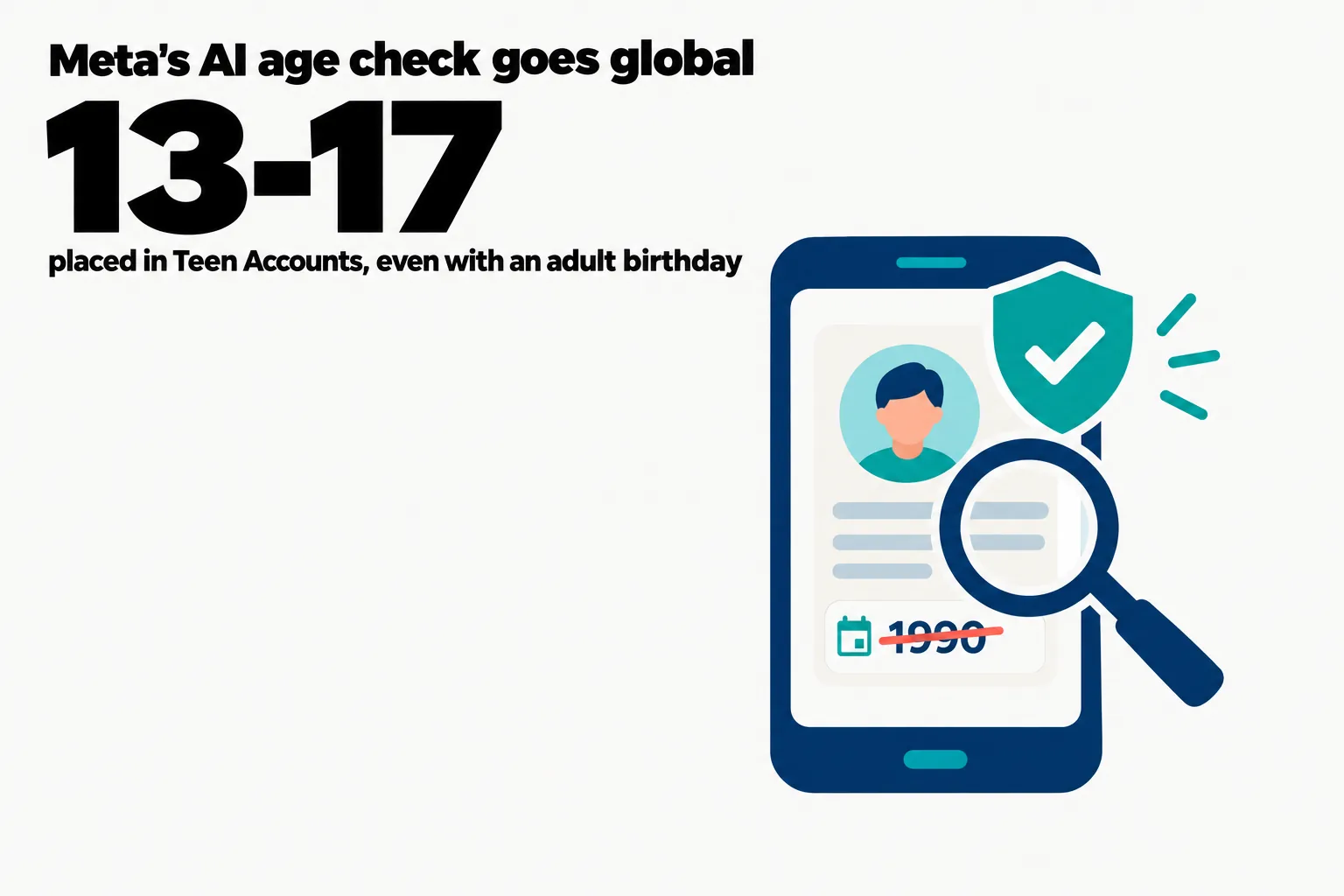
Meta said on November 9, 2026 that it is taking worldwide the AI it uses on Instagram to spot teenagers who sign up with an adult birthday. Accounts the system believes belong to 13 to 17 year olds are moved into Teen Accounts, which are private by default, limit what teens see and stop strangers from messaging them. Meta says “millions more teens across the world who use Instagram will receive these built-in protections”.
The announcement also says the same technology is still rolling out on Facebook, comes to Threads later this year, and that Meta has started using Apple’s age-range signal in Australia. Below: what changed, how the rollout got here, the legal pressure behind it, and what it means for anyone building an app that teens use.
On this page · 7 sectionsOpen
 On November 9, 2026, Meta expanded to Instagram users worldwide its AI that finds suspected teens who signed up with an adult birthday.
 Accounts judged to be 13 to 17 are moved into Teen Accounts: private by default, content limits, no messages from strangers.
 Meta ties the move to its agreement with 52 attorneys general, which its Q3 results say provides for payments of up to about $18.59 billion.
 Meta has started using Apple’s age-range signal in Australia and wants app stores to verify age once for every app.
 Facebook is still rolling out and Threads comes later this year; Meta published no count of accounts moved and no error rate.
§ 01What Meta announced
In Meta’s words: “We use AI technology to find people we suspect to be teens, even if they use an adult birthday, and place them in Teen Account protections.” Until today that applied on Instagram in a list of named countries. Now it applies everywhere Instagram runs.

| Item | What Meta says | Timing |
|---|---|---|
| AI teen detection expands worldwide | Starting now | |
| The same technology | Still rolling out | |
| Threads | Similar technology, globally | Later this year |
| Apple’s age-range signal | Used as an extra age input | Australia only, so far |
| US parents | In-feed video linking to a ConnectSafely article | This month |
Meta gave no count of accounts moved, no accuracy figure and no rate of adults wrongly placed in Teen Accounts. As The Verge noted, the same age system is also used to remove users Meta believes are under 13, the minimum age for its apps.
§ 02How the rollout got here
Meta’s May 5 post said it had already launched the technology on Instagram in the US, Australia, Canada and the UK, “placing millions of accounts into these age-appropriate protections”. In May it added the 27 EU countries and Brazil, and Facebook in the US. Neither post gave an exact number.
| When | Where | Source |
|---|---|---|
| Announced in 2025 | US, UK, Canada, Australia | Meta, May 5, 2026 |
| May 5, 2026 | 27 EU countries and Brazil; Facebook in the US | Meta, May 5, 2026 |
| November 9, 2026 | Instagram worldwide; Threads later this year | Meta, November 9, 2026 |
How does it guess an age? The May post describes AI that reads profiles for contextual clues such as birthday celebrations or mentions of school grades, across posts, comments, bios and captions, and visual analysis of photos for underage accounts. On July 31 Meta added a correction that “our AI does not use biometric data to identify whether a person is underage” and does not identify who is in a photo.
§ 03The legal pressure behind it
Meta ties the expansion to “our recent agreement with 52 bipartisan attorneys general to strengthen how we identify teens and children under 13 on our apps.” Its third-quarter results say that agreement, announced in August 2026, provides for payments of up to approximately $18.59 billion. Meta says it is also investing in stronger technology to catch accounts that may belong to children under 13.
Outside the US, Australia’s High Court began hearing two challenges this month to the country’s ban on under-16s holding social media accounts, which took effect last year. Meta’s Australian use of Apple’s signal sits next to that law.
§ 04Apple’s age-range signal, and the fight over who checks age
Apple’s Declared Age Range API, available from iOS 26, lets an app ask for a person’s age range instead of a birth date. For children in a Family Sharing group, a parent decides whether the range is always shared, asked for each time, or never shared. Apple says the data is declared by the person or a parent and “may be confirmed using a method like a credit card or government ID”.
Meta’s argument is that the check belongs at the app store, once per device: “One verified signal from people’s devices, shared consistently with all apps, is far more effective and privacy-preserving than asking every platform to verify age individually.” It says it has long supported laws requiring app-store age verification, and it is “calling on our industry peers, TikTok and YouTube, to adopt these same practices to keep teens safe”.
§ 05What this means if you build an app teens use
- Self-declared birthdays are no longer the bar. The largest social apps now estimate age from behavior and signals, and a settlement with state attorneys general is pushing in the same direction. Smaller apps will be asked why they do not.
- App-store signals are becoming real input. Apple’s age-range API exists today; whether stores must share it, and apps must use it, is now a lobbying fight.
- Accuracy is the open question. Meta has published no error rates, so adults moved into Teen Accounts by mistake, and how they get out, are not yet on the record.
§ 06What we are watching
- Threads. The global launch Meta promised for later this year.
- Numbers. Any count of accounts moved, or an error rate.
- Australia. The High Court’s ruling on the under-16 law.
- TikTok and YouTube. Whether either answers Meta’s call.
§ 07Sources
- Meta, Expanding Teen Account Protections to Teens Around the World, November 9, 2026
- Meta, New AI-Powered Age Assurance Measures, May 5, 2026
- Meta, Third Quarter 2026 Results
- Apple Developer, Declared Age Range
- The Verge, Instagram’s AI age detection is expanding globally
- ABC News, Australia’s highest court hears challenges to social media ban
Q1How does Meta guess a user's age?
Its May 2026 post describes AI that reads profiles for clues like birthday celebrations or mentions of school grades, across posts, comments, bios and captions.
Q2Does Meta use facial recognition for this?
Meta says no. A July 31, 2026 correction says its AI does not use biometric data or identify who is in a photo.
Q3Which Meta apps get it?
Instagram worldwide now; Facebook is still rolling out; Threads gets similar technology later this year.
Q4What is Apple's Declared Age Range?
An Apple API, from iOS 26, that lets an app ask for an age range instead of a birth date, with parents deciding what is shared for children.
Q5How many accounts has it moved?
Meta says millions so far and millions more to come, but it has not published an exact count or an error rate.