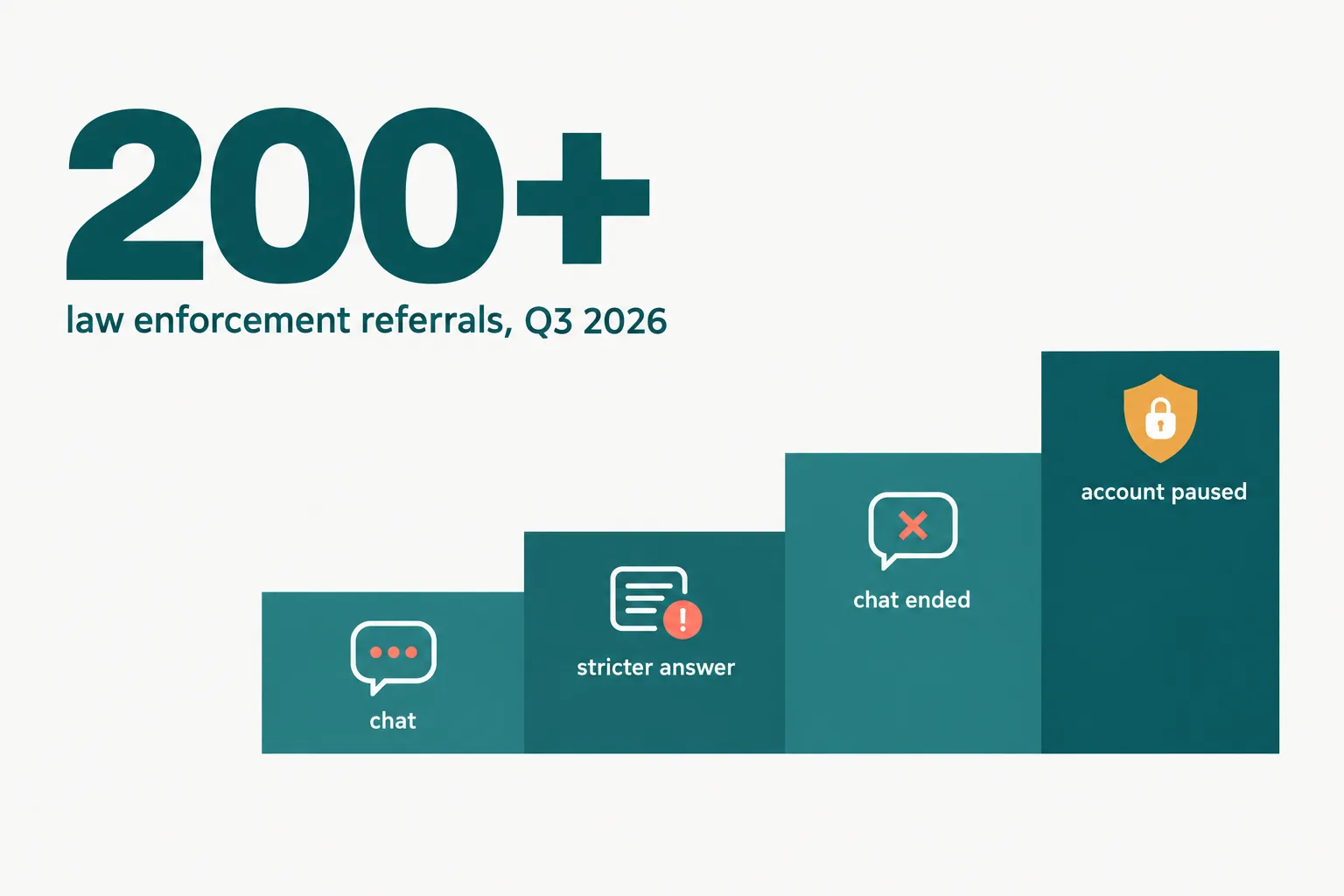
OpenAI announced two sets of changes to ChatGPT on October 30, 2026: a twice-yearly report on violence prevention, and tighter limits on what ChatGPT tells users it predicts are under 18 about weapons. In the same announcement, OpenAI says ChatGPT will be able to end a chat on its own when a conversation shows someone “fixating on violence”, and may pause the account if that happens repeatedly. It also reports that it “made over 200 law enforcement referrals in Q3 2026.”
None of it is live yet. OpenAI says the safeguards “will begin rolling out in the next few weeks”, and the first report is due in early 2027, covering the second half of 2026. We read the announcement as published on October 30 and set it beside what we have tracked on ChatGPT for Teens since the Common Sense Media rating on October 7.
On this page · 6 sectionsOpen
 OpenAI announced on October 30, 2026 a Community Safety Report on violence prevention, published every six months from early 2027.
 OpenAI says it made over 200 law enforcement referrals in Q3 2026, without saying how many conversations it reviewed.
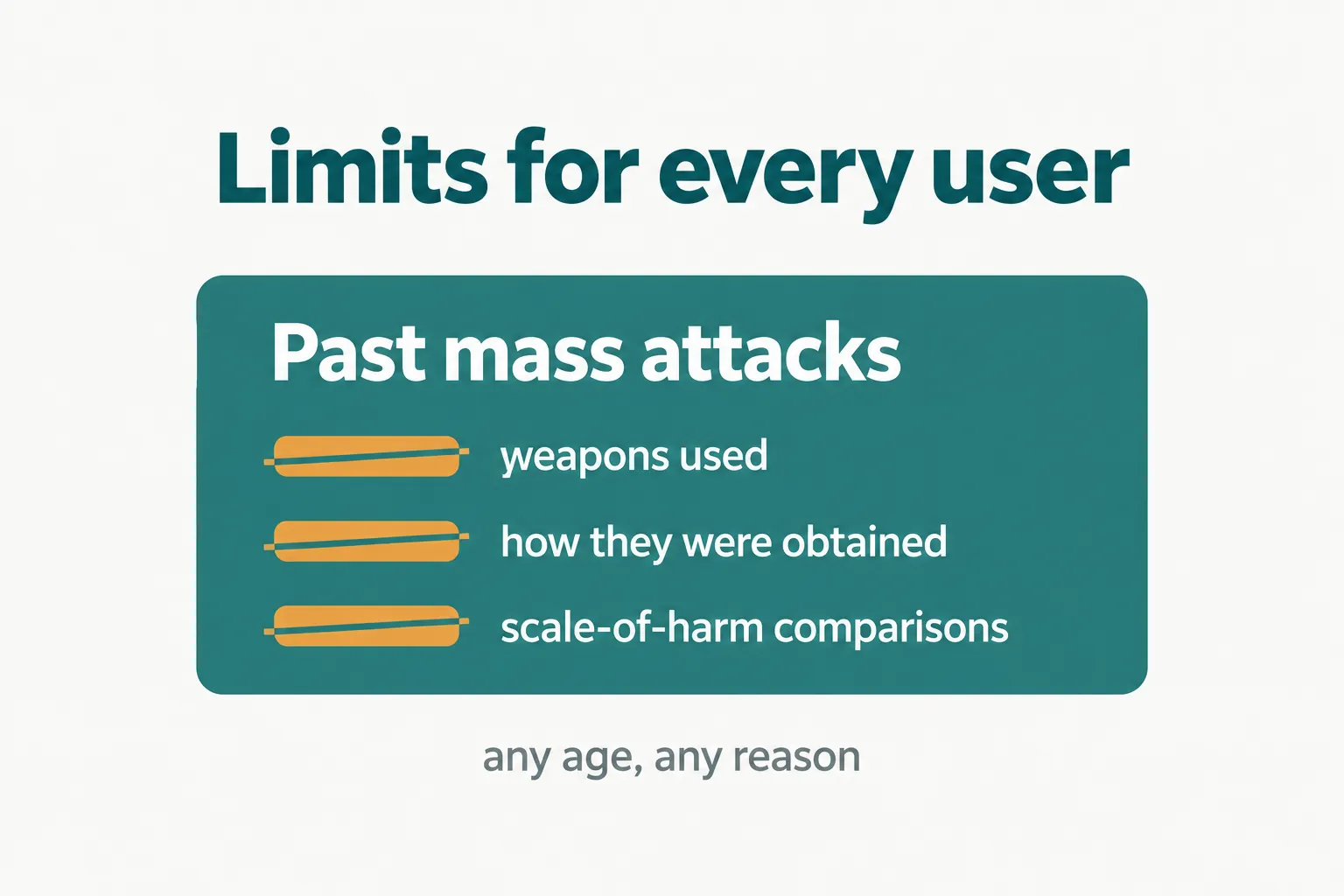
 ChatGPT will give less detail on past mass attacks, including weapons and how they were obtained, for every user of any age.
 When a conversation shows fixation on violence, ChatGPT will be able to end the chat, and several endings may pause the account.
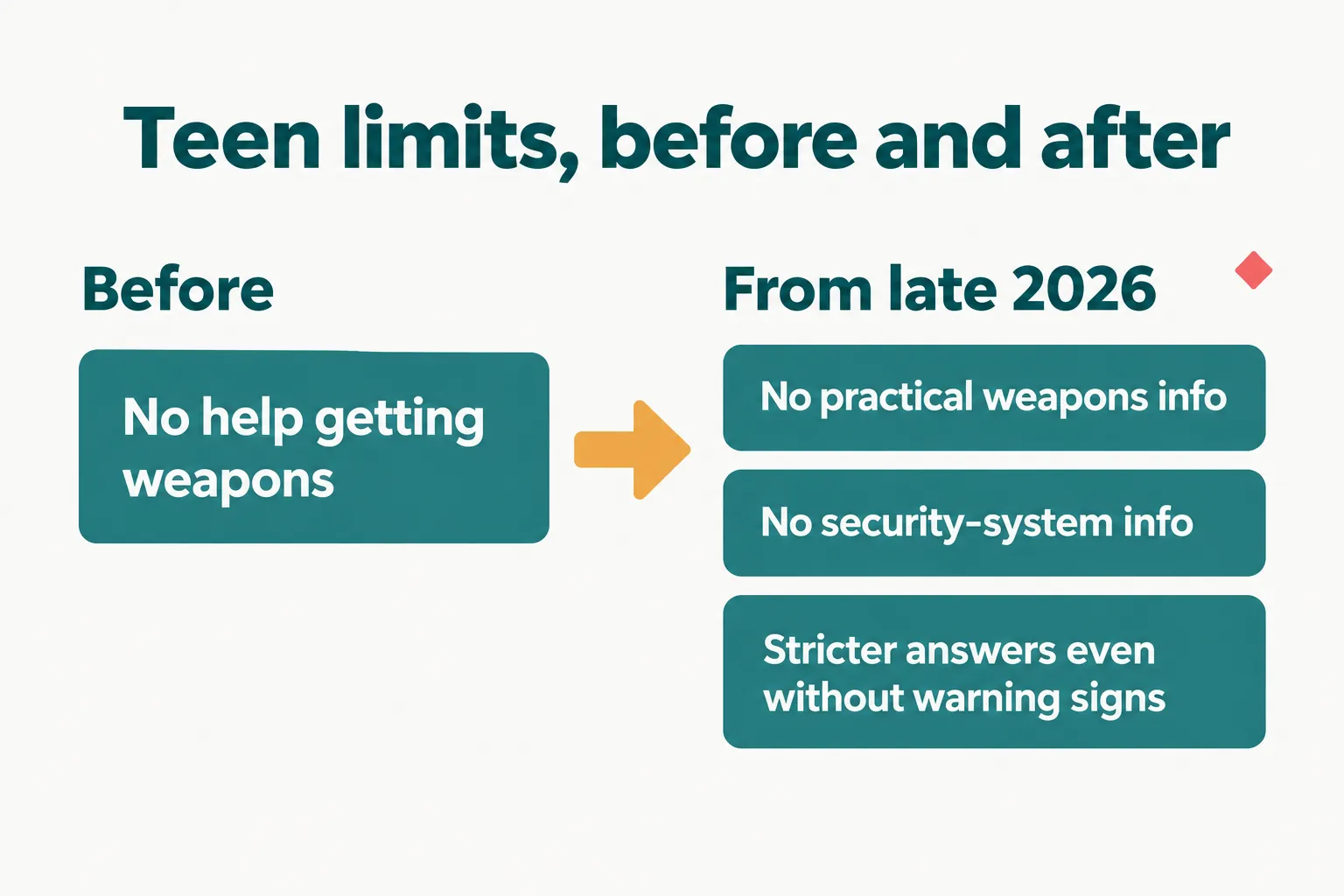
 Users predicted to be under 18 lose practical information on weapons and security systems, even with no sign of violent intent.
§ 01What OpenAI announced
| Change | Who it applies to | What it does |
|---|---|---|
| Community Safety Report | Public | A report every six months on violence prevention and how well OpenAI’s safeguards work, starting early 2027 |
| Mass-attack limits | Every user, any age, any reason | Less detail on past mass attacks: the weapons and equipment used, how they were obtained, and comparisons of scale of harm |
| Warning-sign answers | Users whose recent chats show warning signs, and predicted under-18s even without them | More conservative answers on information that could be misused |
| Chat ending and pauses | Users whose conversation shows fixation on violence | ChatGPT can end the chat; several endings may pause the account |
| Teen weapons limits | Users OpenAI predicts are under 18 | Restricts practical information on weapons and security systems, even with no sign of violent intent |
The mass-attack limits are the one change that reaches adults directly. OpenAI says they “apply regardless of a user’s age or reason for asking”, so a historian, a journalist and a curious reader get the same narrower answer. People can still ask about how victims and communities were affected and how to recognize warning signs.
§ 02How the new steps escalate

Until now, OpenAI described two ends for violent content: the model refuses to help plan or carry out violence, and OpenAI bans accounts that violate its violent-activity policy. The announcement fills in the steps between them. In May, OpenAI said ChatGPT can use “short, factual summaries” of earlier warning signs to answer more carefully in a later chat. Those signs will now make answers more conservative, a conversation that shows fixation can be ended, and repeated endings can pause the account.
| Step | What triggers it | What ChatGPT does |
|---|---|---|
| 1 | Any request to plan or carry out violence | Refuses, as the model is trained to |
| 2 | Recent chats show warning signs of possible violence | Answers more conservatively on information that could be misused |
| 3 | A conversation shows fixation on violence or on seriously harming someone | Ends the chat |
| 4 | ChatGPT ends multiple chats for that reason | May pause the account for a time |
| Separate | OpenAI determines the account violated its violent-activity policy | Bans the account |
OpenAI says it is building the automated steps with mental health and violence prevention experts and calls it “an ongoing effort”. The post does not say what counts as a warning sign, how long a pause lasts, or whether a person can appeal one.
§ 03What changes for teens
ChatGPT for Teens, which launched on August 18, 2026, already applied stricter defaults to users OpenAI places in its under-18 experience. The October 30 changes widen three of them.
| Protection | Before | Announced October 30 |
|---|---|---|
| Weapons | No help finding or obtaining weapons | Also no practical information on weapons and security systems, even with no violent intent |
| Warning-sign limits | Applied when chats showed warning signs | Applied to predicted under-18s even when chats show none |
| Age prediction | Estimates age from signals such as behavior patterns | Keeps reassessing new signals and moves teens into the under-18 experience as it goes |
| Parent alerts | Self-harm and disordered eating; since July, a teen account deactivated for violence | Planned: an alert when a teen’s account is paused for repeatedly discussing violence |
Adults who land in the teen experience by mistake can confirm their age through Persona, the verification partner OpenAI already uses, and have the extra protections removed. Teens, OpenAI says, “can still use ChatGPT to help prevent and de-escalate violence, seek support, and connect with a trusted adult.”
§ 04Where this sits in 2026
The announcement does not mention Common Sense Media, but it lands 23 days after the Institute’s risk assessment rated ChatGPT for Teens an Unacceptable Risk. That assessment’s sharpest finding was about parent alerts: testers got none across more than a dozen new linked accounts. The October 30 post adds a new reason for an alert, a paused account, but says nothing about how quickly alerts start after a parent links an account, the gap OpenAI pointed to in its rebuttal.
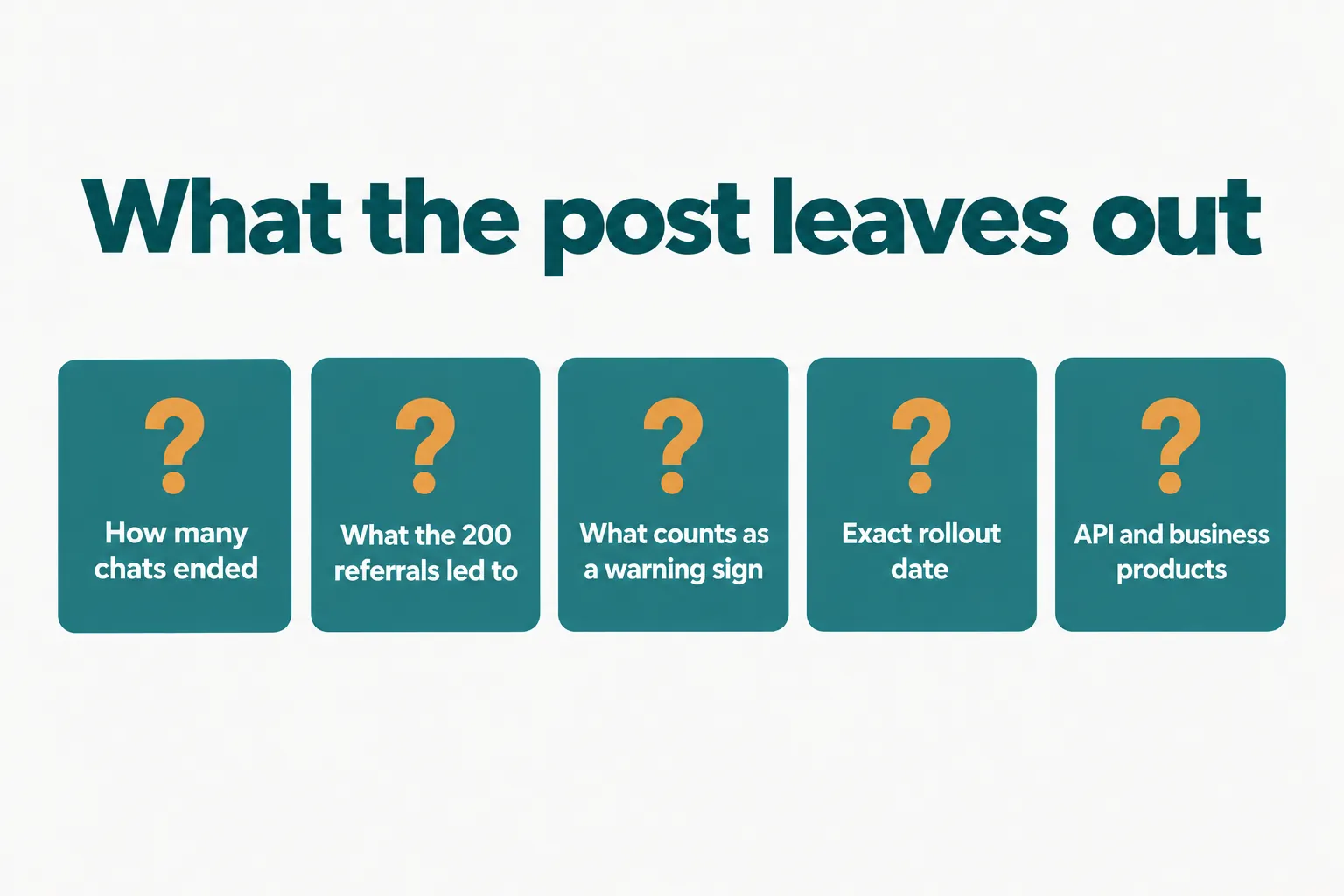
§ 05What the announcement does not say
- How often. There are no numbers for chats ended, accounts paused, or how accurate age prediction is.
- What the 200 referrals mean. OpenAI gives no denominator: not how many conversations were reviewed, and not how many referrals led anywhere.
- What a warning sign is. The post describes the response, not the signals that trigger it.
- When. “The next few weeks” is the only rollout date, and the post covers ChatGPT; it does not say whether the API or business products change.
- The report’s name. The post calls it both the Community Safeguards Report and the Community Safety Report.
The first report is the place to look for those numbers. OpenAI says it will include “relevant data to support these findings”, with anonymized examples of how violence-related harm shows up.
§ 06A note for businesses running agents
These are ChatGPT product changes. CellCog’s AI employees reason on Anthropic’s Claude Opus 5.5, so they do not inherit them. The pattern is still worth knowing for anyone who builds on a model provider: safety decisions are moving from the single request to the history of an account, and providers now describe ending sessions and pausing accounts as normal tools. When you pick a provider for agents, read its usage policy for what can pause an account, not only for what it refuses.
Q1Can ChatGPT really end a chat on its own?
OpenAI says it will be able to when a conversation shows signs that someone is fixating on violence or on seriously harming another person, and that several such endings may pause the account.
Q2How does ChatGPT know someone is under 18?
Through age prediction, which OpenAI launched last year. It estimates age from signals such as behavior patterns and now keeps reassessing as people use ChatGPT.
Q3What if an adult is wrongly placed in the teen experience?
OpenAI says they can confirm their age through Persona, its age verification partner, and have the extra teen protections removed.
Q4Do parents get told?
Linked parent accounts already get alerts for serious self-harm concerns, disordered eating and violence-related deactivations. OpenAI is working on an alert when a teen’s account is paused for repeatedly discussing violence.
Q5Does this affect CellCog's AI employees?
No. These are ChatGPT product changes, and CellCog’s AI employees reason on Anthropic’s Claude Opus 5.5.