Microsoft announced Maia 300 on October 12, 2026, its third in-house AI inference chip, and said it will scale the Maia family to multi-gigawatt deployments starting in 2027. Satya Nadella called it “our biggest bet yet on our own silicon” in a LinkedIn post at 13:03 UTC. The details sit in Scott Guthrie’s post on the Official Microsoft Blog, published at 13:01 UTC, and a technical deep dive on the Azure blog. The plan, in Guthrie’s words, means “making Maia the primary inference system for Microsoft products and services.”
Below: the chip and the rack next to Maia 200, what the headline 40% claim does and does not say, and where Maia already runs.
On this page · 8 sectionsOpen
 Microsoft will scale its Maia chips to multi-gigawatt deployments starting in 2027 and make Maia the primary inference system for its products and services.
 Maia 300 uses TSMC N2P compute chiplets, 8 HBM4 stacks with 18 TB/s of bandwidth, 288 GB of memory and a 950 W chip power budget.
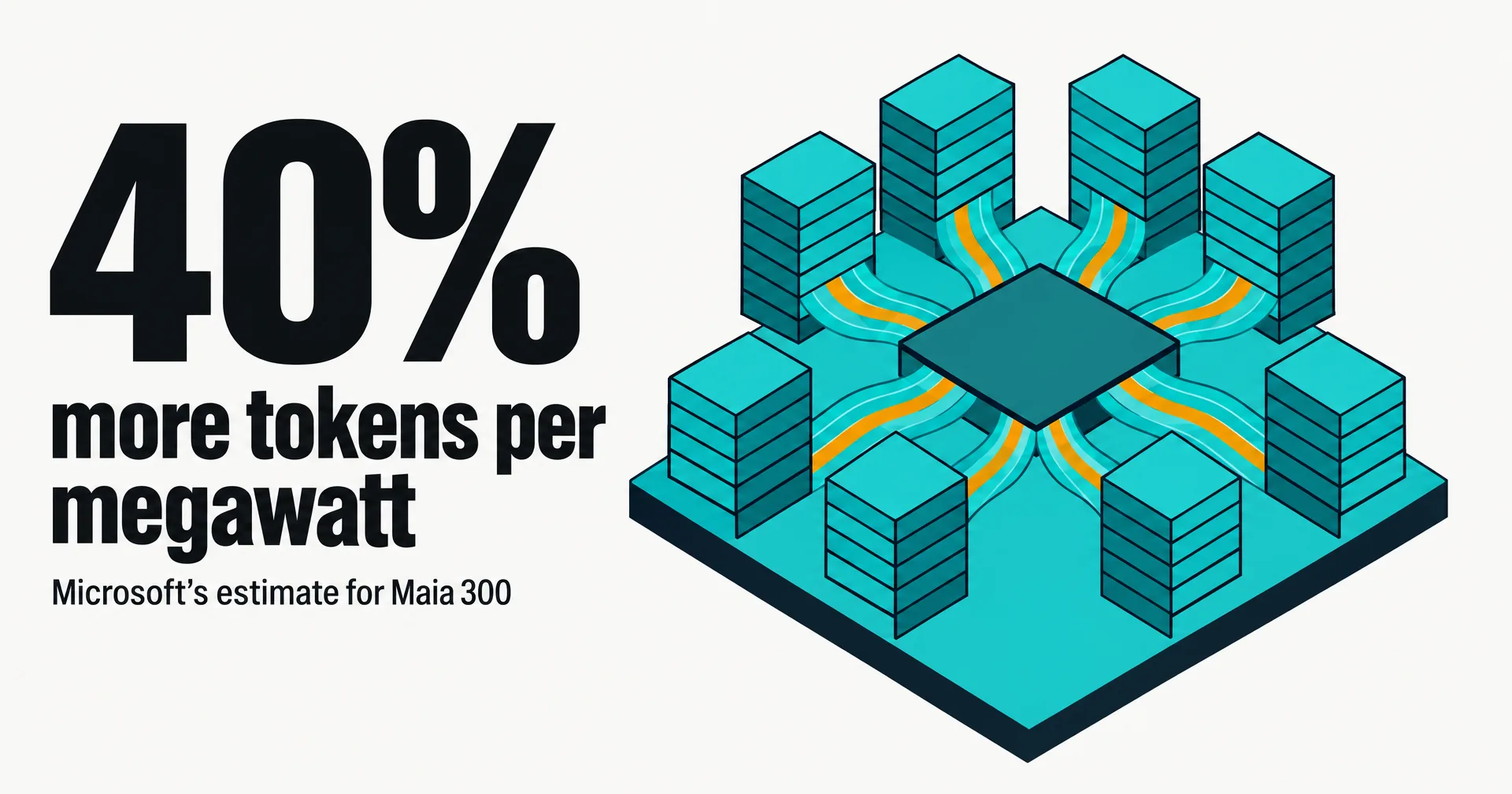
 The 40% more tokens per megawatt versus GPU systems is an expectation: production starts in 2027 and Microsoft names no GPU system or workload.
 A Maia 300 rack holds 96 accelerators in 167 kW, with 5.1x the memory bandwidth of a Maia 200 rack and up to 7x its token throughput, Microsoft says.
 It is a memory chip first: memory bandwidth per watt doubles over Maia 200, while FP4 compute per watt rises about 8%.
 Maia 200 already serves Microsoft Copilot in production, with GitHub Copilot and Microsoft Foundry to follow by end of year.
§ 01The chip, next to Maia 200
| Peak spec | Maia 200 | Maia 300 | Change |
|---|---|---|---|
| Process | Monolithic, TSMC N3P | Multi-chiplet, TSMC N2P compute | New design |
| FP4 compute | 10.1 petaops | 13.8 petaops | +37% |
| FP8 compute | 5.1 petaops | 6.9 petaops | +35% |
| Chip power (TDP) | 750 W | 950 W | +27% |
| Memory | 6 HBM3E stacks | 8 HBM4 stacks | +2 stacks |
| Memory bandwidth | 7.1 TB/s | 18 TB/s | 2.5x |
| Memory capacity | 216 GB | 288 GB | +33% |
| Scale-up bandwidth | 2.8 TB/s | 3.2 TB/s | +14% |
| Accelerators per rack | 48 | 96 | 2x |
| Cluster in one scale-up domain | about 6,000 | about 12,000 | 2x |
Read Maia 300 as a memory chip first. Compute per watt barely moves: FP4 goes from 13.5 to 14.5 teraops per watt, about 8% better. Memory bandwidth per watt doubles, from 9.5 to 18.9 GB/s per watt. Guthrie’s post says the same thing in words: “Moving data efficiently, rather than raw compute power, is increasingly the bottleneck in large inference systems.”
That matches the work Microsoft says the chip is for: “Long-context reasoning, latency-sensitive conversational experiences and sustained, multi-step agentic tasks.” Generating tokens for a long agent session is mostly reading weights and the conversation’s cache from memory, again and again. More bandwidth per watt is where that work gets cheaper.
§ 02The rack
| Rack spec | Maia 200 | Maia 300 | Relative |
|---|---|---|---|
| Accelerators | 48 | 96 | 2x |
| Memory bandwidth | 341 TB/s | 1,728 TB/s | 5.1x |
| Memory bandwidth per watt | 5.3 GB/s | 10.6 GB/s | 1.95x |
| Memory capacity | 10.4 TB | 27.7 TB | 2.7x |
| FP4 compute | 485 petaops | 1,324 petaops | 2.74x |
| Rack power | 64 kW | 167 kW | 2.6x |
The rack draws 2.6 times the power for 2.74 times the compute, so compute per kilowatt rises only about 5%. Memory bandwidth rises 5.1 times. Microsoft’s headline rack number is larger than any row in the table: in a full 96-accelerator configuration, Guthrie writes, “it delivers up to 7x the rack-scale token throughput of Maia 200.” That figure includes software and networking gains Microsoft does not break out.
Two small mismatches in Microsoft’s own materials: the blog post says 27.6 TB of memory per rack, the slide 27.7 TB (96 chips of 288 GB is 27.6 TB). The January Maia 200 announcement gave 7 TB/s of memory bandwidth per chip; the new slide says 7.1 TB/s.
§ 03The 40% claim, read carefully
Nadella’s post says Maia 300 “delivers 40% more tokens per watt compared to leading GPU-based systems”. Guthrie’s post states the same number as an expectation: “we expect Maia 300 to deliver 40% more tokens per megawatt compared to leading GPU-based systems.”
Three things are missing from that sentence. Maia 300 begins production deployments in 2027, so nobody outside Microsoft has a measured number. Microsoft does not name the GPU system it compared against. And it does not name the model or workload behind the token count.
The measured claim today is for Maia 200: “up to 1.7x more tokens per watt for built-in AI capabilities in Microsoft Teams, Copilot and Cowork experiences compared with leading GPU infrastructure.” In January, Microsoft compared Maia 200 to rivals by name: three times the FP4 performance of Amazon’s third-generation Trainium and FP8 performance above Google’s seventh-generation TPU. The Maia 300 announcement makes no named comparison.
§ 04Where Maia runs
- Maia 100, November 2023: Microsoft’s first Azure Maia chip, for training and inference.
- Maia 200, January 26, 2026: an inference accelerator on TSMC 3nm, first deployed in the US Central region near Des Moines. Microsoft now says it is “deploying across the United States, Europe and Australia”.
- Maia 200 today: serving Microsoft production workloads including Microsoft Copilot and supporting the MAI team, with “GitHub Copilot and Microsoft Foundry to follow by end of year”. It runs OpenAI models, Microsoft’s MAI models and open-source model families.
- Maia 300, announced October 12, 2026: production deployments in 2027, then multi-gigawatt scale. Microsoft says it will share more at Ignite 2026 in San Francisco next month.
Google (TPU), Amazon (Trainium) and Meta (MTIA) already run their own AI chips. What is new is the scale and the role: Microsoft is saying its own silicon, not bought GPUs, will be the default place its products run inference.
§ 05Where CellCog sits
Our conflict, declared: we build CellCog, where businesses hire AI employees, and every CellCog tier runs on Claude Opus 5.5. Microsoft’s list of Maia workloads names OpenAI models, its MAI models and open-source families; it does not name Claude. We do not choose the chips our model provider runs on. What we do watch is the cost of long agent sessions, which is the workload Maia 300 is built for.
§ 06What we are watching
- Microsoft Ignite 2026 next month, where Microsoft says it will share more.
- The first measured tokens-per-watt result for Maia 300, and which GPU system it is compared against.
- Whether Microsoft Foundry customers can choose Maia for their own models once Foundry moves onto Maia 200.
§ 07Update log
- October 12, 2026: page opened, from Microsoft’s posts and spec slides published at 13:00 UTC.
§ 08Sources
- Scott Guthrie, Microsoft to expand Azure Maia system to multi-gigawatt deployments, Official Microsoft Blog, October 12, 2026, 13:01 UTC.
- Rani Borkar and Saurabh Dighe, Deep dive into Azure Maia 300 architecture, Azure blog, October 12, 2026; chip and rack specification slides read the same day.
- Satya Nadella on LinkedIn, October 12, 2026.
- Scott Guthrie, Maia 200: The AI accelerator built for inference, Official Microsoft Blog, January 26, 2026.
Q1What did Microsoft announce on October 12, 2026?
Maia 300, its third Azure Maia chip, and a plan to scale Maia to multi-gigawatt deployments from 2027 as the primary inference system for its products.
Q2How is Maia 300 different from Maia 200?
Chiplets on TSMC N2P instead of one N3P die, 8 HBM4 stacks instead of 6 HBM3E, 18 TB/s instead of 7.1 TB/s, and 96 accelerators per rack instead of 48.
Q3What runs on Maia today?
Maia 200 serves Microsoft Copilot and the MAI team, with GitHub Copilot and Microsoft Foundry to follow by end of year; it runs OpenAI, MAI and open-source models.
Q4Can Azure customers rent Maia 300?
Microsoft has not said. The announcement covers Microsoft’s own products and services; more details are due at Ignite 2026.
Q5Does CellCog run on Maia?
No. Every CellCog tier runs on Claude Opus 5.5; we do not choose the chips our model provider uses.