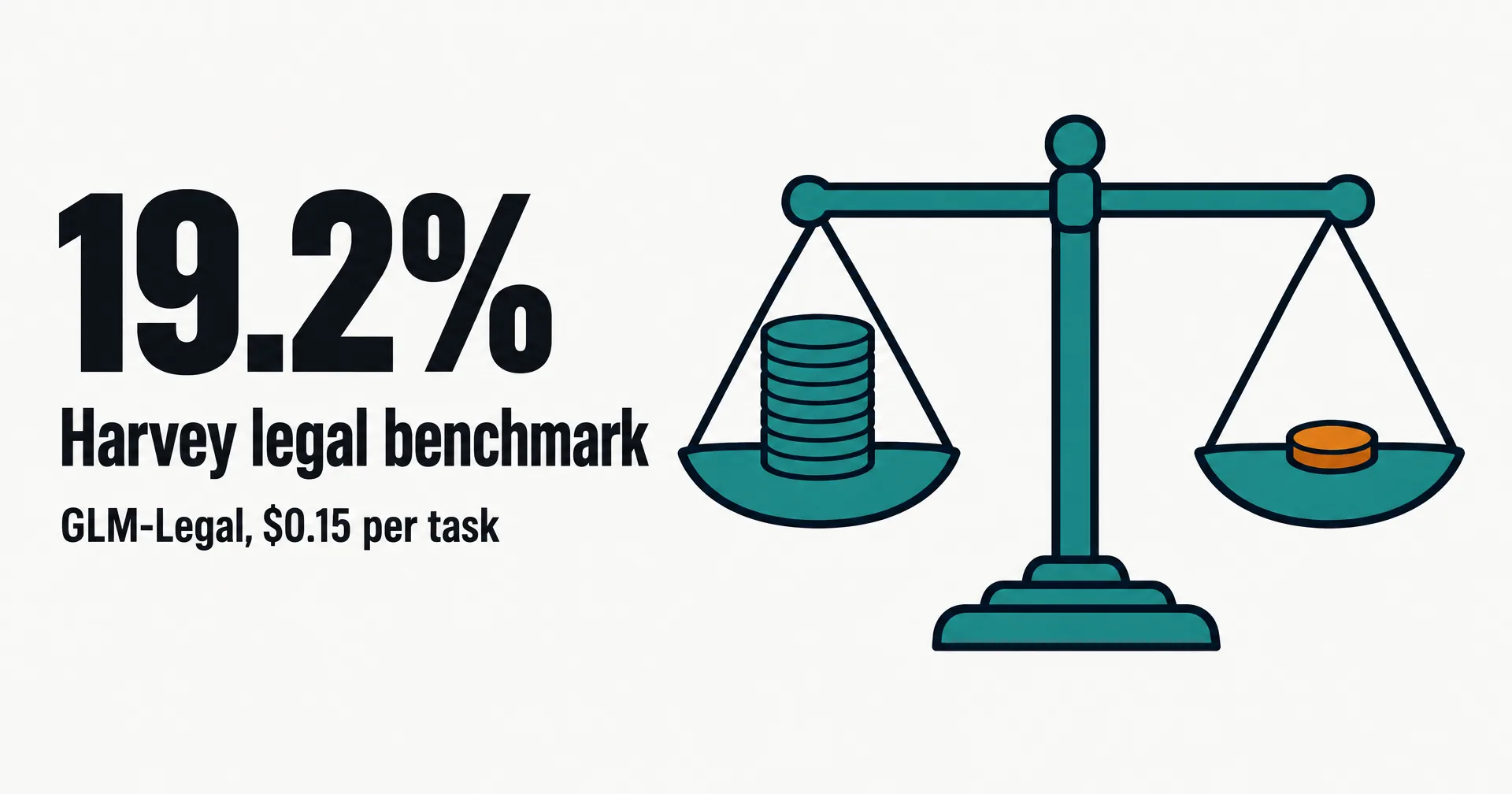
Z.ai released GLM-Legal on October 12, 2026, a legal model built on GLM-5.3-Flash and trained for contract review, evidence analysis and compliance work. Its launch post at 16:10 UTC says it “matches frontier models on mainstream legal benchmarks”, and its tech blog puts the headline number at a 19.2% all-pass rate on Harvey’s Legal Agent Benchmark (LAB). Access is by application for now: “Apply for API access”, with Z.ai’s AutoClaw desktop agent to follow.
We checked the number against the independent leaderboard. It holds, and it tells a more useful story than Z.ai’s chart does.
On this page · 8 sectionsOpen
 Z.ai released GLM-Legal on October 12, 2026: a legal model built on GLM-5.3-Flash, trained for contract review, evidence analysis and compliance.
 Its 19.2% all-pass rate on Harvey’s Legal Agent Benchmark matches the Vals AI leaderboard (19.17%), where it ranks sixth behind four Muse Spark models and Gemini 4 Argon.
 Its edge is cost: $0.15 per Harvey LAB test on Vals, against $10.55 for Gemini 4 Argon and $26.16 for GPT-6 Astra.
 The trade is time: an average Harvey LAB run took 1 hour 12 minutes, against 24 minutes for the leader, Muse Spark 1.2.
 Z.ai trained the model and its agent harness together with reinforcement learning across tens of thousands of legal environments.
 Access is by application only; Z.ai has published no GLM-Legal price. It is coming to Z.ai’s AutoClaw desktop agent.
§ 01The number, checked
Harvey LAB gives an agent a partner-style instruction and a folder of client documents, and a task counts as passed only when every rubric criterion passes. Vals AI runs the held-out set and updated its leaderboard on October 12 with GLM Legal on it.
| Model | Z.ai’s chart | Vals AI leaderboard | Vals rank |
|---|---|---|---|
| GLM-Legal | 19.2% | 19.17% | 6 |
| Kimi K3 | 12.9% | 12.92% | 10 |
| Claude Fable 5 | 11.3% | 11.25% | 14 |
| GLM-5.3-Flash | 6.7% | 6.67% | 29 |
| GPT-6 Astra | 5.4% | 5.42% | 32 |
| Muse Spark 1.2 | not shown | 25.42% | 1 |
| Gemini 4 Argon | not shown | 19.58% | 5 |
Every number on Z.ai’s chart matches Vals to the rounding. What the chart leaves out is the five models above it: Meta’s Muse Spark 1.2, 1.3 Max, 1.3 and 1.1 (25.42% down to 20.00%) and Google’s Gemini 4 Argon at 19.58%. GLM-Legal is sixth, within the leaderboard’s roughly 2.5-point error bars of Argon. The gain over its base model is real: 19.17% against 6.67% for GLM-5.3-Flash, the 12.5 points Z.ai claims.
§ 02Where it wins: cost per task
On the same leaderboard GLM Legal cost $0.15 per test against $10.55 for Gemini 4 Argon, its nearest neighbour by score, and $2.09 for the leader. Vals ran it at $0.075 in and $0.25 out per million tokens, GLM-5.3-Flash’s rate; Z.ai has not published a GLM-Legal price. The trade is time: an average run took 1 hour 12 minutes, against 24 minutes for Muse Spark 1.2.
§ 03The other two benchmarks
Z.ai’s blog says GLM-Legal matches “frontier closed-source models on LegalBench and PLawBench”. Its own chart puts it at 86.2 on LegalBench against 88.6 for Claude Fable 5 and 87.1 for GPT-6 Astra, and 77.3 on PLawBench (Chinese legal practice) against Fable 5’s 77.7. Close, not ahead. Those two are Z.ai’s runs; we found no independent scores yet.
On Artificial Analysis’s LAB-AA v1.1, a private 120-task version that fails any deliverable with a material hallucination, GLM-Legal is not listed yet; its base models are.
§ 04How Z.ai built it
The blog describes two stages on top of GLM-5.3-Flash: legal mid-training on a larger corpus, then reinforcement learning “across tens of thousands of realistic legal environments” in which the agent harness and the model were changed together: “Harness architecture and model training iterate in lockstep.” The examples it shows are agent work, not chat: tracked-change edits to a services contract, a contradiction map across 40 dispute documents, a pre-launch privacy checklist for three countries.
That is the same direction as OpenAI’s Astra for Law in September, which wrapped GPT-6 Astra in a legal search index and instructions, sold first to selected firms. Two labs, one month, the same bet: the value in legal AI sits in the configuration around the model.
§ 05Where CellCog sits
Our conflict, declared: we build CellCog, where businesses hire AI employees, and every CellCog tier runs on Claude Opus 5.5, which scores 3.75% on the same Vals leaderboard. We do not route to GLM-Legal. An AI employee doing legal operations reads, drafts and organises; it is an assistant to a lawyer, never counsel.
§ 06What we are watching
- A published GLM-Legal price and general API access.
- Independent LegalBench and LAB-AA scores.
- GLM-Legal arriving in AutoClaw.
§ 07Update log
- October 12, 2026: page opened, from Z.ai’s post and blog and the Vals AI leaderboard updated the same day.
§ 08Sources
- Z.ai, GLM-Legal: Advancing Agentic Legal Intelligence, October 12, 2026; announcement on X, 16:10 UTC.
- Vals AI, Harvey’s Legal Agent Benchmark leaderboard, updated October 12, 2026.
- Artificial Analysis, Harvey LAB-AA v1.1.
- Harvey, Introducing Harvey’s Legal Agent Benchmark, May 6, 2026.
Q1Is GLM-Legal better than GPT-6 Astra and Claude?
On Harvey LAB, yes: 19.17% against 5.42% for GPT-6 Astra and 11.25% for Claude Fable 5. On LegalBench, Z.ai’s own chart has it slightly behind both.
Q2Is GLM-Legal open-weight?
Z.ai has not released weights; access is through an application for the API.
Q3How is it different from Astra for Law?
Astra for Law wraps GPT-6 Astra in a legal search index for selected firms; GLM-Legal is a smaller model trained with its agent harness for legal tasks.
Q4What is Harvey LAB?
Harvey’s Legal Agent Benchmark: an agent gets a partner-style instruction and client documents, and a task passes only if every rubric criterion passes.
Q5Does CellCog use GLM-Legal?
No. Every CellCog tier runs on Claude Opus 5.5; we cover GLM-Legal as a model for legal work.