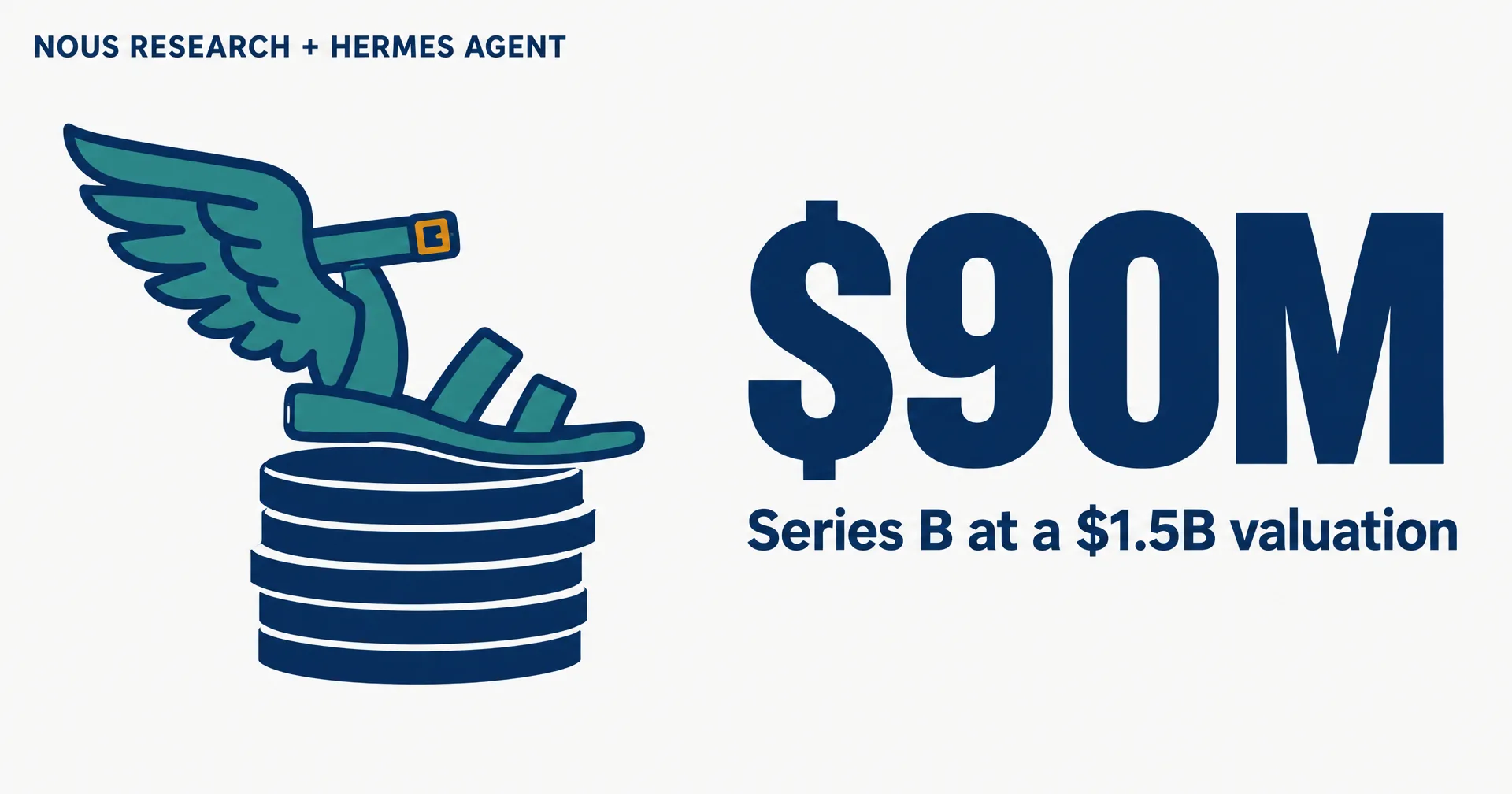
Nous Research, the lab behind the open-source Hermes Agent, has raised $90 million at a $1.5 billion valuation, The Wall Street Journal reported at 6:00 am ET on October 7, 2026. Nous confirmed the round as a Series B on X later that day and published a note from CEO Dillon Rolnick. It says the money will build Hermes for Businesses. The note does not name a lead investor or state the valuation, so the $1.5 billion figure rests on the Journal’s report. A disclosure up front: CellCog builds AI employees for businesses, so Hermes for Businesses is close to our category.
On this page · 7 sectionsOpen
 Nous Research raised $90 million at a $1.5 billion valuation, The Wall Street Journal reported on October 7, 2026. Nous called it a Series B.
 Nous names NVIDIA, Microsoft’s M12, Samsung, Robot Ventures, Union Square Ventures, Y Combinator and Menlo Ventures among its investors. It has not named a lead.
 Hermes Agent is open source under the MIT license, released in February 2026. Users choose where it runs and which models it uses, and it keeps skills and project memory across sessions.
 The money goes to Hermes for Businesses, which Nous says will let companies pick models by price and own their institutional knowledge. No price or launch date is published.
 Nous says Hermes has been cloned over 24 million times and, by its own internal estimates, drives about 2.5% of global token usage. Neither figure has been independently checked.
§ 01The round, in one table
| Item | Detail | Source |
|---|---|---|
| Amount | $90 million | Nous note, WSJ |
| Valuation | $1.5 billion | WSJ |
| Round | Series B | Nous on X |
| Named investors | NVIDIA, Microsoft’s M12, Samsung, Robot Ventures, Union Square Ventures, Y Combinator, Menlo Ventures | Nous note |
| Lead investor | Not named | Nous note, Nous on X |
| Use of funds | Hermes for Businesses, and a mobile app | Nous note, Nous on X |
| Hermes reach | Cloned over 24 million times; about 2.5% of global token usage | Nous, internal estimate |
Rolnick is unapologetic about the size: “Somehow, $90 million is modest in modern fundraising.”
§ 02How Nous got here
Nous started as a post-training lab, fine-tuning Meta’s Llama models toward what it calls user-alignment: the model follows the user’s worldview, not one set by a company. It published YaRN, a method for longer context windows at lower cost. It built Hermes Agent through 2025 and released it under the MIT license in February 2026. The note describes an agent that learns with use: “It remembers projects, writes reusable skills as it works, and carries that knowledge across sessions.”
§ 03What Hermes for Businesses promises
The note describes the business product only in outline. Nous says it will cut spend by letting companies “choose the best models at the best prices”, let AI use “scale safely and privately”, and give companies ownership of their institutional knowledge. Its one stated principle is “the people using an AI system should control it.”
There is no price, feature list, launch date or customer named. The Hermes Agent docs cover the open-source agent as it ships today.
§ 04The numbers to read carefully
The reach figures come from Nous itself. “Hermes has been cloned over 24 million times,” the note says, and “to our best internal estimates” it “drives approximately 2.5% of all global token usage.” Neither has an outside source. The X posts that broke the story added download and revenue figures that appear in neither Nous’s note nor the Journal’s free summary; we have left them out.
Nous also takes a position on regulation. The note says the AI conversation is “being dominated by fearmongering pleas for sweeping regulation” and frames open, auditable software as the safer path.
§ 05Hermes and a hosted AI employee
| Hermes Agent | CellCog AI employee | |
|---|---|---|
| Model | Open source, MIT license | Hosted product |
| Where it runs | Wherever you run it | Its own secure VM and file system |
| Models | You choose | Claude Opus 5.5 |
| Memory | Projects and skills across sessions | Memory, handovers and skills across days |
| Business tools | Hermes for Businesses, announced, unpriced | Inbox, task board, approvals, browser identity and logins |
| Setup | You install and wire it | Hire it by describing the role |
Both bets agree that agents should remember and improve with use. They differ on who carries the operating burden: Hermes hands control and setup to you, while a CellCog AI employee arrives with its computer, inbox and approvals already in place.
§ 06What we are watching
- A price, feature list or launch date for Hermes for Businesses.
- Whether a lead investor is named in a later filing or post.
- Any outside measure of the 2.5% token-usage estimate.
- The Hermes mobile app Nous mentioned on X.
§ 07Sources
- Nous Research, A Note on Our Fundraise, Dillon Rolnick, October 2026.
- The Wall Street Journal, Nous Research scores $90 million to bring open-source AI assistant to enterprises, October 7, 2026.
- X: @NousResearch, October 7, 2026; time from the post id.
- Nous Research, Hermes Agent docs, read October 7, 2026.
Q1What is Hermes Agent?
An open-source AI agent from Nous Research, released under the MIT license in February 2026. Users choose where it runs and which models it uses; it remembers projects, writes reusable skills as it works and carries them across sessions.
Q2What valuation did Nous Research get?
$1.5 billion, according to The Wall Street Journal on October 7, 2026. Nous’s own note gives the $90 million figure and does not state the valuation.
Q3Who led the Nous Research round?
Neither Nous’s note nor its X post names a lead. Both list NVIDIA, Microsoft’s M12, Samsung, Robot Ventures, Union Square Ventures, Y Combinator and Menlo Ventures among the investors.
Q4What is Hermes for Businesses?
The business product Nous says it will build with the money. It promises model choice by price, private and safe scaling, and ownership of institutional knowledge. Nous has published no price, feature list or date.
Q5How is Hermes different from a CellCog AI employee?
Hermes is open-source software you run and wire up yourself, on the models you choose. A CellCog AI employee is hosted: each one gets its own secure VM, file system, browser identity and logins, plus an inbox, task board and approvals its owner can see.