Update, September 26, 2026: Thursday passed without Aeon, and the story now has a second name. TestingCatalog reported that OpenAI’s upcoming always-on assistant will be called o, and that Aeon is the internal name of the existing custom agents feature in ChatGPT Workspace accounts. The one named date left is DevDay on Monday, September 29. The o report has the detail.
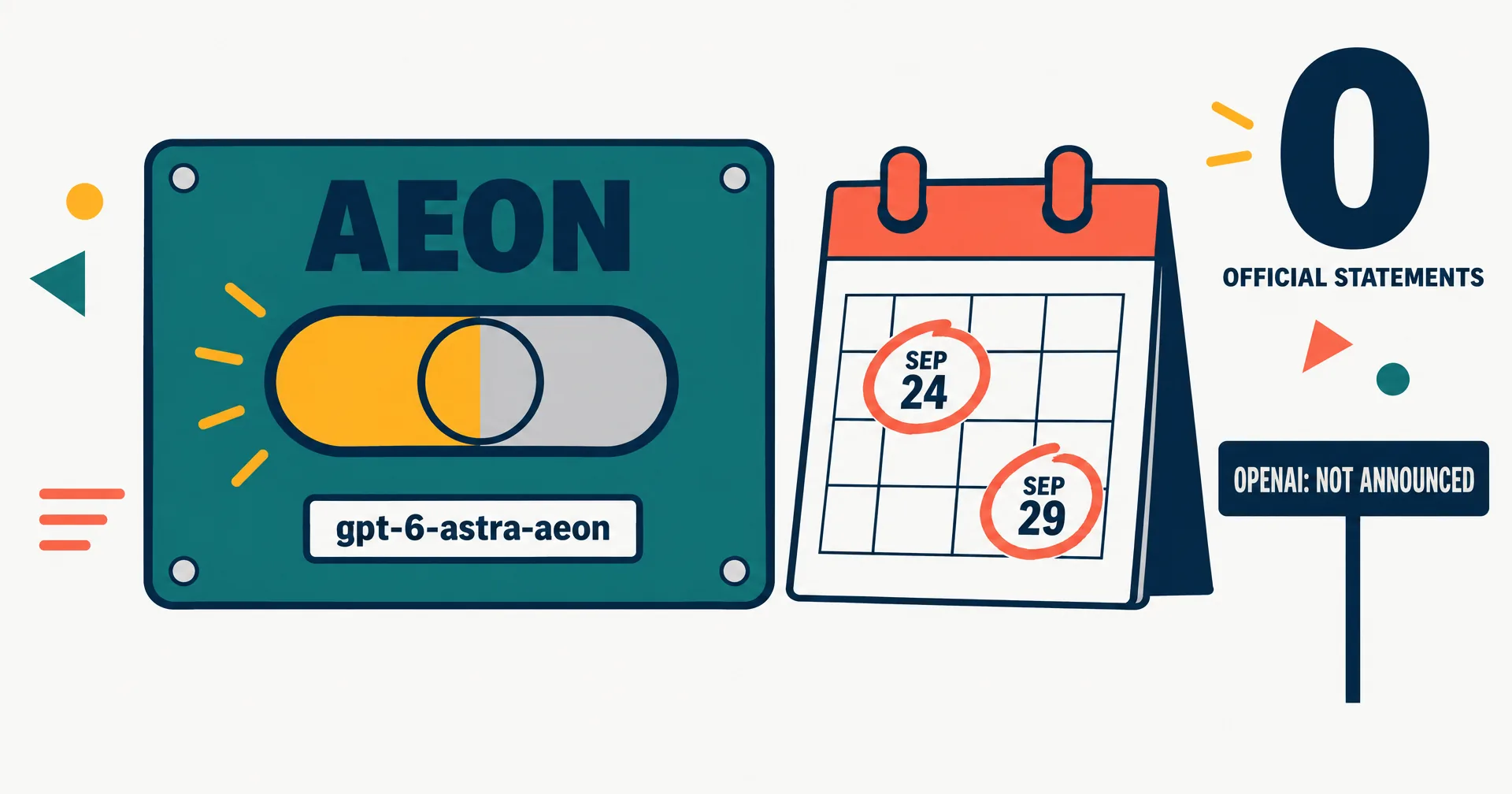
Aeon is the most specific rumor OpenAI has had this month, and it is still only strings. Posts since September 22 describe a persistent agent for ChatGPT and Codex, built to compete with Grok Bot and Meta’s Muse, that keeps working after you close the laptop. As of September 24, 2026, 20:40 UTC, OpenAI’s model documentation, API changelog and news feed contain no mention of Aeon, and neither does OpenRouter’s catalog.
What does exist is a trail of identifiers, and the name has changed jobs along the way. On September 3 it was a suffix on a model ID. On September 22 it was a set of fields for configuring an agent. By September 23 it was a product with its own profile. This page tracks what each layer actually shows, and the two dates the posts have named.
On this page · 12 sectionsOpen
 OpenAI has not announced Aeon as of September 24, 2026. The word appears in none of OpenAI’s model docs, API changelog or news feed, in no OpenRouter catalog entry, and in no file of the open-source Codex repository as cloned at 20:28 UTC.
 Aeon started as a model ID. On September 3 a Codex Desktop feature flag listed gpt-6-astra and gpt-6-astra-aeon. Astra shipped that day; the Aeon suffix did not.
 On September 22 @ChrisGPT reported Aeon fields in Codex’s shipped build: a model selector, a draft name and appearance, a cloud environment and a thread/startAeon operation, with some paths disabled.
 The product claims are secondhand: its own profile, DMs and groups, work that continues after you close the laptop, memory across days. They come from posts and write-ups, not from OpenAI.
 One dated test remains: DevDay on September 29 in San Francisco, which OpenAI confirmed. Two named dates have passed without Aeon: GPT-6 Sol on September 22 and Thursday, September 24.
§ 01What we actually know
| Claim | Status |
|---|---|
| A gpt-6-astra-aeon model ID exists | Codex Desktop feature-flag screenshot, September 3; not in OpenAI’s docs |
| Codex’s build carries Aeon agent fields | @ChrisGPT, September 22; closed build, some paths disabled |
| ChatGPT web and Android carry Aeon references | Community reports relayed by @ChrisGPT; no screenshot of our own |
| An agent ID named aeon-agent-01 | @Mr_Salio, September 23 |
| Its own profile, DMs and groups | @Mr_Salio, September 23; no artifact |
| Keeps working in the background until done | Insider Paper, September 23; secondary |
| Launches Thursday or at DevDay | Thursday passed with no launch; DevDay is confirmed for September 29 |
| Launched with GPT-6 Sol on September 22 | No; Sol and Luna shipped, Aeon did not |
| An always-on assistant named o | TestingCatalog, September 26; a ChatGPT upgrade-screen reference and internal config |
| Aeon is the internal name for Workspace custom agents | TestingCatalog, September 26; differs from the model-ID reading |
| Product page, price, model card, statement | None exist |
§ 02Three layers of evidence
| Layer | What it is | Who | Weight |
|---|---|---|---|
| Artifact | Screenshot of two model IDs in a Codex Desktop feature flag | @notjazii, relayed by @kimmonismus, Sep 3 | Real staging, says nothing about behavior |
| Reported strings | Field names in Codex’s shipped build and ChatGPT code | @ChrisGPT and others, Sep 22 to 24 | Consistent across posters, not independently readable |
| Interpretation | Profile, DMs, groups, days of background work, memory | @Mr_Salio, Insider Paper, others | Secondhand |
| Vendor | Anything from OpenAI | Nobody | None |
The artifact is the September 3 screenshot. @kimmonismus relayed it with the line “Could be here any minute now.” Astra did arrive that day. The Aeon suffix did not, and RuntimeWire’s reading of the same screenshot still holds three weeks later: “Treating it as a distinct public model would run ahead of the available evidence.”
The reported strings came on September 22, when @ChrisGPT listed fields he said he found in Codex’s shipped code: aeonModelId, allowAeonDraftModelSelection, aeonDraftName, aeonDraftAppearance, a cloud-environment selector and a thread/startAeon operation tied to the Agents sidebar. His own reading was modest, “the groundwork for configurable agents inside Codex”, and he added: “The code references are verified in the build I inspected, some paths remain disabled.” A September 24 post by @SecretFilesww added a durable host and a Long-lived label. We cloned OpenAI’s open-source Codex repository at its 20:28 UTC commit and found no Aeon string in any file; the fields are reported in the closed desktop build, which we cannot read.
Everything that makes Aeon sound like a product sits in the third layer. @Mr_Salio posted on September 23 that “It could have its own profile, DMs and groups” and that it was built to compete with Grok Bot and Muse. Insider Paper described an agent that works in the background until it messages you that the task is done, and wrote: “Rumors suggest that this tool could be officially released between September 24 and September 29.”
§ 03The o report, September 26
On September 26 at 10:02 UTC, TestingCatalog posted that an upcoming always-on assistant from OpenAI will be named o. “Its reference appeared briefly on the ChatGPT upgrade screen for some users.” It added that internal config uses o as a display name and as an email suffix, which it read as email handling, and that “OpenAI is hosting its DevDay next week, where we will likely hear more about their always-on assistant.”
The same post reframes Aeon. TestingCatalog wrote that Aeon is an internal name for the existing custom agents feature in ChatGPT Workspace accounts, and that OpenAI will likely build the consumer o assistant on top of it. That fits the September 22 field names, which describe configuring an agent, better than it fits the September 3 model-ID suffix. It also means the name the posts spent a week on may not be the name on the product.
None of this comes from OpenAI. It is one more report of strings and a screen seen by some users, from an account that follows OpenAI’s builds closely. DevDay is Monday.
§ 04The rumor chain, dated
| Date | Event | Source |
|---|---|---|
| Sep 3, 16:30 | gpt-6-astra and gpt-6-astra-aeon in a Codex feature flag | @kimmonismus, from @notjazii |
| Sep 3 | GPT-6 Astra ships; no Aeon | OpenAI |
| Sep 22, 03:06 | Aeon called OpenAI’s Grok Bot, release before DevDay | @kimmonismus |
| Sep 22, 04:23 | Aeon fields listed from Codex’s shipped build | @ChrisGPT |
| Sep 22, 08:17 | Aeon could launch today alongside GPT-6 Sol | @Mr_Salio |
| Sep 22 | GPT-6 Sol and Luna ship; no Aeon | OpenAI |
| Sep 23, 10:26 | Own profile, DMs and groups; Thursday or DevDay | @Mr_Salio |
| Sep 23, 16:34 | Agent ID aeon-agent-01 | @Mr_Salio |
| Sep 23, 19:48 | Release window Sep 24 to 29 | Insider Paper |
| Sep 24, 15:09 | Durable host, long-lived label | @SecretFilesww |
| Sep 24, 20:40 | Docs, changelog, news feed, OpenRouter, Codex repo: no Aeon | Our read |
| Sep 25 | Thursday, Sep 24, passed with no launch | Our read |
| Sep 26, 10:02 | Always-on assistant to be named o; Aeon read as Workspace agents | @testingcatalog |
§ 05The dates, graded
| Named date | Who | Status at Sep 26, 19:30 UTC |
|---|---|---|
| Sep 3, any minute now | @kimmonismus | Passed |
| Sep 22, alongside GPT-6 Sol | @Mr_Salio | Passed; @ChrisGPT had said Sol came first |
| Sep 24, Thursday | @Mr_Salio, @ChrisGPT | Passed, no launch |
| Sep 29, DevDay | @kimmonismus, @Mr_Salio, @ChrisGPT | Open; the event is confirmed |
DevDay is the one date in the chain OpenAI set itself: “OpenAI DevDay is back.” it posted on April 29, San Francisco, September 29. A developer conference is a natural stage for an agent that developers configure in Codex. It is also a stage for many other things, and nothing OpenAI has published ties Aeon to it.
§ 06What Aeon would compete with
The posts frame Aeon against two launches. SpaceXAI opened Grok Bot in beta on August 11, 2026 (what it is), and Meta launched Muse this month (the Connect record). Both are persistent agents that act on your behalf between conversations. The reported Aeon fields, a draft name and appearance and a member list for group threads, point the same way: an agent with an identity rather than a chat window.
That is the category CellCog works in. A CellCog AI employee has a name, its own email inbox, a task board and memory that carries from one session to the next, and it runs on whichever model does the job best. If Aeon ships, it will be one more sign the market has moved from answers to agents that own the work.
§ 07What would confirm it
- An OpenAI announcement, product page or news entry naming Aeon.
- An Aeon model ID in the API model documentation or changelog.
- An Aeon option in shipped ChatGPT or Codex that a user can turn on.
- A system card or help-center article.
- A DevDay keynote segment.
Another screenshot of a string would not. Those go in the chain table.
§ 08Where CellCog stands
CellCog does not route to Aeon, which does not exist as a public model. Our Claude tiers run on Opus 5.5 since September 22. If OpenAI ships an Aeon model through its API, that would be a routing decision on the same terms, and it would be recorded here.
§ 09What we are watching for
- OpenAI’s news feed, model docs and changelog on every scan.
- The Codex and ChatGPT release notes for an Aeon or agents entry.
- An o assistant or an agents entry on ChatGPT’s upgrade screen or in its release notes.
- The DevDay keynote on September 29.
- A first-party screenshot of the Aeon setup screen, not a relayed string list.
§ 10The tracker
As of September 26, 2026, 19:30 UTC: Aeon is described by code strings and posts only, and TestingCatalog now reads it as the internal name of Workspace custom agents beneath a consumer assistant called o. OpenAI has named neither. Three of the four named dates have passed; DevDay on September 29 remains.
§ 11Update log
As of September 24, 2026, 20:40 UTC: page opened. Next named dates Thursday, September 24 and DevDay, September 29.
September 26, 2026, 19:30 UTC: Thursday graded as passed; TestingCatalog’s o report folded (new section, table rows, FAQ). DevDay is the last named date.
§ 12Sources
- OpenAI, models, changelog and news, read September 24, 2026, 20:38 UTC.
- OpenRouter, models API, read September 24, 2026, 20:38 UTC.
- openai/codex on GitHub, cloned at the September 24, 2026, 20:28 UTC commit.
- X: @kimmonismus, September 3 and September 22; @ChrisGPT, September 22; @Mr_Salio, September 22, September 23 and later that day; @OpenAI, April 29. Read directly; times from the post ids.
- Insider Paper, OpenAI Aeon leak, September 23, 2026. RuntimeWire, Codex leak labels.
- X: @testingcatalog, September 26. Read directly; time from the post id.
Q1Where does the Aeon rumor come from?
Three layers. A September 3 screenshot of a Codex Desktop feature flag listing gpt-6-astra-aeon, posted by @notjazii and relayed by @kimmonismus. A September 22 post by @ChrisGPT listing Aeon fields he says he found in Codex’s shipped build. Then posts and write-ups, from @Mr_Salio, Insider Paper and others, describing what Aeon would do.
Q2Are the Aeon code strings real?
Several posters report consistent strings, and staging names in feature flags is normal before a launch. But OpenAI has published none of them and the Codex Desktop build is closed source. The open-source Codex repository contains no Aeon string as of September 24, 2026, 20:28 UTC.
Q3Will Aeon have its own social profile?
@Mr_Salio posted on September 23 that it could have its own profile, DMs and groups. A reported field named memberAeonIds would fit an agent that sits in group threads. Nothing from OpenAI confirms it.
Q4What model would Aeon run on?
The September 3 string paired it with GPT-6 Astra, and @ChrisGPT wrote that GPT-Astra helped build it. OpenAI’s newest models are GPT-6 Sol and GPT-6 Luna, released September 22, 2026.
Q5Should I wait for Aeon?
Not on this evidence. Persistent agents you can use today include Grok Bot, Meta’s Muse and AI employee platforms such as CellCog, where each employee has its own inbox, task board and memory that carries from one session to the next.
Q6What is OpenAI's o assistant, and is it Aeon?
TestingCatalog reported on September 26, 2026 that an upcoming always-on assistant from OpenAI will be named o. A reference briefly appeared on the ChatGPT upgrade screen for some users, and internal config uses o as a display name and an email suffix, which points to email handling. TestingCatalog also wrote that Aeon is an internal name for the existing custom agents feature in ChatGPT Workspace accounts, with the consumer o assistant likely built on top of it. OpenAI has confirmed neither.