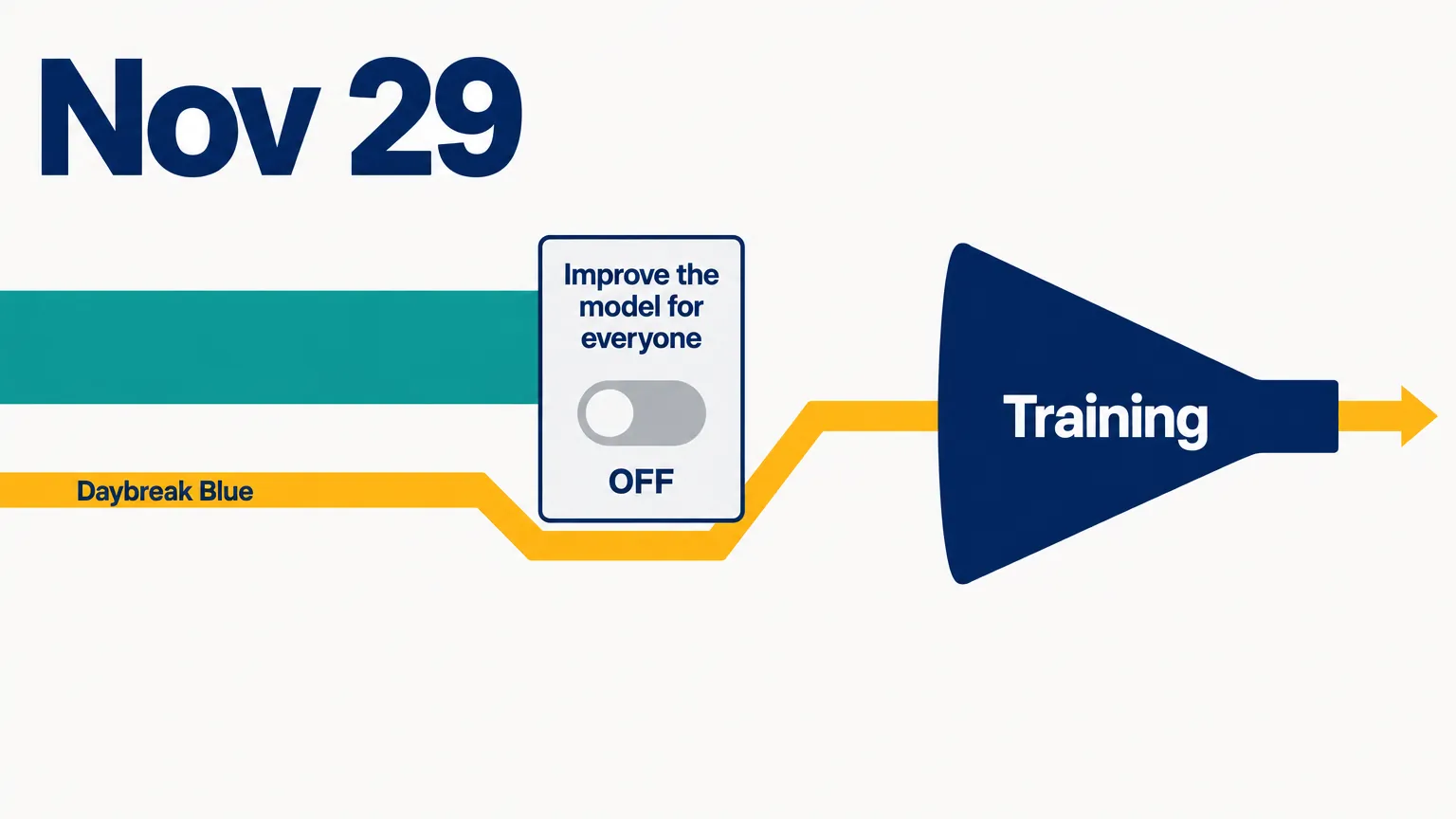
OpenAI told users of Daybreak Blue, its trusted-access tier for security work, on October 30, 2026 that their sessions will become training data. From November 29, the email reads, “we may use content from Daybreak Blue sessions on personal accounts to improve our models”, and that holds even with the model-improvement setting switched off. Researchers posted the email on X within hours, and OpenAI’s data controls help page carried the same rule that afternoon.
The catch is how Daybreak works. To join, individuals must turn on Advanced Account Security, and the email itself says that setting turns training off. Daybreak sessions on personal accounts were therefore excluded until now. The change does not touch business or enterprise customers, other ChatGPT use, or Zero Data Retention.
On this page · 6 sectionsOpen
 OpenAI emailed Daybreak Blue users on October 30, 2026 about a change to how their Trusted Access data may be used.
 From November 29, Daybreak Blue sessions on personal accounts may be used to train models even with the opt-out setting off.
 Daybreak requires Advanced Account Security, which turns that setting off, so these sessions were excluded until now.
 Business and enterprise customers, other ChatGPT use and Zero Data Retention are not affected, per OpenAI’s email.
 Researchers worry that unreported bugs and exploit techniques found in Blue sessions will end up as training data.
§ 01What OpenAI changed

The help page gained a section titled “Trusted Access on personal accounts”. It says: “During Daybreak sessions on your personal account, we may use content from your interactions to improve our models”. The stated reason is one line: “This helps us to strengthen safeguards against cyber misuse.” The opt-out setting “still applies to your other activity when not in a Trusted Access session”.
The help page gives no start date; the email does. The page read “Updated: 3 hours ago” when we opened it at 21:08 UTC on October 30.
| Who or what | From November 29 |
|---|---|
| Daybreak Blue sessions on a personal account | May be used to train models, setting off or on |
| Other ChatGPT activity on the same account | The opt-out setting still applies |
| Business and enterprise customers | Not affected, per the email |
| Non-Daybreak Advanced Account Security sessions | Not affected, per the email |
| Private Safety Processing and Zero Data Retention | Handling unchanged, per the email |
| Daybreak Red | Not named in the email |
§ 02What Daybreak Blue is
Daybreak is OpenAI’s Trusted Access for Cyber program, with two tiers. According to the Daybreak overview, Blue gives “Reduced refusals on supported mainline models” (GPT-5.5, GPT-5.6 Sol, GPT-6 Sol and GPT-6 Luna) for vulnerability triage, secure code review, malware analysis, detection engineering, incident response and patch validation. Red adds cyber-specialized models such as GPT-5.5-Cyber and needs a separate approval.
Joining as an individual takes an eligible paid plan, Advanced Account Security and at least one physical FIDO2 hardware key, and existing individual users had to meet those requirements by October 1, 2026. The same overview lists what Daybreak does not do, including: “Grant Zero Data Retention by default.” Anthropic runs a comparable cyber verification program for security researchers.
§ 03Why researchers are angry
The worry is specific. A researcher who finds an unreported flaw in a Daybreak session could hand its details to a training set before the vendor has a patch. One user who posted the email put it this way: “If you hunt with it, your unreported bugs, targets, PoCs and techniques become training data.” Another, Justin Kalland, posted the same email about half an hour after OpenAI’s help page changed.
Security researcher @seanhn was harsher: “Literally stealing people’s private work, as they do it, is cartoonishly evil.” He also predicted the cost: “It also will presumably kill Daybreak usage by security researchers.” He ended on “Yet another reminder of the importance of open models.” OpenAI has not said whether findings like unpatched vulnerabilities are filtered out or held back from training.
§ 04What is confirmed, and what is not
| Claim | Status |
|---|---|
| Training on Blue sessions can start November 29 | Confirmed: OpenAI’s email to users |
| It applies with the opt-out setting off | Confirmed: the email and the help page |
| Business and enterprise customers are exempt | Confirmed: the email |
| A personal user can opt out of it | No setting offered for Daybreak sessions |
| Unpatched findings are filtered out | Not stated by OpenAI |
| Daybreak Red is covered | Not stated; the email names Blue only |
§ 05What to do if you use Daybreak Blue
- Treat personal-account sessions as shared from November 29. Anything you type into a Blue session on a personal account may be used to improve OpenAI’s models.
- Keep embargoed findings out. Unpatched vulnerabilities, client targets and working exploits are the material researchers are most worried about.
- Use an organization account if you have one. The email says business and enterprise customers are not affected, and organizations can request Daybreak access.
§ 06Where CellCog stands
Our conflict, declared: CellCog sells AI employees and runs them on Claude Opus 5.5 through Anthropic’s API, not on OpenAI models, so this change does not reach our customers’ work, and Anthropic does not train on our API traffic. More on how AI employee memory and retention work.
Q1What is Daybreak Blue?
A tier of OpenAI’s Trusted Access for Cyber program that reduces refusals on mainline models such as GPT-6 Sol for verified defensive security work.
Q2When does the training start?
November 29, 2026, according to OpenAI’s email to Daybreak Blue users. The help page does not give a date.
Q3Does it cover Daybreak Red?
The email names Daybreak Blue only, and OpenAI has not said anything about Red.
Q4Why is OpenAI doing it?
Its help page says the content helps strengthen safeguards against cyber misuse. It has not said whether unpatched findings are filtered out.
Q5Does this affect CellCog?
No. CellCog’s AI employees run on Claude Opus 5.5 through Anthropic’s API, not on OpenAI models.