OpenAI shared a preprint on November 24, 2026 that it says shows its GPT-6 models can design proteins, tested in a wet lab. Its thread on X puts the claim in one line: “Our models can design new protein shapes and sequences using reasoning and code, without calling specialized biology models to generate them.”
The announcement links to OpenAI’s post, which we did not open; everything below comes from OpenAI’s own thread, which had about 53,000 views when we read it. OpenAI calls the work “a proof of concept.”
- OpenAI shared a preprint on November 24, 2026 with wet-lab tests of protein design by its GPT-6 family of models.
- Its claim: the models design protein shapes and sequences with reasoning and code, without calling specialized biology models.
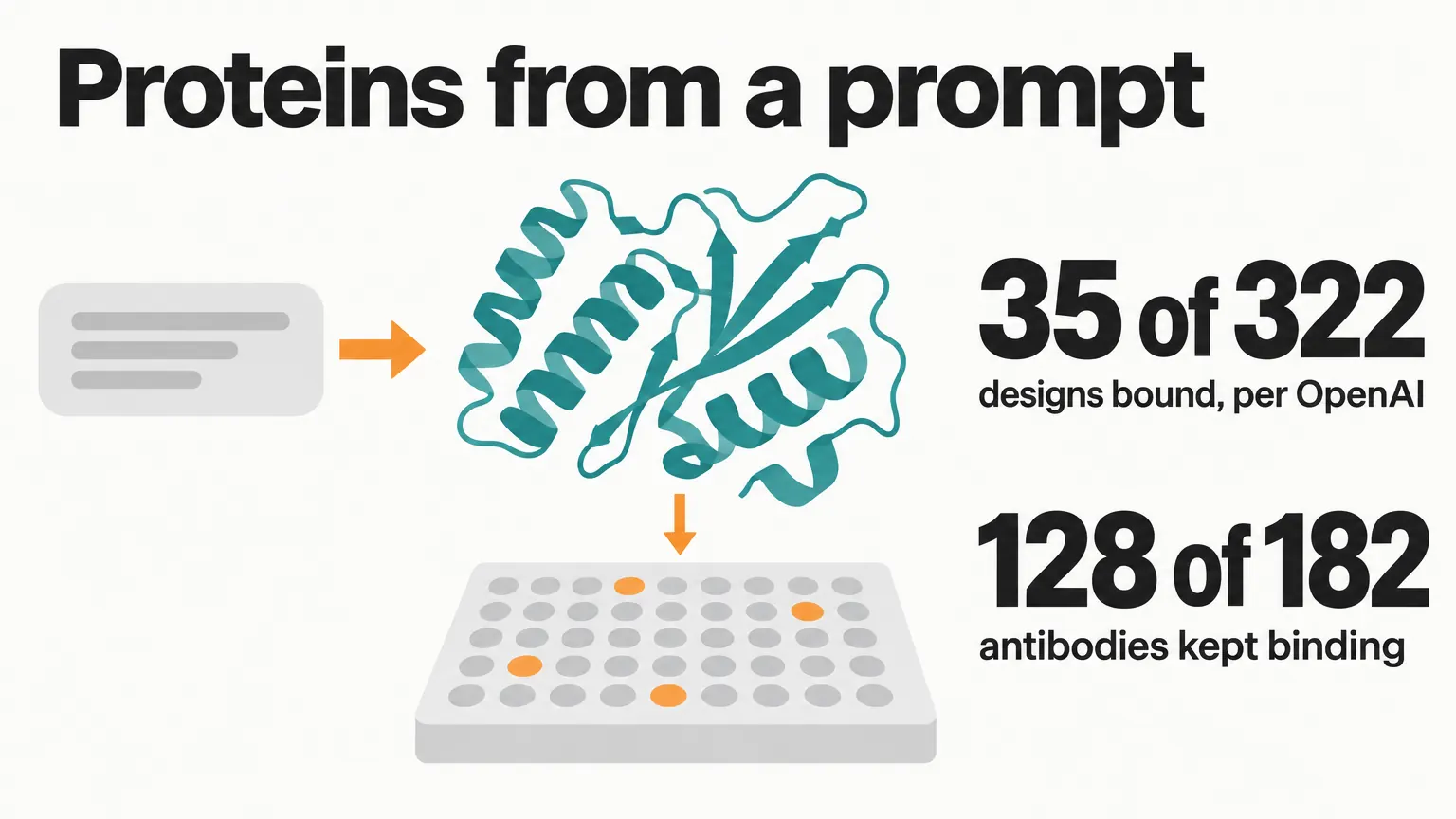
- With research partner Onava, GPT-6.2 designed the shapes and specialized models filled in the rest: 35 of 322 proteins showed binding, with binders for all five targets.
- Redesigned antibody parts kept binding in most cases: 128 of 182 small antibodies and 179 of 272 antibody fragments.
- OpenAI calls it a proof of concept; whether the proteins do anything useful after attaching is the next test.
- We read OpenAI’s X thread, not the preprint; the figures here are OpenAI’s.
§ 01What OpenAI says it tested
The thread describes two kinds of evidence:
- Computer tests. “An internal research model matched or outperformed specialized models on many protein tasks, including designing shapes and predicting how molecules fit together.” OpenAI adds that performance improved across model generations.
- Prompted control. With GPT-6.2, a prompt could pick out the two atoms that bonded a small molecule to a protein, or specify “where a new protein should attach and how many coils or strands to include.”
- Lab tests. “With our research partner Onava, we also tested two parts of protein design in the lab.” In that campaign GPT-6.2 designed the shapes and “Specialized models filled in the rest of the workflow.”
§ 02The lab numbers
| Experiment | Showed binding | Tested | Share (%) |
|---|---|---|---|
| Shapes by GPT-6.2, rest by specialized models (with Onava) | 35 | 322 | 11 |
| New sequences for three GPT-6.2 shapes | 14 | 107 | 13 |
| Redesigned small antibodies | 128 | 182 | 70 |
| Redesigned antibody fragments | 179 | 272 | 66 |
The first two rows are new designs, and about one in nine bound. The last two are redesigns of existing antibody parts, where most kept binding. In the main campaign, OpenAI reports binders for all five targets.

§ 03What is not shown yet
- Function. Binding is attachment. OpenAI says it next wants “to test whether these proteins do something useful after attaching”.
- Harder targets. The thread names harder targets and other types of molecules as next steps.
- Independent checks. The figures are OpenAI’s own; we have seen no outside lab repeat them.
OpenAI states the long-term goal plainly: “Our goal is for scientists to one day design working medicines simply by prompting.” Our record of Claude’s scorpion antivenom binders covers Anthropic’s own protein design campaign, and MedChemBench is OpenAI’s recent test of AI reasoning in drug discovery.
§ 04Where CellCog sits
Our conflict, declared: CellCog builds AI employees on Anthropic’s Claude models, a rival lab, and we route nothing to GPT-6.2. Our research agents read papers and summarize results; they do not run wet labs.
§ 05Sources
- OpenAI on X, November 24, 2026, 21:02 UTC, and the replies in its thread
- OpenAI’s reply on the Onava lab campaign and its reply on the antibody redesigns
- OpenAI’s post on the preprint (linked, not read)
Q1What does binding mean here?
That a designed protein attached to the target it was designed for in a lab test. It says nothing yet about whether it blocks or changes anything.
Q2Did GPT-6.2 do the whole design alone?
Not in the main lab campaign: GPT-6.2 designed the shapes and specialized models filled in the rest of the workflow, per OpenAI. In a separate test it also wrote new sequences itself.
Q3Which model did the computer tests?
An internal research model, which OpenAI says matched or outperformed specialized models on many protein tasks. It is not named.
Q4Who is Onava?
OpenAI names Onava as its research partner for the lab tests. It gives no more detail in the thread.
Q5Does CellCog use this?
No. CellCog runs on Anthropic’s Claude models and routes nothing to GPT-6.2 for protein design.