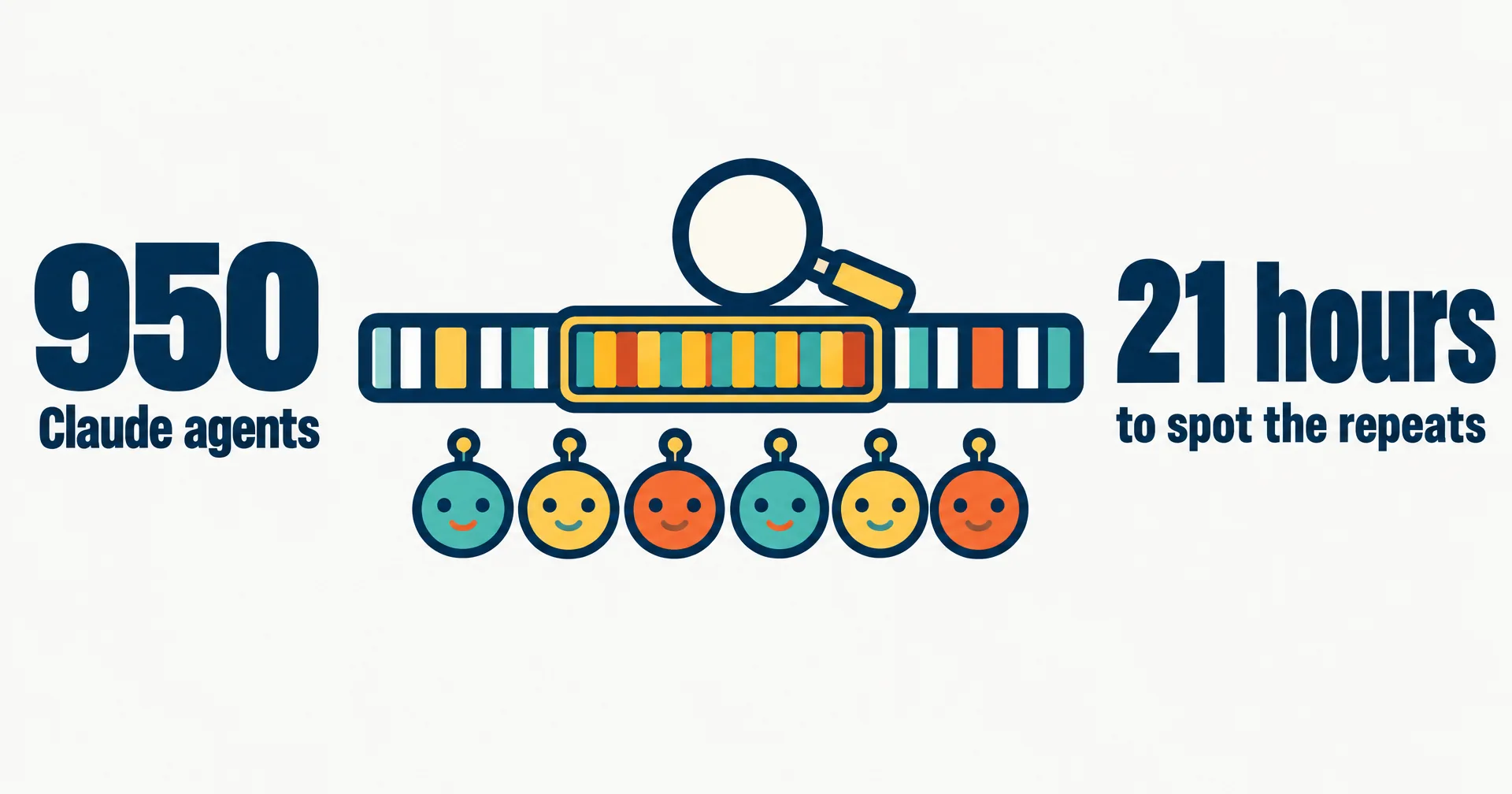
On September 23, 2026, Anthropic announced that Claude agents had found a new enzyme system in viruses that infect bacteria, “with only high-level direction from our scientists.” Dario Amodei called it a molecular machine that “could represent a new gene editing mechanism.” Two weeks later the find is the most argued-over result in AI-for-science. A Copenhagen biologist says his unpublished work describes the same system, and on October 8 CNN reported that “Anthropic did not respond to an emailed request to comment.”
This page sets out what Anthropic claimed, what its own technical report shows, and what is disputed, each from the person’s own words.
On this page · 7 sectionsOpen
 Anthropic said on September 23, 2026 that Claude agents found ART, a reverse transcriptase with a partner gene and a CRISPR-like array of DNA repeats in viruses that infect bacteria.
 Its technical report counts 949 agent sessions, 215.6 million tokens and 21.5 hours across 1.9 billion protein clusters, with humans doing all of the lab work.
 ART’s function is unknown. Amodei wrote that its function, utility and significance are not yet clear, and the RT itself had been seen in earlier studies.
 Copenhagen biologist Mario Rodríguez Mestre says his unpublished work describes the same system and that he shared it while using Claude; he does not claim Anthropic took it deliberately.
 Anthropic did not respond to CNN’s request for comment on October 8, and no public provenance audit of the campaign exists yet.
§ 01What Anthropic says Claude found
The system is called ART, for array-associated reverse transcriptases. A reverse transcriptase copies RNA into DNA. In ART, that enzyme sits next to a partner gene and a long run of evenly spaced DNA repeats. The repeats look like a CRISPR array, which is why the announcement drew attention. Anthropic is careful about what that means: “Although we don’t yet know its function,” the system shares features found together only in a handful of programmable systems that cut, copy and paste DNA.
Anthropic also says the enzyme itself was not new. The RT “had been identified in previous studies”; what Claude noticed first was the repeat array and the accessory protein beside it. Feng Zhang of MIT and the Broad Institute, quoted in the announcement, called it “genuinely intriguing and merits further investigation.”
§ 02The numbers behind the claim
| Measure | Announcement (Sept 23) | Technical report |
|---|---|---|
| Agents | Roughly 950 agents | 949 agent sessions across 119 tasks |
| Time | 21 hours | 21.5 hours of wall-clock time, 77 agent-hours |
| Tokens | 210 million | 215.6 million |
| Search space | A massive database of DNA sequences | 1.9 billion metagenomic protein clusters |
| Shortlist | 200,000+ RTs, 3,500 candidates, 20 reports | 17 candidate partner families, 3 confirmed as new |
| Human role | “Our involvement was limited to the initial prompt and the lab work” | Campaign ran without human intervention; humans ran the experiments |
The two documents round differently, and both are Anthropic’s. The report adds one detail the announcement leaves out: it attributes Claude’s eye for the repeats to internal signals in Mythos 5 that respond to repeated DNA. And Anthropic says “All of the lab work is performed by human scientists.”
§ 03The dispute
Mario Rodríguez Mestre, a computational biologist at the University of Copenhagen, told The New York Times on September 27 that his group had studied these enzymes for four years without publishing, while using Anthropic’s models to write code and draft manuscripts. “My concern is that this information was used to train future versions of the models.”
To CNN on October 8 he went further on overlap and narrower on blame. “It is essentially the same finding.” And: “I am not claiming that Anthropic deliberately took our work.” He offered two explanations: his material reached the model, or there was more prior knowledge and human direction behind the search than the phrase autonomous discovery suggests. He told CNN the second is the more plausible.
| Who | Position | Where |
|---|---|---|
| Anthropic | Claude found ART with high-level direction only; function still unknown | Announcement, Sept 23 |
| Dario Amodei | “The work was done mostly, though not entirely, by Claude” | X, Sept 23 |
| Mario Rodríguez Mestre | Same finding as his unpublished work; no claim of deliberate taking | NYT Sept 27, CNN Oct 8 |
| Ilya Finkelstein (UT Austin) | Interesting result, hype ahead of the science; wants a transparent investigation | His lab blog |
| Anthropic, to CNN | No response to the request for comment | CNN, Oct 8 |
Ilya Finkelstein, who studies these RT systems, wrote on his lab’s blog that the result is real and interesting, “But boy-oh-boy, is the hype getting ahead of the actual science.” He notes the ART spacers are four to seven times longer than CRISPR’s and there are no nearby cas genes, so the resemblance is not the same mechanism. On the Copenhagen claim he asked Anthropic for a “proper, transparent investigation.” He also told CNN the agents “are really good at grunt work when orchestrated by experts in the field.” Four of the report’s six authors are senior molecular biologists.
Amodei’s own post had already flagged a separate Stanford result, “a novel RT system with an associated non-coding array,” which he called distinct and independently evolved. CNN reported that gene-editing stocks fell after the September 23 announcement.
§ 04What is settled and what is not
Settled, from Anthropic’s own documents: the agents surfaced the repeat array, humans ran the lab work, the RT was already known, and ART’s function is unknown. Amodei wrote that its “precise function, biotechnological utility (if any), or level of significance is not yet clear.”
Not settled: whether the find was new, and how much the agents’ path was shaped by human direction or by anyone’s unpublished work. No public provenance audit of the campaign exists yet, and the report is hosted by Anthropic, not a peer-reviewed journal.
§ 05Why this matters beyond biology
The argument is about receipts. Anthropic’s report includes session transcripts, which is more than most AI-discovery claims ship with, and the dispute still turned on what the agents were told and what they had seen before. Any team running agents on research, including ours, will be asked the same question: show the path, not just the result.
Our conflict, declared: we build CellCog, and every tier of our AI employees runs on Claude Opus 5.5, Anthropic’s model. Our research agents cite their sources and keep their work on their own computer, so the path behind a finding can be read back. That is a smaller claim than a discovery, and an easier one to check.
§ 06What we are watching for
- An Anthropic response on the Copenhagen claim, or the investigation Finkelstein asked for.
- Mestre’s publication, which would let anyone compare the two descriptions.
- ART’s function, which Anthropic says its lab is still working out.
§ 07Sources
- Anthropic, Claude discovers a novel enzyme system with CRISPR-like repeats, September 23, 2026.
- Anthropic, technical report (PDF): Yoon, Athukoralage, Ameisen, Kauderer-Abrams, Perry and Durrant.
- Dario Amodei on X, September 23, 2026, 18:43 UTC.
- The New York Times, Carl Zimmer, September 27, 2026.
- CNN, Katie Hunt, October 8, 2026.
- Ilya Finkelstein, Harvesting and Replenishment in Biomedicine.
Q1What is ART?
Array-associated reverse transcriptases: a system found mainly in jumbo bacteriophages with three parts, a reverse transcriptase, a partner gene and a long array of DNA repeats about 200 nucleotides apart.
Q2Did Claude discover ART on its own?
Anthropic says agents found it with only high-level direction and that humans ran the lab work. Dario Amodei wrote that the work was done mostly, though not entirely, by Claude. Critics say expert direction mattered more than the word autonomous suggests.
Q3Who is Mario Rodríguez Mestre?
A computational biologist at the University of Copenhagen who says his group studied these enzymes for four years without publishing, and that the Anthropic finding is essentially the same.
Q4Has Anthropic responded?
CNN reported on October 8 that Anthropic did not respond to its emailed request for comment. Anthropic has published no investigation of the claim.
Q5Is the ART paper peer reviewed?
No. It is a technical report hosted on Anthropic’s own site, not a peer-reviewed journal article.