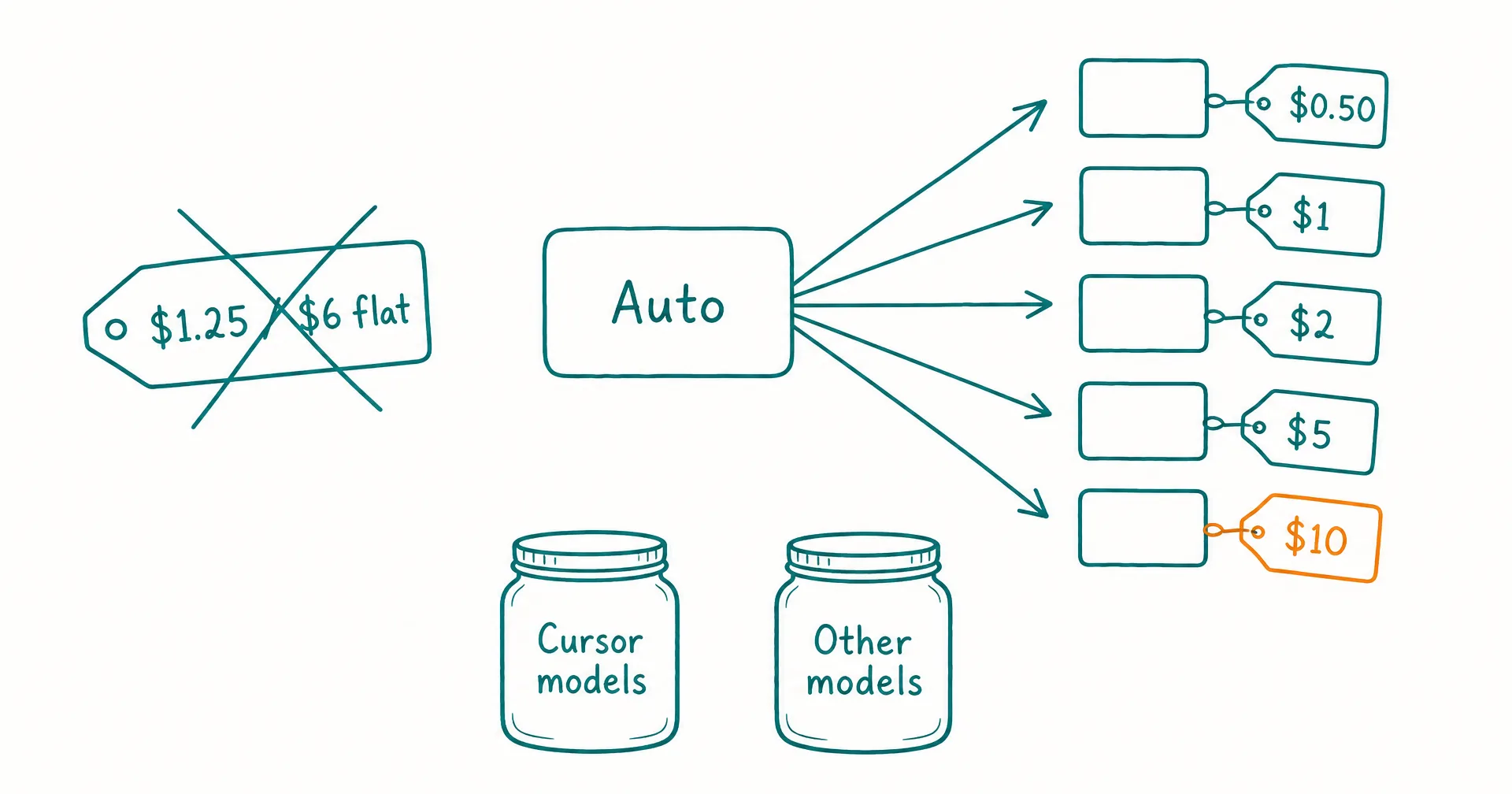
On August 24, 2026, Cursor turned off the single most predictable number in its pricing: the flat Auto rate. Auto, the default mode that picks a model for each request, now bills at whatever the chosen model costs. Cursor said it plainly in the customer email announcing the change: “for most requests, this means a higher rate.”
The restructuring arrived with a compensating gift, larger included allowances for Cursor’s own models, and with a communication gap that produced most of the anger: the new allowances were announced without numbers. As of August 25, the dollar sizes of the usage pools still do not appear on Cursor’s public pricing page. Users have been reconstructing their own limits from dashboards.
This page collects what is verified: the mechanics from Cursor’s canonical documentation, the numbers visible only in dashboards (labeled as exactly that), and the fine print that decides what a Teams seat actually pays.
- Effective August 24, 2026, Cursor’s Auto no longer bills at a flat rate. Every Auto request now bills at the list price of whichever model it gets routed to, and Cursor’s own email said most requests get more expensive.
- The old Auto rate was $1.25 per million input tokens and $6 per million output. Routed models range from Composer 2.5 at $0.50/$2.50 to Claude Fable 5 at $10/$50, so an Auto request can now cost 8x what an identical request cost last week.
- Usage splits into two monthly pools: Cursor Models (Grok 4.6, Grok 4.5, Composer 2.5) and Other Models (everything third-party). Cursor’s public pricing page says only ‘Included’ and does not print either pool’s dollar size for any plan.
- Ultra dashboards show $500 of Other Models and $3,000 of Cursor Models (raised from $2,000 on launch day). These are dashboard observations, not published entitlements, which is itself part of the story.
- Teams and Enterprise pay an extra $0.25 per million tokens on third-party requests, the Cursor Token Rate, on top of the model’s own price. Legacy Enterprise Auto keeps the old flat rate until September 7, 2026.
- The predictability problem is structural: you no longer know a request’s price before Auto picks its model, and on Teams the routed model can be hidden from the user by default.
§ 01What changed: one flat rate became a routing lottery
The old Auto price was model-independent:
| Token category | Old price per 1M tokens |
|---|---|
| Input | $1.25 |
| Cache write | $1.25 |
| Cache read | $0.25 |
| Output | $6.00 |
The new rule, from Cursor’s Models and Pricing page: all Auto modes bill at the list price of the model each request is routed to. What that means in practice depends entirely on where the router sends you:
| Routed model | Input | Cache read | Output | vs old flat rate |
|---|---|---|---|---|
| Composer 2.5 | $0.50 | $0.20 | $2.50 | Cheaper |
| Grok 4.6 | $2.00 | $0.50 | $6.00 | Input 60% higher |
| Claude Sonnet 5 | $2.00 | $0.20 | $10.00 | Output 67% higher |
| Claude Opus 5 | $5.00 | $0.50 | $25.00 | Roughly 4x |
| Claude Fable 5 | $10.00 | $1.00 | $50.00 | Roughly 8x |
Auto’s routing behavior did not change, only the billing did. The same request that cost the flat rate last week now costs whatever the router decides it costs. That is the structural complaint: the price of a request is determined after you send it.
One documentation footnote worth knowing: as of August 25, one Cursor Help Center page still describes Auto’s Cost mode at the old flat rate, while the canonical pricing page says all Auto modes use routed-model pricing. The canonical page and the customer email agree with each other, so treat the Help Center entry as stale.
§ 02The two pools, and the numbers Cursor does not publish
Usage now splits into two monthly allowances that reset with the billing cycle:
- Cursor Models: Grok 4.6, Grok 4.5, and Composer 2.5, billed at Cursor’s own rates.
- Other Models: every third-party model, billed at provider list prices.
Cursor’s public plan table says both pools are “Included” on Pro ($20), Pro+ ($60), and Ultra ($200). It does not say how many dollars of usage “Included” means, on any plan. The numbers below are what subscribers have measured in their own dashboards, and they should be read as the current implementation rather than a published entitlement:
| Plan | Price | Cursor Models pool | Other Models pool | Source |
|---|---|---|---|---|
| Pro | $20/mo | ~$300 reported | Not reliably established | Dashboard reports |
| Pro+ | $60/mo | ~$450 reported | ~$70-75 reported | Dashboard reports |
| Ultra | $200/mo | $2,000, raised to $3,000 same day | $500 | Multiple dashboard reports |
| Teams Standard | $40/user/mo | “Standard allowance” | Included, amount unpublished | Official page, no numbers |
| Teams Premium | $120/user/mo | 5x Standard agent usage | Included, amount unpublished | Official page, no numbers |
The Ultra story compresses the whole launch into one day: subscribers logged in on August 24 to find $500 of third-party usage and $2,000 of Cursor-model usage, did the arithmetic against the plan’s “20x usage” marketing, complained, and watched the Cursor-model pool rise to $3,000 the same day. The adjustment is real responsiveness. It is also exactly what pricing looks like when the entitlements live in dashboards instead of documentation.
§ 03The surcharge Teams actually pays
Teams and Enterprise requests to third-party models carry an additional charge that individual plans do not: the Cursor Token Rate, $0.25 per million tokens, applied to input, output, and cached tokens, on top of the model’s own price. It applies whether the model was picked directly or by Auto, and it applies to BYOK traffic too, where the provider bills the inference and Cursor still bills the processing.
Worked example: a Teams request to Claude Sonnet 5 that processes one million input and one million output tokens costs $2 + $10 in model charges plus $0.50 in Cursor Token Rate, $12.50 total before caching. Cursor’s first-party models are exempt, which is a quiet but real thumb on the scale toward routing work to Cursor’s own stack.
Enterprise gets one temporary carve-out: legacy Enterprise Auto keeps the old flat rate until September 7, 2026. After that, the public default is routed-model pricing everywhere, unless a negotiated order form says otherwise.
§ 04What this means if you run agents on Cursor
The predictability loss lands hardest on exactly the workloads Cursor is best at: long agent sessions. An agent loop that accumulates context pays input rates on an ever-growing transcript, and under routed pricing the same loop can cost 4x more on the days the router favors Opus-class models. Budgeting a month of agent work now requires assumptions about routing behavior that Cursor does not publish and that users on Teams may not even be able to observe, since the routed model can be hidden from non-admin users by default.
None of this makes Cursor a bad product. Composer 2.5 at $0.50 input is genuinely cheap, the allowance increase is real, and the router exists precisely because most people do not want to pick models per request. But the pricing shape has changed from “a subscription with a known rate” to “a subscription wrapping two metered pools with unpublished sizes and variable per-request prices.” That is a shape you budget differently.
§ 05Where this sits in agent economics
Across the agent category in 2026 the pattern keeps repeating: the subscription is the door, and the real cost lives in how the work is metered behind it. Grok Bot bundles access into premium plans and meters weekly allowances, a structure we priced out in our Grok Bot pricing guide. Cursor now wraps two usage pools inside its tiers and prices each request by routing outcome, alongside the Origin bundle that rides the same plans. And AI employee platforms price the work directly: CellCog plans start at $8 a month; you pay for the work of an AI employee, not the hire, and the cost depends purely on how much work you assign. The full arithmetic, worked scenarios included, is in our AI employee cost guide.
The honest buyer summary: if your usage is light and Composer-friendly, August 24 made Cursor cheaper for you. If you run heavy agent work through Auto, your effective rate went up, your predictability went down, and the numbers that govern your month are in a dashboard, not a contract. Check your own usage page before your next billing cycle does it for you.
Q1How does Cursor Auto pricing work after August 24, 2026?
Auto routes each request to a model and bills at that model’s published token price. The old model-independent rate ($1.25 per million input tokens, $1.25 cache write, $0.25 cache read, $6 output) is retired for individual and Teams plans. Cursor’s canonical Models and Pricing page states that all Auto modes bill at the routed model’s list price.
Q2What are the Cursor Models and Other Models pools?
Two separate monthly usage allowances that reset with your billing cycle. Cursor Models covers Cursor’s own Grok 4.6, Grok 4.5, and Composer 2.5. Other Models covers third-party models like Claude, GPT, and Gemini at their providers’ list prices. The dollar size of each pool per plan is not published; it is visible only inside your usage dashboard.
Q3What do Ultra subscribers actually get?
Dashboard reports from August 24 show $500 per month of Other Models usage and $3,000 of Cursor Models usage, the latter raised from $2,000 the same day. Cursor has not published these numbers as plan entitlements, so treat them as the current implementation rather than a guarantee.
Q4What is the $0.25 Cursor Token Rate?
A processing surcharge on Teams and Enterprise: $0.25 per million tokens, applied to input, output, and cached tokens on eligible third-party model requests, on top of the model’s own price. It applies to included usage, on-demand usage, and BYOK, and does not apply to Cursor’s first-party models.
Q5Why are users upset about the change?
Three reasons keep recurring in public threads. Price predictability is gone, since Auto picks the model after you send the request. The allowance increase was announced without numbers, so users reverse-engineered their own limits from dashboards. And on Teams the routed model can be hidden by default, so a user may not see which model consumed their budget.
Q6How does this compare with usage-based pricing for AI workers?
Cursor’s model is quota pools inside a subscription: you prepay a tier and the pools cap how much work fits inside it. The alternative shape is pricing the work directly. A CellCog AI employee has plans from $8 a month; you pay for the work, not the hire, and the cost depends purely on how much work you assign, with no pool to exhaust mid-cycle.