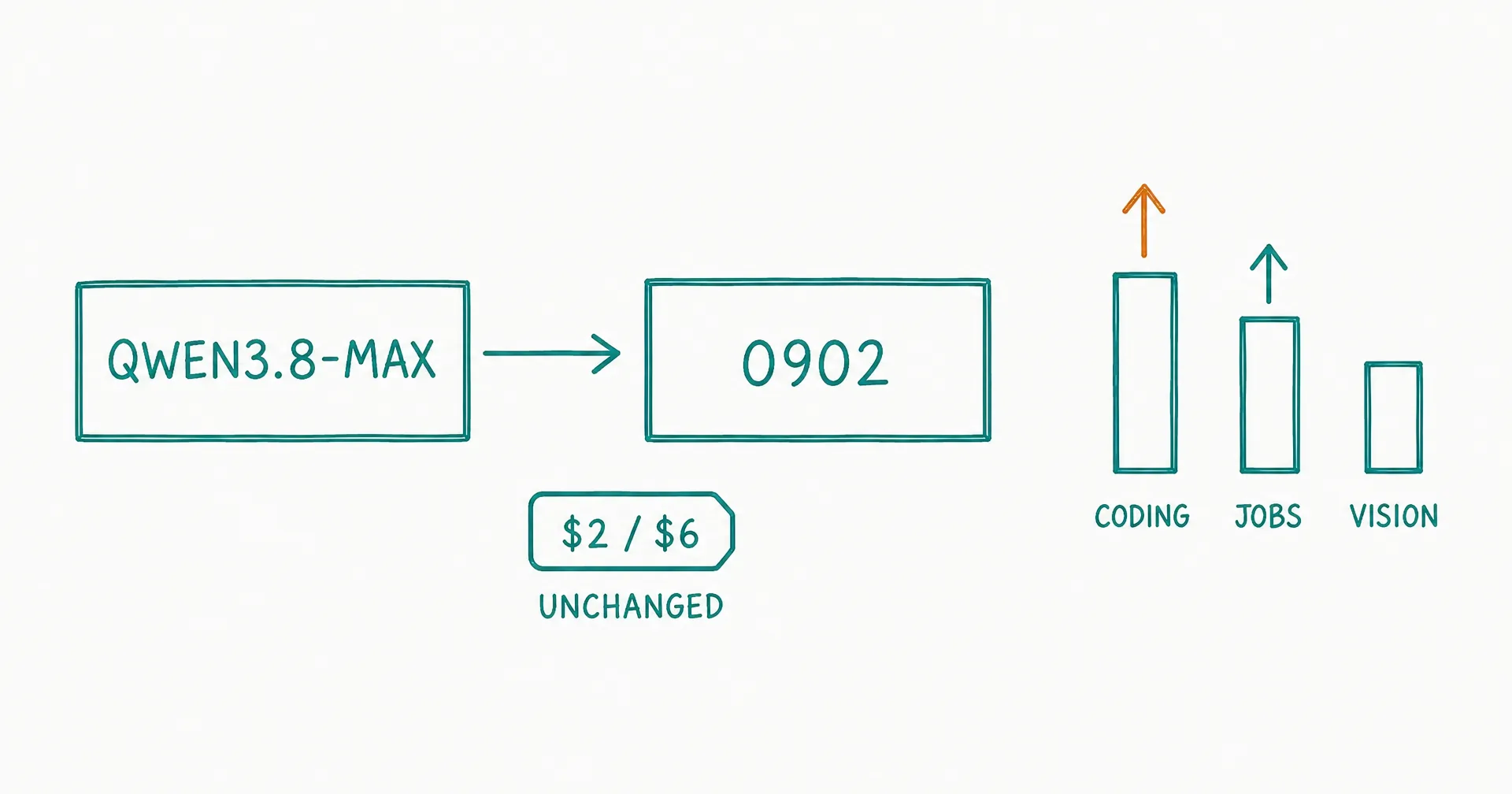
Alibaba’s Qwen team upgraded its flagship in place on September 1, 2026. Qwen3.8-Max-0902 is the same 2.4T-parameter model with the same 1M context window and the same $2 input and $6 output price per million tokens, further post-trained on what Qwen calls “Coding & Cowork”. The announcement went out on X at 10pm ET and the model page was live on QwenCloud the same night.
The headline is not the price or the parameter count, both unchanged. It is how much ground the snapshot makes up against its own predecessor on agentic coding and professional job tasks, and how the table Qwen published reads once you take its footnotes seriously. The short version: a real upgrade, the same bill, and Claude Opus 5 still ahead on most of the coding and office-work rows Qwen chose to show.
On this page · 7 sectionsOpen
- Qwen3.8-Max-0902 (alias qwen3.8-max-2026-09-02) went live on QwenCloud on September 1, 2026, at 10pm ET. It is an upgraded snapshot of the 2.4T-parameter Qwen3.8-Max, further post-trained on coding and cowork tasks, with the 1M context window, thinking mode, and tool ecosystem retained.
- Pricing did not move: $2 per million input tokens and $6 per million output. The cache lanes are the cheap part: $0.25 per million for implicit cache hits and $0.17 for explicit cache reads (explicit cache creation is $2.50).
- The gains over its own predecessor are the story: TerminalBench 3.0 goes from 11.3 to 29.0, ProgramBench from 10.5 to 28.0, JobBench from 53.4 to 64.0, and the WorkArena Elo from 1348 to 1468.
- Against rivals it is mixed: 0902 leads the listed models on repository-level code understanding (SWE-Atlas QnA 66.3), Automation Bench (50.8), embodied and general visual reasoning, and Qwen’s own QwenSWEBench V2. Claude Opus 5 still leads on most agentic coding rows and on both office-work benchmarks.
- Read the footnotes before quoting the table: the Fable5 column ‘may involve fallbacks’, other models’ TerminalBench scores are ‘the best published score across harnesses’, and three benchmarks (QwenSWEBench V2, CoWorkBench, WorkArena) are Qwen in-house.
- The comparison is against Fable 5 and Opus 5, not Fable 5.1, which shipped the same day. The announcement says nothing about open weights for this snapshot; it is an API model as of September 1.
§ 01What changed, in Qwen’s own words
The QwenCloud model page describes 0902 (alias qwen3.8-max-2026-09-02) as “an upgraded snapshot of qwen3.8-max” with three claims: coding capability that handles “more complex engineering-scale projects and long-horizon autonomous development”, collaborative agent performance with “greater composure in multi-tool orchestration and end-to-end task delivery”, and refined native vision across chart reasoning and document parsing. It retains the 1M context window, thinking mode, and the full built-in tool set (code interpreter, web search, web extractor, image search).
The X post adds the framing: “Further post trained on Coding & Cowork.” That is the same direction the August 26 Qwen3.8-Flash-Next release leaned in, where the launch table led with office-work benchmarks. Labs are now optimizing for jobs, not tokens, and the Max line just got the same treatment.
§ 02Pricing: unchanged at the top, cheap in the cache lanes
| Lane | Price per 1M tokens |
|---|---|
| Input | $2.00 |
| Output | $6.00 |
| Input, implicit cache hit | $0.25 |
| Explicit cache creation | $2.50 |
| Explicit cache read | $0.17 |
The limits carry over from the previous snapshot: 991K max input (983K with thinking on), 131K max output, 262K max reasoning tokens, 1M context, and rate limits of 1M tokens and 15K requests per minute. For a long-horizon agent that re-reads the same repository or document set every turn, the implicit cache lane at $0.25 is where the real cost lives; the $2 sticker is what you pay for novel tokens. Anthropic’s Fable 5.1, released the same day, holds $10 input and $50 output with cache reads at $0.25, so the two models now share a cache-read price while sitting five to eight times apart on fresh tokens.
§ 03The benchmark table, read honestly
Qwen published a five-column table: 0902, the previous Qwen3.8-Max, Claude Opus 5, Fable 5, and GPT-5.6 Sol. Here are the rows where the upgrade matters most, with the leader among the five in bold.
| Benchmark | 0902 | Qwen3.8-Max | Opus 5 | Fable 5 | GPT-5.6 Sol |
|---|---|---|---|---|---|
| TerminalBench 3.0 (agentic terminal coding) | 29.0 | 11.3 | 42.7 | 34.0 | 34.6 |
| DeepSWE 1.1 (agentic coding) | 69.3 | 56.6 | 73.6 | 69.7 | 72.7 |
| NL2Repo-Bench (repo-level generation) | 64.9 | 55.9 | 72.3 | 70.2 | not reported |
| ProgramBench (black-box replication) | 28.0 | 10.5 | 41.5 | 33.0 | 23.0 |
| SWE-Marathon (ultra-long-horizon SWE) | 44.8 | 39.1 | 50.0 | 45.0 | 42.5 |
| SWE-Atlas QnA (repo-level understanding) | 66.3 | 60.3 | 63.2 | 39.0 | 46.0 |
| QwenSWEBench V2 (in-house) | 70.0 | 55.1 | 68.0 | 67.1 | not reported |
| CoWorkBench (long-horizon office work, in-house) | 76.1 | 74.8 | 79.6 | 75.9 | 71.5 |
| JobBench (professional job tasks) | 64.0 | 53.4 | 67.8 | 57.4 | 45.4 |
| Automation Bench v1.0.6 (agentic SaaS workflow) | 50.8 | not reported | 50.3 | 46.2 | 45.8 |
| Toolathlon Verified (real-world tool use) | 73.3 | 72.5 | 77.6 | 77.9 | 74.9 |
| WorkArena Elo (expert evaluation, in-house) | 1468 | 1348 | 1437 | not reported | 1482 |
| ERQA (embodied intelligence) | 78.3 | 77.8 | 67.3 | 70.0 | 70.0 |
| BabyVision (general visual reasoning) | 93.8 | 91.3 | not reported | 90.5 | 88.9 |
Four footnotes change how much of this you should quote:
- The Fable5 column “may involve fallbacks.” Qwen says so in footnote one. That column is the least reliable in the table, and it is the column 0902 beats most often.
- Other models’ TerminalBench scores are “the best published score across harnesses.” Qwen ran its own model with Claude Code at a 10-hour timeout and compared against whatever number each rival published anywhere. Cross-harness comparisons are directionally useful and not much more.
- Three benchmarks are Qwen’s own: QwenSWEBench V2, CoWorkBench, and WorkArena. 0902 leads one of them and trails Opus 5 and GPT-5.6 Sol on the other two, which is to Qwen’s credit; a vendor that loses on its own test is being straight with you.
- Empty cells are “not yet available or not applicable.” GPT-5.6 Sol has no NL2Repo or QwenSWEBench score; Opus 5 has no multimodal-tool-use or BabyVision score. Absence is not a loss.
§ 04Where 0902 actually leads
Against its own predecessor, everywhere that matters: the coding rows that were embarrassing in August (11.3 on TerminalBench, 10.5 on ProgramBench) roughly doubled and tripled, professional job tasks rose ten points, and the expert-evaluation Elo climbed 120. If you were already on Qwen3.8-Max, this is a free upgrade and you should switch the model id today.
Against the field, the wins are specific: repository-level code understanding (SWE-Atlas QnA, where it beats Opus 5 by three points and Fable 5 by 27), agentic SaaS workflows (Automation Bench, by half a point over Opus 5), machine-learning research engineering (MLS-Bench-Lite 50.1 vs 49.8, a coin flip), and the two visual-reasoning rows where it was already the leader. Everywhere Opus 5 has a number for agentic coding or office work, Opus 5 is still ahead, by margins of four to fourteen points.
§ 05What the announcement does not say
Nothing about open weights. The August 12 Qwen3.8-2.4T-A95B checkpoint is the downloadable Max-class Qwen; whether this snapshot follows it to Hugging Face is unstated. Nothing about Fable 5.1 or Opus 5.1, both of which postdate Qwen’s evaluation; Anthropic’s Fable 5.1 announcement went out the same day. And nothing about a knowledge cutoff or training data change; “further post trained” is the whole description of what was done.
§ 06Who should switch
If your workload is repository comprehension, SaaS-workflow automation, chart and document parsing, or anything where a $2 input price against a 1M window is the constraint, 0902 is the strongest Qwen yet and competitive with the closed frontier at a fraction of the price. If your workload is long-horizon agentic coding where the last five points decide whether a task completes, Opus 5 is still the pick on Qwen’s own numbers, and Fable 5.1 shipped the same day with pricing that did not move either. Our GLM 5.3 vs Qwen3.8-Max comparison has a September 2 update reflecting this snapshot; the monthly harness ranking is where we track which of these actually completes work inside a harness.
§ 07What this means above the model layer
Two frontier upgrades shipped on the same day, September 1, and neither changed its price. That is the pattern now: capability moves monthly, price moves rarely, and the labs compete on the rows a business actually hires for (office work, job tasks, tool use) rather than on token benchmarks. The right response for a team running agents is not to re-platform every time a table like this appears. It is to build on a layer that treats the model as a replaceable part, and read tables like this one for what they are: a good reason to flip a config value, not to rewrite a stack.
Q1When did Qwen3.8-Max-0902 come out?
September 1, 2026. Qwen announced it on X at 10pm ET and the model page went live on QwenCloud the same evening. It is available through the API as qwen3.8-max-0902, with the dated alias qwen3.8-max-2026-09-02.
Q2Do I need to change my code to use it?
Only the model id. The QwenCloud page shows the standard OpenAI-compatible call against the DashScope endpoint with model set to qwen3.8-max-0902 and enable_thinking available as an extra parameter. Context, output caps, and built-in tools match the previous snapshot: 991K max input, 131K max output, 262K max reasoning tokens, 1M context.
Q3How much better is it than Qwen3.8-Max?
On Qwen’s own table, substantially, especially where the old snapshot was weak. Agentic terminal coding more than doubled (11.3 to 29.0), black-box software replication nearly tripled (10.5 to 28.0), professional job tasks rose ten points (53.4 to 64.0), and the WorkArena expert-evaluation Elo rose 120 points. Multimodal rows moved by fractions of a point.
Q4Are the weights open?
The announcement does not say. It describes an API launch on QwenCloud and nothing about a downloadable checkpoint. The open-weight Qwen3.8 story so far is the August 12 Qwen3.8-2.4T-A95B release and the August 26 Qwen3.8-Flash-Next preview; treat 0902 as API-only until Qwen says otherwise.
Q5Why does the table compare against Fable 5 and not Fable 5.1?
Timing. Anthropic shipped Fable 5.1 on September 1, the same day as this upgrade, so Qwen’s evaluation predates it. The Fable5 column also carries a footnote that results ‘may involve fallbacks’, which is Qwen’s own caution about that column.
Q6Which benchmarks in the table are Qwen's own?
Three are labeled in-house: QwenSWEBench V2 (complex real-world software engineering), CoWorkBench (long-horizon office work), and WorkArena (crowdsourced expert evaluation, reported as Elo). They are useful signal, but they are the rows where the vendor also designed the test.