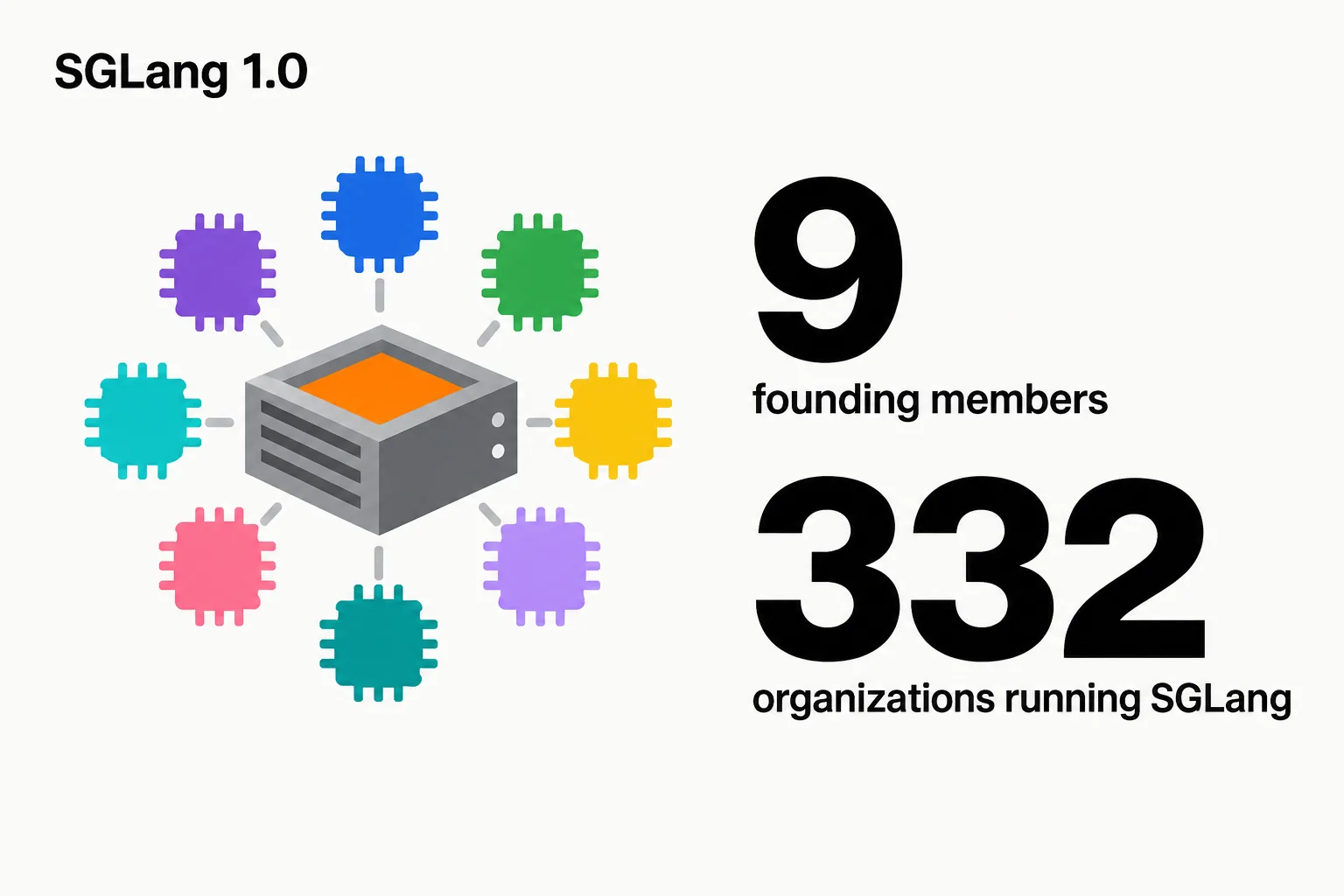
LMSYS announced SGLang v1.0 and a nine-member SGLang Consortium at the first SGLang Summit. The recap, published on November 17, 2026, names Nvidia, AMD, Intel, Google, Meta, Thinking Machines Lab, Cloudflare, Modal and RadixArk as founding members of a standing group that will work with SGLang’s maintainers on its roadmap.
SGLang’s own post about the summit, “2,000+ people. Two days.”, had 707,381 views on X by 15:22 UTC on November 18. SGLang is the open-source engine many labs use to serve models in production; the consortium puts most of the chip makers and two of the largest model builders behind one shared stack.
On this page · 6 sectionsOpen
 LMSYS published its SGLang Summit recap on November 17, 2026: SGLang v1.0, a consortium, Miles v0.2 and new hardware support.
 Nine founding members joined the SGLang Consortium: Nvidia, AMD, Intel, Google, Meta, Thinking Machines Lab, Cloudflare, Modal and RadixArk.
 Members get a standing forum on the roadmap; SGLang’s maintainers keep the final say on technical decisions and code.
 SGLang v1.0 targets efficiency and production scale, with unified memory management and hierarchical caching for long agent histories.
 LMSYS says agents now produce most of SGLang’s merged pull requests.
 Meta reported more than 2x GPU savings after moving its inference to SGLang; 332 organizations now use it, per LMSYS.
§ 01What was announced
| Announcement | What it is |
|---|---|
| SGLang Consortium | Nine founding members; roadmap forum with appointed technical representatives |
| SGLang v1.0 | Efficiency and production scale; unified memory and hierarchical caching |
| Miles v0.2 | RL post-training on Nvidia, AMD and Google TPU hardware; image, video, audio; Multi-LoRA |
| Nvidia NIM | SGLang now powers NIM Certified microservices |
| Intel + RadixArk | Collaboration to optimize SGLang for Intel CPUs, GPUs and accelerators |
| SGLang-Neuron v0.1.0 | Open-source preview on AWS Trainium, co-developed with Amazon Annapurna Labs |

§ 02Who runs the consortium
Members appoint technical representatives and join regular roadmap discussions, the recap says, while “SGLang’s maintainers retain responsibility for technical decisions and code acceptance”. The project stays open to the wider community. AMD CEO Lisa Su backed the launch in a recorded message: “At AMD, we are big believers in open,”
The focus areas are frontier model support, reasoning and multimodal workloads, distributed inference and hardware optimization.
§ 03What v1.0 is for
LMSYS frames v1.0 around strengthening what exists rather than new features: clearer configuration errors and compatibility expectations for later releases. The engineering reason is agents. Hybrid model architectures hold different kinds of state, and long-running agents build histories that outgrow GPU memory; unified memory management and hierarchical caching are meant to let that state be reused across memory tiers.
The recap also says the project itself is now built largely by agents, “with agents now producing most of the project’s merged PRs”, and that the team will next build AI tools that write code, review pull requests, build tests and propose roadmaps.
§ 04The numbers LMSYS reported
| Figure | Value | Who reported it |
|---|---|---|
| Organizations using SGLang | 332 | LMSYS |
| Consortium founding members | 9 | LMSYS |
| Meta GPU savings after migrating | More than 2x | Meta, on stage |
| Kimi K3.1 Pro on Vera Rubin vs GB300 NVL72 (AgentX) | Up to 6x token throughput per GPU | Nvidia slide |
The 6x figure counts total tokens including cached input, at matched interactivity, per the slide caption. None of these numbers come from an independent benchmark.
§ 05Where CellCog sits
CellCog runs on Anthropic’s Claude models through Anthropic’s API, so we do not host an inference engine and use neither SGLang nor its rivals directly. What touches us is cost: cheaper serving at the labs and open-model hosts is part of why model prices keep falling.
§ 06Sources
- LMSYS, SGLang Summit 2026 Recap: Building Open AI Infrastructure Together, November 17, 2026.
- SGLang on X, summit post, November 17, 2026.
- SGLang on X, the v1.0 announcement, November 12, 2026.
- SGLang on GitHub.
- Views read through the X API on November 18, 2026.
Q1Who are the SGLang Consortium founding members?
Nvidia, AMD, Intel, Google, Meta, Thinking Machines Lab, Cloudflare, Modal and RadixArk, per LMSYS’s November 17, 2026 recap.
Q2What does SGLang v1.0 change?
LMSYS describes it as hardening existing features, surfacing configuration problems clearly and setting compatibility expectations, with unified memory management and hierarchical caching for hybrid models and long-running agents.
Q3What is Miles v0.2?
SGLang’s reinforcement-learning post-training framework. v0.2 runs on Nvidia GPUs, AMD GPUs and Google TPUs, with AWS Trainium coming, and adds image, video and audio RL plus Multi-LoRA.
Q4Does Meta use SGLang?
Yes, per the recap: SGLang runs production inference for Muse App, Muse Code, Model API and the Meta family of apps, and Meta reported more than 2x GPU savings after migrating.
Q5Does CellCog run on SGLang?
No. CellCog runs on Anthropic’s Claude models through Anthropic’s API, so it does not host its own inference engine.