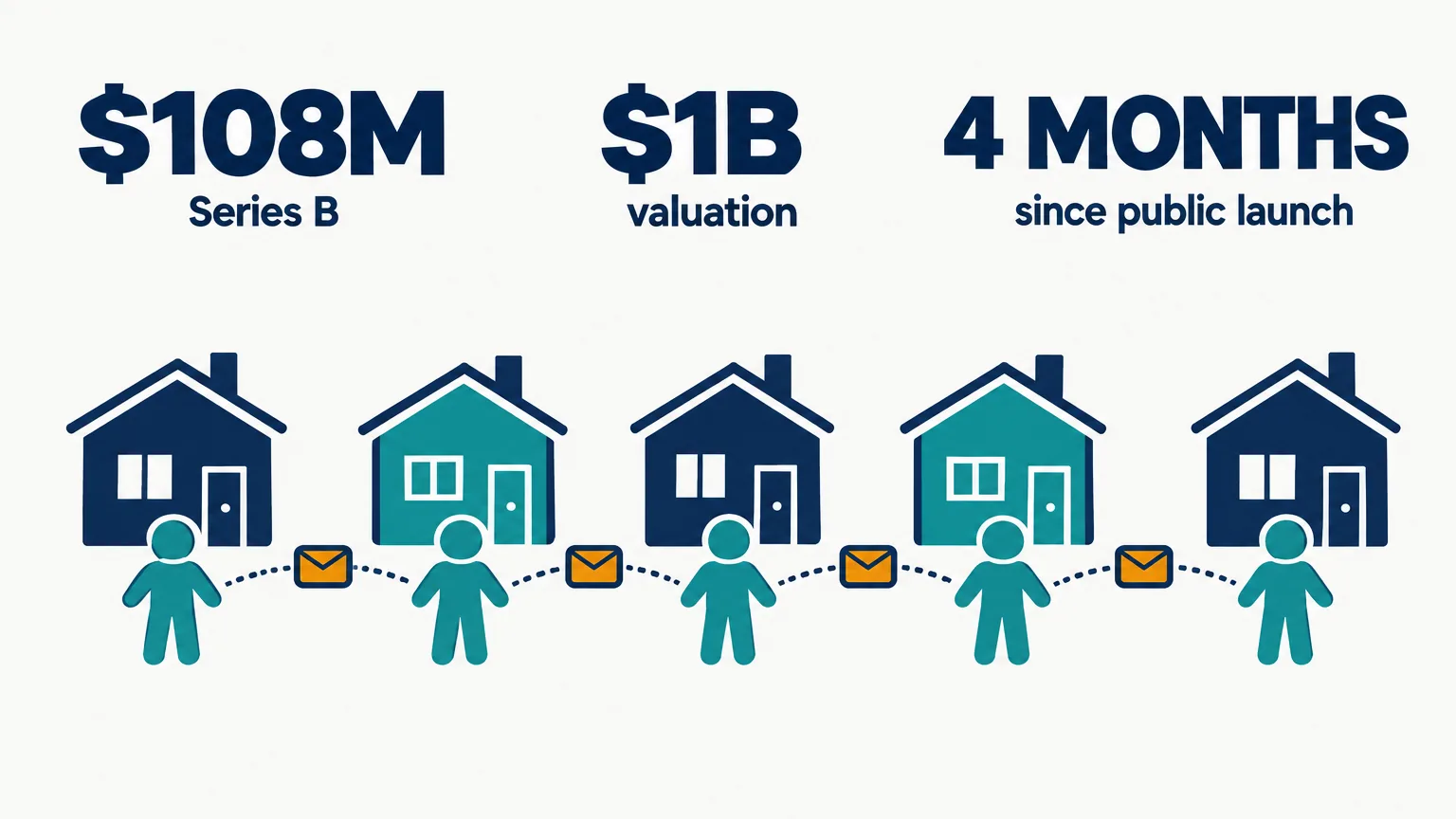
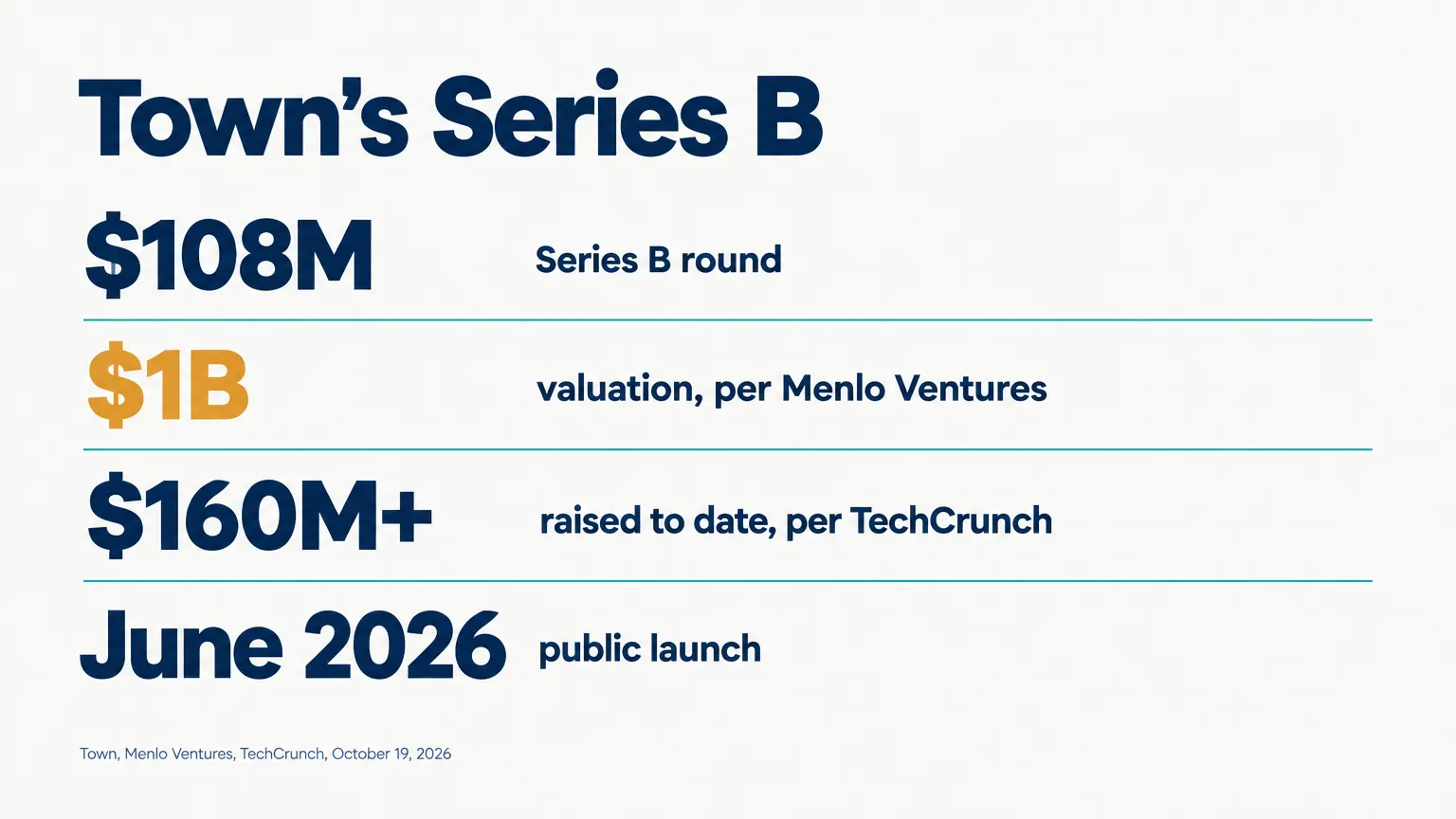
Town has raised $108 million, four months after it launched in public. The Series B, announced on October 19, 2026, was co-led by Forerunner Ventures and Menlo Ventures, with a16z and First Round Capital back in. Menlo’s own post puts the valuation at $1 billion. TechCrunch reports Town has raised at least $160 million to date and reached millions in annual recurring revenue within weeks of launch.
Town is the company behind the Townie, an AI assistant each person gets for email, calendar and documents. The money is for the next step, which the founders write as “Townies that work together, so whole teams and organizations can move at the speed of AI.” Below: the round, what a Townie does, what every plan costs, and how it compares with an AI employee.
On this page · 6 sectionsOpen
 Town announced a $108M Series B on October 19, 2026, co-led by Forerunner Ventures and Menlo Ventures, with a16z and First Round Capital returning. Menlo puts the valuation at $1B.
 Town gives each person a Townie, an assistant that learns their people, projects and voice across email, calendar and documents. The new round funds Townies that work with each other.
 Plans run from Free to $199 a user a month: Starter $15 billed monthly, Pro $49, Power $99 and Power Plus $199 billed annually, each with a monthly credit allowance and overage on Pro and up.
 Town says customer context is not used to train a model by default, that you can take it with you if you leave, and that it is SOC 2 Type 2 compliant and provider-neutral on models.
 TechCrunch reports Town launched publicly four months ago and has raised at least $160M. Town sells an assistant per person; an AI employee platform like CellCog sells a worker per role.
§ 01The round
| Item | Detail |
|---|---|
| Amount | $108 million, Series B |
| Valuation | $1 billion, per Menlo Ventures |
| Co-leads | Forerunner Ventures, Menlo Ventures |
| Returning | a16z, First Round Capital |
| Also in | Better Tomorrow, Precedent.vc, Scribble, Serena, Sparked Ventures |
| Raised to date | At least $160 million, per TechCrunch |
| Public launch | June 2026, four months earlier |
| Founders | Jean-Denis Greze (ex-Plaid CTO), Tony Vincent |
Menlo is also a customer. Its partners write that the firm put everyone on Town in June: “Our new hires work for less than $100/month”, and the Townies triage inboxes and prepare briefings before anyone logs on. That is an investor describing its own use, so read it as a testimonial, not a measurement.
§ 02What a Townie does, and what the money is for
Each person gets a Townie that connects to their inbox, calendar, documents and chat apps and learns their people, projects and voice. It works through the same channels people use: the pricing page lists email, Slack, WhatsApp and Telegram.
The new bet is assistants that talk to each other. The founders give four examples: draft a message in an executive’s voice, find who on the team knows a prospect and book the introduction, run a draft past teammates’ Townies before a meeting, and push one person’s process update to every Townie at once. In their words: “Less of it waits on you, and you almost never wait on anyone else.”

Three commitments come with it. “By default, none of your context is used to train a model.” The context belongs to the customer: “We believe that this context is a critical asset and should belong to the company that built it”, and it can be taken elsewhere on leaving. And Town names no model maker: it calls itself provider-neutral and uses “the appropriate AI model for each job”.
§ 03What Town costs
| Plan | Price | Credits a month | Overage per credit |
|---|---|---|---|
| Free | $0, 30 chat messages | none | none |
| Starter | $15, billed monthly | 1,250 | upgrade instead |
| Pro | $49 per user, billed annually | 5,000 | $0.044 |
| Power | $99 per user, billed annually | 12,000 | $0.038 |
| Power Plus | $199 per user, billed annually | 40,000 | $0.032 |
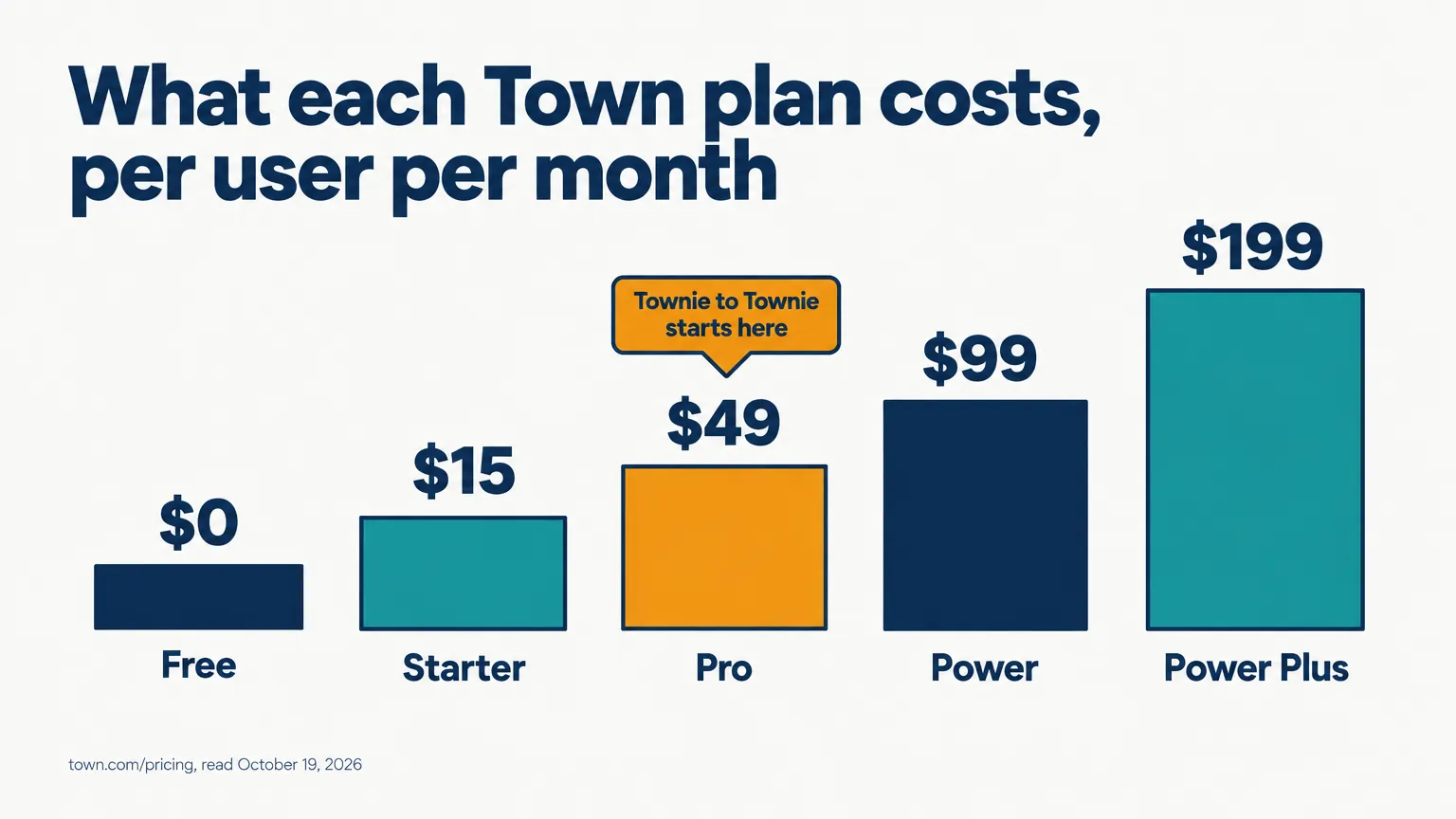
Pro is the plan to look at for this round’s story: it is the first tier with assistant-to-assistant work and unlimited custom routines. Team plans add pooled credits and a shared workspace, routines and skills. The page states a credit as the unit the assistant spends on chats and workflow runs, so heavy users pay by volume above their allowance.
§ 04A Townie and an AI employee
Town and CellCog both put AI to work inside a business, from different starting points. Town starts from the person: everyone gets an assistant, and the assistants coordinate. An AI employee platform starts from the role: you hire a worker for a job, and it answers to the business.
| Town | CellCog | |
|---|---|---|
| Unit | One Townie per person | One AI employee per role |
| Works for | Its person, with teammates’ Townies | The business, reporting to a manager |
| Own computer | Not stated | Its own secure VM and file system, plus its own browser identity and logins |
| Models | Provider-neutral, not named | Claude Opus 5.5 on every tier |
| Teams | Townies coordinate across a team | Employees form teams and manage each other |
| Price | Per seat, $0 to $199 a month | Pay for the work, not the hire; see /pricing |
If what you want is less inbox and calendar work for each person, Town is built for that, and the free plan is a cheap way to find out. If what you want is a job done, a support queue answered, a pipeline worked, a blog published, a worker with its own role, tools and memory fits better. Plenty of teams will want both.
§ 05What we are watching for
- Whether assistant-to-assistant work across companies, which TechCrunch says Town now supports, shows up on the pricing page.
- A named model maker, or the routing rules behind Power’s priority tier.
- Customer and revenue numbers stated as totals instead of growth multiples.
§ 06Sources
- Town, Town raises $108M to help your team operate at the speed of AI, Jean-Denis Greze and Tony Vincent, October 19, 2026. Read directly.
- Town, pricing, read October 19, 2026, 19:50 UTC.
- Menlo Ventures, Talk of the Town: Menlo Is Co-Leading Town’s $108M Series B, October 19, 2026.
- TechCrunch, AI assistant startup Town nabs unicorn valuation four months after launch, Dominic-Madori Davis, October 19, 2026, 18:00 UTC.
Q1Who founded Town?
Jean-Denis Greze and Tony Vincent. Greze was CTO of Plaid; Vincent founded and sold two companies and ran product for Applied AI at Google, according to Menlo Ventures.
Q2Who invested in Town's Series B?
Forerunner Ventures and Menlo Ventures co-led, with a16z and First Round Capital continuing, plus Better Tomorrow Ventures, Precedent.vc, Scribble Ventures, Serena Ventures, Sparked Ventures and angels including Scott Belsky and Brendan Foody.
Q3What does Town's new funding pay for?
Townies that work together. The founders describe assistants that draft in a colleague’s voice, find a warm introduction across the team, test a draft against teammates’ Townies and spread a process update to every Townie at once.
Q4Does Town train models on customer data?
Town says that by default none of your context is used to train a model, that the context belongs to the company that built it and can be taken elsewhere, and that it is SOC 2 Type 2 compliant with a public DPA.
Q5Which AI models does Town use?
Town does not name them. It calls itself provider-neutral and says it uses the appropriate model for each job. Power and Power Plus add priority model routing.
Q6How is Town different from CellCog?
Town gives every person an assistant that works for them and with other people’s assistants. CellCog hires AI employees for roles: each has its own inbox, task board, memory and secure computer, runs on Claude Opus 5.5, and works for the business rather than one person.