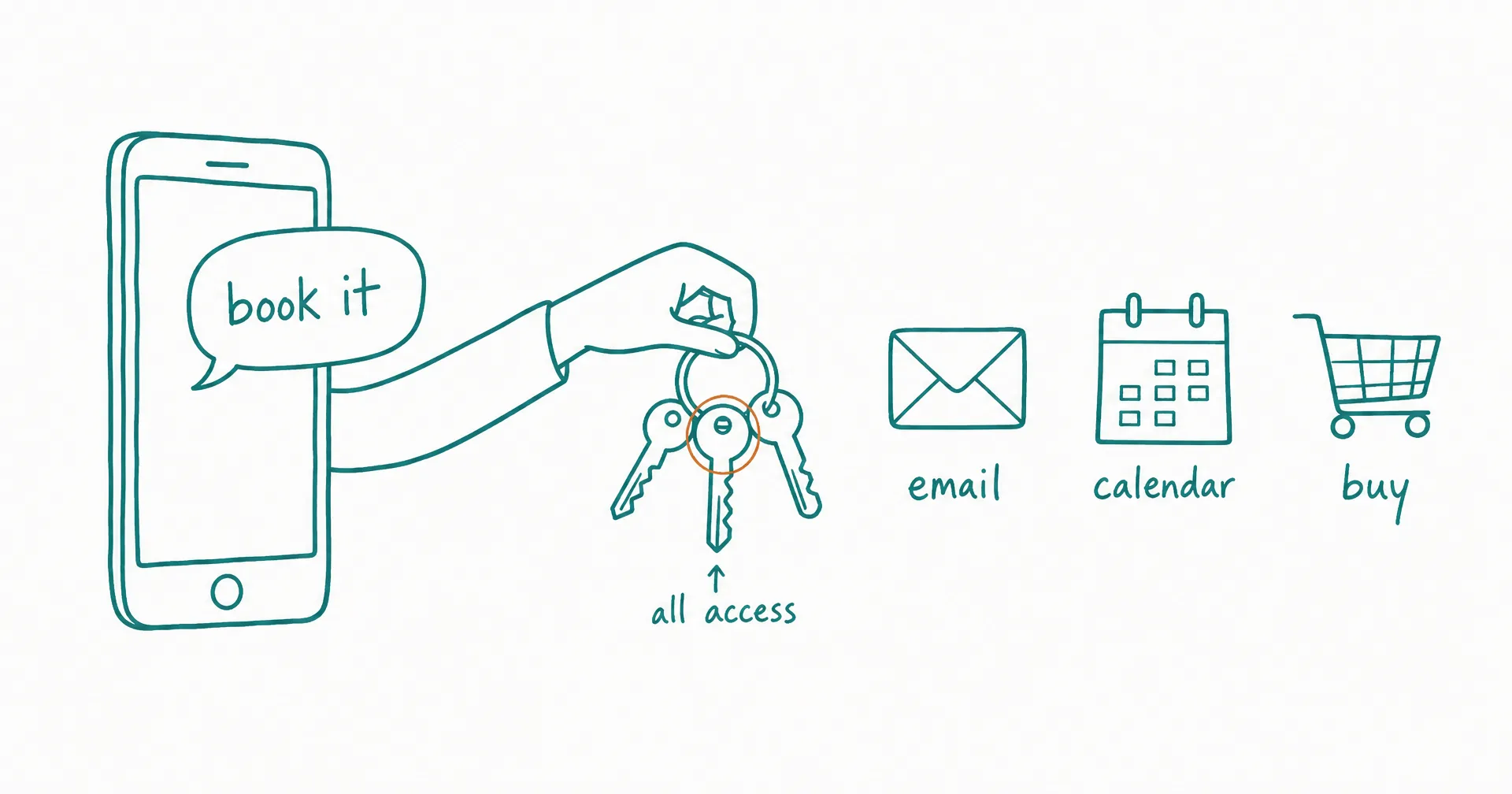
Instinct is the most talked-about AI product of the last two weeks, and most of the people talking about it cannot use it. It is an invite-only personal assistant from San Francisco’s Spear Street Technology: you text it or call it, it connects to your email, messages, calendar, and devices, and it does things. Not suggests things. Does them.
In the space of one week in late August 2026, Instinct went from near-total stealth to a $2.5 billion valuation, a security controversy, and a founder introduction that pulled roughly a million views in a day. This explainer covers what it actually is, sourced from Instinct’s own site and terms of service rather than the hype cycle: what it does, who built it, why it blew up twice in the same week, and what its terms say you are agreeing to.
On this page · 6 sectionsOpen
- Instinct is an invite-only personal AI assistant from San Francisco’s Spear Street Technology, led by 23-year-old former Sierra researcher Noah Shinn. You text or call it; there is no app interface to learn.
- It connects to your email, messaging, calendar, screen, audio, and location, and it acts: booking travel, buying groceries and tickets, cancelling subscriptions, and sending email on your behalf. Since October 5, early-access users can also add it to group chats, even with friends who have no account.
- It went viral in late August 2026 in two waves: credible completed-task stories from early users, then a security backlash over data retention and unconfirmed actions.
- On August 26, 2026 the company told the Wall Street Journal it raised a $250M Series B at a $2.5B valuation, co-led by Index Ventures and Benchmark, bringing total funding to $350M (per TechCrunch).
- Instinct’s own terms are direct about the trade: disconnecting an account does not delete the data already indexed from it, and the service is appointed as your agent to enter agreements that bind you.
- It is free during the private beta, with no announced pricing. Access is by waitlist or invite from an existing member.
- Instinct is a personal-life agent, not an AI employee: it manages your life admin, while an AI employee owns a business role with its own inbox, task board, and working schedule.
§ 01What Instinct actually does
Instinct’s own description is compact: “a personal assistant that understands what you’re working on and what’s important to you.” The interface pitch is that there is no interface. In the company’s words: “there are no new interfaces. It’s trained to use a phone and a computer. You can text or call it.”
Under that simplicity sits very deep access. Instinct connects to your applications and devices: email, messaging, screen, audio, location, and more. Its model is trained to operate a phone and computer the way a human does, which means it can act inside services that have no API at all. The site’s own examples include following up on threads you have dropped, proactively calling or texting you, arranging a ride to the airport, and booking a handyman.
Early users pushed it much further. Reports collected by TechCrunch and posted directly by testers describe Instinct booking and rebooking flights, making restaurant reservations (including retrieving a signup code from email to complete a Resy booking), buying groceries and concert tickets, cancelling hundreds of dollars of subscriptions, managing investor follow-ups, and in one case helping plan a wedding.
The common thread, and the reason the stories spread: these anecdotes end with a completed real-world task, not with instructions for the user to go do it themselves.
Group chats (since October 5)
On October 5, 2026 Instinct opened group chats to early-access users. Adding Instinct to a thread brings in a separate Instinct that works for the whole group, and it works even when friends in the thread have no Instinct account. The company’s examples are travel planning, event tickets, carpools and sorting out who brings what to Thanksgiving.
The privacy model, as founder Noah Shinn described it on X and TechCrunch reported:
- The group’s Instinct is siloed and cannot reach any member’s personal accounts.
- A member’s personal Instinct asks permission before it connects to the group’s agent, and before it shares information or takes any action.
- Members choose which groups they trust and can remove that trust at any time.
- If someone new joins the thread, pending replies from a personal Instinct are held before they reach the group.
It is the first feature where Instinct is clearly ahead of Meta’s Muse, which TechCrunch notes does not yet offer group chats (Meta’s older Meta AI app can join group chats on WhatsApp, Messenger, Instagram and Facebook). It is early access only for now; the company says it will reach all users soon.
§ 02Who is behind it, and the $2.5B week
Instinct is operated by Spear Street Technology, Inc., a San Francisco company led by Noah Shinn, a 23-year-old former research scientist at Sierra, the AI customer-service company founded by Bret Taylor and Clay Bavor. Shinn introduced himself publicly for the first time on August 26, 2026: “I’m Noah, the founder of Instinct. Instinct is a personal agent that we’ve been building for the past few months.”
The same day, the company told the Wall Street Journal it had raised a $250 million Series B at a $2.5 billion valuation, co-led by Index Ventures and Benchmark, bringing total funding to $350 million, per TechCrunch. TechCrunch had earlier reported Kleiner Perkins and Conviction as investors in prior rounds. One precision note as of August 28: The Information, citing a person with direct knowledge, reported the round was expected to close within weeks, so the honest tense is raising rather than raised; no formal company or investor announcement has appeared yet. For a product still in private beta, with a one-page website, that is one of the fastest valuation runs the agent category has seen.
Update, September 12. Two weeks on, the round has a sequel and the product a new capability. On September 10 The Information reported that Instinct is seeking about $1 billion in new funding at a valuation near $10 billion, roughly four times the August figure; the article is paywalled, and the numbers above come from investors and reporters summarizing it on X, so read them as reported, not confirmed. The same summaries repeat the compute problem from August: Shinn does not want to charge users, so the money goes to chips and data centers. On the product side, Shinn posted on September 11 that Instinct can now complete the six-digit authenticator step of a login for you, using the same time-based one-time password standard as Authy and Google Authenticator. That widens what the agent can do inside your accounts, and what a compromise of the agent could do; the terms section below applies with more force, not less.
Update, September 17. The $10 billion round moved from a figure to a set of names, and the product gained a phone. On September 15 The Information reported that Instinct is in talks to raise about $1 billion at a valuation of about $10 billion, with Sequoia Capital and Benchmark discussing the lead, and that the service has passed 100,000 users; Reuters carried the report the next morning, attributed to The Information. Talks, not a close: no lead has been named by the company, no terms announced, and neither Instinct nor Shinn has commented. The valuation path, as reported, runs from about $50 million in the spring to $2.5 billion on August 26 to $10 billion under discussion. On the product, Shinn posted on September 16 that “Your Instinct can now handle phone calls” through Instinct Concierge, “a white glove service meant to handle high-touch cases”, rolling out to the early-access group first. An agent that emails, logs in with your authenticator and now calls on your behalf is the whole thesis of the terms section below.
Update, September 24. A week of product, and the first trust test in public. On September 18 Shinn posted that Instinct can create shareable Files, private or public interactive pages it builds to compare options. On September 23 he posted that the Instinct-to-Instinct network, opened to all users on September 14, had “coordinated over 300k+ times” and that Instincts can now pass PDFs, images and spreadsheets to each other; he says “Every file that’s transferred between Instincts is encrypted end-to-end between the sender and recipient.” Two minutes later, at 23:04 UTC, he answered a user who said Instinct had described a financial document that was not theirs: “This was not a data breach, no user data was shared, and no user isolation boundary was violated.” His account is that the model fabricated a proper noun and its reasoning ran with it, and that in the last 48 hours the company built “an active hallucination detection system that now scans and verifies every token that flows through the platform”, with a deeper write-up promised. That is the company’s explanation, not an independent one; no outside audit has been published. The shape of the question is the one this page keeps returning to: an agent with this much access has to be right about whose data it is looking at, and the user has to be able to tell which kind of failure happened.
Update, September 29. The round closed. On September 28 Instinct announced a $1 billion Series C at a $10 billion valuation from Sequoia Capital, Benchmark Capital and Coatue, in a Business Wire release. It is the round The Information first reported on September 10, now confirmed by the company, and it is four times the $2.5 billion valuation of August 26. Shinn, in the release: “This funding helps us bring Instinct to more people and continue building the future of personal AI.” The release gives no user or revenue figures, and the product is still in early access.
Update, October 6. A week after the round, three product moves and the first numbers from the founder. On a podcast with investor Patrick O’Shaughnessy, reported by TechCrunch on September 29, Shinn said more than half of transactions on Instinct are travel, that the platform is approaching a billion dollars in annual transactions, and that it is growing 10 percent a day; he did not say how the annual figure is calculated, and the company still publishes no user count. The same night Instinct began sending curated picks, called Instinct Selections, and some early users objected to product suggestions they had not asked for. On October 5 it opened group chats to early-access users: a separate Instinct joins the thread, works for people who have no account, and per Shinn cannot reach anyone’s personal accounts.
Update, October 7. The agent now talks to the company’s agent. Shinn announced at 16:45 UTC that Instinct will partner with Sierra and Decagon on customer service: when your Instinct connects with a participating business on either platform, “the agents will be able to work together to solve your problem with speed, reliability, and safety without making a phone call.” His examples are home wifi trouble, a delayed package, a bill higher than last month, and a confusing return or cancellation policy. It extends Instinct Concierge, which already places calls on your behalf. The plumbing was announced the day before: Instinct is a named partner in the Personal Agent Protocol that Meta and Sierra introduced on October 6, and Decagon’s PACT, open-sourced the same day, was “co-developed and supported by Instinct.” No participating business is named yet, and Sierra’s protocol has no published specification (v0.1 is planned for later in October). For the terms section below, the change is one of direction: the agent that holds your accounts can now settle a dispute with the company’s own agent, with no person on either end.
| Date | What happened | Source |
|---|---|---|
| Sep 28 | $1 billion Series C at a $10 billion valuation, from Sequoia Capital, Benchmark Capital and Coatue | Business Wire release |
| Sep 29 | Founder on a podcast: more than 50% of transactions are travel; approaching $1 billion in annual transactions; growing 10% a day | TechCrunch, founder’s claims |
| Sep 29 | Instinct Selections: curated picks from local chefs, designers, architects and travel guides | Founder on X, via TechCrunch |
| Sep 30 | Early users push back on unsolicited product suggestions | TechCrunch |
| Oct 5 | Group chats for early-access users, including friends without an account | TechCrunch, founder on X |
Shinn’s pitch for Selections was taste: partners such as “local chefs, designers, architects, travel guides” instead of only what a model finds on the web. The pushback was about timing, not quality. One investor, Shruti Gandhi of Array VC, wrote that she “didn’t need to buy carry-on luggage, sunglasses, or a brim hat.” Instinct has not said whether it earns money from the picks. TechCrunch counts the company at 14 people and names Meta’s Muse and Wajo as its rivals; OpenAI’s dots, launched September 29, now compete for the same personal-agent slot.
§ 03Why it went viral twice in one week
The first wave, roughly August 17 to 23, was capability: founders and investors posting completed-task stories. One investor described it as outperforming Hermes, OpenClaw, Tasklet, and Grok Bot for travel, reservations, email, and CRM work. The invite-only scarcity did the rest.
The second wave was the backlash, and it is the more instructive one, because every incident traces back to the same design property: an agent with standing read/write access to your accounts.
- Claire Vo disconnected Instinct from Google at 11 AM and got a summary of her email at 2 PM. The bot confirmed her emails were stored in plain text for later searches.
- Peter Yang found Instinct would not delete his indexed Gmail records when asked. The team later added a deletion tool in settings.
- Alex Cohen ran a prompt-injection test: he emailed his own account from a fresh address with instructions for Instinct, found it could be phished, and deleted his account.
- Katie Jacobs Stanton reported Instinct sent an email on her behalf without checking first. Her summary of the whole trade is the sharpest one written so far: “The more powerful these agents become, the more trust matters. Every successful action earns a little more trust. One unauthorized action can reset that trust to zero.”
None of these were external breaches. They were demonstrations of what standing access plus autonomous action means when the guardrails are still being built in public.
§ 04What Instinct’s terms actually say
Instinct revised its Terms of Service on August 26, 2026, after screenshots of the earlier version circulated widely (TechCrunch’s August 24 coverage quotes the earlier terms granting a broad “perpetual and irrevocable” license over user materials). We read the current version directly. Three clauses matter most:
Disconnecting is not deleting. Verbatim: “even if you disconnect a Connected Service, we may still use the indexed Connected Service Input data unless you follow the instructions to request deletion.” Deletion is a separate request, made from the workspace settings.
The agent can bind you. The terms appoint the service “as your agent to enter into agreements, commitments or transactions on your behalf,” and any such agreements “shall be binding on you as if entered into directly by you.” For purchases, you are the buyer, the connected service’s cancellation and refund policies apply, and disputes are between you and that provider.
Safeguards carry no warranty. The terms state the company may implement confirmation requirements or other controls on actions, but “we make no representation or warranty that such safeguards will prevent unintended or erroneous Actions.” Responsibility for the consequences, financial and contractual, sits with you.
On training: by default your materials can be used to train models, with a go-forward opt-out in settings, and a Vault feature whose contents are excluded from training. To the company’s credit, all of this is stated plainly rather than buried.
§ 05Instinct vs an AI employee
Instinct and AI employees sit on the same tectonic change: AI that acts instead of AI that answers. But they are different products for different halves of your life, and the delegated-authority design is where the difference shows.
Instinct works for you, the person: your inbox, your dinner reservations, your subscriptions. Its authority model is broad by design, because life admin is unstructured, and the August incidents show the cost of getting that model right in public.
An AI employee works for your business, in a role. That structure changes what safe delegation looks like. A CellCog employee has its own email address and its own workspace rather than standing inside yours, and you control which credentials and tools each employee can use. Every command that reaches your world is classified by the agent, and the platform rejects any command that arrives unclassified; actions above the level you set wait for your approval. The unconfirmed-email incident that reset Katie Stanton’s trust is, in a role-based system, a permission you simply have not granted yet.
§ 06Should you join the waitlist?
Honestly: if the life-admin problem is real for you, yes. Instinct is the most credible consumer personal agent to appear since OpenClaw, the early-user reports are impressive, and the company moved quickly on the loudest complaints (the deletion tool, the revised terms). The waitlist costs you nothing but patience; there is also a fast-growing set of alternatives you can use today while you wait.
Go in with your eyes open about the trade. Before connecting your primary email, read the terms yourself, know that disconnect and delete are separate acts, decide what belongs in the Vault, and set the training opt-out if that matters to you. The category Instinct is dragging into the mainstream, agents with real authority over real accounts, is going to define consumer security norms for the next decade. It is worth understanding the terms of that trade before you make it, whether with Instinct or anyone else.
Q1What is Instinct AI and what can it do?
Instinct is a personal AI agent from Spear Street Technology that you reach by text or call. It connects to your applications and devices, including email, messaging, screen, audio, and location, and takes actions on your behalf: users report it booking and rebooking flights, making restaurant reservations, buying groceries and concert tickets, cancelling subscriptions, cleaning up inboxes, and planning trips. Since October 5, 2026 it also works in group chats for early-access users: a separate Instinct joins the thread, works for friends without an account, and cannot reach anyone’s personal accounts.
Q2How do I get access to Instinct?
As of late August 2026 it is invite-only. You can join the waitlist at instinct.co or get an invitation from an existing member. The company says it is scaling up compute before opening access wider.
Q3How much funding has Instinct raised?
Per TechCrunch, the company told the Wall Street Journal on August 26, 2026 that it raised a $250 million Series B at a $2.5 billion valuation, co-led by Index Ventures and Benchmark, bringing total funding to $350 million. TechCrunch had earlier reported Kleiner Perkins and Conviction as investors. In September 2026 The Information reported the company was seeking about $1 billion more at roughly a $10 billion valuation, and on September 15 that it was in talks with Sequoia Capital and Benchmark about leading that round; Reuters carried the report on September 16. As of September 17, 2026 no round has been announced as closed and Instinct has not commented.
Q4Is Instinct AI safe to connect to my email?
That is the live debate. Early testers documented real issues in August 2026: email data retained and summarized after a connector was disconnected, an email sent without confirmation, and a successful prompt-injection test. Instinct revised its terms on August 26 and added a deletion tool. The current terms still say disconnecting a service does not delete already-indexed data unless you separately request deletion, and that safeguards on actions carry no warranty. Read the terms before connecting anything you cannot afford to expose.
Q5Does Instinct train AI models on my data?
By default the terms allow the company to use your materials to improve the service, including training AI models. There is an opt-out in settings, which applies on a go-forward basis only, and a Vault feature whose contents the company says are never used for training.
Q6Is Instinct an AI employee?
No. Instinct is built around one person’s life: your inbox, your reservations, your subscriptions. An AI employee is built around a role in a business: it has its own email address, a task board your team can see, a working schedule, and reports back on outcomes. The two categories share the same underlying move, from AI that answers to AI that acts, but they answer to different bosses.