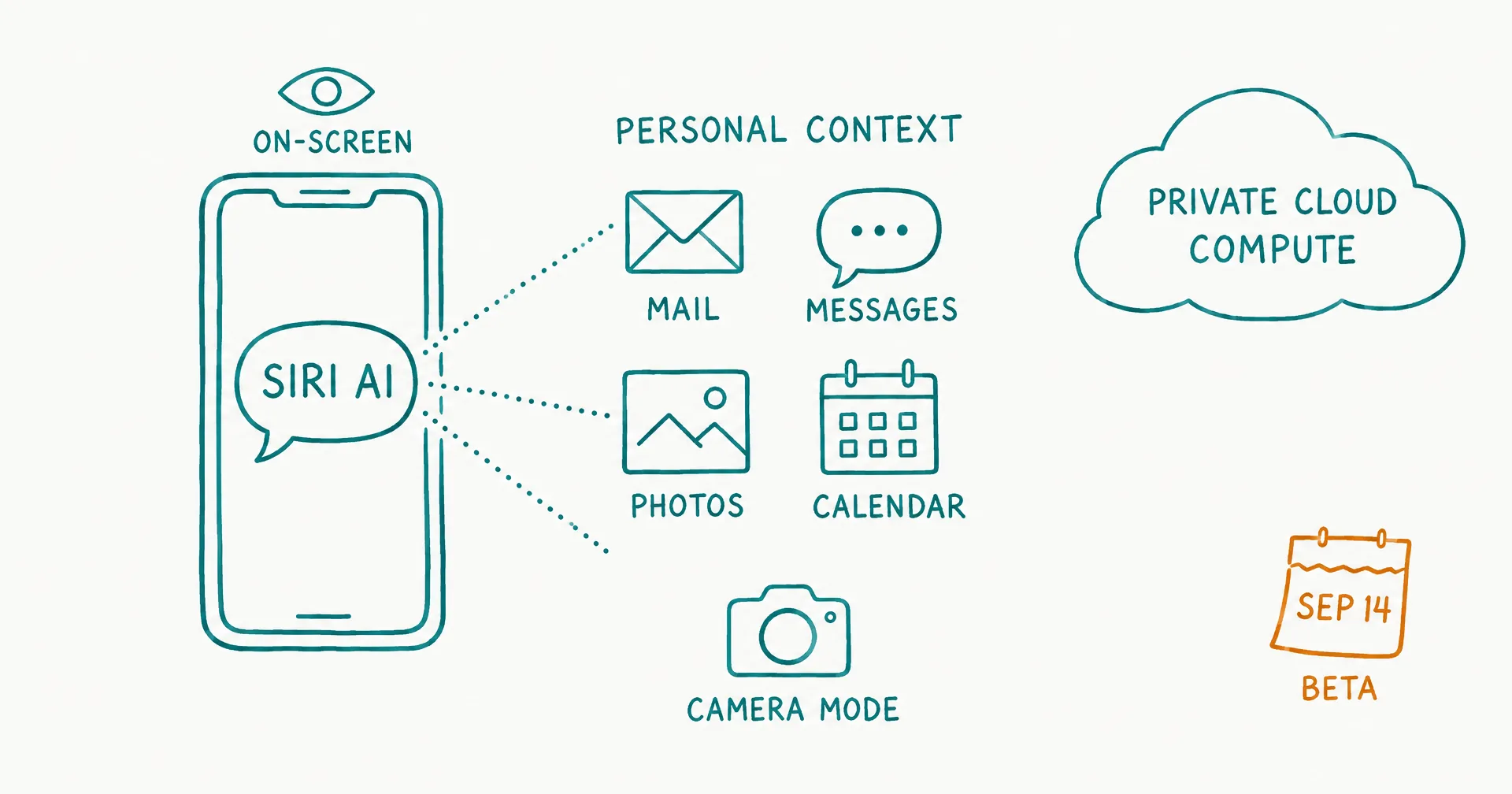
Apple used its September 9 event to put a date on the Siri it first described in June. Siri AI, “an entirely new version of Siri” powered by Apple Intelligence, arrives in beta with iOS 27 on Monday, September 14, 2026, and it is the software story running under every product on the stage: the iPhone 18 Pro pair, the foldable iPhone Duo, and the new Apple Watch and AirPods lines. Apple’s CEO John Ternus opened the event by arguing, per TechCrunch’s report, that the best AI device is still the iPhone.
This page keeps to what Apple itself published: the WWDC26 announcement of June 8, the iPhone Duo and iPhone 18 Pro press releases of September 9, the Apple Intelligence product page, and Apple’s developer documentation. It covers what Siri AI is, what it can do on day one, where it runs, the limits Apple printed in its own footnotes, what Apple left out, and where it sits next to the other assistants and agents that launched this summer.
On this page · 9 sectionsOpen
- Siri AI is Apple’s rebuilt Siri, announced at WWDC26 on June 8, 2026 and rolling out in beta with iOS 27 on Monday, September 14, 2026. Apple calls it ‘an entirely new version of Siri’ that is ‘profoundly more personal, capable, and conversational’.
- What it does, in Apple’s words: draws on personal context across messages, emails, photos and more; takes actions in apps like Messages, Music and Reminders; answers questions about what is on your screen; pulls current information from the web; and keeps conversations in a new Siri app synced through iCloud.
- A Siri Camera mode on iPhone Duo and Camera Control ‘lets Siri see what the user sees to answer questions and take action’, and you can type to Siri AI instead of speaking.
- The limits Apple published: English only at launch, with French, Japanese, Korean, Portuguese and Spanish ‘coming in October’; not initially available in the EU on iOS, iPadOS or watchOS; not available in China; not for users under 13; and server-side features including Siri AI are ‘subject to daily usage limits’, with ‘expanded access’ to be ‘available for a fee in the future’.
- It runs on device and on Private Cloud Compute. The A20 Pro in iPhone 18 Pro and iPhone Duo carries a dual 16-core Neural Engine with, per Apple, twice the compute for on-device AI models.
- Apple never uses the word ‘agent’ for Siri AI in the September 9 announcements, and names no third-party model partner. Developers reach it through App Intents and the View Annotations API.
- Siri AI is built for one person’s phone. An AI employee is hired for a role in a business, with its own inbox, task board and memory, and it works alongside other employees. Same wave, different job.
§ 01What Siri AI is
| Question | What Apple says | Where |
|---|---|---|
| What it is | “An entirely new version of Siri that is profoundly more personal, capable, and conversational” | iPhone Duo press release, September 9, 2026 |
| Personal context | “Draw on personal context understanding to help users find what they need in the moment across messages, emails, photos, and more” | iPhone 18 Pro press release, September 9, 2026 |
| Actions | “Take actions in apps like Messages, Music, Reminders, and more based on what you’re doing in the moment” | Apple Intelligence product page |
| On-screen awareness | “Answer questions related to the content on a user’s screen” | WWDC26 announcement, June 8, 2026 |
| World knowledge | “Go out to the web to get up-to-date information using broad world knowledge and generate a helpful answer” | WWDC26 announcement |
| The app | “A dedicated Siri app allows users to revisit a past conversation or kick off a new one” with history synced “privately” through iCloud | WWDC26 announcement |
| Camera | Siri Camera mode “lets Siri see what the user sees to answer questions and take action” | iPhone Duo press release |
| Input | “Type or talk naturally with Siri AI” | Apple Intelligence product page |
The part that is new since June is the calendar, not the feature list. Apple’s June release promised Siri AI “as a beta later this year” in English. The September releases fix it to September 14 and add the language schedule: French, Japanese, Korean, Portuguese and Spanish “coming in October”.
§ 02What it can do on day one
Apple’s examples, gathered from the three pages, are concrete and small: find a photo from years ago by describing it, locate an email buried in an inbox, pull the details from a saved note, edit a message you just sent, add a song you hear in the car to a workout playlist, create a Calendar event for a tennis match from a conversation, describe what you want written and have Siri compose it, and point the camera at a dish to get nutrition information or at a receipt to split the bill. The Siri app keeps every conversation, so a question started on iPhone can be picked up on iPad.
Two things frame those examples. First, the actions run inside Apple’s apps and inside third-party apps that have adopted App Intents; Apple’s developer page says apps integrate “content and actions into Siri AI and across the system via App Intents”, and the View Annotations API adds on-screen awareness by mapping views to entities. Second, Apple describes app actions and on-screen answers, not open-ended browsing or purchases. That is a narrower definition of “acting” than the one Meta shipped for Muse a day earlier, and the difference is deliberate: Siri AI works through the apps on your phone, not through a browser on a remote computer.
§ 03Where it runs
Apple’s line is unchanged: on-device processing first, Private Cloud Compute for requests that need larger models, and a privacy promise that data on the servers “is never stored” and is “used only for your requests”. The September hardware is built around that split. Apple says the A20 Pro in iPhone 18 Pro and iPhone Duo carries a dual 16-core Neural Engine with 2x the compute power to run on-device AI models, on a 2-nanometer process, and that on iPhone Duo the chip package “can reach peak performance for on-device AI immediately”.
| Device | Starting US price | Pre-orders | Available |
|---|---|---|---|
| iPhone 18 Pro | $1,199 | September 12 | September 18 |
| iPhone 18 Pro Max | $1,299 | September 12 | September 18 |
| iPhone Duo | $1,999 | October 16 | October 23 |
The foldable is the headline of the event and the one device that does not ship Siri AI first: iOS 27 with Siri AI reaches existing supported iPhones on September 14, a month before iPhone Duo is in anyone’s pocket. Apple positions Duo’s 7.6-inch inner display as the place Siri AI “becomes even more useful”, with an app open on one side of the screen and the Siri conversation on the other.
§ 04The limits Apple published
Apple’s footnotes are the most useful paragraph of the launch, so here they are in one place.
| Limit | Apple’s wording | Source |
|---|---|---|
| Language | “Available in English to start”; French, Japanese, Korean, Portuguese and Spanish “coming in October” | Apple Intelligence page; iPhone 18 Pro release |
| Region | “Will not be initially available in the EU on iOS, iPadOS, and watchOS”; Mac and Vision Pro users in the EU can use it | Apple Intelligence page; WWDC26 release |
| China | “Will not be available in China while Apple works through regulatory requirements” | WWDC26 release |
| Age | “Siri AI is not available for users under 13” | Health press release footnotes, September 9 |
| Usage | Server-side features “are subject to daily usage limits, including but not limited to Siri AI” | Health press release footnotes |
| Price | “Expanded access to such features will be available for a fee in the future”; increased access with most iCloud+ plans | Health footnotes; WWDC26 release |
| Status | “Rolling out in beta” | Every September 9 release |
Two of those rows matter for anyone planning around it. The usage limits mean Siri AI is metered from day one, with Apple already telling you the meter will have a paid tier. And “beta” is Apple’s word, printed on every page; the September 14 release is the start of the rollout, not the finished product.
§ 05The road to September 14
| Date | Event | Source |
|---|---|---|
| June 8, 2026 | Siri AI announced at WWDC26; developer testing begins | Apple Newsroom |
| September 9, 2026 | iPhone Duo and iPhone 18 Pro announced with Siri AI | Apple Newsroom |
| September 12, 2026 | iPhone 18 Pro pre-orders open | Apple Newsroom |
| September 14, 2026 | iOS 27 ships; Siri AI beta, English | Apple Newsroom |
| October 2026 | French, Japanese, Korean, Portuguese, Spanish | Apple Newsroom |
| October 23, 2026 | iPhone Duo available | Apple Newsroom |
§ 06What Apple did not say
- The word “agent”. It does not appear in the September 9 releases or on the Apple Intelligence page. Apple says “assistant”, “personal context”, “app actions” and “on-screen awareness”. Meta, xAI and Spear Street all sell “agents”; Apple is describing overlapping behavior in a different vocabulary, and the vocabulary is a product decision.
- A model partner. No third-party model is named anywhere in the September pages. Apple’s developer page says the Foundation Models framework accepts “any provider that conforms to the Language Model protocol”, which is a statement about what developers can plug in, not about what runs Siri.
- The size of the daily limit. “Daily limits may vary by feature, request complexity, system demand, system policies, and other factors” is the whole disclosure.
- The price of expanded access. “Available for a fee in the future” has no number and no date attached.
- A supported-app list. Actions work “in apps like Messages, Music, Reminders, and more”; the third-party set depends on which developers adopt App Intents, and Apple publishes no catalog.
§ 07Siri AI vs Muse vs Grok Bot vs an AI employee
Four launches in four weeks now cover the whole personal-assistant-to-agent spectrum. Siri AI is the assistant on your phone, working through your apps. Muse is Meta’s agent on a dedicated cloud computer with its own browser. Grok Bot is xAI’s always-on teammate on a per-user computer. All three are built for one person. A business role needs something else: a worker other people can assign work to, that keeps records the team can read, and that coordinates with other workers. That is what a CellCog AI employee is for, and since we build it, read our column with the discount it deserves.
| Siri AI (Apple) | Muse (Meta) | Grok Bot (xAI) | CellCog AI employee | |
|---|---|---|---|---|
| Built for | One person’s phone, tablet, Mac and watch | One person’s own tasks and goals | One person’s work, with team plans | A role inside a business |
| Where it runs | On device plus Private Cloud Compute | One dedicated VM per person, Sentinel-gated | One computer per user per xAI’s docs | Its own workspace, and its own browser identity and logins, separate per employee |
| How it acts | App actions through App Intents; on-screen and camera awareness | Browser, email, forms and payments on its VM | Persistent sessions with tool access | Email, browser, code, documents, video, dashboards, from its own inbox and task board |
| Who assigns work | The person | The person | The person | You, your team, and the employee itself from its task board |
| Memory | Personal context across apps; Siri app history synced via iCloud | Remembers what matters; can be told to forget | Per xAI’s memory advisory | Carries what it learns from one working session into the next; team memory shared across employees |
| Works with others | No | No | Limited to sharing with a team | Yes: channels, direct messages, delegation between employees, org chart |
| Sensitive actions | Apple describes app actions, not purchases or outbound email | Sentinel approval plus person approval before email and purchases | Per-command approval settings | Every command that reaches your world is classified by the agent before it runs; the platform rejects any command that arrives unclassified, and you set the threshold |
| Pricing shape | Free in iOS 27 with daily limits; expanded access “for a fee in the future” | Free with limits, $20 and $100 a month | Plans from $20 a month as of August 26, 2026 | Pay for the work, not the hire; the cost depends purely on how much work you assign (pricing) |
| Status | Beta from September 14, English, not in the EU | Limited testing, US only | Beta since August 11 | Available today |
§ 08What we are watching for
- The daily limit in practice. How many Siri AI requests a free iOS 27 user gets before the meter stops decides whether this is a feature or a paid tier with a preview.
- The price of expanded access. Apple has named the fee’s existence and nothing else.
- Third-party App Intents adoption. The action list on September 14 will be Apple’s apps plus whoever shipped intents in time; the breadth a month later is the real measure.
- The EU. Mac and Vision Pro get Siri AI in the EU; iPhone does not, and Apple gives no date.
- A model disclosure. Any statement about which models answer Private Cloud Compute requests would change the comparison table above.
§ 09Sources
Apple Newsroom, Apple unveils iPhone Duo and Apple debuts iPhone 18 Pro and iPhone 18 Pro Max, September 9, 2026. Apple Newsroom, Apple advances health and fitness capabilities using Apple Intelligence, September 9, 2026 (footnotes on usage limits, fees and age). Apple Newsroom, WWDC26: Apple unveils next generation of Apple Intelligence, Siri AI, powerful parental controls, and an expansive set of software improvements, June 8, 2026. Apple, Apple Intelligence and Siri product page and Apple Intelligence for developers, read September 9, 2026. TechCrunch, Apple CEO John Ternus says the best AI device is still the iPhone, September 9, 2026.
Q1Is Siri AI the same as Apple Intelligence?
No. Apple Intelligence is the umbrella system: on-device and Private Cloud Compute models powering photo editing, writing tools, Visual Intelligence and more. Siri AI is the assistant built on top of it, an entirely new Siri per Apple, with a dedicated app and conversational history.
Q2Which devices get Siri AI?
Apple says it requires an Apple Intelligence-enabled device set to a supported language, in beta on iOS 27, iPadOS 27, macOS 27, watchOS 27 and visionOS 27. The September 9 hardware, iPhone 18 Pro, iPhone 18 Pro Max and iPhone Duo, all ship with it; the older-device list is on Apple’s Apple Intelligence page.
Q3Can Siri AI take actions on my behalf?
Within Apple’s frame, yes: it takes actions in apps like Messages, Music and Reminders based on what you are doing, edits a message you just sent, adds a song to a playlist, creates a Calendar event from context, and acts on what the camera sees. Apple describes app actions and on-screen awareness; it does not describe open-ended browsing, purchases or email-sending the way Meta’s Muse does.
Q4Does Siri AI use Gemini, ChatGPT or another company's model?
Apple’s September 9 announcements name no third-party model. They describe Apple Intelligence running on device and on Private Cloud Compute, where Apple says your data is never stored and is used only for your requests.
Q5How is Siri AI different from an AI employee?
Siri AI works for one person on their own devices, in their own apps. An AI employee is hired into a role in a business: it has its own inbox and task board, keeps records your team can read, works with other employees, and every command that reaches your world is classified by the agent before it runs. One is a personal assistant; the other is a coworker.