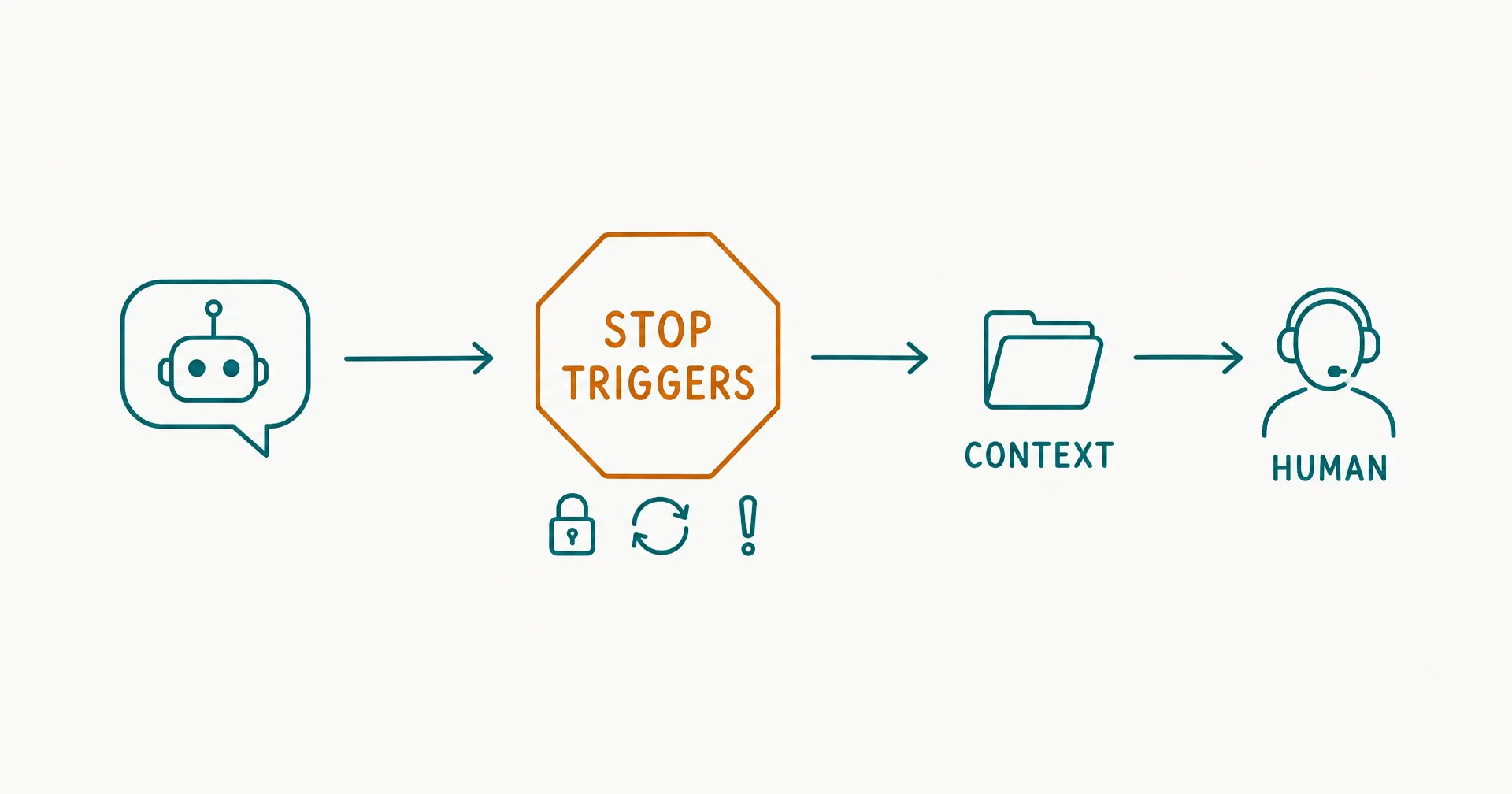
An AI customer-support agent should stop when continuing would create more uncertainty, consequence, or customer effort than a controlled handoff.
“Escalate when unsure” is not an operating rule. A production workflow needs explicit triggers for:
- unresolved identity;
- ambiguous or changing intent;
- unsupported policy interpretation;
- low answer confidence;
- conflicting sources;
- customer or account state that does not match the request;
- repeated failed resolution;
- strong frustration or vulnerability signals;
- pricing, refund, credit, cancellation, or contractual exceptions;
- security, privacy, fraud, safety, legal, or regulatory issues;
- high-impact account or data changes;
- threats, abuse, or employee-safety concerns;
- missing tools or permissions;
- failed postconditions; and
- any promise outside approved authority.
The operating pattern is:
Receive > identify > classify > retrieve current policy > assess consequence > answer or act within authority > verify result > resolve or escalate > transfer context > human acceptance > customer update > disposition
On this page · 12 sectionsOpen
- What Is an AI Customer-Support Escalation?
- What Should the Support Charter Define?
- Which Triggers Should Make the Agent Stop?
- How Should Identity and Customer State Be Checked?
- How Should Intent, Policy, and Confidence Be Handled?
- When Do Repetition, Sentiment, or Vulnerability Require a Human?
- Which Actions Are Too Risky for Unsupported Automation?
- What Must Be in the Escalation Packet?
- How Should the Receiving Queue Accept the Escalation?
- What Should You Measure?
- What Does a Complete Escalation Look Like?
- How Do You Pilot and Scale the Workflow?
- Define escalation as a transfer of current customer state and action ownership - not a tag or apology.
- Use mandatory triggers for identity, intent, policy, confidence, repeated failure, customer condition, and high-risk actions.
- Separate answer confidence from action authority. A correct explanation does not authorize a refund, access change, disclosure, or contractual promise.
- Stop repeated troubleshooting when the same failure persists, the diagnosis changes without new evidence, or the customer must restate information.
- Give the receiving human exact customer language, verified identity state, history, evidence, attempts, results, promises, urgency, restrictions, and a recommended next step.
- Require the receiving queue to accept, reroute, return, or reject the escalation and preserve the customer-facing response deadline.
- Measure accepted escalations, avoidable escalations, missed escalations, customer repetition, review time, resolution, cost, and severity together.
§ 01What Is an AI Customer-Support Escalation?
An AI customer-support escalation is a controlled transfer of a case, current evidence, customer commitments, and next-action ownership to a qualified human or specialist queue.
It can transfer to:
- frontline support agent;
- billing specialist;
- account owner;
- product or engineering support;
- security or incident response;
- privacy owner;
- fraud team;
- legal or compliance reviewer;
- safety or trust team;
- accessibility specialist;
- customer-success owner;
- supervisor; or
- emergency route defined by policy.
The transfer is complete when the receiving owner accepts the case or the routing system assigns a valid fallback. A message saying “someone will contact you” is not enough.
Escalation versus deflection
| Dimension | Deflection mindset | Controlled escalation |
|---|---|---|
| Goal | Avoid human ticket | Achieve the safest accepted outcome |
| Trigger | Bot cannot answer | Named risk, uncertainty, failure, or authority boundary |
| Customer effort | Often repeats context | Context travels with case |
| Ownership | Queue or channel unclear | Named receiving owner |
| Promise | Generic response | Approved deadline and next step |
| Evidence | Transcript link | Structured packet plus transcript |
| Receipt | Ticket created | Queue accepts, reroutes, returns, or rejects |
| Learning | Count escalations | Review missed and avoidable escalations |
The AI employee examples guide shows a bounded customer-support role. This article owns the mandatory stop and human-transfer mechanism.
Accepted outcome
One accepted escalation:
- identifies the canonical customer, account, case, and affected object;
- records verification status without exposing unnecessary secrets;
- names the trigger and policy version;
- separates customer statements, system evidence, inference, and unknowns;
- preserves every attempted action and result;
- includes commitments and response deadlines;
- routes to a qualified owner;
- receives an explicit disposition; and
- keeps the customer informed through an approved message.
“Escalation created” is an intermediate state.
§ 02What Should the Support Charter Define?
The support charter sets the service and authority boundary before a case arrives.
Support charter
| Field | Required decision |
|---|---|
| Customers | Accounts, users, prospects, partners, public |
| Channels | Email, chat, form, phone, social, in-product |
| Languages | Supported languages and qualified fallback |
| Hours | Staffing, time zones, after-hours route |
| Case classes | Access, billing, product, how-to, incident, complaint |
| Identity | Required verification by request and consequence |
| Sources | Current policies, product docs, account and incident state |
| Answer authority | What the agent may explain |
| Action authority | What the agent may change |
| Exceptions | Who may approve policy deviations |
| Escalation | Mandatory triggers and destination queues |
| Service objective | Response, update, and resolution expectations |
| Accessibility | Available formats and accommodation route |
| Retention | Transcript, evidence, personal-data, and deletion rules |
| Measurement | Customer, quality, flow, cost, and risk metrics |
| Owner | Accountable service and policy owners |
Case taxonomy
| Class | Example | Default boundary |
|---|---|---|
| Information | “Where is the export setting?” | Answer from current source |
| Troubleshooting | “The export fails at 80%” | Diagnose within tested procedure |
| Account | “Change our administrator” | Verify identity and authority |
| Billing | “Explain this invoice” | Explain approved fields |
| Financial action | “Refund the last charge” | Permission and approval gate |
| Cancellation | “Close our account today” | Identity, retention, contract, approval |
| Security | “A login came from another country” | Incident route |
| Privacy | “Delete my data” | Privacy workflow |
| Legal/contract | “Does our agreement cover this?” | Qualified owner |
| Complaint | “Your agent exposed another customer’s data” | Immediate incident/escalation |
The best-tasks guide helps separate repeatable classification, retrieval, drafting, and low-risk actions from consequential decisions that need people.
Answering is not acting
| Capability | Example | Separate authority required? |
|---|---|---|
| Explain documentation | Describe approved export steps | No beyond answer policy |
| Read account state | Show current plan or case status | Yes: data access |
| Modify record | Change contact preference | Yes |
| Change access | Add administrator | Yes, high consequence |
| Issue credit | Apply billing adjustment | Yes |
| Cancel service | End subscription | Yes |
| Disclose data | Send account or activity information | Yes |
| Promise resolution | Commit engineering delivery | Yes |
A reliable answer model does not inherit authority to perform the related action.
§ 03Which Triggers Should Make the Agent Stop?
Use a trigger registry with mandatory and reviewable conditions.
Stop-trigger registry
| Trigger class | Stop condition | Route |
|---|---|---|
| Identity | Required verification fails or conflicts | Identity/account owner |
| Intent | Two plausible intents require different actions | Human support |
| Policy | No current rule or sources conflict | Policy owner |
| Confidence | Material answer cannot be supported | Subject specialist |
| Repeat failure | Accepted attempt limit reached | Human/technical support |
| Customer state | Account, plan, region, or ownership conflicts | Account owner |
| Sentiment | Frustration plus unresolved consequence | Human support |
| Vulnerability | Customer may need accommodation or special care | Qualified route |
| High-risk action | Refund, access, deletion, disclosure, cancellation | Approver |
| Security/fraud | Suspicious access, compromise, abuse | Incident/fraud route |
| Privacy/legal | Rights request, legal threat, regulated issue | Qualified owner |
| Tool failure | Required system unavailable or postcondition fails | Operations |
| Promise | Customer requests commitment outside authority | Account/product owner |
| Safety | Threat or immediate safety concern | Approved urgent route |
Trigger priority
| Priority | Meaning | Customer-facing behavior |
|---|---|---|
| P0 | Immediate safety/security or severe active harm | Stop ordinary flow; urgent route |
| P1 | High consequence or strict response window | Acknowledge and route immediately |
| P2 | Material unresolved issue | Transfer with defined response target |
| P3 | Specialist knowledge or policy review | Preserve state and set expectation |
| P4 | General human preference | Honor according to service policy |
Priorities are buyer-defined labels. They should control queue behavior without changing the underlying severity record.
Any-trigger rule
Do not require a customer to accumulate a high score before escalation. One mandatory trigger can be sufficient:
mandatory identity failure OR security signal OR privacy request OR high-risk action OR repeated failure OR unsupported policy = stop
Use scores only to prioritize cases that are already eligible for a queue. Do not let a low total neutralize a severe trigger.
The permissions-and-approvals guide shows how technical capability, business authority, approval, execution, and verification should remain separate.
§ 04How Should Identity and Customer State Be Checked?
Verification should match the requested disclosure or action.
Verification by consequence
| Request | Example verification need |
|---|---|
| Public product question | None beyond abuse controls |
| General account navigation | Signed-in session may be sufficient |
| Account-specific status | Authenticated account and authorized visibility |
| Billing explanation | Account identity plus billing visibility |
| Contact change | Stronger verification and postcondition |
| Administrator change | High-assurance identity and authorization |
| Data export/deletion | Privacy and identity procedure |
| Credential or access recovery | Security recovery procedure |
| Refund/cancellation | Account, contract, and action authority |
These are examples, not universal rules. Qualified security, privacy, legal, and service owners should define the exact verification steps.
Never request secrets casually
The support agent should not ask a customer to paste:
- password;
- full authentication token;
- private key;
- recovery code;
- full payment credential;
- government identifier;
- unredacted sensitive document;
- another person’s private data; or
- production data unrelated to diagnosis.
Use approved secure collection routes for any sensitive evidence that is genuinely required.
Customer-state reconciliation
| Object | State to reconcile |
|---|---|
| Person | Identity, role, contact, language, accessibility need |
| Account | Plan, region, owner, status, restrictions |
| Entitlement | Current product and support rights |
| Case | Open, waiting, escalated, resolved, reopened |
| Incident | Active, affected scope, approved communication |
| Invoice | Period, amount, payment, credit, dispute |
| Contract | Current version and qualified interpretation owner |
| Product | Version, environment, feature state |
| Consent/preference | Approved communication and data choices |
If the user says they are an administrator while the account record says otherwise, preserve both observations and escalate. Do not silently choose the more convenient state.
NIST’s Privacy Framework is a voluntary tool for identifying and managing privacy risk. It can help the organization connect support-data collection, use, communication, correction, retention, and protection to enterprise privacy decisions.
§ 05How Should Intent, Policy, and Confidence Be Handled?
Intent classification determines which policy and action boundary applies.
Intent test
Ask:
- What does the customer explicitly request?
- Which affected object do they name?
- What result do they expect?
- What consequence follows from a wrong interpretation?
- Does the next action disclose, modify, delete, refund, cancel, or commit?
- Is another plausible intent materially different?
- Can one clarifying question resolve the difference?
Ambiguous-intent example
Customer:
I need this user removed today.
Possible meanings:
- remove the user from one project;
- revoke all account access;
- delete the user’s profile;
- remove a billing seat;
- erase personal data;
- terminate an employee’s access during an incident.
The AI support agent should not choose. It should ask a bounded clarifying question unless the surrounding evidence indicates an urgent security route.
Source hierarchy
| Rank | Source | Use |
|---|---|---|
| 1 | Current approved incident/safety instruction | Active exception behavior |
| 2 | Current policy or contract interpretation | Governing rule |
| 3 | Current product documentation | Supported behavior |
| 4 | Current account and product state | Case-specific evidence |
| 5 | Approved procedure and examples | Execution |
| 6 | Prior resolved case | Analogy only |
| 7 | Model memory or general knowledge | Never final authority |
Confidence record
| Field | Example |
|---|---|
| Question | Why did export stop? |
| Accepted source | Export diagnostics v4.1 |
| Evidence | Job code E-204 |
| Candidate cause | Source file exceeded limit |
| Competing cause | Storage quota exhausted |
| Missing check | Current quota endpoint unavailable |
| Answer confidence | Insufficient for definitive cause |
| Safe response | Explain known code and collect job ID |
| Stop condition | Do not claim root cause |
| Route | Technical support |
Confidence should be tied to the material claim and missing evidence, not expressed as an unexplained percentage.
Conflicting policy
When two current-looking sources disagree:
- preserve both source identities and versions;
- do not blend them into a new rule;
- block the affected answer or action;
- route to the policy owner;
- tell the customer what can safely be said;
- set an update expectation; and
- correct downstream knowledge after owner decision.
The AI employee context-pack guide explains how to store authoritative sources, conflicts, unknowns, owners, freshness rules, and removal paths.
§ 06When Do Repetition, Sentiment, or Vulnerability Require a Human?
The customer should not have to prove that automation failed by repeating the same story.
Repeat-failure trigger
Stop when:
- 2 materially equivalent troubleshooting attempts fail;
- the customer returns with the same unresolved outcome;
- the proposed diagnosis changes without new evidence;
- the workflow loops to an earlier step;
- the customer must re-enter information already available;
- a tool reports success but the customer-visible state is unchanged;
- the case reopens after an asserted resolution;
- another agent already attempted the same step; or
- the remaining action requires unapproved access.
The exact count can differ by workflow. A single failed step may be enough when the consequence is high.
Failure ledger
| Attempt | Hypothesis | Action | Result | New evidence |
|---|---|---|---|---|
| 1 | Browser session stale | Refresh and sign in | Failure persists | Error E-204 |
| 2 | Export configuration invalid | Validate settings | Settings valid | None |
| 3 | Storage or service issue | Requires privileged diagnostic | Not attempted | Escalate |
Attempt 3 should not be another customer-visible guess. It is the point where a qualified owner needs the job ID, error, configuration check, and account state.
Sentiment is context, not diagnosis
| Signal | Possible meaning | Safe response |
|---|---|---|
| “This is the third time” | Repeat failure | Inspect history and escalate |
| “I’m angry” | Frustration | Acknowledge; do not argue |
| All caps | Urgency, habit, or accessibility | Use case evidence too |
| Threat to leave | Commercial risk or unresolved harm | Human/account route |
| Legal threat | Complaint or legal issue | Qualified route |
| Self-harm or physical threat | Possible immediate safety issue | Urgent approved safety protocol |
| Confusion | Complexity, language, cognitive load | Clarify or offer human help |
Do not infer health, disability, identity, or dangerousness from tone alone.
Accessibility and accommodation
A customer may need:
- alternative format;
- live human assistance;
- slower or simpler instructions;
- screen-reader-compatible content;
- captions or transcript;
- keyboard-accessible path;
- interpreter or language support; or
- another approved accommodation.
W3C’s Web Content Accessibility Guidelines 2.2 provide recommendations for more accessible web content. The support organization should define its conformance target, testing, and human accommodation routes with qualified owners.
§ 07Which Actions Are Too Risky for Unsupported Automation?
Risk depends on impact, reversibility, authority, evidence, and customer condition.
High-risk action matrix
| Action | Risk | Default control |
|---|---|---|
| Reset password | Account takeover | Secure recovery flow |
| Change administrator | Privilege transfer | Strong verification + approval |
| Reveal account data | Privacy/security | Authorization and minimization |
| Delete data | Irreversibility/legal duty | Privacy workflow + approval |
| Cancel account | Service and contract impact | Identity + contract + confirmation |
| Issue refund/credit | Financial impact | Bounded amount + approval |
| Change invoice | Financial record | Billing owner |
| Commit delivery date | Customer reliance | Product/account owner |
| Interpret contract | Legal consequence | Qualified legal/account owner |
| Disable security control | Security exposure | Security approval |
| Share incident detail | Investigation and customer harm | Incident communications owner |
Precondition, action, postcondition
For every permitted action:
| Layer | Required check |
|---|---|
| Identity | Right person and authenticated route |
| Authorization | Person may request this change |
| Object | Exact account, user, invoice, or record |
| Current state | Read immediately before action |
| Policy | Current rule and limits |
| Approval | Exact action and parameters approved |
| Idempotency | Retry cannot duplicate effect |
| Execution | Tool returns result |
| Postcondition | Customer-visible state matches |
| Evidence | Action, result, owner, time logged |
| Recovery | Undo, correct, pause, or incident path |
“API returned success” is not a verified customer outcome.
Security and privacy signals
Examples requiring an incident or qualified route:
- customer reports access they should not have;
- another customer’s data appears;
- credential or token is exposed;
- suspicious sign-in or takeover is alleged;
- unauthorized account change occurs;
- prompt injection or malicious instruction appears in retrieved content;
- audit record is missing or altered;
- sensitive data is sent to an incorrect destination;
- system action repeats unexpectedly; or
- customer disputes an action the system attributes to them.
NIST’s Cybersecurity Framework 2.0 helps organizations understand and improve cybersecurity-risk management. Support escalation should connect suspected security events to the organization’s governed detection, response, and recovery process.
The Federal Trade Commission’s data-breach response guide advises organizations to mobilize a response team, stop additional loss, preserve evidence, document investigation, address vulnerabilities, and communicate without misleading customers or increasing risk. A frontline support agent should preserve the report and route it; it should not independently declare scope, cause, notification duty, or remediation.
The AI employee incident-response guide provides the contain, revoke, preserve, assess, communicate, recover, and re-entry workflow.
§ 08What Must Be in the Escalation Packet?
The packet should prevent the customer from starting over.
Minimum packet
| Object | Required content |
|---|---|
| Escalation ID | Unique ID and creation time |
| Case | Canonical case ID, channel, status |
| Customer | Canonical identity and verification state |
| Account | Account, plan, region, owner, restrictions |
| Intent | Exact request and interpreted case class |
| Trigger | Mandatory stop reason and priority |
| Customer language | Exact relevant wording |
| Evidence | Sources, logs, account/product state, timestamps |
| Attempts | Action, parameters, result, postcondition |
| Policy | Governing version and conflict if any |
| Impact | Affected person, object, service, money, data, deadline |
| Sentiment/need | Observable statements and requested accommodation |
| Promises | Every commitment and due time |
| Unknowns | Facts still missing |
| Restrictions | What must not be said or done |
| Recommendation | Next action and qualified destination |
| Ownership | Sender, receiver, queue, response target |
Strong packet example
Weak:
Customer upset. Export broken. Please help.
Useful:
Account AC-204, user U-18, identity verified in the signed-in support flow. The customer reports that export job J-771 stops at 80% with E-204 and says this is the third attempt since July 27. Public diagnostics v4.1 maps E-204 to two possible causes. Settings validation passed; quota verification is unavailable to the support role. No account change was made. Customer needs the file before a July 30 board review. Route to technical support within 30 minutes. Do not claim root cause or completion time.
Attempt record
| Time | Actor | Action | Result | Postcondition |
|---|---|---|---|---|
| 09:04 | Customer | Started export J-771 | Job began | Progress reached 80% |
| 09:12 | System | Returned E-204 | Job stopped | No file created |
| 09:18 | AI support | Validated export settings | Pass | Failure still unresolved |
| 09:21 | AI support | Requested quota check | Permission denied | No state change |
| 09:23 | AI support | Built escalation packet | Packet ready | Owner not yet accepted |
Customer-facing message
A safe message should:
- acknowledge the unresolved issue;
- summarize what was verified;
- state what has and has not changed;
- identify the next owner or queue;
- give an approved response expectation;
- avoid unsupported cause or timing claims;
- tell the customer how updates will arrive; and
- preserve any urgent workaround approved by policy.
The AI agent handoff-protocol guide defines the identity, task, evidence, authority, acceptance, timeout, and closure objects that should travel with a transfer.
§ 09How Should the Receiving Queue Accept the Escalation?
The receiver needs an explicit response contract.
Escalation states
Proposed > validated > assigned > accepted/returned/rerouted/rejected > actioned > customer updated > resolved/reopened/incident
| State | Meaning | Owner |
|---|---|---|
| Proposed | Trigger detected and packet started | AI support |
| Validated | Required fields and route checked | Router |
| Assigned | Qualified queue or person named | Service operations |
| Accepted | Receiver owns next action | Human/specialist |
| Returned | Correctable packet defect | Sender/data owner |
| Rerouted | Different qualified owner required | Router |
| Rejected | Trigger or route invalid | Policy/service owner |
| Actioned | Receiver performed next step | Receiver |
| Customer updated | Approved status sent | Case owner |
| Resolved | Customer-visible acceptance met | Case owner |
| Reopened | Outcome failed or new evidence appeared | Case owner |
| Incident | Incident workflow now governs | Incident owner |
Receiver dispositions
- accept;
- return for identity evidence;
- return for missing attempt or postcondition;
- reroute to billing;
- reroute to account owner;
- reroute to product/technical;
- reroute to security/fraud;
- reroute to privacy/legal;
- merge with existing case or incident;
- reject as non-customer/test/invalid;
- downgrade with owner approval; or
- urgent incident route.
Response targets
| Class | Illustrative target | Timeout behavior |
|---|---|---|
| P0 active severe harm | Immediate | Urgent fallback and leadership route |
| P1 high consequence | 15 minutes | Backup specialist |
| P2 material unresolved issue | 2 hours | Queue supervisor |
| P3 specialist knowledge | 1 business day | Reassign or update customer |
| P4 human preference | Service-policy target | Maintain place and expectation |
The times are examples. Every route needs staffing, time-zone, holiday, and after-hours behavior that can actually meet its promise.
The AI employee handover guide explains how to transfer current state, commitments, blockers, and next ownership without coordination debt.
Preserve one case owner
A technical specialist may own diagnosis while the case owner remains responsible for customer communication. Make that split explicit:
| Responsibility | Owner |
|---|---|
| Customer updates | Case owner |
| Technical diagnosis | Specialist |
| Security scope | Incident owner |
| Policy decision | Policy owner |
| Refund approval | Billing approver |
| Final case closure | Accountable case owner |
Many internal contributors should not create many conflicting customer promises.
§ 10What Should You Measure?
Escalation quality includes both escalation and non-escalation decisions.
KPI system
| Layer | Metric |
|---|---|
| Intake | Cases by class, channel, language, account |
| Automation | Resolved within authority, action postconditions |
| Escalation | Proposed, accepted, returned, rerouted, rejected |
| Detection | Missed mandatory trigger, false trigger |
| Quality | First-pass packet acceptance, customer repetition |
| Flow | Queue age, acceptance time, update time, resolution |
| Human demand | Review and correction minutes per accepted escalation |
| Customer | Recontact, reopened case, complaint, satisfaction |
| Risk | Identity, privacy, security, financial, promise incidents |
| Cost | Full cost per accepted resolution |
| Learning | Repeated defect, policy conflict, evaluation coverage |
The AI employee KPI framework explains why accepted outcomes, quality, correction, escalation, cost, reliability, and severity should remain together.
Core formulas
Escalation precision = accepted mandatory/material escalations / reviewed escalations
Escalation recall = correctly escalated mandatory cases / all mandatory cases
First-pass packet acceptance = packets accepted without return / packets reviewed
Customer repetition rate = escalated cases requiring repeated customer context / accepted escalations
Reopen rate = resolved cases reopened / cases marked resolved
Precision without recall can hide missed high-risk cases. Recall without precision can overload human queues.
Fictional monthly scorecard
| Result | Count/rate |
|---|---|
| Cases received | 4,800 |
| Resolved within approved boundary | 3,312 |
| Proposed escalations | 1,488 |
| Accepted first pass | 1,176 |
| Accepted after return | 168 |
| Rerouted | 72 |
| Rejected | 72 |
| Mandatory cases in audited sample | 240 |
| Mandatory cases correctly escalated | 236 of 240, 98.3% |
| Missed mandatory triggers | 4 of 240, 1.7% |
| Customer repeated material context | 94 of 1,344, 7.0% |
| Median human acceptance | 38 minutes |
| Human review/correction | 50,400 minutes |
| Minutes per accepted escalation | 37.5 |
| Reopened cases | 112 of 4,656, 2.4% |
| Severe unresolved incidents | 0 |
| Full monthly cost | $96,000 |
| Cost per accepted resolution | $20.62 |
All figures are illustrative.
The 98.3% recall may look strong, but the 4 missed mandatory triggers deserve case-level severity review. The 7.0% customer-repetition rate points to packet or queue-access defects.
Reconcile the specialist queue
An escalation ledger should account for every waiting case. The following fictional 10-shift trace uses:
Opening + accepted in - resolved or rerouted = closing
| Shift | Opening | Accepted in | Resolved/rerouted | Closing |
|---|---|---|---|---|
| 1 | 0 | 18 | 12 | 6 |
| 2 | 6 | 21 | 17 | 10 |
| 3 | 10 | 16 | 19 | 7 |
| 4 | 7 | 24 | 20 | 11 |
| 5 | 11 | 19 | 22 | 8 |
| 6 | 8 | 17 | 16 | 9 |
| 7 | 9 | 23 | 18 | 14 |
| 8 | 14 | 20 | 25 | 9 |
| 9 | 9 | 18 | 21 | 6 |
| 10 | 6 | 22 | 24 | 4 |
Shift 1 reconciles as 0 + 18 - 12 = 6; Shift 10 reconciles as 6 + 22 - 24 = 4. Across the period, 198 cases enter, 194 resolve or move to another qualified owner, and 4 remain open.
The balance does not prove timely or correct handling. Reconcile the 194 exits to accepted final states and the 4 open cases to a named owner, last customer update, and next deadline. If the support system reports 193 exits while the specialist queue reports 194, investigate a duplicate merge, reopened case, deleted test record, integration retry, or missing disposition before calculating acceptance and resolution rates.
Counter gaming
| Metric alone | Bad behavior | Countermeasure |
|---|---|---|
| Deflection | Trap customers in automation | Reopen, repetition, complaint, recall |
| Low escalation rate | Miss mandatory triggers | Consequence-weighted recall |
| Fast handle time | Rush classification | Acceptance and correction |
| High satisfaction | Avoid difficult customers | Representative sampling |
| Low cost | Exclude human review | Full-cost ledger |
| Resolution count | Close unresolved cases | Postcondition and reopen rate |
The customer outcome, not the closure event, is the unit that matters.
§ 11What Does a Complete Escalation Look Like?
Consider a fictional B2B software case.
Case
At 09:04, an authenticated administrator reports:
A former contractor can still open a project after we removed them yesterday. I can see their access event from this morning. Please make sure they cannot see any customer files.
Trigger evaluation
| Trigger | Result |
|---|---|
| Identity | Authenticated administrator |
| Intent | Revoke access and assess exposure |
| Customer state | User marked removed; access event conflicts |
| Policy | Security incident route applies |
| Confidence | Cause unknown |
| Repeat failure | Prior removal did not produce expected state |
| High-risk action | Access and possible data exposure |
| Priority | P0/P1 per buyer policy |
The AI support agent should not merely repeat the removal action. It should avoid exposing additional data, preserve the report and relevant identifiers, invoke the approved containment route, and create the incident packet.
Escalation packet
- Case: CS-69018
- Account: AC-204
- Customer: Authenticated administrator U-18
- Affected identity: Contractor U-91
- Expected state: Removed July 28 at 16:42
- Observed conflict: Access event July 29 at 08:51
- Customer request: Revoke access and protect customer files
- Trigger: Unauthorized access or failed revocation
- Action taken: Ordinary troubleshooting stopped; incident route invoked
- Action not taken: No repeated removal; no exposure scope claimed
- Evidence: Removal event, access-event identifier, account and project IDs
- Unknowns: Session status, files accessed, root cause, wider scope
- Promise: Security owner update within approved urgent window
- Restrictions: Do not disclose unverified incident scope or blame
- Owner: Security incident lead; support case owner retains customer updates
Timeline
| Time | Event | State |
|---|---|---|
| 09:04 | Customer report received | Case open |
| 09:06 | Identity and account resolved | Verified |
| 09:08 | State conflict confirmed | Mandatory trigger |
| 09:09 | Ordinary support stopped | Safe hold |
| 09:11 | Incident packet assigned | Awaiting acceptance |
| 09:14 | Security owner accepts | Ownership transferred |
| 09:17 | Customer receives approved update | Promise active |
| 09:26 | Active session revoked by authorized owner | Containment verified |
| 10:02 | Scope assessment continues | Incident active |
| 10:15 | Customer receives next approved update | Case open |
The accepted escalation is the 09:14 transfer with intact evidence and commitments. The case is not “resolved” merely because access was revoked at 09:26; scope, communication, recovery, and closure remain under the incident process.
The audit-log guide explains how to preserve the request, evidence, policy, decision, approval, action, postcondition, and final state.
§ 12How Do You Pilot and Scale the Workflow?
Begin with one queue and representative boundary cases.
Four-week pilot
| Week | Focus | Exit condition |
|---|---|---|
| 1 | Charter, taxonomy, triggers, routes | Owners approve rules and cases |
| 2 | Observe and shadow | Decisions compared with qualified reviewers |
| 3 | Draft answers and packets | Packet acceptance loop works |
| 4 | Bounded low-risk action and live escalation | Outcomes and incidents reviewed |
Evaluation set
Include at least:
- 20 clear information cases;
- 20 low-risk troubleshooting cases;
- 15 ambiguous-intent cases;
- 15 identity or authorization conflicts;
- 15 billing/refund/cancellation cases;
- 15 repeated-failure cases;
- 10 customer or account-state conflicts;
- 10 privacy or data-rights requests;
- 10 security or fraud reports;
- 10 policy conflicts or missing sources;
- 10 accessibility or language routes;
- 10 strong-frustration cases;
- 5 legal or contractual questions;
- 5 sensitive personal disclosures; and
- 5 tool-success but failed-postcondition cases.
The fictional set contains 170 cases. The real mix should be weighted by actual frequency and consequence.
Pilot checklist
- Canonical customer, account, case, and object IDs
- Support charter and taxonomy
- Identity requirements by consequence
- Source hierarchy and freshness
- Mandatory stop-trigger registry
- Answer and action boundaries
- Tool preconditions and postconditions
- Repetition and reopen rules
- Sentiment, vulnerability, language, and accessibility routes
- Security, privacy, fraud, legal, billing, and account queues
- Escalation packet schema
- Receiver disposition contract
- Customer update ownership
- Response targets and after-hours fallback
- KPI, severity, pause, rollback, and retirement rules
Scale gates
Expand only when 2 consecutive review periods meet:
- mandatory-trigger recall threshold;
- escalation-precision threshold;
- first-pass packet-acceptance threshold;
- customer-repetition threshold;
- postcondition-verification threshold;
- human queue capacity;
- response-update threshold;
- zero unresolved severe incident;
- acceptable reopen rate; and
- acceptable full cost per accepted resolution.
Pause or narrow when:
- the same mandatory trigger is missed;
- customers repeat material context;
- policy conflicts recur;
- failed actions are reported as successful;
- identity or account errors rise;
- the receiving queue returns packets without controlled reasons;
- specialists act but the customer is not updated;
- the agent makes cause, timing, refund, or security promises outside authority;
- reopen rate rises; or
- deflection improves while complaints worsen.
NIST describes its AI Risk Management Framework as a voluntary framework for incorporating trustworthiness considerations into AI design, development, use, and evaluation. Its govern, map, measure, and manage functions can help owners connect support-agent risk to the broader organization.
Runbook
- Resolve customer, account, case, and affected object.
- Determine the verification requirement.
- Classify explicit and possible intent.
- Load current policy, product, account, and incident state.
- Check mandatory stop triggers.
- Separate statements, evidence, inference, and unknowns.
- Answer only within accepted evidence.
- Act only within approved authority.
- Verify the customer-visible postcondition.
- Stop on conflict, repeat failure, or high-risk condition.
- Build the escalation packet.
- Assign a qualified receiver and response target.
- Send an approved customer update.
- Require accept, return, reroute, reject, or incident disposition.
- Preserve case owner and promise ownership.
- Record the human action and customer outcome.
- Review missed and avoidable escalations.
- Change triggers only through owner approval.
For CellCog, verify the current configuration and scope of the AI Customer Support Agent role page. Product capabilities change. The buyer still owns identity, policy, customer data, permissions, actions, queues, service promises, specialist staffing, accessibility, incident response, and resolution acceptance.
Define 5 mandatory stop triggers for one support queue, test them against historical cases, and verify that the receiving human gets the evidence without asking the customer to begin again.
Q1Should an AI support agent escalate whenever confidence is low?
Low confidence in a material claim should stop that answer, but the next step depends on the case. The agent may ask one safe clarifying question, provide a bounded fact, route to a specialist, or open an incident path. The confidence record should identify missing evidence rather than show an unexplained score.
Q2How many troubleshooting attempts should happen before escalation?
Set a limit by consequence and procedure. Two materially equivalent failed attempts are a practical default for many low-risk cases. One failure may be enough for access, security, financial, privacy, safety, or irreversible actions. Never repeat an action whose postcondition failed without understanding retry behavior.
Q3Should customer frustration always trigger a human?
Not by itself. Use the customer’s words, case history, consequence, repetition, and request for a person. Strong frustration combined with repeated failure, deadline, vulnerability, complaint, or high-impact action should receive a prompt human route.
Q4What information should not appear in an escalation packet?
Exclude passwords, full tokens, private keys, unnecessary payment or identity data, unrelated customer records, hidden credentials, speculative diagnoses stated as fact, and internal discussion that does not help the receiver. Link to protected evidence through approved access controls.
Q5Who owns the customer after a specialist accepts the escalation?
Define it explicitly. A specialist may own diagnosis or action while a case owner retains customer communication and final closure. The packet should name both roles, every promise, update deadline, and the condition for returning or closing ownership.
Q6What is the best first customer-support escalation pilot?
Choose one well-understood queue with current policies and a staffed human fallback. Test information, ambiguity, identity, repeated failure, high-risk action, privacy/security, and accessibility cases in observation mode. Advance only after trigger recall, packet quality, response timing, and customer repetition meet the approved gates.