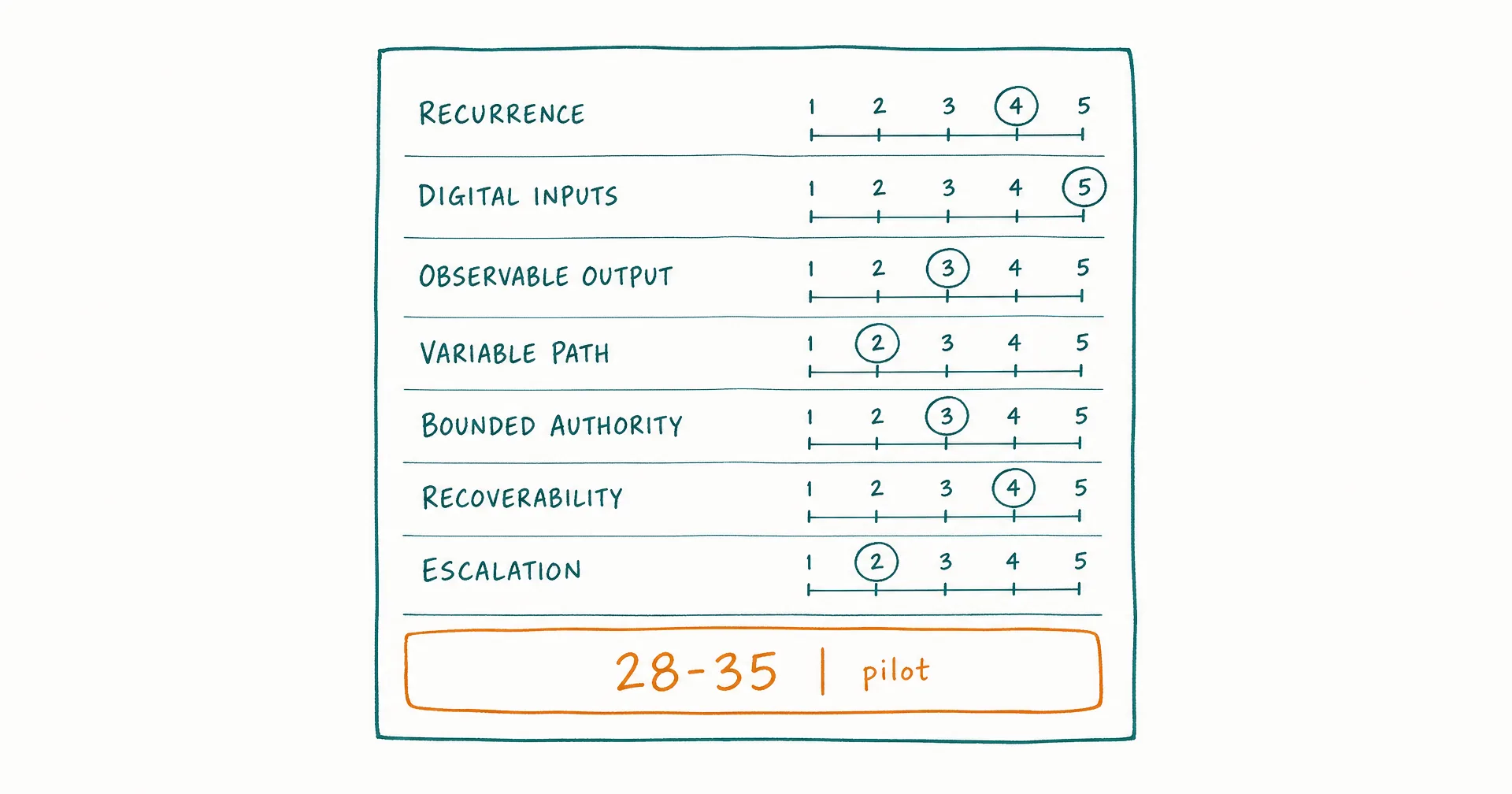
The best tasks for AI employees are recurring, digital, observable, variable enough to benefit from judgment, bounded enough to govern, and recoverable when something goes wrong.
That definition rules out 2 common mistakes. First, do not assign a vague title such as “run marketing” and hope the system invents a safe job. Second, do not wrap a stable 5-step rule in an agent when ordinary automation can execute it more predictably.
Start with one outcome you can inspect: a source-backed briefing, a triaged queue, a reconciled report, a draft response, a maintained knowledge artifact, or a clearly evidenced escalation. Then define the inputs, tools, permissions, acceptance test, and stop conditions around it.
The decision framework covers 12 strong starting tasks, 10 tasks to keep human-led, and a 35-point scorecard for choosing a role or platform.
On this page · 21 sectionsOpen
- The 7-Factor AI Employee Task Test
- What Makes a Task Employee-Shaped Rather Than Agent-Shaped?
- 1. Recurring Research and Change Monitoring
- 2. Executive and Operational Briefings
- 3. Knowledge-Base Maintenance
- 4. First-Pass Support Triage and Drafting
- 5. Sales and Account Research
- 6. Content Operations With Editorial Approval
- 7. Project Status and Risk Preparation
- 8. Recurring Data Analysis and Narrative
- 9. Inbox and Calendar Triage
- 10. SOP and Process-Documentation Maintenance
- 11. Quality Assurance and Preflight Review
- 12. Exception Investigation and Escalation Preparation
- 10 Tasks You Should Not Delegate End to End
- How to Turn a Vague Role Into One Good Task
- How to Measure Whether the Task Is Working
- Which Task Should Each Team Pilot First?
- How CellCog Maps These Tasks to Roles
- A 4-Stage Task Pilot
- Final Recommendation
- A strong AI-employee task scores well on 7 factors: recurrence, digital inputs, observable outputs, variable path, bounded authority, recoverability, and human escalation.
- Research monitoring, recurring briefings, knowledge maintenance, first-pass triage, account research, content operations, project-risk preparation, and data narratives are strong starting patterns.
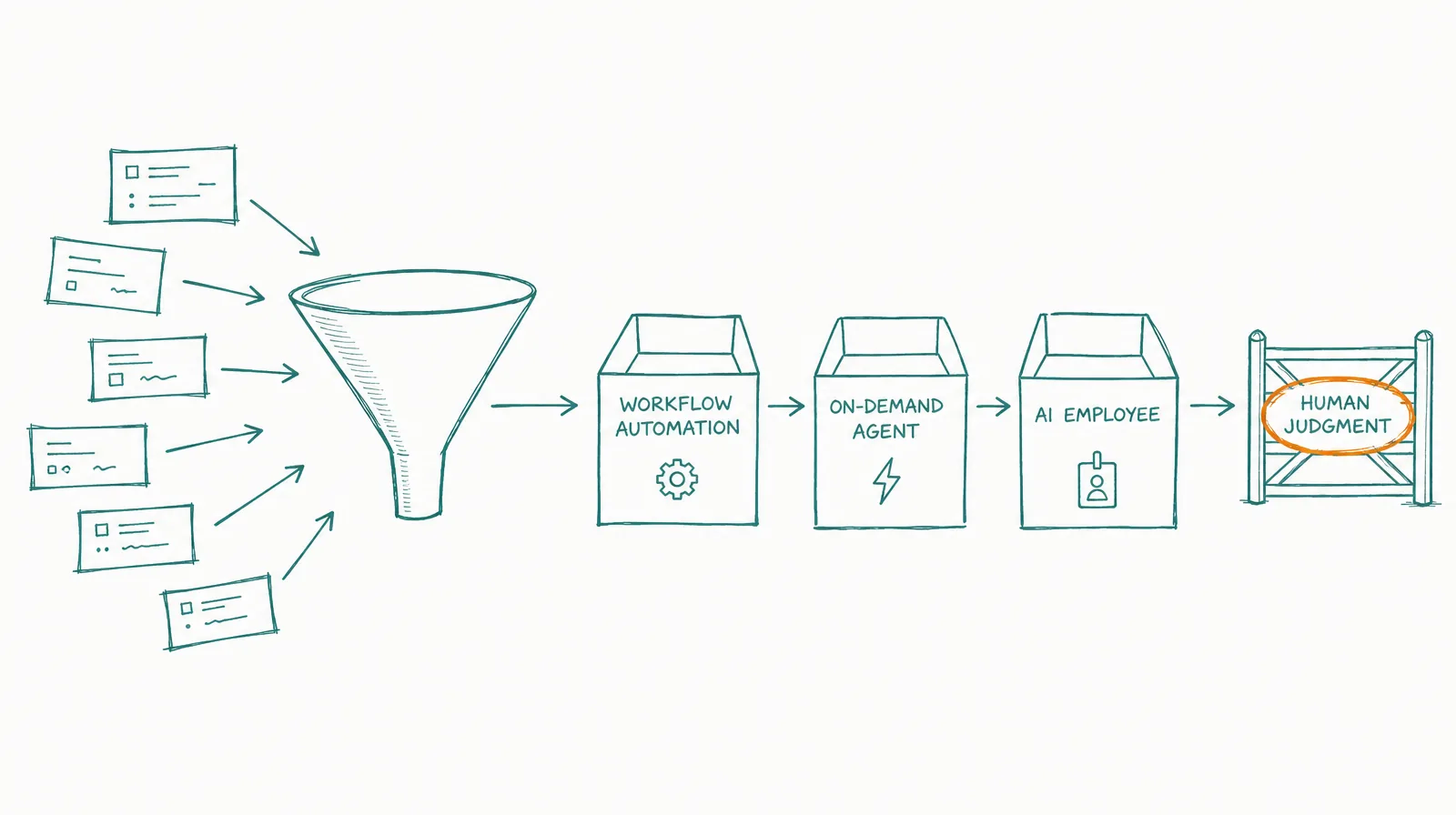
- Stable trigger-action work belongs in workflow automation; irregular one-off work may need only an on-demand agent.
- Keep final legal, medical, financial, hiring, safety, security, and other high-impact decisions with qualified people.
- Measure accepted outcomes, correction time, cycle time, source completeness, escalation quality, error severity, and cost per accepted outcome - not prompts or tasks started.
- CellCog AI Employees can be configured for role-level work, but buyers should begin with one bounded responsibility and the minimum access it requires.
§ 01The 7-Factor AI Employee Task Test
Score one task, not a job title.
| Factor | 1 point | 3 points | 5 points |
|---|---|---|---|
| Recurrence | Rare or unpredictable | Monthly or event-based | Daily/weekly or reliable event queue |
| Digital inputs | Mostly physical/tacit | Some files and some interviews | Approved messages, files, records, APIs, or web sources |
| Observable output | Subjective aspiration | Reviewable draft | Clear artifact, state change, or evidence-backed escalation |
| Variable path | Exact steps repeat | Some judgment | Sources, sequence, and tools vary by case |
| Bounded authority | Broad/open-ended | Several defined constraints | Narrow read/prepare/act scope |
| Recoverability | Error is hard to reverse | Correction is possible with work | Draft, reversible update, or staged action |
| Human escalation | No reliable owner | Owner exists but conditions are vague | Named owner plus explicit stop/approval rules |
Maximum score: 35.
- 28-35: strong AI-employee pilot candidate.
- 21-27: redesign the scope or use a hybrid.
- 14-20: likely better as workflow automation, an on-demand agent, or human-led work.
- 7-13: do not assign as a standing AI role yet.
This is a screening framework, not a scientific benchmark. A single severe risk can override the total. For example, an irreversible high-impact action should remain approval-gated even if every other factor scores 5.
Why recurrence matters
The employee layer adds a queue, triggers, persistent context, metrics, access review, and handovers. That overhead earns its keep when the responsibility returns.
If the task happens once and ends, use an agent. The difference between an AI agent and an AI employee is capability versus continuing accountability.
Why observable outputs matter
“Improve customer experience” cannot be accepted or rejected. “Triage new support messages, draft policy-grounded responses, and escalate refund exceptions with evidence” can.
An observable task leaves an artifact: a report; a cited briefing; a proposed message; a task update; a reconciled spreadsheet; a dashboard change; a structured record; or an escalation packet.
Why recoverability matters
Drafting a message is more recoverable than sending it. Proposing a CRM change is more recoverable than overwriting a revenue field. Preparing a payment is more recoverable than releasing it.
Start at the reversible layer, prove quality, then expand authority only when logs, approvals, and recovery work under stress.
§ 02What Makes a Task Employee-Shaped Rather Than Agent-Shaped?
An agent-shaped task has a goal and an end. An employee-shaped task has a goal that returns, an open queue, and a definition of what happens next.
| Task description | Better pattern | Reason |
|---|---|---|
| “Research this company” | On-demand agent | One bounded request |
| “Maintain a weekly account-research queue for new opportunities” | AI employee | Recurring intake, priorities, context, and handover |
| “Send this approved reminder when an invoice is overdue” | Workflow | Stable trigger and action |
| “Investigate disputed invoices and prepare an evidence packet” | AI employee + human | Variable evidence path, consequential resolution |
| “Summarize this meeting” | Assistant or agent | User initiates one output |
| “Maintain project risks from meetings, tasks, and stakeholder updates” | AI employee | Ongoing responsibility across sources |
The assistant-versus-employee ownership test separates work where a person should remain the active operator from recurring work that needs durable state and follow-through.
The 5-part definition of an AI employee adds role, continuity, initiative, agency, and accountability. A suitable task should exercise those properties without demanding unlimited authority.
§ 031. Recurring Research and Change Monitoring
A research AI employee can monitor a defined set of companies, markets, policies, products, or technical sources and produce a change-focused briefing on a schedule.
A good first assignment
Choose 5-20 entities, 3-5 decision dimensions, a fixed delivery cadence, and an approved source hierarchy. Ask for changes since the last accepted briefing rather than a fresh encyclopedia every week.
The worker should preserve monitored URLs, last-seen evidence, unresolved discrepancies, and the reviewer’s accepted interpretation. It should not treat a missing page as proof that a fact changed or use search snippets as final evidence.
| Role element | Recommended definition |
|---|---|
| Outcome | Source-backed change briefing |
| Inputs | Approved source list, prior briefings, comparison dimensions |
| Actions | Search, retrieve, compare, cite, draft, flag uncertainty |
| Success | Material changes found, evidence linked, duplicates suppressed |
| Escalation | Conflicting sources, inaccessible evidence, high-impact claim |
| Non-goal | Publish unsupported conclusions or make final strategic decisions |
This task benefits from an agent because the research path changes. It benefits from the employee layer because the monitored set, prior state, open questions, and delivery cadence persist.
OpenAI’s practical guide to building agents identifies complex decisions, unstructured data, and brittle rule-based systems as strong agent signals. Monitoring fits when sources and evidence vary; a fixed price-page checker may still be better as a workflow.
CellCog’s AI Research Assistant is the closest role page. Treat any vendor’s benchmark or showcase as capability evidence, then test your own sources, citation standard, and decision context.
§ 042. Executive and Operational Briefings
An AI employee can assemble a recurring briefing from defined business sources: KPIs, project changes, open decisions, risks, customer signals, and commitments.
A good first assignment
Limit the first briefing to one audience and one decision cadence. A founder’s Monday operating brief should not also be a board report, sales forecast, customer-health review, and product roadmap.
Define a freshness requirement for every source. If the dashboard was not updated, the employee should expose the stale input rather than turn last week’s value into this week’s fact. Require a distinct “decision needed” field so summary volume does not hide action.
The strongest assignment is not “write an executive summary.” It is:
Every Monday, prepare a 1-page decision briefing from the approved dashboard, task board, meeting notes, and prior commitments. Separate fact, interpretation, and recommendation. Flag missing or conflicting inputs. Do not invent status.
Measure source completeness; factual correction count; decisions surfaced; stale item detection; reviewer minutes; on-time delivery; and open-loop carryover.
Do not let the briefing become a fluent rewrite of stale dashboards. Every material statement needs a current source or a visible “unknown.”
§ 053. Knowledge-Base Maintenance
Knowledge bases decay when product behavior, policy, pricing, and customer questions change faster than documentation.
A good first assignment
Start with one bounded collection, such as the 25 highest-traffic support articles or one product’s setup guide. Give the employee an authoritative product-change feed, resolved-ticket sample, owner list, and publication workflow.
Keep discovery and publication separate. The employee may identify a conflict and draft a fix, but the policy or product owner should decide which source becomes authoritative when official pages disagree.
An AI employee can:
- Review resolved tickets, release notes, and approved product changes.
- Detect repeated questions or conflicting answers.
- Identify the source of truth.
- Draft an update with citations and change rationale.
- Route policy-sensitive changes to an owner.
- Publish only inside delegated authority.
- Recheck linked or dependent articles.
This is employee-shaped because the queue never truly ends. It requires source provenance, freshness, open tasks, and handover.
| Good KPI | Misleading activity metric |
|---|---|
| Accepted update rate | Articles touched |
| Time from approved change to published update | Words generated |
| Reopened documentation issue rate | Prompts run |
| Source-complete draft rate | Links collected |
| Support deflection validated by the support owner | Pageviews alone |
Keep policy ownership human. The worker can identify inconsistency and prepare a correction; it should not silently redefine refund, security, legal, or employment policy.
§ 064. First-Pass Support Triage and Drafting
Support is a strong fit when the employee interprets variable language but stable policy remains deterministic or approval-gated.
A good first assignment
Select 2-3 low-risk ticket categories with stable answers and clear escalation. Exclude refunds, security, legal threats, account ownership disputes, vulnerable customers, and anything the worker cannot resolve from an approved source.
Build the evaluation set from real, de-identified tickets. Include incomplete messages, angry language, multiple intents, outdated policy references, and cases that should be refused or escalated.
A safe first version reads a new ticket; identifies intent, account, urgency, and missing information; retrieves the current approved policy; drafts a response with source evidence; routes known low-risk categories; escalates refunds, threats, security issues, policy conflicts, or vulnerable customers; and updates the ticket state and handover.
| Authority stage | Allowed work | Human control |
|---|---|---|
| Shadow | Classify and draft without touching live queue | Compare with current agents |
| Prepare | Add internal note and proposed reply | Human sends |
| Bounded action | Send approved low-risk responses | Sample and exception review |
| Standing role | Own first-pass queue inside policy | KPI, audit, and incident review |
The CellCog AI Customer Support Agent provides a role-specific product example. Before connecting a live inbox, verify current policy retrieval, disclosure, approval, identity, retention, and action controls.
§ 075. Sales and Account Research
Account research is a better starting task than autonomous high-volume outreach.
A good first assignment
Assign a daily queue of named accounts already approved by the sales owner. Require 3-5 source-backed facts, one dated change signal, a relevance hypothesis, disqualifying evidence, and explicit unknowns.
The employee should never turn a weak inference into personal knowledge. “The company announced a new market” is a sourced fact; “the VP must be struggling with pipeline” is a hypothesis and should be labeled or removed.
The employee can maintain a queue of assigned accounts, gather public and approved internal evidence, map likely relevance, and prepare a cited brief for a representative.
Strong output: company and role facts; source dates; relevant changes; likely problem hypotheses labeled as hypotheses; approved product mapping; missing information; disqualifying evidence; and a suggested human next step.
Avoid: invented personalization; unverified headcount, funding, or technology claims; sensitive personal-data enrichment without a valid business basis; autonomous commitments; deceptive identity; and optimizing send volume without reply quality and reputation controls.
If outreach is added later, measure valid positive replies, accepted meetings, complaint/unsubscribe patterns, corrections, and domain health - not messages sent.
§ 086. Content Operations With Editorial Approval
Content is employee-shaped when the system maintains a recurring queue and follows an evidence, review, update, and distribution process.
A good first assignment
Choose one article family, one audience, one source standard, and one editor. Supply an approved brief that locks the primary intent and excluded adjacent intents before research begins.
Require a claim ledger, a contextual internal-link pass, and a human acceptance decision. Keep publishing permission separate from drafting permission until factual corrections, brand edits, and source quality remain inside the agreed threshold.
A content AI employee can:
- Receive an approved brief.
- Gather current primary sources.
- Create the draft and evidence ledger.
- Check category vocabulary and intent boundaries.
- Add contextual internal links.
- Route factual, legal, and brand questions.
- Apply editor feedback.
- Prepare repurposed assets.
- Preserve update triggers and open claims.
The output must remain draft-first until the publisher trusts the review and correction system. Generating 50 articles is not a useful success metric if editors accept 5 and rewrite 45.
CellCog’s AI Content Writer maps to this role. Evaluate it on your sources, house style, factual risk, CMS permissions, and accepted-output economics.
§ 097. Project Status and Risk Preparation
Project work produces scattered evidence: tickets, meeting notes, deadlines, owner messages, decisions, and dependencies. An AI employee can maintain the synthesis without becoming the project’s accountable executive.
A good first assignment
Use one project with a stable task system and a weekly owner review. The employee should reconcile, not overwrite, conflicting status. When a ticket says “done” but meeting notes describe an unresolved blocker, both facts belong in the review.
Give each risk an evidence date, impact, owner, next action, and next review. A generic “high risk” label without source or ownership is not useful.
Recommended scope: reconcile status from approved systems; identify overdue or contradictory updates; draft a risk register; preserve decisions and commitments; request missing status; prepare the weekly review; propose, but not silently change, owners or deadlines; and escalate scope, budget, or dependency decisions.
| Output | Acceptance test |
|---|---|
| Status report | Every material status maps to a current source |
| Risk register | Risk, evidence, probability basis, impact, owner, next review |
| Decision log | Decision, date, approver, rationale, affected work |
| Handover | Completed, open, blocked, next owner, wake condition |
The best KPI is not the number of task updates. Track stale-status detection, reopened blockers, decision latency, correction minutes, and whether owners accept the record.
§ 108. Recurring Data Analysis and Narrative
An AI employee can turn recurring datasets into an analysis queue: validate inputs, run reproducible calculations, identify changes, investigate anomalies, update a dashboard, and explain the result.
A good first assignment
Select one existing report whose formulas and owner are already known. Preserve the raw input, transformation code or formula, output, and reviewer-approved narrative for every cycle.
Introduce deliberate data faults during shadow testing: duplicate rows, missing periods, changed field types, implausible values, and late-arriving records. The worker should flag the issue before narrating a trend.
Keep the calculation layer reproducible. The agent may choose an investigation path, but totals, rates, joins, and transformations should be captured in code, queries, formulas, or traceable steps.
Strong boundaries: no number without the source and period; no silent exclusion of missing data; distinguish correlation from causation; label estimates and assumptions; compare like periods and populations; route accounting, financial, or regulatory interpretation to qualified owners; and preserve the exact artifact used for the conclusion.
CellCog’s AI Data Analyst is a relevant product path. Test it with deliberately incomplete, duplicated, stale, and contradictory inputs before granting any write access.
§ 119. Inbox and Calendar Triage
Inbox triage is suitable when the employee prepares and routes rather than making unrestricted commitments.
A good first assignment
Start with one shared or role-specific inbox, not the executive’s complete private mailbox. Define allowed senders, protected categories, response expectations, scheduling rules, and the exact cases that must remain unread or human-only.
Use draft mode first. Measure correct routing, missed urgency, false urgency, calendar conflicts, correction time, and the quality of next-step tasks before allowing any automatic send or booking.
It can classify messages; connect a message to existing context; draft a response; identify an owner; propose a meeting time; create a follow-up task; snooze with a reason and wake date; and escalate sensitive or ambiguous requests.
Do not delegate: binding commercial terms; legal admissions; employee relations; security incidents; payment instructions; confidential disclosure decisions; or calendar commitments that violate protected focus or travel rules.
A dedicated inbox can improve ownership, but it also creates identity and reputation risk. Review the current product terms, disclosure behavior, and human-supervisor model before external use.
§ 1210. SOP and Process-Documentation Maintenance
An AI employee can observe approved process artifacts, compare stated procedure with actual accepted practice, and prepare updates.
A good first assignment
Choose one process with a named owner and recent evidence: recordings, tickets, checklists, or system events. Ask the employee to expose differences between documented and observed practice without declaring either one correct.
The owner must decide whether the documentation is stale, the team is bypassing policy, or the process genuinely changed. That decision becomes the new dated source of truth.
The task is not to invent policy. It is to:
- Collect current source documents.
- Identify contradictions and missing steps.
- Interview or request decisions from the process owner.
- Draft a versioned procedure.
- Add inputs, outputs, owners, controls, and failure paths.
- Route approval.
- Update dependent checklists after acceptance.
Measure time-to-approved-update, contradiction rate, procedure-use feedback, and incidents caused by stale instructions.
This task is especially valuable before broader automation. A process that cannot be explained, bounded, and owned is not ready to become a standing autonomous role.
§ 1311. Quality Assurance and Preflight Review
An AI employee can run a recurring preflight against explicit standards.
A good first assignment
Start with an artifact type that already has a release checklist, such as a blog post, report, customer-facing document, or structured record. Split rules into executable checks and semantic checks.
Require evidence for every failure. “Tone is off” is not a release-blocking result unless the worker identifies the violated standard and the relevant text. False positives create reviewer fatigue and eventually cause teams to ignore real alerts.
Checks can include required sections; source presence; field completeness; policy language; formatting; broken links; calculation reconciliation; version mismatch; accessibility checks; duplicate records; and release criteria.
Use deterministic checks for exact rules and an agent for semantic review. A missing H1, invalid schema, or failed formula is a rule. Whether an argument answers the buyer’s question may require judgment.
The employee should report pass; fail; evidence; severity; owner; suggested correction; and whether release is blocked.
Do not let a fluent “looks good” replace executable tests.
§ 1412. Exception Investigation and Escalation Preparation
Many teams do not need an AI employee to execute the normal path. They need one to investigate the cases ordinary automation cannot resolve.
A good first assignment
Select one exception queue where the final decision already belongs to a named specialist. Define the evidence packet that specialist needs: affected record, timeline, relevant policy, prior attempts, system errors, competing explanations, and proposed next step.
Do not let the employee close the case because its explanation sounds plausible. Completion means the reviewer received a complete, source-backed packet or the case was returned for missing evidence.
Suitable exception work includes: gather the affected record and history; identify which rule or integration failed; retrieve relevant policy; reproduce the issue; separate known facts from hypotheses; prepare options and consequences; propose a resolution inside policy; and route the final decision to the accountable person.
This is a strong hybrid. The workflow owns the stable transaction, the employee prepares novel exceptions, and the person owns consequential judgment.
Track exception cycle time, evidence completeness, correct routing, reopened cases, reviewer time, and severity.
§ 1510 Tasks You Should Not Delegate End to End
The AI employee may prepare evidence or draft options, but a qualified human should retain the final decision or action.
| Task | Why it stays human-led | Safe supporting role for AI |
|---|---|---|
| Final legal advice or contract acceptance | Licensed judgment, liability, binding terms | Summarize, compare clauses, prepare questions |
| Medical diagnosis or treatment decision | Safety and professional accountability | Organize approved information for clinician review |
| Final hiring, firing, or promotion decision | High-impact rights, bias, context | Schedule, organize evidence, draft structured notes |
| Release of payment or transfer | Fraud and irreversibility | Reconcile data and prepare approval packet |
| Security containment with broad access | High blast radius and adversarial context | Gather logs, propose steps, route incident |
| Production deletion or destructive change | Recovery may be incomplete | Simulate, prepare change, verify backup |
| Public crisis statement | Reputation, legal, stakeholder judgment | Monitor sources and draft options |
| Safety-critical physical control | Potential physical harm | Analyze logs or prepare maintenance evidence |
| Policy creation affecting rights | Organizational and legal accountability | Research precedent and draft for owner review |
| Secret or credential disclosure | Access can be immediately abused | Detect exposure and trigger revocation workflow |
NIST’s Generative AI Profile notes that generative-AI use may require different human-AI configurations, additional review, tracking, documentation, and management oversight. Apply that principle in proportion to impact and recoverability.
High impact beats a high suitability score
A recurring, digital, observable task can still be a poor end-to-end delegation candidate. Payroll release is recurring and digital; that does not make final release authority a good first role.
Split the task. Let the employee prepare, reconcile, and flag. Let deterministic controls validate. Let the authorized person approve.
§ 16How to Turn a Vague Role Into One Good Task
Replace the title with an outcome contract.
Test whether the scope can survive a bad day
Write 5 adverse cases before launch: missing source, conflicting policy, unavailable tool, malicious instruction, and high-impact request. The role description should tell the worker what to do in each case without inventing authority.
If the only safe answer is “ask the owner,” that can be acceptable during the first stage. The objective is not to eliminate escalation; it is to make escalation precise, evidence-rich, and visible.
| Vague role | Bounded starting task |
|---|---|
| “Marketing manager” | Maintain a weekly source-backed competitor-change briefing |
| “Sales rep” | Prepare cited account briefs for the assigned opportunity queue |
| “Support agent” | Triage and draft first-pass responses for 3 approved categories |
| “Project manager” | Reconcile weekly status and prepare the risk review |
| “Data analyst” | Refresh one dashboard and explain validated material changes |
| “Executive assistant” | Triage one inbox and prepare a daily decision brief |
| “Content writer” | Draft one approved content type through evidence and editor review |
Then write 9 fields:
- Outcome.
- Trigger and frequency.
- Approved inputs.
- Expected output.
- Tools.
- Permission level.
- Acceptance metrics.
- Escalation and stop conditions.
- Human owner.
If those fields do not fit on 1 page, the first assignment is probably too broad.
§ 17How to Measure Whether the Task Is Working
Measure outcomes and control quality together.
| Metric | What it reveals | Common gaming risk |
|---|---|---|
| Accepted-output rate | How much work survives review | Lowering the acceptance bar |
| Correction minutes | True review burden | Hiding reviewer time |
| Cycle time | Operational speed | Closing incomplete tasks |
| Source completeness | Evidence quality | Linking irrelevant sources |
| Escalation precision | Whether the right cases reach people | Escalating everything |
| Reopened-task rate | Durability of completion | Suppressing reopen signals |
| Error severity | Tail risk | Reporting only averages |
| Cost per accepted outcome | Economic viability | Excluding platform or review cost |
Define the metric before the worker starts. A role that chooses its own KPI after seeing the result can optimize the story rather than the outcome.
Use the accepted-outcome AI employee KPI scorecard to pair task volume with quality, escalation, durability, total cost, and worst-error severity.
Use a baseline
Run the current process and the proposed role on the same representative cases. Record human time, elapsed time, accepted results, corrections, exceptions, and severe failures.
A 20-50-case starting set can be useful for a narrow pilot, but it is illustrative. Include normal work, missing data, conflicting sources, stale context, tool failure, malicious instructions, and genuine out-of-scope requests.
§ 18Which Task Should Each Team Pilot First?
Choose the task that removes recurring coordination work without transferring final authority.
| Team | Strong first pilot | Keep human-led | First acceptance test |
|---|---|---|---|
| Founder/leadership | Weekly decision briefing | Final strategy and commitments | Every claim maps to a current source |
| Operations | Status and exception preparation | Policy, budget, and owner changes | Open loops and blockers are complete |
| Support | Low-risk triage and drafts | Refund and security exceptions | Correct route, source, and escalation |
| Sales | Account research briefs | Commercial promises and qualification judgment | Facts are sourced; hypotheses are labeled |
| Marketing | Competitor monitoring or content draft queue | Final brand and publication approval | Material changes or drafts meet rubric |
| Product | Feedback synthesis and evidence grouping | Roadmap priority | Themes preserve source and frequency |
| Data | Recurring report refresh and narrative | Final financial/accounting interpretation | Calculations reproduce from saved inputs |
| People/HR | Scheduling and document preparation | Hiring, firing, pay, promotion | No sensitive decision delegated |
| Legal/compliance | Evidence collection and clause comparison | Legal advice and acceptance | Sources, version, and unresolved issue are explicit |
| Security | Log collection and incident packet | Containment with broad/destructive authority | Timeline and evidence survive expert review |
The team column does not authorize access. A support pilot still needs a narrow ticket set and approved policy. A security pilot should usually begin read-only. A legal pilot should prepare evidence rather than produce an unreviewed legal conclusion.
Prefer coordination debt over judgment transfer
The best first task often removes the work around a decision rather than the decision itself. Gathering sources, reconciling status, preparing the record, tracking open loops, and routing the exception can consume substantial time while remaining observable.
This pattern also improves human judgment. The owner receives a consistent evidence packet instead of searching across 6 systems under deadline pressure.
Reject the most glamorous first role
Public posting, unrestricted outreach, payment release, production changes, and employee decisions may produce visible demos, but they also combine identity, access, irreversibility, and reputational risk.
A quiet internal briefing or exception-preparation queue creates better evidence about the system. If it cannot preserve sources, follow boundaries, and escalate correctly in a draft-only role, broader autonomy will not fix it.
§ 19How CellCog Maps These Tasks to Roles
CellCog’s AI Employee platform provides the standing-work machinery: roles, goals, KPIs, schedules, wake conditions, memory, inboxes, task boards, permissions, approvals, shifts, and handovers.
The underlying Super-Agent supplies research, data, code, document, spreadsheet, presentation, image, video, audio, dashboard, application, and other execution capabilities.
When one responsibility requires several of those formats, map the multimodal artifact chain before assigning the task so each source, transformation, render, and final output has an evaluator.
That breadth is useful only after the task is bounded. “Can create a spreadsheet” is a capability. “Refresh the approved operating dashboard every Monday, reconcile missing inputs, explain material changes, and escalate anomalies” is a responsibility.
Start with the smallest role surface
For the first pilot: one queue; one recurring outcome; one human owner; one source-of-truth set; the minimum connected tools; draft or reversible actions; one acceptance rubric; explicit escalation; and one weekly review.
CellCog’s first-party guide to how it uses its own product provides implementation examples, but it is not an independently audited customer case study. Use it to form test cases, not to assume the same result.
Review access and economics before live work
Read the current AI Employees guide, privacy policy, and terms of service before connecting inboxes, browsers, computers, customer data, or other consequential systems.
Translate the selected task into an action-specific permission and approval matrix before any connector, browser session, or computer access goes live.
CellCog uses credits. As of July 19, 2026, its pricing page stated that more complex work consumed more credits, top-ups cost 90 credits per $1, and subscription credits remained valid for 60 days after the billing period. Test the exact task and calculate cost per accepted outcome; do not use an entry plan as the implied price of a full role.
Before expanding the task, apply the AI employee total-cost framework to the observed usage, review, correction, setup, monitoring, and incident data from the pilot.
§ 20A 4-Stage Task Pilot
| Stage | Worker authority | Evidence required to advance |
|---|---|---|
| 1. Observe | Read approved inputs in a sandbox | Sources and task boundaries are complete |
| 2. Shadow | Produce output without live changes | Acceptance and escalation can be scored |
| 3. Prepare | Add drafts or proposed actions to a review queue | Correction burden and tail risk are viable |
| 4. Act within policy | Execute only reversible low-risk actions | Logs, recovery, sampling, and incident response work |
Do not promote on a calendar alone. Advance when the role meets the predeclared gate across representative normal and adverse cases.
The graduated AI employee onboarding method expands this pilot into six evidence-gated stages, including process observation, shadow comparison, specific approved actions, and the first bounded independent shift.
If the task repeatedly fails for the same stable reason, add a deterministic rule. If it fails because the role is too broad, narrow the outcome. If the failure is high-impact or unrecoverable, keep the action human-led.
§ 21Final Recommendation
The best first AI-employee task is not the most impressive one. It is the smallest recurring responsibility that creates visible value and leaves enough evidence to govern; the next step is to turn that responsibility into an outcome-first AI employee hiring process.
Look for recurring intake; approved digital context; variable but bounded reasoning; an inspectable output; reversible action; clear acceptance; explicit escalation; and one accountable human owner.
Keep stable rules in workflows. Keep one-off ambiguity with an on-demand agent. Keep consequential judgment with qualified people.
When those boundaries are clear, the employee layer can reduce repeated prompting and context reconstruction without turning a vague job title into uncontrolled software access.
Q1What is the single best task for a first AI employee?
A recurring source-backed briefing is often a strong first candidate because it uses variable research, produces an inspectable artifact, can remain draft-only, and has a natural human review gate. The actual best task is the highest-scoring bounded responsibility in your own workload.
Q2Are repetitive tasks always best for AI employees?
No. Repetitive tasks with stable rules are usually better for workflow automation. AI employees are most useful when the outcome recurs but the path, evidence, language, or exceptions vary.
Q3Can an AI employee send email autonomously?
It may be technically able to, but start with drafting. Add sending only for approved low-risk categories after testing identity, disclosure, policy retrieval, permissions, logs, reputation controls, and escalation.
Q4What should an AI employee never decide?
Keep final high-impact legal, medical, financial, hiring, safety, security, rights-affecting, and irreversible decisions with qualified humans. The AI employee can prepare evidence and options.
Q5How many tasks should the first role own?
Start with 1 recurring outcome and the few tasks required to complete it. A long list of unrelated duties weakens context, permissions, evaluation, and accountability.
Q6How do I know when to expand the role?
Expand only after the current task shows acceptable output quality, correction burden, escalation behavior, cost, and worst-case failure across representative work. Add one adjacent responsibility at a time and review the access change separately.