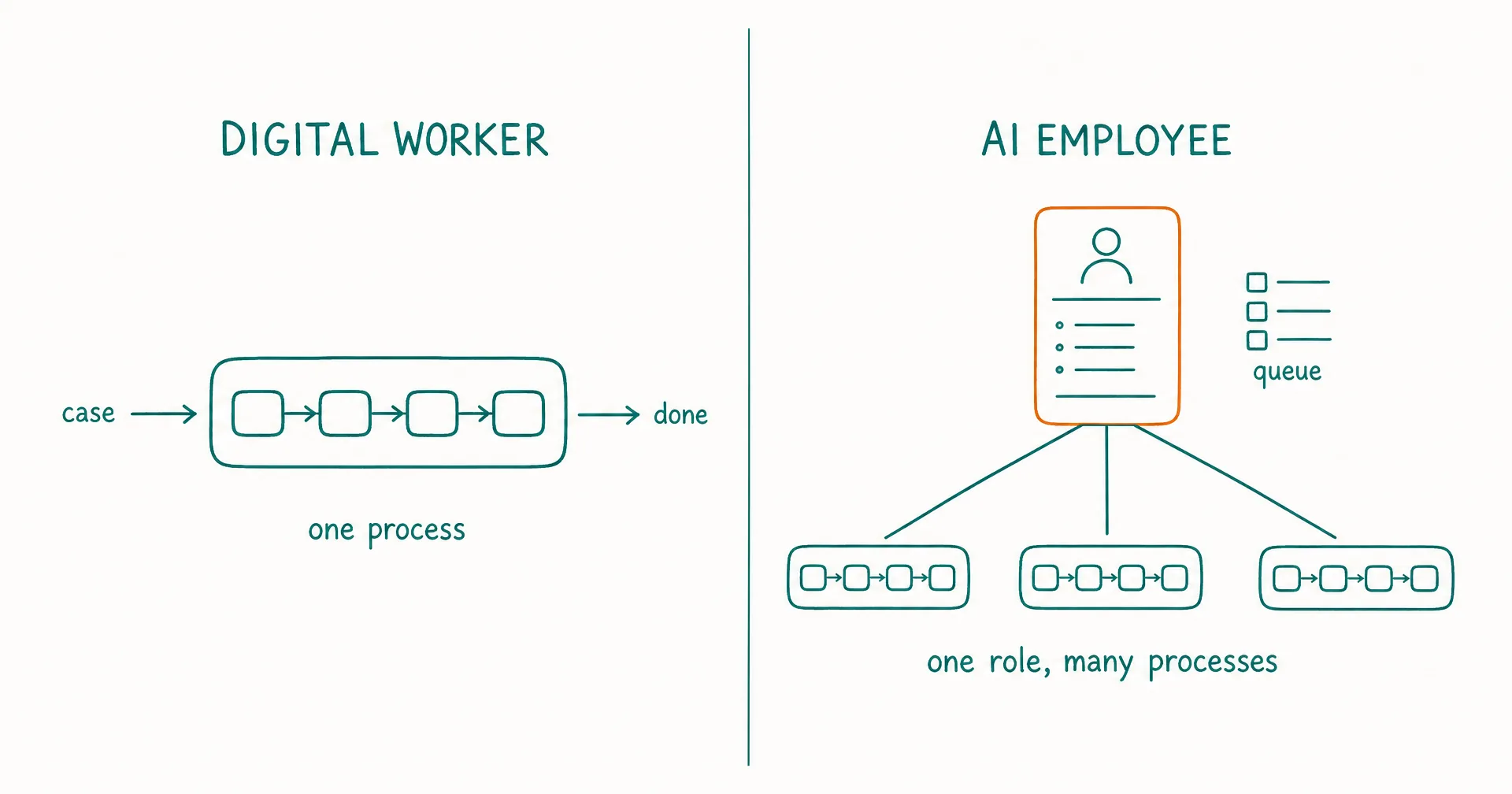
A digital worker is software that performs meaningful parts of a business process through automation and AI. An AI employee is agentic software placed inside a standing role with recurring work, persistent context, bounded authority, and an accountability loop.
The categories overlap heavily. In some products, nothing changes except the label.
The useful distinction is process capacity versus role ownership.
A digital worker is often designed around an end-to-end process or set of automation skills. An AI employee is designed around an ongoing organizational responsibility: work can arrive from several triggers, task state survives a run, the role chooses among tools, performance is reviewed over time, and unfinished work is handed forward.
Do not assume that “AI employee” is more advanced, autonomous, or trustworthy. Ask both vendors to demonstrate the same operating evidence.
On this page · 15 sectionsOpen
- Digital Worker vs AI Employee at a Glance
- What Is a Digital Worker?
- What Is an AI Employee?
- Are Digital Workers and AI Employees Actually Different?
- Why the Category History Still Matters
- What Are the 10 Practical Differences to Test?
- When Is a Digital Worker the Better Fit?
- When Is an AI Employee the Better Fit?
- When Should You Combine Them?
- How Should Buyers Normalize Vendor Claims?
- What Are the Governance Differences?
- How Do You Upgrade a Digital Worker Into an AI Employee Role?
- How CellCog Fits the Comparison
- A 15-Point Evaluation Scorecard
- Final Verdict
- Digital worker is an established intelligent-automation term for software that combines RPA, workflow, conversational AI, document processing, and machine learning to execute part or all of a business process.
- AI employee is a newer operating label for an agent placed in a recurring role with triggers, persistent context, task state, permissions, metrics, approvals, escalation, and handovers.
- A process-centric digital worker can satisfy every AI employee test. An AI employee may also use digital-worker and RPA components. There is no universal technical boundary.
- Compare role ownership, path selection, continuity, authority, evidence, exception handling, evaluation, and lifecycle - not anthropomorphic names.
- Choose process automation when the work is stable enough to model. Choose an employee role when the outcome recurs but the path and evidence vary. Combine them when an agent interprets exceptions and deterministic components execute stable steps.
- CellCog AI Employees implement the role-centric pattern through inboxes, shifts, wake conditions, memory, task boards, KPIs, permissions, approvals, and handovers around a general-purpose agent.
§ 01Digital Worker vs AI Employee at a Glance
| Decision dimension | Digital worker | AI employee | What to verify |
|---|---|---|---|
| Historical center | Intelligent automation and end-to-end process execution | Agentic role ownership | Product architecture, not category age |
| Primary unit | Process, workflow, or automation skill set | Role, queue, or recurring outcome | What remains owned after one run? |
| Path | Often orchestrated from workflows, RPA, and AI components | Model-directed planning plus deterministic tools | Which layer chooses the next step? |
| Start | Event, queue, schedule, request, or user | Person, schedule, message, event, queue, or delegation | Trigger policy and suppression |
| Continuity | Process state; advanced products may remember interactions | Role, task, decision, and handover state | Provenance, correction, and expiry |
| Action | APIs, RPA, workflow, applications, and AI skills | Tools and connected systems inside role authority | Exact read/write scope |
| Human role | Collaborator, exception handler, or process owner | Supervisor, approver, evaluator, and accountable owner | Named decisions and response path |
| Measurement | Process throughput, cycle time, exception, accuracy, and cost | Accepted outcomes, quality, reliability, intervention, cost, and risk | Same denominator for comparison |
| Best fit | Documented process with automation components | Recurring variable work with observable outcomes | Simplest governable architecture |
| Main risk | Process brittleness, hidden exceptions, or automation sprawl | Model variance, excess authority, stale context, or drift | Failure visibility and recovery |
The table describes common market usage. A specific vendor may use either term for a system that sits in the other column.
§ 02What Is a Digital Worker?
IBM’s current digital-worker definition describes software-based labor that can independently run meaningful parts of complex, end-to-end processes by applying a range of skills. It traces the category from software robots toward intelligent automation that can combine conversational intelligence, RPA, machine learning, computer vision, and natural-language processing. The full digital-worker definition guide covers the category on its own terms - this page focuses on the comparison.
A digital worker may receive a process item, read structured and unstructured data, interpret a request, apply business rules, operate applications, call APIs, ask a person for information, route exceptions, update process state, and complete several tasks across systems.
The digital worker grew out of automation
Traditional RPA bots execute defined user-interface actions. Digital-worker platforms broadened that execution with workflow orchestration, document capture, classification, conversational interfaces, machine learning, process mining, decision services, APIs, and human task queues.
For the underlying automation layer, UiPath currently defines RPA around software robots performing repetitive, rule-based work in digital systems while describing RPA as one capability inside newer agentic automation.
The AI employee versus RPA guide covers the narrower distinction between adaptive role execution and deterministic software robots.
Its natural unit is commonly the process
A digital accounts-payable worker may collect an invoice, extract fields, validate them, enter data, route an exception, and preserve the process record.
The worker may span several tasks, but each task contributes to a defined business process.
That process-centric design can be extremely sophisticated. It can also be more reliable than an open-ended agent when policies and transitions can be represented explicitly.
“Digital worker” once meant a person
The term has also described human employees with digital skills. Current automation marketing usually means non-human software, but buyers should remove ambiguity in policies, contracts, and metrics.
Use “human worker,” “software agent,” “automation,” or a named product role when confusion could affect access, accountability, or reporting.
§ 03What Is an AI Employee?
An AI employee is agentic software assigned a continuing business role. It can start or resume work from approved triggers, preserve relevant context and task state, choose steps and tools inside policy, and report through evidence, tasks, KPIs, approvals, escalations, and handovers.
The five-part test for an AI employee checks role, continuity, initiative, agency, and accountability.
Its natural unit is the role
A role contract defines the recurring outcome, in-scope responsibilities, non-goals, work-intake rules, approved context, tool and data access, permitted actions, approval thresholds, quality and evidence standards, KPIs, escalation, and handover.
The role may use a workflow, RPA bot, or digital-worker platform as a tool. “Employee” describes the surrounding operating relationship.
The label does not create employment
An AI employee is software. It is not a human, legal person, licensed professional, or automatic party to an employment relationship.
The organization remains accountable for purpose, data, provider selection, permissions, outputs, external actions, affected users, monitoring, and incidents.
The label is useful only if it makes responsibility and control more explicit.
§ 04Are Digital Workers and AI Employees Actually Different?
Sometimes. The terms are not standards, so the difference depends on implementation.
Case 1: same product, new label. A vendor may rename a digital worker under the AI employee label after adding a generative model or changing positioning. If the process, state, access, evaluation, and human controls remain the same, the buyer should treat it as the same operating system.
Case 2: process worker versus role owner. A digital worker may own one defined process, such as invoice entry. An AI employee may own a broader recurring responsibility, such as maintaining the weekly finance exception queue and choosing among several approved processes.
Case 3: deterministic composite versus agentic planner. The digital worker may combine many automation components while a workflow engine still selects every path. The AI employee may use a model to plan dynamically after interpreting the case.
Case 4: both layers together. An AI employee receives the business responsibility and delegates stable operations to digital workers.
| Architecture | Process owner | Next-step selector | Best description |
|---|---|---|---|
| Fixed RPA and workflow sequence | Workflow owner | Encoded logic | Automation or digital worker |
| Intelligent automation across one process | Process/service owner | Workflow plus bounded AI | Digital worker |
| Agent with a recurring role and queue | Human supervisor | Model-driven agent inside policy | AI employee |
| Role agent calling intelligent automation services | AI role under human owner | Agent for routing; services for execution | AI employee plus digital workers |
The category label should follow the buyer’s mental model. The operating evidence should drive the decision.
§ 05Why the Category History Still Matters
Labels influence which questions a buyer asks.
Automation programs begin with process
Digital-worker programs commonly ask: Which process is documented? Which steps consume time? Where is data structured? Which applications are involved? Which decisions can be encoded? Where do exceptions go? What transaction volume justifies implementation? How will the process be monitored and changed?
This discipline is valuable. It discourages vague role prompts and forces teams to observe the work before automating it.
Its weakness appears when the real responsibility does not fit one process. A market-research role may monitor several sources, accept requests from several owners, investigate unexpected changes, and decide which artifact the business needs. Encoding every case as a process can create branch sprawl.
Agent programs begin with goal and capability
AI-employee programs commonly ask: What outcome should the role own? Which context and tools does it need? What can begin work? How much autonomy should it receive? Which KPI defines success? When should it ask a person?
This framing accommodates variable work. It can also skip the process observation that reveals stable rules, hidden dependencies, and real exception volume.
Strong design combines both habits
Start from the role outcome, then decompose the work:
| Work element | Design question | Likely implementation |
|---|---|---|
| Stable validation | Can the rule be stated exactly? | Code or workflow |
| Repeatable transaction | Is there a supported operation? | API, workflow, or RPA |
| Variable interpretation | Does evidence change the path? | Agentic judgment |
| Ongoing ownership | Must work wait, resume, and be prioritized? | Employee task and role state |
| Consequential decision | Who bears accountability? | Qualified human |
| Shared policy | Must several roles use one version? | Governed source or shared service |
The history also explains procurement language. An automation buyer may expect process mining, orchestration, bot operations, and straight-through-processing metrics. An agent buyer may expect model choice, tool use, memory, evaluations, and multi-agent coordination. A credible platform should state what it actually provides instead of relying on the buyer to infer the missing layer.
Ask who maintains the world model
Every system contains assumptions about source location, valid fields, current policy, application behavior, user intent, ownership, risk, and completion.
In a digital-worker program, these assumptions may live in process maps, rules, integrations, and exception queues. In an AI employee, they may live in instructions, retrieval sources, memory, tool definitions, and evaluators.
Neither location maintains itself. Assign an owner, version changes, test affected paths, and preserve an effective date.
§ 06What Are the 10 Practical Differences to Test?
1. Process scope versus role scope
Ask whether the system owns a named process or a recurring organizational outcome.
“Process vendor invoices” is process scope. “Maintain a reconciled weekly accounts-payable exception queue and prepare approval-ready resolutions” is role scope.
Both can be valuable. Role scope usually contains several processes and more prioritization.
2. Predefined flow versus dynamic planning
Digital-worker systems often coordinate RPA, workflow, and AI steps through a designed process map.
An AI employee may determine the next step after interpreting new evidence. It should still call deterministic controls for exact rules.
Anthropic’s agent engineering guide uses the same useful architecture boundary: workflows follow predefined code paths while agents dynamically direct their own process and tool use.
The AI employee versus workflow automation decision separates stable paths from stable outcomes with variable paths.
3. Process state versus open-work state
Process state tracks where one case is in a known flow.
Employee task state may also represent unplanned investigation, competing priorities, waiting on an external event, cross-role delegation, a promise made, an unresolved policy question, and next-shift work.
The two forms of state can and should integrate.
4. Skill invocation versus tool selection
A digital worker may invoke predefined automation skills at defined stages.
An AI employee may choose among tools based on the task. That flexibility raises the need for tool descriptions, permission separation, budget limits, error handling, source evidence, and post-action verification.
Tool choice is useful only when paths genuinely vary.
5. Workflow data versus persistent context
Digital workers carry process data. Advanced systems may also preserve interaction and business context.
Employee memory should distinguish current task state, role instructions, authoritative policies, prior decisions, user or account context, learned preference, shared organization knowledge, and records that must expire or be deleted.
Provenance, scope, freshness, correction, and deletion are operating requirements, not administration.
6. Exception queue versus investigation
A digital worker may route known exceptions to a human queue.
An AI employee may investigate the exception, gather supporting evidence, propose a resolution, and then escalate the consequential decision.
The improvement should be measured in accepted resolutions and reviewer time, not in exceptions “touched.”
7. Process permission versus role authority
A digital worker commonly receives credentials and actions required for one process.
An employee role may use several systems and therefore needs a more explicit authority model: read versus write, object scope, account or tenant, action, threshold, time, approval, spend, delegation, and revocation.
Action-level policy replaces a single autonomy toggle.
8. Transaction logging versus decision reconstruction
Automation logs may show step, input, output, error, and terminal state.
An agentic role also needs to show the source used, instruction and policy version, retrieved memory, tool choice, the recommendation or decision, approvals, state changes, handovers, and evaluator results.
The difference appears after a surprising outcome: can the organization explain both what happened and why the system had authority to do it?
9. Process KPIs versus role KPIs
Digital-worker measures often include throughput, straight-through processing, cycle time, exception rate, accuracy, utilization, uptime, and cost per transaction.
AI employee measures add accepted outcomes, first-pass quality, correction effort, source completeness, appropriate escalation, reopened work, intervention load, and consequence-weighted error.
Both should normalize around the same business outcome when compared.
10. Deployment lifecycle versus role lifecycle
Automation lifecycle includes build, test, deploy, monitor, change, and retire.
The employee role also needs a hiring or creation decision, a job specification, context onboarding, graduated autonomy, performance review, role redesign, permission review, reassignment, and termination.
Those organizational metaphors are useful when they create clear gates. They are harmful when they encourage buyers to treat software like a self-accountable person.
§ 07When Is a Digital Worker the Better Fit?
Choose a digital worker when the business process is known and intelligent automation can cover its steps and exceptions.
| Fit signal | Why it favors a digital worker |
|---|---|
| Documented end-to-end process | Workflow and automation components can be mapped |
| High transaction volume | Reusable automation repays implementation |
| Stable business rules | Deterministic controls improve reliability |
| Existing RPA estate | New capabilities can reuse orchestration and governance |
| Legacy applications | UI automation bridges missing APIs |
| Process-specific data | Context can remain within the case |
| Known exception classes | Human queues or AI substeps can be designed |
| Mature process owner | Service quality and change are accountable |
Strong examples: accounts-payable intake and entry; customer-master updates; benefits-request processing; claims-document collection; periodic report assembly; onboarding provisioning; order-to-cash tasks; and service-request fulfillment.
The digital-worker design is especially attractive when adding an open-ended role would increase variability without improving the process outcome.
§ 08When Is an AI Employee the Better Fit?
Choose an AI employee when one recurring responsibility crosses several processes and the correct path depends on context.
| Fit signal | Why it favors an employee | Required control |
|---|---|---|
| Variable work intake | Requests do not share one fixed flow | Scope and priority |
| Stable recurring outcome | Role value persists across cases | Acceptance criteria |
| Open investigation | Evidence changes the plan | Source and tool budget |
| Several processes | Role chooses the appropriate bounded service | Tool permissions |
| Work waits and resumes | State must outlive one execution | Task board and wake rule |
| Novel recoverable exceptions | Not every branch is worth encoding | Escalation |
| Longitudinal performance | The role is reviewed across weeks | KPI and sampling |
| Cross-role handoff | Ownership moves beyond one process | Acceptance contract |
Strong examples: maintain a weekly executive intelligence brief; own first-pass account research across a sales queue; manage content operations from source pack to reviewed draft; reconcile project-risk signals across tools; maintain a support knowledge-gap queue; or prepare KPI exceptions with evidence and proposed actions.
§ 09When Should You Combine Them?
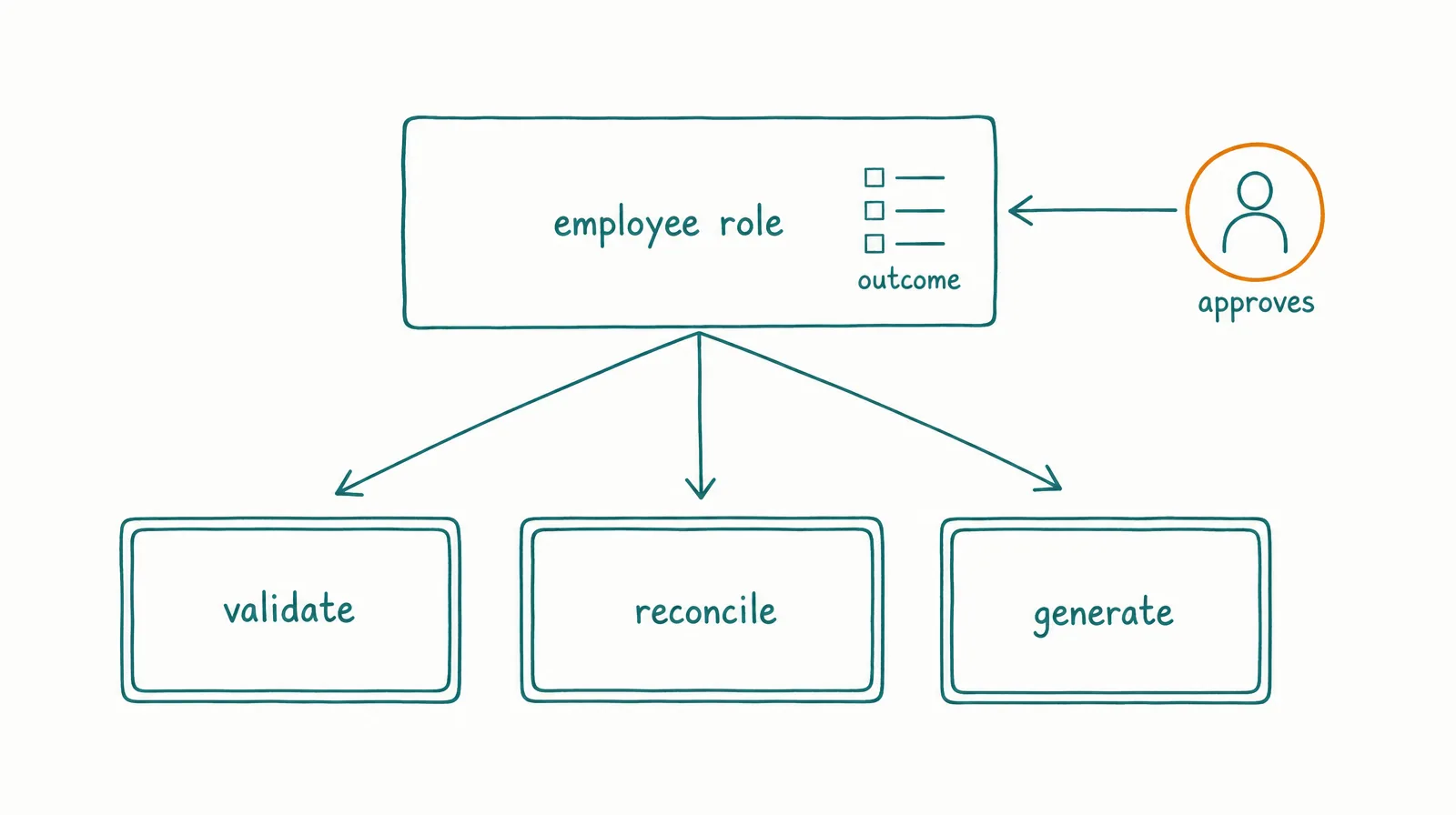
Use a role layer for variable responsibility and digital-worker services for stable process execution.
Example: quarterly executive reporting
Digital-worker layer: downloads approved reports; validates schemas; reconciles exact totals; refreshes charts; applies the document template; stores the version; and logs data exceptions.
AI-employee layer: reviews material changes; investigates anomalies; gathers contextual evidence; ranks exceptions; drafts the narrative; asks for missing decisions; updates the briefing task; and monitors follow-up.
Human owner: approves definitions and thresholds; resolves disputed interpretation; owns the executive message; approves consequential recommendations; and reviews service performance.
Define the service contract
The employee should invoke a digital worker through a bounded operation - for example, a “refresh validated quarterly pack” service that takes the period, source IDs, and template version.
The service returns an execution ID, source versions, reconciled tables, exceptions, the produced artifact, validation results, cost, and terminal state.
The employee should not copy values from a screen when a validated service can produce them. The digital worker should not invent an explanation for an exception unless that interpretive responsibility is explicitly part of its design.
The hybrid’s main risk is false completion
The automation can finish its steps even when the business outcome remains incomplete.
For example: every chart refreshes, but one source is stale; every section exists, but two numbers conflict; the deck is generated, but no decision owner is named; or the file is delivered, but the executive question is unanswered.
The employee layer should evaluate postconditions beyond “workflow succeeded.”
A complete handoff for the reporting example
When the digital-worker layer finishes the validated pack, it should send the employee: the reporting period, immutable source versions, reconciliation results, missing or late sources, material variances, chart and table artifact locations, the template version, known calculation limitations, execution cost, and terminal status.
The employee should return: exceptions investigated, evidence used, unresolved contradictions, the narrative draft, requested human decisions, actions approved, owners and deadlines, the final artifact version, and the next monitoring condition.
This separation makes correction cheaper. A broken formula returns to the deterministic reporting service. A weak explanation returns to the employee role. A disputed recommendation returns to the human owner.
Measure the end-to-end outcome
Do not report that the digital worker processed 12 sources and the AI employee produced 8 sections. Measure whether the executive pack was accepted.
| Measure | Why it matters |
|---|---|
| Source completeness | Prevents polished reports built from partial data |
| Reconciliation pass rate | Confirms numbers agree with approved systems |
| Material-exception recall | Tests whether important changes were found |
| Narrative acceptance | Tests decision usefulness |
| Reviewer minutes | Reveals hidden supervision |
| On-time delivery | Tests the recurring service |
| Reopened decisions | Reveals false completion |
| Cost per accepted pack | Normalizes the combined system |
| Incident severity | Prevents average quality from hiding tail risk |
The service succeeds when the decision artifact is accurate, traceable, timely, and useful - not when both software layers finish their own tasks.
§ 10How Should Buyers Normalize Vendor Claims?
| Vendor claim | Evidence to request |
|---|---|
| “End-to-end digital worker” | Process map, unsupported exception, human queue, and terminal evidence |
| “AI employee owns the role” | Trigger-to-handover trace across several work sessions |
| “Learns over time” | Exact memory or model change, provenance, approval, and rollback |
| “Works across systems” | Named read/write actions, identity, and post-action verification |
| “Fully autonomous” | Stop, approval, retry, budget, and incident controls |
| “Human in the loop” | Named decision, evidence, approver, timeout, and resume behavior |
| “Enterprise ready” | Plan-specific identity, access, logs, data handling, and support evidence |
| “Reduces cost” | Same-scenario total operating cost per accepted outcome |
Ask for one adverse demonstration
Give each system a missing required source, conflicting process and policy data, an expired credential, an out-of-scope action, a duplicate case, a human approval that times out, and a downstream system that partially succeeds.
Observe whether it:
- detects the issue;
- keeps one visible owner;
- avoids duplicate or unauthorized action;
- preserves evidence;
- escalates to the right person;
- resumes from the correct state; and
- closes only after the postcondition is reconciled.
Category language matters less than this behavior.
§ 11What Are the Governance Differences?
The governance foundations are mostly shared: an accountable human owner, identity, least privilege, approved data, environment separation, change control, logging, testing, monitoring, exception handling, incident response, cost control, and retirement.
NIST’s Generative AI Profile treats governance, measurement, and management as lifecycle activities. That framing applies whether the deployed system is marketed as a worker, employee, agent, or automation.
Agentic roles add special emphasis to untrusted instructions, dynamic tool choice, model-provider behavior, persistent memory, probabilistic evaluation, long-running task state, cross-agent delegation, and repeated error.
Intelligent automation adds special emphasis to process maps, selector and application change, bot infrastructure, queue configuration, deterministic rule versioning, straight-through processing, and exception operations.
One governance program can cover both
Register the role and every independently acting automation. Link them through service ownership, dependency, identity, permission, data class, trigger, evaluation, budget, and incident scope.
That creates one accountable service without pretending every component is the same kind of worker.
§ 12How Do You Upgrade a Digital Worker Into an AI Employee Role?
Add the employee layer only when the process has become part of a broader recurring responsibility.
Step 1: preserve the proven process
Document the input contract, process states, validation rules, actions, exception classes, logs, service level, owner, cost, and current performance.
Do not replace deterministic components simply to make the architecture more agentic.
Step 2: define the broader outcome
Weak: run the quarterly reporting bot.
Role-level: maintain a reconciled executive performance brief, surface material exceptions with evidence, capture approved actions, and monitor their next review.
The broader outcome explains why the system needs prioritization, investigation, follow-through, and persistent state beyond one process.
Step 3: write the role contract
Define the mission, recurring outputs, non-goals, triggers, sources, tools, permissions, evidence, KPIs, approvals, escalation, and stop conditions - the same objects an outcome-first hiring process produces.
Step 4: expose the digital worker as a bounded service
The role should call a named operation instead of improvising through the underlying systems.
The service contract should include a validated input schema, permission requirements, idempotency, an execution ID, structured errors, a postcondition, cost, retry policy, and a recovery owner.
Step 5: add task and handover state
The role needs visible states such as: New, Validating, Investigating, Waiting on source, Waiting on approval, Ready, Completed, Reopened.
Each wait state needs a current owner, reason, expected event, deadline, next action, and escalation.
Step 6: onboard through evidence gates
Begin with observation and draft-only output.
Promote only after the role demonstrates correct source selection, accurate use of the digital-worker service, appropriate escalation, complete evidence, low correction burden, reliable handover, and viable cost.
Step 7: test role failure, not only process failure
The digital worker may already handle an invalid field, an unavailable application, a duplicate transaction, and known process exceptions.
The employee role also needs tests for conflicting goals, stale memory, missing sources, misleading external instructions, tool overreach, approval timeouts, abandoned tasks, incorrect delegation, and repeated bad outcomes.
Step 8: keep a rollback path
The organization should be able to pause the employee trigger, revoke role access, keep the proven digital-worker service available, return exception ownership to a person, preserve open tasks and evidence, and compare performance with the prior baseline.
An upgrade is successful only if the broader role reduces repeated human coordination without weakening the proven process.
§ 13How CellCog Fits the Comparison
CellCog uses the AI Employee label for a standing agentic role.
Its current AI Employees page describes a name and role, an inbox, shifts, schedules and event wake conditions, persistent memory, a task board, goals and KPIs, connected tools, permissions and approvals, handovers, and delegation to other AI employees.
This is role-centric language rather than classic process-automation language.
CellCog can still call connectors, operate software, use browser or computer access, and work through deterministic steps. Buyers should identify which operations are fixed workflow, API, UI action, agentic judgment, human approval, and multi-agent delegation.
CellCog is a fit when one recurring outcome needs broad digital reasoning and production across varying tasks. A digital-worker or RPA platform may be the better choice when the process is already mapped and most value comes from predictable transaction execution.
§ 14A 15-Point Evaluation Scorecard
Score each system from 0 to 2 on every item.
| Evaluation item | Score |
|---|---|
| Recurring outcome is explicit | 0–2 |
| Process or role boundaries are visible | 0–2 |
| Trigger and duplicate suppression are testable | 0–2 |
| Current task owner is visible | 0–2 |
| Approved sources and data scope are visible | 0–2 |
| Tool and application permissions are action-specific | 0–2 |
| Exact rules remain deterministic | 0–2 |
| Variable judgment is evidence-backed | 0–2 |
| Human approval names the decision | 0–2 |
| Exception state preserves context | 0–2 |
| Logs reconstruct action and authority | 0–2 |
| Memory can be corrected and deleted | 0–2 |
| Postconditions are reconciled | 0–2 |
| Cost uses accepted outcomes | 0–2 |
| Pause, revoke, recover, and retire work | 0–2 |
Interpretation:
- 0–14: the label is ahead of the operating evidence.
- 15–23: viable for a bounded pilot with gaps to close.
- 24–30: strong operating evidence for the tested scenario.
The score is not a security certification. A severe failure can override the total.
§ 15Final Verdict
A digital worker is usually an intelligent-automation system built around a process. An AI employee is usually an agentic operating system built around a role.
In mature products, those systems can converge. The buyer should therefore ignore claims that one label is automatically newer or more advanced.
Choose the architecture that makes the recurring outcome, process, context, authority, exceptions, evidence, human accountability, and recovery easiest to govern.
Explore CellCog AI Employees when the requirement is a standing role across variable digital work. Keep process automation and RPA for stable steps that benefit from determinism.
Q1Is a digital worker the same as an RPA bot?
Not necessarily. RPA is commonly one component of a digital worker. A digital worker may combine RPA with workflow, document processing, conversational AI, machine learning, APIs, and human task queues to execute a larger process.
Q2Is an AI employee more advanced than a digital worker?
The label does not establish capability. A mature digital worker may satisfy every employee test, while a product called an AI employee may be only a chatbot or prompt. Compare observable operating behavior.
Q3Can a digital worker own a business role?
Yes, if it has a recurring responsibility, work intake, continuity, bounded authority, accepted-outcome metrics, escalation, and handovers. At that point, digital worker and AI employee may describe the same system from different category histories.
Q4Which is better for finance operations?
Use deterministic workflows, APIs, or RPA for stable validation and transactions. Use agentic behavior for variable document interpretation, investigation, and exception preparation. Keep final financial authority with qualified people and require independent controls for consequential actions.
Q5Should a company replace its digital-worker platform with AI employees?
Not by default. Preserve working automation and add an employee layer only where variable evidence, repeated human exception handling, or cross-process responsibility creates a measured bottleneck. Compare the hybrid with the baseline.
Q6What proof matters most in a demo?
Ask the system to handle a realistic task across a missing source, conflicting evidence, approval timeout, and partial tool failure. Verify visible ownership, scoped authority, correct escalation, state preservation, postcondition reconciliation, and recovery.