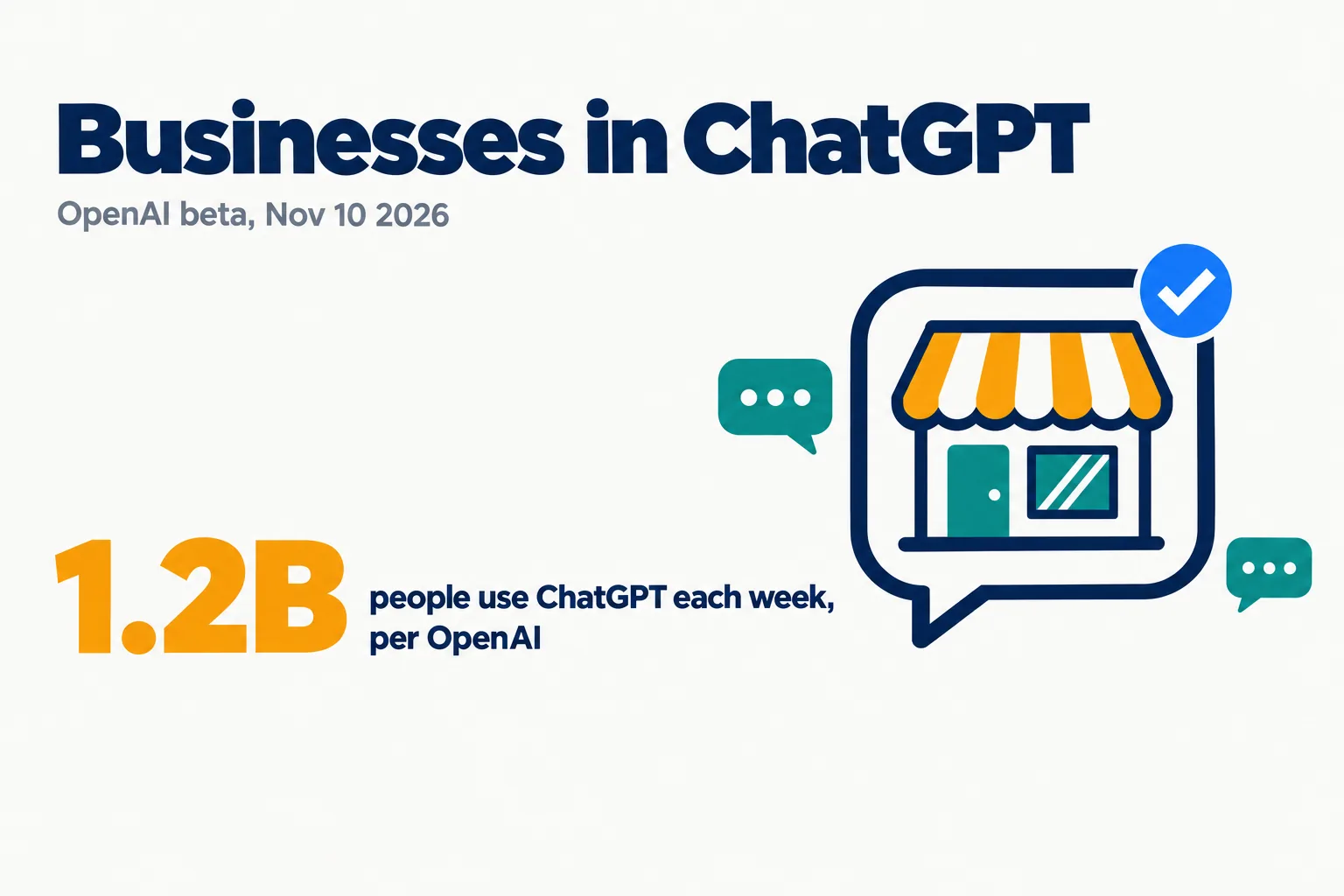
OpenAI launched Businesses in ChatGPT in beta on November 10, 2026. A business can now claim a profile in a new Business Hub, correct its own information and see how often ChatGPT mentions it. Eligible ecommerce and online service businesses in the United States can also build a Business Agent, which answers customer questions inside ChatGPT. OpenAI’s post on X went up at 18:06 UTC: “Now in beta: Businesses in ChatGPT.”
OpenAI published an announcement, a product page and two policies the same day. This page reads all four. The pitch is reach: OpenAI describes the product as a new way to connect with “the 1.2 billion people who use ChatGPT each week”. None of the four pages states a price.
On this page · 8 sectionsOpen
 OpenAI launched Businesses in ChatGPT in beta on November 10, 2026. A business claims a profile in Business Hub and gets a blue check once it is claimed.
 Business Hub shows aggregated insights: mentions, website clicks and discovery topics. OpenAI says it does not share users’ conversations with businesses.
 Eligible ecommerce and online service businesses in the United States can build a Business Agent that answers customer questions in a labeled, separate chat.
 OpenAI says claiming does not guarantee higher placement or sales, and that ChatGPT keeps making independent recommendations.
 A business can sponsor its Business Agent and use it as the destination for ChatGPT Ads. OpenAI’s pages give no price for the hub or the agents.
§ 01How it works

| Part | What it does | Who can use it |
|---|---|---|
| Business Hub profile | Claim the business, verify it and update key details | Eligible businesses with a website, where ChatGPT is offered |
| Product feeds | Share product details, pricing and availability | Retailers; Shopify stores share theirs through Shopify’s catalog |
| Insights | Mentions, website clicks and discovery topics, aggregated | Claimed businesses, once there is enough activity |
| Business Agent | Answers customer questions from the business’s own information | Eligible ecommerce and online service businesses in the US |
| Sponsored Business Agent | The agent becomes the destination for ChatGPT Ads | Businesses that have an agent |
§ 02Claiming your business
OpenAI’s rule is one sentence: “Any eligible business located where ChatGPT is available can claim their business in ChatGPT through Business Hub.” The steps it describes:
- Claim and verify. You claim the business in Business Hub and OpenAI verifies it. You must own the business or be authorized to represent it.
- Update your details. Once verified, you can update key details. The policy lists the business name, category, address or service area, hours, contact details, and products or services.
- Add product feeds. Retailers can upload a feed with product details, pricing and availability.
- Shopify stores. A merchant can connect the store from Business Hub or the Shopify admin, which streamlines verification. You do not need a Shopify store to claim a business. Our list of AI tools for Shopify covers the other options.
- Larger accounts. Existing OpenAI Enterprise customers and advertisers claim through their OpenAI representative.
Not everyone gets in. The product page says: “Eligibility depends on factors including industry, location, and our verification and integrity checks.” The Businesses in ChatGPT policy is blunter: “Not every business can create or claim a profile.” Claiming is also limited at first to eligible businesses with a website.
What you get for claiming is control of your own facts and a badge. The product page says: “A blue check will appear on your business profile in ChatGPT to show it’s been claimed.”
What you do not get is ranking. OpenAI says ChatGPT continues to make independent recommendations and comparisons. In its words: “Claiming does not guarantee higher placement or sales.”
§ 03What the insights show
| Insight | What it counts |
|---|---|
| Mentions | How often the business is mentioned in ChatGPT |
| Website clicks | Clicks through to the business’s website |
| Discovery topics | Common themes across conversations where the business’s website is cited |
OpenAI defines discovery topics as “common themes across conversations where their website is cited”. It presents them as a way for a business to see how it is represented and to improve the information it shares.
The privacy line is direct: “We don’t share users’ conversations or Business Agent chats with businesses.” Insights are aggregated, and they appear only when there are enough conversations or interactions to meet certain thresholds. OpenAI does not publish those thresholds, so a business with few mentions may see nothing at first.
§ 04Business Agents
After claiming, an eligible organization can build, test and launch a Business Agent. A customer reaches it from an answer. When a business appears in a ChatGPT response, a person can click through to the business’s profile and, if an agent is available, start a conversation with it. OpenAI’s example is someone comparing two products who asks about the differences and which one fits.
OpenAI says the agent conversation is “clearly labeled, separate from the customer’s original ChatGPT conversation, and distinct from ChatGPT’s independent answers”.
The Business Agents Policy, updated November 10, sets the rules for the business:
- Say what it is. The policy says: “An agent must be clear that it is AI representing the business”. It must not appear to be a human, an independent adviser or endorsed by OpenAI.
- No pressure. No false urgency, and no pushing a sale or a follow-up after someone declines.
- Little personal data. An agent must not ask for health details, protected traits, government IDs, or financial or authentication credentials.
- No licensed advice. An agent may explain what the business offers. It must not give advice that legally requires a professional license.
- No action without consent. It may not submit a form, a booking or a purchase for a user without explicit authorization through an approved feature.
Access is narrower than for profiles. Business Agents are available to eligible ecommerce and online service businesses in the United States. Being verified is not enough either. The policy says: “Business verification alone does not guarantee agent eligibility.”
§ 05Ads
A business can sponsor its Business Agent and use it as the destination for ChatGPT Ads. OpenAI’s line on this is: “Sponsored placements are clearly labeled and separate from ChatGPT responses.” Our earlier post covers how the ChatGPT ad stack works.
§ 06What OpenAI has not said
- Price. None of the four pages gives a price for Business Hub or for Business Agents.
- Thresholds. How much activity a business needs before insights appear.
- Industries. Which industries are eligible to claim a profile, and which ecommerce and online service categories qualify for an agent.
- How agents are built. The policy mentions instructions, links, forms and tools. It does not say which tools an agent can use.
- Rollout. OpenAI says it plans to expand to more markets and business categories over time. It gives no dates.
§ 07What it means for a small business
This part is our read, not OpenAI’s.
- Claiming is the simple part. By OpenAI’s description it is three steps: claim, verify, correct your details. If ChatGPT shows the wrong hours or an old price for you, this is where you fix it.
- The insights are the new thing. Until now a business could only estimate how often ChatGPT named it. We do that for CellCog by asking answer engines a fixed set of questions and counting. Mentions and clicks from OpenAI itself would be better data than that.
- Claiming is not ranking. OpenAI says so in plain words, and it says ChatGPT may show information about a business whether or not it has an agent.
- An agent speaks for you. The policy holds the business responsible for the information and instructions it gives the agent. Someone has to keep both current.
Our conflict, declared: we build CellCog, AI employees that work inside a business. A Business Agent is a different thing. It faces the customer, inside ChatGPT, and answers from what the business gave it. An AI employee is the one who would keep that information correct. We have not claimed CellCog’s profile or built a Business Agent yet, so this page reports what OpenAI published and not our own test.
§ 08Sources
- OpenAI, Introducing Businesses in ChatGPT, November 10, 2026
- OpenAI, Businesses in ChatGPT: Claim Your Business, product page and FAQ, read November 10, 2026
- OpenAI, Business Agents Policy, updated November 10, 2026
- OpenAI, Businesses in ChatGPT policy, updated November 10, 2026
- OpenAI on X, 18:06 UTC, November 10, 2026
Q1How do I claim my business in ChatGPT?
Open Business Hub at chatgpt.com/business-hub, claim the business and verify it. Shopify merchants can connect their store from Business Hub or the Shopify admin. You must own the business or be authorized to represent it.
Q2What is a ChatGPT Business Agent?
An AI agent a business builds to answer customer questions inside ChatGPT, using the business’s own product and policy information. The conversation is labeled and separate from the customer’s ChatGPT conversation.
Q3Who can build a Business Agent?
As of November 10, 2026, eligible ecommerce and online service businesses in the United States. OpenAI says business verification alone does not guarantee agent eligibility.
Q4What does Businesses in ChatGPT cost?
OpenAI’s announcement, product page and two policies give no price. A business can sponsor its Business Agent through ChatGPT Ads.
Q5Can businesses see my ChatGPT conversations?
No, per OpenAI. It says it does not share users’ conversations or Business Agent chats with businesses, and that insights are aggregated.