Anthropic added a gallery of ready-made legal artifacts to Claude for Legal on October 28, 2026. The announcement defines them plainly: “Artifacts are interactive tools, such as trackers and dashboards, that teams can use and share in Claude.” Six come from Anthropic. Four more come from Harvey, PwC, Goodwin and Foley & Lardner, and Anthropic says artifacts from Legora and Orrick are next. Claude posted it on X at 15:34 UTC.
The new part is not a model. It is the shape of the work: each artifact opens on a built-in example, the legal team swaps in its own documents and connectors, Claude does the first pass and a lawyer applies judgment. Anthropic’s promise for every output is short: “Each answer or output has a link to its source.”
On this page · 6 sectionsOpen
 Anthropic added a gallery of ready-to-use artifacts to Claude for Legal on October 28, 2026: interactive tools such as trackers and dashboards that legal teams adapt and share.
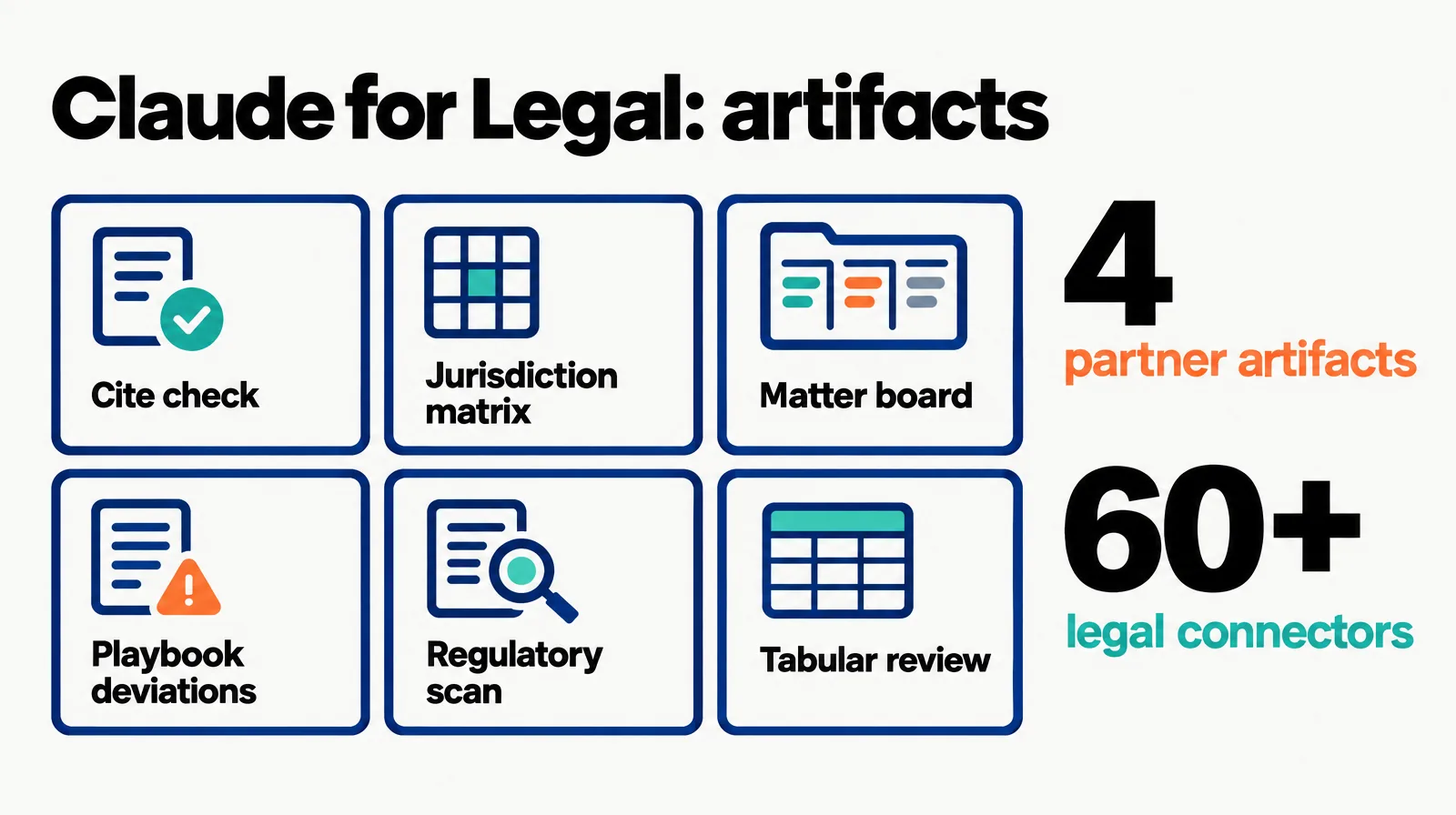
 Six come from Anthropic: cite check, jurisdiction survey matrix, matter board, playbook deviation board, regulatory horizon scan and tabular review.
 Four more come from partners: Harvey, PwC, Goodwin and Foley & Lardner. Anthropic says Legora and Orrick artifacts are coming.
 Harvey Intake connects Claude to Harvey through its MCP server: routine questions get answered from Legal’s own guidance, the rest go to a lawyer in Harvey.
 Anthropic files the launch under Claude Enterprise and names no plan list or price for the gallery. OpenAI’s Astra for Law took the other route on September 17.
§ 01What is in the gallery

Anthropic says the six cover the work legal teams asked for most often since Claude for Legal launched in May.
| Artifact | What it does |
|---|---|
| Cite check | Compares a document with its sources; flags mismatched quotes, wrong page numbers and unsupported claims |
| Jurisdiction survey matrix | Compares one legal topic across states or countries in a table, with links to the law |
| Matter board | Turns engagement letters, emails or spreadsheets into one board of open matters, owners and deadlines |
| Playbook deviation board | Flags each contract clause that differs from company standard terms and routes it to the approver |
| Regulatory horizon scan | Maps upcoming regulations on a timeline for the company’s business and markets, ranked by impact |
| Tabular review | Builds a table of chosen terms across a set of contracts, linked to the exact language |
Two features carry the rest. Connectors bring in a team’s playbooks and research sources, so nobody uploads documents by hand: Anthropic counts more than 60 legal connectors added since May, including Bloomberg Law, Filevine, Ivo, Legora and Patlytics. And sharing reaches beyond the legal team, to colleagues, clients and partners, with settings that “ensure privacy and support ethical walls between teams.”
§ 02Partner artifacts and Harvey Intake
The partner shelf is the bigger signal: firms and legal tech companies now ship their own tools into Claude’s gallery.
The four partner artifacts at launch:
- AI Governance Benchmark (Goodwin): benchmarks a company’s AI governance to surface gaps.
- Harvey Intake (Harvey): one place in Claude for legal requests; routine answers come from Legal’s guidance, the rest go to a lawyer.
- Obligations Checker (Foley & Lardner): reviews agreements for both parties’ obligations before and after closing.
- Subpoena Response Tool (PwC): turns precedents, standard objections and templates into audit-ready first drafts.
Harvey Intake shows how the pieces fit. Harvey’s launch post says the artifact connects to Harvey through its MCP server. A business user asks a legal question in Claude; routine questions are answered from Legal’s guidance, playbooks and prior work in Harvey; anything that needs legal judgment goes to a lawyer in Harvey, and the reply comes back in Claude. Every request is logged in Intake, where Legal sets assignment rules and tracks progress. Harvey’s example is a sales rep sending back a prospect’s marked-up contract without leaving Claude.

Harvey’s Matt Zerweck put the reason in one line: “Business teams are already bringing their questions to Claude.” The artifact keeps those questions inside Legal’s process instead of getting a general answer.
§ 03Access to justice and training
Anthropic is also funding public interest groups that build artifacts for access-to-justice work, plus legal education programs that teach law students to build with Claude, and it is starting a Legal Ambassadors Program. Two of the groups appear in the post: Zealous, whose Criminal Charge Reality Check tool started, in founder Scott Hechinger’s words, “with one question: how do we make that part faster, so the time goes to the person instead?”, and The Access Project, which built a record-clearance artifact for legal teams and self-represented litigants.
§ 04How it compares with OpenAI’s Astra for Law
Six weeks ago OpenAI took a different route into the same profession. We covered Astra for Law on its launch day.
| Anthropic: Claude for Legal artifacts | OpenAI: Astra for Law | |
|---|---|---|
| Announced | Oct 28, 2026 (Claude for Legal since May) | Sep 17, 2026 |
| What ships | A gallery of shareable artifacts plus 60+ legal connectors | GPT-6 Astra configured with a legal search index of 230M+ URLs |
| Partners | Harvey, PwC, Goodwin, Foley & Lardner; Legora and Orrick next | 26 partner-built plugins at launch |
| Access | Filed under Claude Enterprise; no plan list or price in the post | Trusted Access Program for selected firms; API coming soon, no price |
| Where the work lives | Artifacts shared inside Claude | ChatGPT, Codex and, later, the API |
OpenAI tuned the model and its retrieval for law. Anthropic built the tools a legal team opens every morning and let firms add their own. Legora sits on both sides: a connector into Claude here, and one of the API builders OpenAI named for Astra for Law.
§ 05What it means for legal teams
An artifact is a tool someone opens. The work around it, logging requests, keeping the matter board current, chasing the documents a review is waiting on, still needs someone to own it between sessions. That is the job an AI legal assistant takes: they run intake and follow-ups, keep the tracker true, never give legal advice, and leave every judgment call to a lawyer. The gallery makes the first pass faster; ownership of the work is the next layer.
§ 06What to watch
- Which Claude plans get the legal gallery, and whether it ever carries a price of its own.
- The Legora and Orrick artifacts Anthropic says are coming.
- Independent tests of cite check against human cite checking.
- OpenAI’s gpt-6-astra-law API, still without a date.
Q1What are Claude for Legal artifacts?
Interactive tools, such as trackers and dashboards, that legal teams use and share inside Claude. Each starts from a built-in example and links every answer to its source.
Q2Which artifacts are in the gallery?
Anthropic’s six are cite check, jurisdiction survey matrix, matter board, playbook deviation board, regulatory horizon scan and tabular review. Partner artifacts include Harvey Intake and PwC’s Subpoena Response Tool.
Q3How does Harvey Intake work?
Business users send legal questions in Claude. Routine ones are answered from Legal’s guidance and playbooks in Harvey; requests that need judgment go to a lawyer in Harvey, whose reply comes back in Claude. Every request is logged in Intake.
Q4How many legal connectors does Claude have?
Anthropic says it has added more than 60 since Claude for Legal launched in May, including Bloomberg Law, Filevine, Ivo, Legora and Patlytics.
Q5How is this different from OpenAI's Astra for Law?
OpenAI configured GPT-6 Astra with a legal search index and gated it behind a Trusted Access Program. Anthropic ships shareable tools on top of Claude, built by Anthropic and by legal partners.