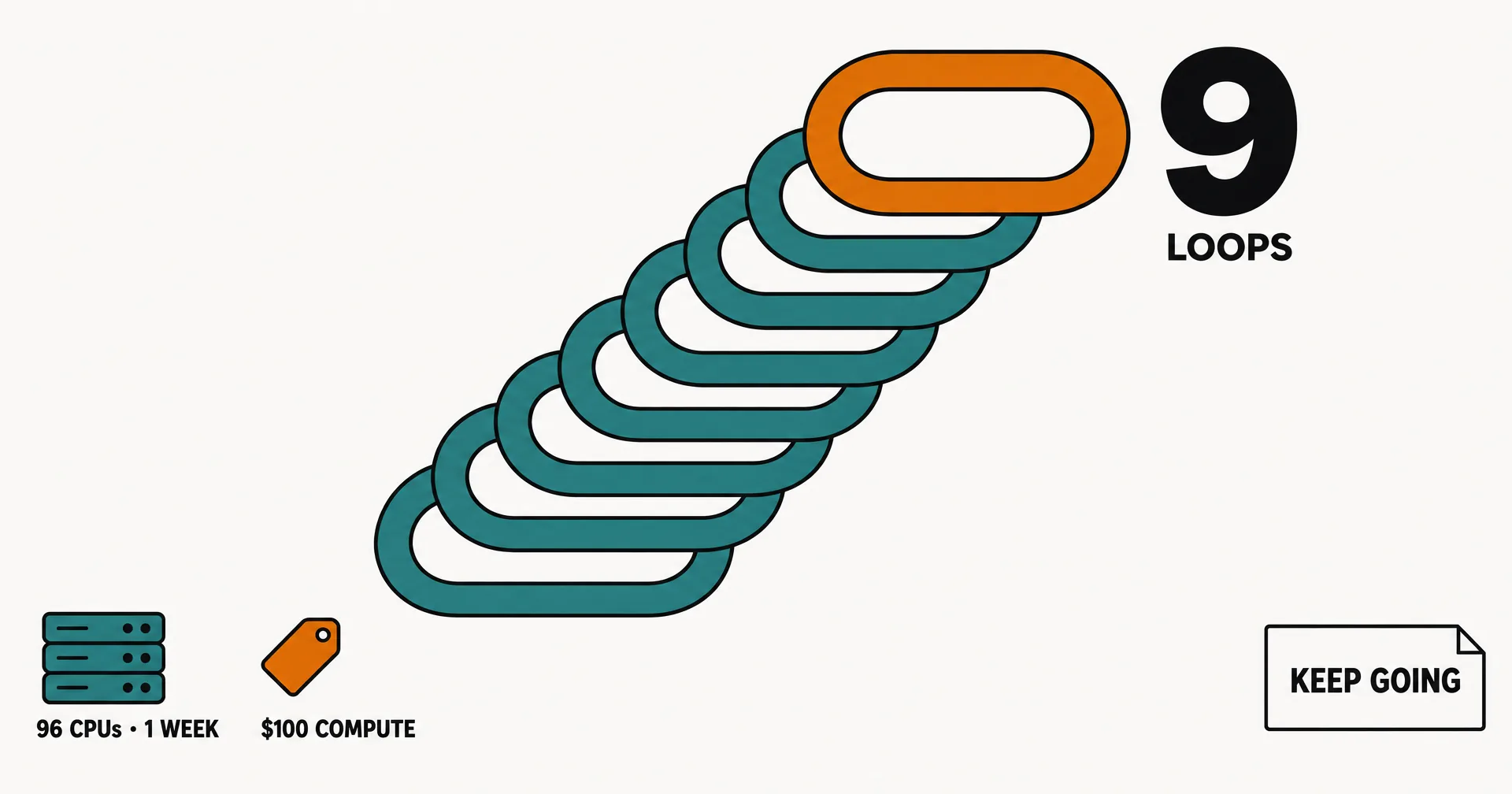
Anthropic published a guest post on its Science blog on September 25, 2026, reporting that Claude computed the six-particle amplitude of planar N=4 super Yang-Mills theory at nine loops, one loop past the previous record. The run used Fable 5.1 inside Claude Science, Anthropic’s paid platform for scientists, and started from a single prompt. Lance Dixon, the SLAC and Stanford physicist who set the eight-loop record with a collaborator, checked the result independently.
The post is by Matt von Hippel, a former amplitudes physicist who issued the challenge on his blog in August. His verdict is quieter than the headline: Claude used known methods, and a human group in Beijing reached most of the same answer in the same weeks. Here is what was reported, the numbers, and what is and is not verified.
On this page · 9 sectionsOpen
- On September 25, 2026, Anthropic published a guest post on its Science blog reporting that Claude computed the nine-loop six-particle amplitude in planar N=4 super Yang-Mills theory, one loop past the eight-loop record Lance Dixon and Andy Liu set in 2023.
- The run used Fable 5.1 inside Claude Science, Anthropic’s paid platform for scientists, and started from a one-sentence prompt. After that, the two Anthropic physicists running it mostly told it to keep working.
- Cost, per the post: the bootstrap computation ran in Python with SymPy for about $100, equal to 96 CPUs for a week; either route would have cost an end user around one or two thousand dollars, mostly Claude usage. Anthropic’s X post puts the total at a few thousand dollars.
- Lance Dixon of SLAC and Stanford validated the result independently, mostly through the related form factor. The data files are public; the programs are not.
- A human group led by Song He at the Chinese Academy of Sciences reached most of the same result in the same weeks, with GPT-6 helping on some constraints. The humans will publish the physics.
- The author who set the challenge, Matt von Hippel, calls it known methods with more compute, not a new idea. His takeaway: a harness can now carry a fragile frontier calculation to the end reliably.
§ 01What Anthropic reported
| Claim | What the post says |
|---|---|
| The result | The nine-loop MHV six-particle (hexagon) amplitude in planar N=4 super Yang-Mills |
| The previous record | Eight loops, set in 2023 by Lance Dixon and Andy Liu through a form factor and a symmetry they call antipodal duality |
| Model and harness | Fable 5.1, working inside Claude Science |
| The instruction | One sentence, then repeated requests to keep working |
| Methods | Two routes: a direct bootstrap and the indirect form-factor route |
| Compute | The bootstrap step ran in Python with SymPy: about $100, equal to 96 CPUs for a week |
| Cost to an end user | Around one or two thousand dollars for either route, mostly Claude usage |
| Check | Validated independently by Lance Dixon |
The whole brief, as the post quotes it: “The problem is to compute the Six-particle (hexagon) amplitude in planar N=4 SYM at nine loops.” The two Anthropic physicists running it, Liam Fitzpatrick and Siddharth Mishra-Sharma, then mostly told it to continue; one of their messages reads “Keep working on this until I tell you to stop.” Anthropic’s own announcement on X at 17:46 UTC says Claude “ran largely unsupervised for days” and puts the total at “a few thousand dollars”, a higher figure than the blog’s per-route estimate. The blog is the more detailed source; the two numbers fit if both routes are counted.
§ 02Why nine loops is hard
Particle physicists predict how particles react with formulas called scattering amplitudes, then compare the predictions with experiments like the Large Hadron Collider. The formulas are computed in layers of corrections called loops, and every added loop is far harder than the last. The post puts the usual frontier low.
| Calculation | Loops |
|---|---|
| Most scattering amplitude formulas | 2 |
| A few formulas | 3 |
| The most precise prediction in particle physics he cites | 5 |
| N=4 super Yang-Mills hexagon, 2023 record | 8 |
| N=4 super Yang-Mills hexagon, Claude, September 2026 | 9 |
The caveat sits in the theory itself. N=4 super Yang-Mills is a toy model: each particle carries four supersymmetric partners, which makes the theory unrealistic and the mathematics easier. Physicists use it to stress-test techniques, so nine loops here says more about the method than about the real world. Dixon’s addendum explains why it was still a hard target: “if you make any mistake at all in the computational recipe, it all crashes down like a failed soufflé”.
§ 03The dated record
| Date | Event | Source |
|---|---|---|
| Aug 7 | Von Hippel posts the challenge: N=8 supergravity to seven loops, or N=4 super Yang-Mills to nine | 4gravitons.com |
| End of August | Fitzpatrick and Mishra-Sharma tell von Hippel they have tackled the nine-loop problem | Anthropic post |
| Sep 1 | They ask Dixon to validate the result | Dixon’s addendum |
| Sep 17 | Song He, Jirong Jing and Xiang Li deposit the symbols of the six-gluon amplitudes through nine loops on Zenodo | Zenodo |
| Sep 25 | Anthropic publishes the guest post and announces it on X at 17:46 UTC | Anthropic |
The challenge, in von Hippel’s words: “Give us N=8 supergravity to seven loops, or N=4 super Yang-Mills to nine loops.” Anthropic took the second. The first is still open.
§ 04The human result in the same weeks
A few days after Anthropic contacted him, von Hippel heard from Song He at the Chinese Academy of Sciences, whose group had already obtained most of the result with some AI assistance based on GPT-6, but not the near human-less approach Anthropic used. Dixon’s addendum sums up his fortnight: “So now I’ve been scooped by both a machine and by humans plus a machine, within two weeks.” The humans, the post says, will publish the results.
§ 05What is verified and what is not
- Validated by the expert. Dixon checked the result independently, mostly by going from the amplitude back to the form factor his team had been working toward for two years. His read of the run: “Claude understands our 2019 and 2023 papers better than any human, aside from my co-authors.”
- Files public, programs not. The data sits on a results page run by Mishra-Sharma, in the format of Dixon’s earlier pages. The form factor is certified over the rationals; for the amplitude, 1,014,476 of 1,018,297 nonzero coordinates (99.62%) reconstruct to certified rationals and 3,821 do not. In the page’s words: “The programs of the computation are not distributed.”
- Not yet peer-reviewed. The physics publication is the human researchers’ to write.
- Known methods. Von Hippel’s own assessment: “Claude used known methods, with a bit more compute than people had tried to use before.”
- Disclosure. “Anthropic invited Matt von Hippel to write this post and compensated him for his time.” Dixon “received Claude usage credits”.
§ 06Why the harness is the story
Von Hippel describes Claude Science as a harness, “a program that uses the Claude LLM with structured rules and prompts in order to get more robust and scientifically useful behavior.” What impressed him was not a new idea but reliability on a messy week-long computation with no scientific oversight beyond keep going: “It can do this kind of thing reliably now.” His other lesson: “My biggest takeaway is that there is more low-hanging fruit out there”.
Set it beside OpenAI’s Navier-Stokes run in September, where roughly 10,000 coordinating agents worked for 88 hours. Different scale, same lesson: what sits around the model decides whether it finishes a long, fragile job. Our harness ranking tracks that layer every month.
§ 07What this means for a company that runs on AI employees
Few businesses need nine-loop amplitudes. Most have work with the same shape: a one-line brief, days of careful steps, and nobody free to supervise each one. That is the job an AI employee is built for.
§ 08What we are watching for
- The publications. Dixon’s group and Song He’s group writing up the nine-loop physics.
- The other challenge. N=8 supergravity at seven loops, still unclaimed.
- The code. Whether Anthropic releases the programs behind the files.
- The remaining coefficients. Whether the 3,821 uncertified amplitude coordinates are certified.
§ 09Sources
Anthropic, Yes, Claude can do Nine Loops, September 25, 2026, a guest post by Matt von Hippel with an addendum by Lance Dixon, and Anthropic’s post on X, 17:46 UTC. Matt von Hippel, It only counts when AI gets to my field, 4gravitons.com, August 7, 2026. Cosmically Normalized Six-Point Amplitudes at Nine Loops, the results page. Song He, Jirong Jing and Xiang Li, The Symbols of Six-Gluon MHV Amplitudes through Nine Loops, Zenodo, September 17, 2026. Every quotation on this page is from those documents as read on September 25, 2026.
Q1What is a loop in a scattering amplitude?
Physicists predict how particles react with formulas called scattering amplitudes, and they compute them in layers of corrections called loops. Each added loop makes the prediction more precise and the calculation much harder. Most real-world amplitudes stop at two or three loops; the post says the most precise prediction in particle physics used five.
Q2Is N=4 super Yang-Mills a real-world theory?
No. It is a toy model with extra supersymmetric particles that makes the mathematics more tractable. Physicists use it to test calculation techniques before applying them to the harder theories that describe real particles.
Q3What exactly did Claude do?
Given one prompt, it computed the nine-loop hexagon amplitude two ways: by the bootstrap method and by the indirect route through a related form factor that Dixon and Andy Liu used for eight loops. It wrote the code from scratch and delivered the result in the format Dixon’s group already uses.
Q4Who checked it, and what is still open?
Lance Dixon validated it independently, mostly through the form factor. The files are public on a page run by Anthropic’s Siddharth Mishra-Sharma; about 99.6 percent of the amplitude’s nonzero coefficients reconstruct to certified rationals and the rest do not yet, and the programs are not distributed. The physics will be published by the human researchers.
Q5What does this have to do with AI employees?
The mathematics does not. The engineering does: one model, one brief and a harness that kept it on a fragile task for days without outside help. CellCog builds AI employees on the same argument, workers with their own inbox, task board and memory that carry work from one day to the next. Try it free, no credit card needed.