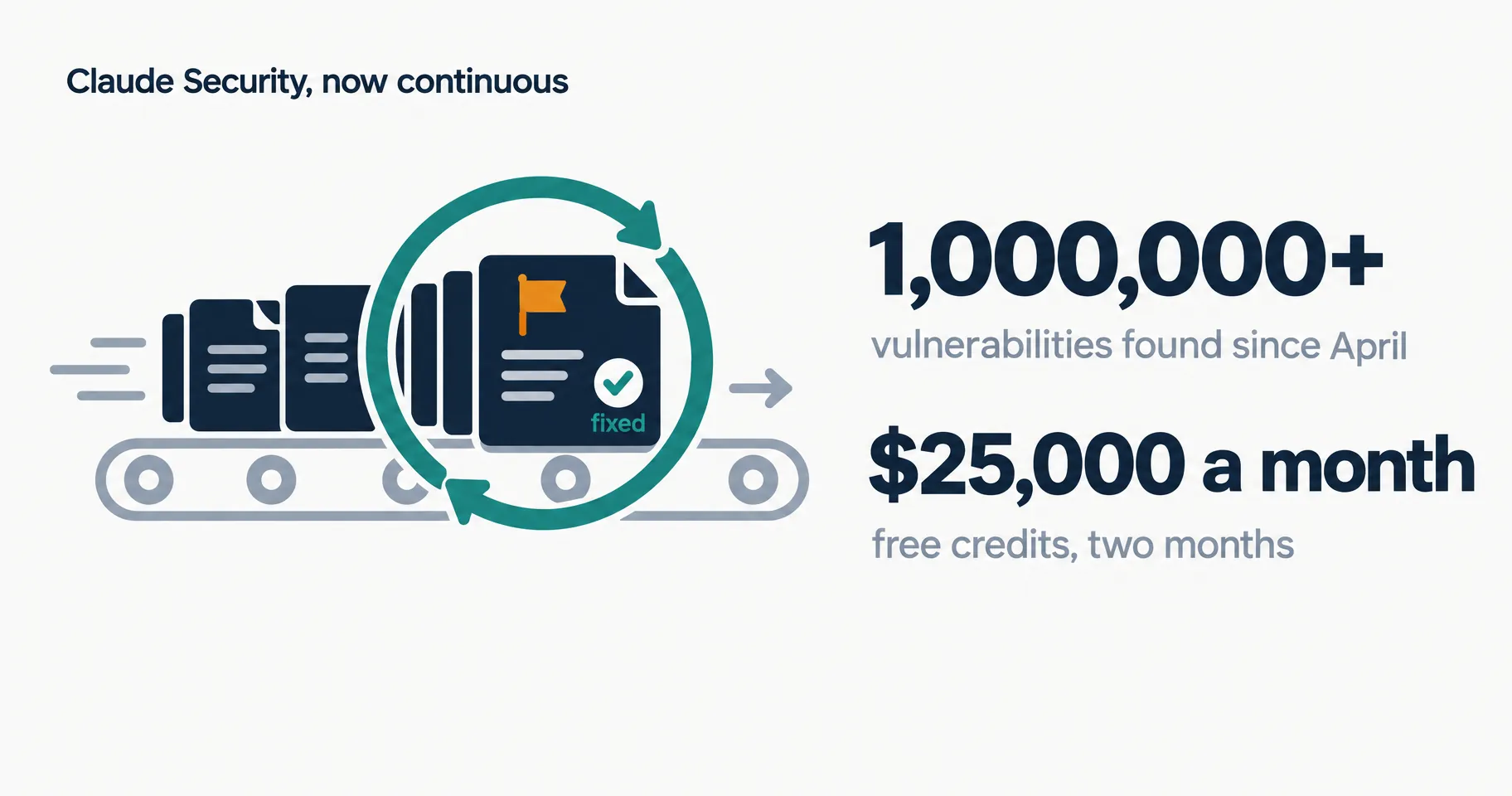
On October 21, 2026, Anthropic turned Claude Security from a scanner you run into one that keeps watching: it now rescans code as it changes, marks findings fixed when the fix ships, and decides what matters using context your team writes down. The release is a public beta for Claude Enterprise.
The numbers behind it, from Anthropic’s announcement: “Since Claude Security entered public beta in April, thousands of organizations have used it to find over a million vulnerabilities.” This page reads that post, the product page and the Help Center terms.
 On October 21, 2026, Anthropic made Claude Security scan continuously: a deep baseline scan, then regular scans of code changes based on their risk and complexity.
 A project can hold several repositories, so Claude can catch issues that live between services.
 Findings are marked fixed when the fix lands, wherever it was made, and reopen automatically if the issue comes back.
 Each project gets a knowledge base and an editable threat model that decide what is worth flagging, plus an API, webhooks, an MCP connector and role-based access.
 It is a public beta for Claude Enterprise, billed at direct token cost, with up to $25,000 a month in free credits for two months through December 31, 2026.
§ 01What changed
- Scans keep up with the code. “Claude runs a deep baseline scan, then scans changes regularly based upon their risk and complexity.” Repositories connect through the Claude GitHub app (GitHub Enterprise Server included) or an access token from GitLab and other Git providers.
- Cross-repository findings. A project can hold several repositories, so it can catch “a backend that trusts input a client was supposed to validate.”
- Fix tracking. Claude Security “marks them fixed when the fix lands, whether your team fixed it in Claude Code or in a separate process.” If the issue comes back, the finding reopens on its own.
- Your context shapes the scan. Each project has a knowledge base for how code is deployed and which policies apply, plus a threat model Claude generates and your team edits. Context also lets it skip risks your environment already handles.
- Severity and exploit paths. Every finding gets a severity judged against the threat model and an explanation of how an attacker could reach the code, sometimes with an attack-path diagram.
- It plugs into your tools. A new API lists, reads, resolves and reopens findings and manages projects. Webhooks push new findings to systems such as Slack or Jira, an MCP connector works in Claude.ai and Claude Code, and role-based access controls decide who can view, triage or create projects.

§ 02The details at a glance
| What Anthropic says | |
|---|---|
| Who can get it | Claude Enterprise customers, public beta |
| Models | Full Claude family including Mythos; Mythos scans only in the Claude Security app on Claude.ai |
| Access program | No Cyber Verification Program access required |
| Price | Direct token cost, no platform fee, separate spend limit |
| Launch offer | Up to $25,000 in credits each of two consecutive months, through December 31, 2026 |
| Integrations | API, personal access tokens, webhooks, MCP connector |
| Scope | Only code you or your company own and have rights to scan |
| Local option | Claude Security plugin for Claude Code, beta, uses the models in your Claude Code account |
The offer is automatic for eligible organizations, including Enterprise bought through AWS Marketplace, and unused credits do not carry over. Organizations that sign up after November 1 will not get two full months, because the offer ends on December 31 either way. It applies only to projects created with the new experience.
§ 03What customers say
Anthropic published four customer quotes. Vanta’s Director of Security, Nathan Hunstad, said it “found a number of logic flaws that none of our other tools had caught.” Jon Donovan, a software engineer at IonQ, said it “found many material issues that a traditional pen test conducted at the same time missed.” Gusto’s Jake Meredith described the new loop: “Claude Security scanned our code once to set a baseline. Now it keeps up as our code changes, and our team fixes issues right in Claude instead of switching to another tool.”
These are vendor-selected quotes, not an independent test. Anthropic’s own caution stands: “Claude can make mistakes, so you should always review proposed patches before applying them, especially for critical systems.”
§ 04Why it matters
A scanner that runs once produces a report that starts aging the next morning. The useful change here is that the finding list now tracks the code, and the backlog closes itself when fixes ship. That is the same move Anthropic has made across its cyber work this month, from the Cyber Mission programs to the Cyber Verification Program: put the strongest models in defenders’ hands and keep them running, not just on request.

For small teams the open question is reach. This version is Enterprise only; everyone else gets the Claude Code plugin, which runs on whatever models their Claude Code account has, not Mythos.
§ 05What to watch
- Whether continuous scanning reaches Team or Pro plans after the beta.
- What token costs look like for a busy repository once the credits run out in January.
- Whether independent teams publish false-positive rates against traditional scanners.
Q1What is continuous scanning in Claude Security?
After a deep baseline scan, Claude Security scans code changes regularly, prioritized by their risk and complexity, so the list of findings stays close to the current state of the code instead of a one-time snapshot.
Q2Who can use the new Claude Security?
It is in public beta for Claude Enterprise customers, including Enterprise bought through AWS Marketplace. Admins enable it in the admin console and choose who can access it.
Q3How much does Claude Security cost?
Anthropic charges direct token cost only, with no platform fee, and lets you set a separate spend limit. The launch offer gives eligible Enterprise organizations up to $25,000 in credits in each of two consecutive months, ending December 31, 2026.
Q4Does Claude Security need Cyber Verification Program access?
No. Anthropic says it runs on its full model family, including Claude Mythos, with no Cyber Verification Program access required. Mythos-powered scans run only in the Claude Security app on Claude.ai.
Q5Can I scan open-source projects with Claude Security?
No. Anthropic’s terms limit it to code you or your company own and have the rights to scan; open-source repositories outside your own codebase are excluded.