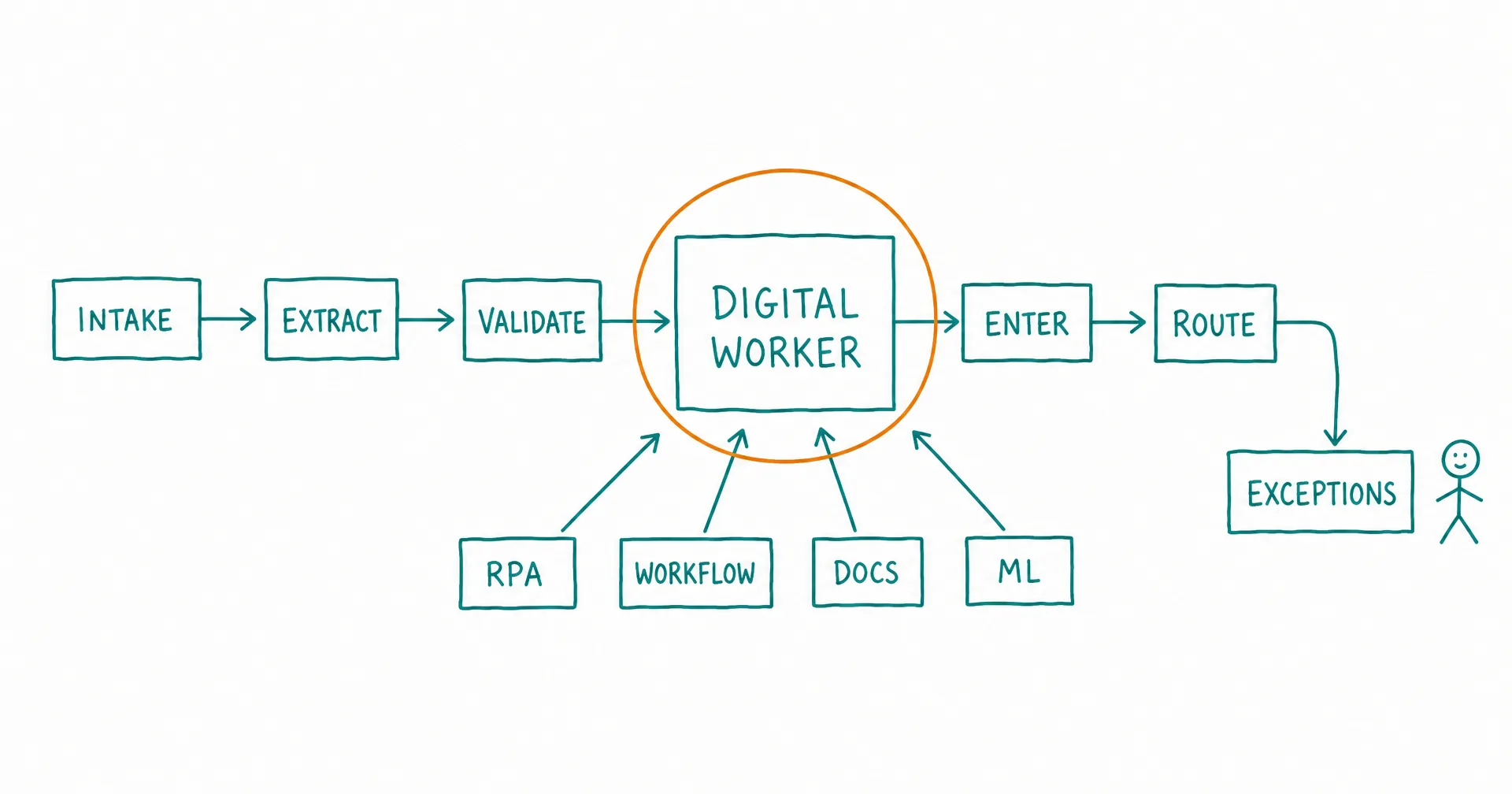
A digital worker is software that independently performs meaningful parts of a business process. It does this by combining automation components: robotic process automation (RPA) for application actions, workflow orchestration for sequencing, document processing for unstructured inputs, conversational interfaces for requests, and machine learning for classification and prediction.
The term comes from the intelligent-automation industry. Vendors needed a word for something bigger than a single-purpose bot but smaller than a human team: one software worker that can carry a process from intake to completion. Some vendors say digital employee instead. The two labels describe the same category, and neither one is a person.
This guide defines the term precisely, separates it from bots and RPA, shows what digital workers actually run in production, and marks the boundary with the newer AI employee category.
On this page · 8 sectionsOpen
- What Is a Digital Worker? A Precise Definition
- Digital Worker vs Bot: The Difference That Matters
- What Do Digital Workers Actually Run? Examples
- What Is a Digital Worker Platform?
- Digital Worker vs AI Employee: Where the Categories Split
- When a Digital Worker Is the Right Choice
- The Digital Worker Market in 2026: Vendors and the Agentic Convergence
- The Bottom Line
- A digital worker is software that independently executes meaningful parts of a business process by combining automation components: RPA, workflow orchestration, document processing, conversational AI, and machine learning.
- The term comes from the intelligent-automation industry. Digital employee is a synonym; both describe process-centric software labor, not a person.
- A bot automates one task with fixed rules. A digital worker coordinates several components and tasks across an end-to-end process.
- Typical production digital workers run accounts-payable intake, claims processing, onboarding provisioning, and report assembly: documented, high-volume processes.
- A digital worker owns a process. An AI employee owns a role: a recurring outcome with triggers, persistent memory, task state, bounded authority, and handovers.
- Choose a digital worker for stable, mapped processes. Choose an AI employee when the outcome recurs but the path and evidence vary. The strongest designs combine both.
§ 01What Is a Digital Worker? A Precise Definition
A digital worker is software-based labor that can independently run part or all of a complex business process by applying a range of automation and AI skills. IBM’s definition of the category, one of the earliest and most cited, traces it from simple software robots toward intelligent automation that combines conversational intelligence, RPA, machine learning, computer vision, and natural-language processing.
Each part of that definition carries weight.
| Definition element | What it means in practice |
|---|---|
| Software-based labor | It occupies a unit of work a person would otherwise do, with its own credentials and workload |
| Meaningful parts of a process | More than one task: intake, interpretation, action, and exception routing across systems |
| A range of skills | RPA, workflow, document extraction, conversational input, and ML combined, not a single script |
| Independence within bounds | It proceeds without step-by-step human direction, inside designed rules and escalation paths |
The unit of design is the process
A digital worker is almost always built around a named, documented process: process the vendor invoices, provision the new hire, assemble the monthly report. The process map decides what the worker does, which systems it touches, and where exceptions go.
That process-centric design is a strength. When policies and transitions can be written down, a deterministic orchestration layer is more reliable and more auditable than an open-ended agent.
One warning about the label
“Digital worker” has also historically described human employees with strong digital skills. Modern automation marketing almost always means software, but contracts, security policies, and metrics should remove the ambiguity: name the software, its owner, and its access explicitly.
§ 02Digital Worker vs Bot: The Difference That Matters
Buyers most often confuse digital workers with bots. The distinction is scope and coordination.
| Dimension | Bot (RPA) | Digital worker |
|---|---|---|
| Scope | One task or screen sequence | An end-to-end process spanning several tasks |
| Inputs | Structured data in known fields | Structured plus documents, messages, and requests |
| Path | Fixed script | Orchestrated components with branching and routing |
| Exceptions | Stops or dumps to a generic queue | Classifies, attaches evidence, routes to the right queue |
| Change tolerance | Brittle to interface changes | Somewhat adaptive; ML components absorb input variance |
| Measurement | Task completion rate | Process outcomes: cycle time, straight-through rate, cost per case |
A bot is a component. A digital worker is a composition. The narrower comparison between deterministic robots and adaptive role execution is covered in the AI employee versus RPA guide.
§ 03What Do Digital Workers Actually Run? Examples
The pattern behind every strong deployment is the same: a documented process, high volume, stable rules, and known exception classes.
| Deployment | What the digital worker does |
|---|---|
| Accounts-payable intake | Collects invoices, extracts fields, validates against purchase orders, enters approved items, routes mismatches |
| Claims processing | Gathers claim documents, classifies them, checks completeness, requests missing items, prepares the adjudication file |
| Employee onboarding | Creates accounts, assigns licenses, provisions access from the role profile, confirms completion to HR |
| Customer-master updates | Applies validated change requests across CRM, billing, and ERP, preserving an audit record |
| Periodic report assembly | Downloads approved sources, validates schemas, refreshes tables and charts, applies the template, files the output |
| Order-to-cash tasks | Enters orders, matches payments, flags disputes with supporting evidence |
If the work you want done looks like a standing responsibility rather than one of these mapped processes, the AI employee examples guide shows what role-shaped deployments look like instead.
§ 04What Is a Digital Worker Platform?
A digital worker platform is the tooling used to build, run, and govern digital workers. Evaluate seven capabilities:
- Process designer and orchestrator: where the process map lives and how changes are versioned.
- Execution layer: RPA for interface actions, API connectors for supported operations.
- Document intelligence: capture, classification, and field extraction for unstructured inputs.
- Human-in-the-loop queues: how exceptions reach people and how decisions return to the process.
- Monitoring and operations: run health, retries, alerting, and workload management.
- Governance: credentials, least-privilege access, change control, and audit logs.
- Analytics: process outcomes measured against the baseline, not just bot activity.
The platform question that matters most is rarely on the datasheet: who maintains the process map when the business changes, and how quickly does a rule change reach production?
§ 05Digital Worker vs AI Employee: Where the Categories Split
The short version: a digital worker owns a process; an AI employee owns a role.
An AI employee is agentic software placed in a standing organizational role. Work arrives from several triggers, task state survives a run, the role chooses among tools inside policy, performance is reviewed over time, and unfinished work is handed forward. Its natural unit is a recurring responsibility that may span several processes and require investigation, prioritization, and follow-through.
The categories overlap heavily, and in mature products they converge: a sophisticated digital worker can pass role tests, and an AI employee can call digital-worker services for its stable steps. Neither label is automatically more advanced. The full digital worker versus AI employee comparison works through ten practical differences and a 15-point evaluation scorecard for any system wearing either label.
§ 06When a Digital Worker Is the Right Choice
Choose a digital worker when:
- the process is documented end to end, with an accountable owner;
- transaction volume is high enough to repay the implementation;
- business rules are stable and can be encoded;
- exception classes are known and can be routed to designed queues;
- legacy applications require interface automation where APIs are missing.
Choose an AI employee instead when the outcome recurs but the path varies: the work needs interpretation of changing evidence, spans several processes, waits on external events, and benefits from persistent context. The decision between stable paths and stable outcomes is treated in depth in the AI employee versus workflow automation guide.
The strongest architecture is often both: an AI employee owns the recurring outcome, investigates exceptions, and delegates the stable, validated steps to digital-worker services. If that is the shape of your work, start from the role definition rather than the tooling: the outcome-first hiring guide shows how to specify the role before choosing any platform.
§ 07The Digital Worker Market in 2026: Vendors and the Agentic Convergence
Two groups now sell under this category, and in 2026 they are visibly converging.
The intelligent-automation incumbents. IBM (which anchored the digital-worker definition and now sells orchestration under watsonx), UiPath, Automation Anywhere, and SS&C Blue Prism built the category: process designers, RPA execution, document intelligence, bot operations, and governance for mapped, high-volume processes. If your work fits the process pattern above, these platforms are mature, and that maturity is the honest reason to shortlist them.
The agentic entrants. A newer group builds role-centric software labor - the AI employee pattern - and 2026 is the year the largest labs joined them. xAI shipped Grok Bot on August 11, 2026 as “always-on AI teammates” on a persistent cloud computer. OpenAI trained its newer models, including GPT-6 Astra (shipped September 3, 2026), to enable persistent agents, per WIRED’s August 27 reporting. And the license Alibaba published with Qwen3.8-Flash-Next on August 26 names “AI Work Assistant” businesses as a licensing class. CellCog, which publishes this guide, builds in this second group - a conflict worth declaring before you weigh the framing.
For a buyer, the convergence means the label on the datasheet predicts less than it used to. An incumbent may now sell an “agentic” layer; an agentic platform may execute deterministic workflows. The evaluation discipline stays the same either way: ignore the label, demand operating evidence, and match the architecture to whether your work is a mapped process or a standing role.
§ 08The Bottom Line
A digital worker is intelligent-automation software built around a process: valuable, proven, and at its best where work is stable enough to map. It is not a bot, and it is not a person. The newer AI employee category answers a different question: who owns the recurring outcome when the path varies? Judge both by operating evidence, never by the label.
Q1What is a digital worker in simple terms?
A digital worker is a software program that does part or all of a business process on its own, the way a person in that seat would: it receives work, reads documents, applies rules, operates applications, and routes exceptions to humans. It combines several automation technologies rather than being one script.
Q2What is an example of a digital worker?
A common example is an accounts-payable digital worker: it collects incoming invoices, extracts the fields, validates them against purchase orders, enters approved invoices into the finance system, and routes mismatches to a human queue with the evidence attached.
Q3Is a digital worker the same as RPA?
No. RPA is usually one component inside a digital worker. RPA bots perform repetitive, rule-based actions in application interfaces; a digital worker adds workflow orchestration, document processing, conversational interfaces, and machine learning around those bots to cover a larger process.
Q4What is a digital worker platform?
A digital worker platform is the software used to build, run, and govern digital workers. It typically includes a process designer, RPA and API execution, document intelligence, human-in-the-loop task queues, monitoring and bot operations, credential management, and analytics.
Q5Do digital workers replace human employees?
They replace specific process work, not whole jobs by default. In practice organizations redeploy the removed effort: humans keep exception handling, judgment calls, and accountability, while the digital worker executes the stable, high-volume steps. Governance and a human owner remain mandatory.
Q6What is the difference between a digital worker and an AI employee?
A digital worker is usually designed around one mapped process; an AI employee is designed around a standing role with recurring outcomes, triggers, persistent context, task state, bounded authority, and handovers. Mature products can converge, so compare operating evidence rather than labels.