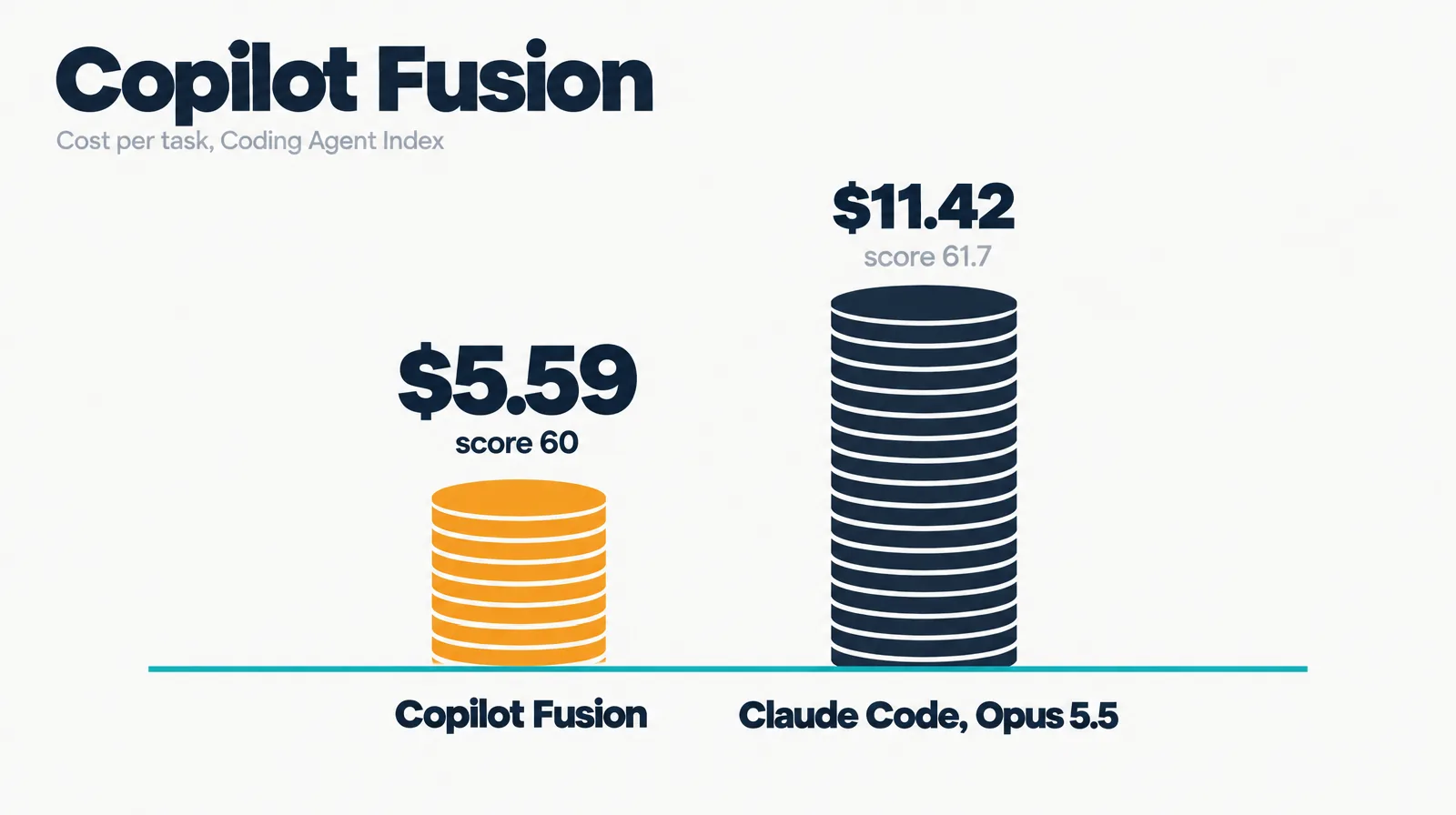
GitHub made Copilot Fusion generally available on October 28, 2026, at its Universe conference. Instead of choosing a model, a developer chooses Fusion and an effort level, and Copilot decides which models handle each prompt. “GitHub Copilot Fusion is generally available,” the changelog says. GitHub’s headline number comes from Artificial Analysis: on its Coding Agent Index, Fusion Max scored 60, within two points of Claude Code running Claude Opus 5.5, at about half the cost per task.
The same day, Microsoft said the harness underneath, the Microsoft Copilot harness, now runs across its Copilot products and is open to developers through Microsoft Foundry. “If you want to compete, you need to be multi-model,” that post opens.
On this page · 6 sectionsOpen
 GitHub made Copilot Fusion generally available on October 28, 2026: developers pick Fusion and an effort level, and Copilot chooses the models for each prompt.
 On Artificial Analysis’s Coding Agent Index, Fusion Max scored 60 at $5.59 per task, against 61.7 at $11.42 for Claude Code with Claude Opus 5.5.
 Fusion runs each prompt one of three ways: one model, a cascade where a judge accepts a quick draft or escalates, or a critique where other models review one draft.
 There is no separate charge: each model Fusion uses is billed at its standard rate, with 30% off on paid Copilot plans through November 30, 2026.
 Microsoft is opening the harness behind Copilot to developers through Microsoft Foundry, in public preview, plus a downloadable SDK.
 Fusion leads Terminal-Bench 4.0 at 71 but places third on FrontierCode at 51, behind Claude Code with Opus 5.5 at 56.
§ 01How Fusion picks models
GitHub’s documentation describes it plainly: “Copilot Fusion is an intelligent runtime model router and orchestrator.” For each prompt it picks the models, the reasoning effort and one of three execution patterns, so two prompts in the same session can run differently.

| Pattern | What happens |
|---|---|
| Single | One model completes the task |
| Cascade | An efficient model drafts; a judge accepts the draft or escalates to a stronger model |
| Critique | One model drafts while several others critique it in parallel; the first model revises |
GitHub says choosing a pattern adds minimal latency, and that “Copilot Fusion only adds model calls when a task warrants them.” A simple task runs on one model and costs what one model costs; cascade and critique take longer because they add review calls.
The developer sets the effort level. Fusion sets everything else.
| Effort level | What GitHub says it prioritizes |
|---|---|
| Fusion Standard | Cost, quality and latency in balance; one model per task |
| Fusion High | Balanced orchestration with moderate token savings, for substantial, well-scoped coding tasks |
| Fusion Max | Frontier capability while still weighing token efficiency |
| Fusion Fast | Fast models only; not selectable, used in VS Code inline chat |
The model pool changes over time. Artificial Analysis lists Claude Opus 5.5, Claude Sonnet 5.5, GPT-6 Astra and GPT-6 Sol among the models Fusion chooses from. On Fusion Standard it can also use two local models in public preview, MAI Code 1.1 Flash and Qwen3.8 Flash Next. Fusion has no context window of its own: each step runs inside the limits of the model running it.
§ 02The benchmark: two points behind, at half the cost
Artificial Analysis ran Fusion Max inside GitHub Copilot CLI on version 2.0 of its Coding Agent Index, which scores a model and its harness together (our read of v2.0).

Fusion Max costs $5.59 per task against $11.42 for Claude Code with Opus 5.5, and used 7.2 million tokens per task, about half as many. GitHub adds that it took about 40% less time per task. Devin Fusion, which pairs Opus 5.5 with GPT-6 Luna, scores 62 at $8.00 per task. The cheapest strong option is still elsewhere: Codex with GPT-6.1 Sol scored 54.1 at $1.50 per task in the same index on October 23.
The parts tell a less tidy story. Fusion leads Terminal-Bench 4.0 at 71, places third on FrontierCode at 51, behind Claude Code with Opus 5.5 at 56 and Devin Fusion at 54, and scores 57 on SWE-Atlas-QnA-AA, between GPT-6 Astra in Codex and Gemini 4 Argon in Antigravity CLI. Artificial Analysis also notes how the bill works: “Token costs are charged based on the underlying models used to complete a request.” These are API costs per task, not subscription prices.
§ 03What it costs and who gets it
Fusion has no fee of its own. GitHub bills each model it uses at that model’s standard rate, so Fusion High and Fusion Max can spend more AI credits on a task than Fusion Standard. Through November 30, 2026, paid Copilot plans get 30% off model costs when they use Fusion.
It is available on all Copilot plans, in Visual Studio Code, the GitHub Copilot app, Copilot CLI and JetBrains IDEs, with more clients promised. Administrators choose which models Fusion may use and can make it the default. GitHub’s docs carry two cautions: Fusion works separately from subagents and does not start them, and when it throws away a draft, any file edits that draft already made stay in your workspace until you review them.
§ 04The harness underneath, now for everyone
Microsoft’s post says the harness GitHub built for Copilot now powers Copilot Code, Copilot Studio, the GitHub Copilot app, the CLI and VS Code. It works across more than 20 frontier models plus bring-your-own-key, and its runtime was recently ported to Rust. Developers can download the Copilot SDK or run the harness managed in Foundry.
Foundry’s announcement puts it in public preview in Foundry Agent Service, with reusable skills, MCP and Foundry tools, built-in subagents and agent definitions kept in source control. The division of labor is stated in one line: “Microsoft runs the agent loop and sandbox; you bring the knowledge, procedures, and tools that make the agent yours.”
GitHub also changed how large customers buy Copilot. GitHub Enterprise now includes Copilot for customers who work with an account team, metered against an enterprise AI budget from the first request, and users without an Enterprise license can get Copilot Standalone at $10 per user per month. Self-serve customers get it later, in stages.
§ 05What it means if you run AI employees
Fusion’s bet is that no single model is best at every step, so a router should choose per prompt. CellCog took the other bet for now: every tier of our AI employees runs Claude Opus 5.5, and the tiers change how much effort and tool depth it gets, not which model answers. Artificial Analysis’s own effort result from October 27 (Intelligence Index v5) shows why that works: the same model moves from 35 to 58 with effort.
Fusion’s 60 at half the cost, and Devin Fusion’s 62, are strong numbers for routing inside a coding harness. An employee’s work is not one coding task, though; it is many tasks over days that share memory, tools and context, and a router that swaps models mid-stream has to keep all of that intact. That is the test any routing change would have to pass for us.
§ 06What to watch
- Fusion’s price once the 30% discount ends on November 30.
- Which models join or leave the pool; Gemini 4 Carbon, announced the same day, is not in any API yet.
- Independent runs of Fusion High and Fusion Standard, which Artificial Analysis has not scored.
- The Copilot harness moving from public preview to general availability in Foundry.
Q1What is GitHub Copilot Fusion?
A router and orchestrator in GitHub Copilot. You pick Fusion and an effort level instead of a model; for each prompt it chooses the models, the reasoning effort and one of three execution patterns.
Q2Which models does Copilot Fusion use?
GitHub says the pool changes over time. Artificial Analysis lists Claude Opus 5.5, Claude Sonnet 5.5, GPT-6 Astra and GPT-6 Sol among them, and Fusion Standard can use two local models in preview.
Q3How does Copilot Fusion score on benchmarks?
Artificial Analysis scored Fusion Max at 60 on its Coding Agent Index, two points behind Claude Code with Opus 5.5, at $5.59 per task. It leads Terminal-Bench 4.0 at 71 and places third on FrontierCode.
Q4How is Copilot Fusion billed?
Per model used, at each model’s standard rate, with no separate Fusion charge. Fusion High and Max can use more AI credits per task than Standard. Paid plans get 30% off through November 30, 2026.
Q5What is the Microsoft Copilot harness?
The agent harness GitHub built for Copilot, which Microsoft now runs across its Copilot products. Developers can use it through Microsoft Foundry Agent Service, in public preview, or download the SDK.