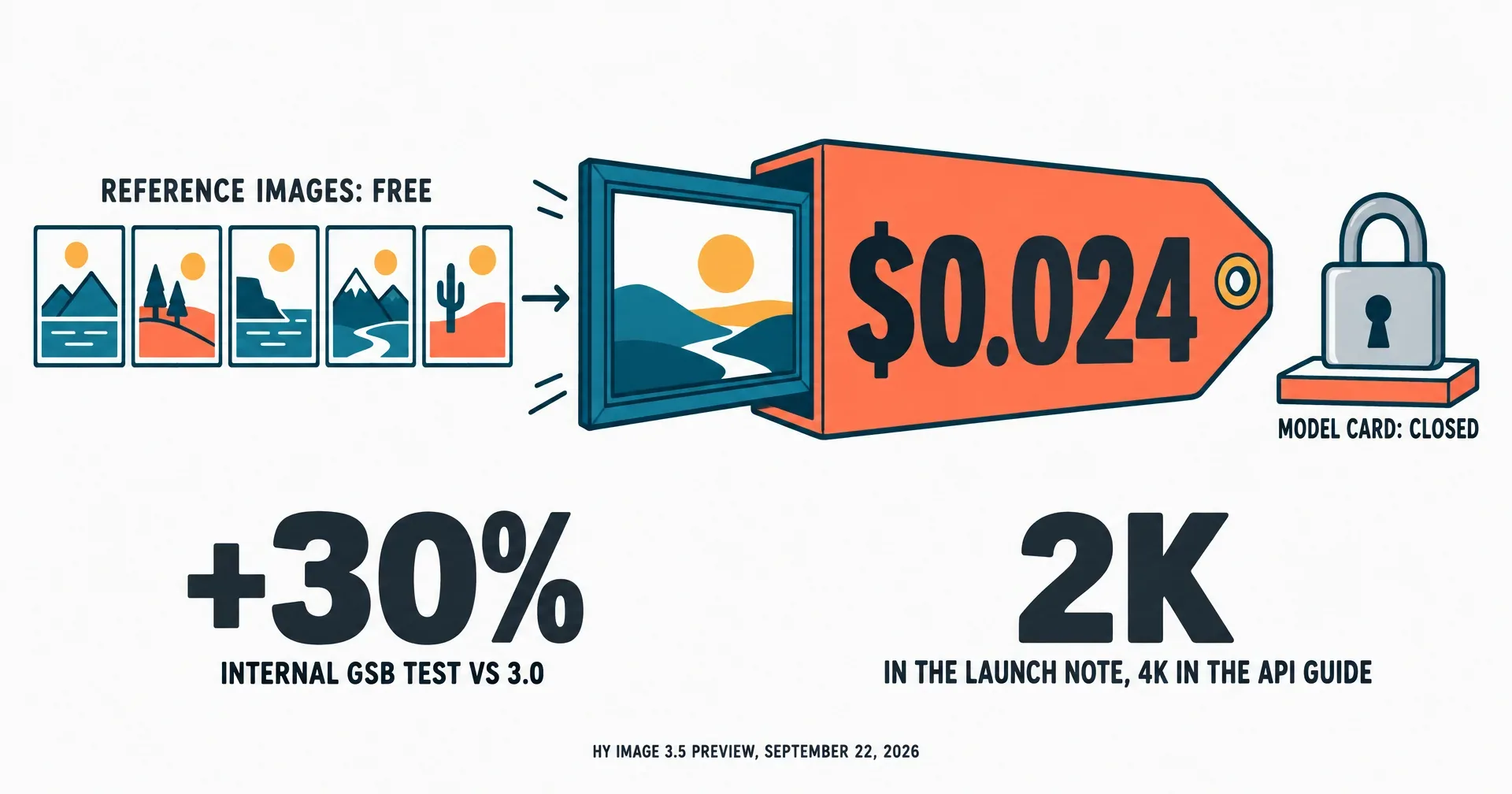
Tencent released Hy Image 3.5 preview on September 22, 2026, and priced it at $0.024 an image. The Tencent Cloud announcement went up at 02:35 UTC; the Hunyuan X post followed at 02:40 with the line “Priced for everyone. $0.024 per image on Tencent Cloud API.” One model handles text-to-image, reference-based generation and multi-turn editing. The quality claim is a 30% win rate over Hy Image 3.0 in an internal blind test by Tencent’s own designers, with parity against Seedream 5.0 Pro claimed alongside it. What Tencent did not publish is anything about the model: no parameter count, no architecture, no report, no weights plan. This is the record of what Tencent shipped, what it charges, what it claims, and what is still closed. Times are UTC.
On this page · 9 sectionsOpen
 Tencent released Hy Image 3.5 preview on September 22, 2026: the Tencent Cloud announcement went up at 02:35 UTC and the Hunyuan X post at 02:40 UTC. One model does text-to-image, reference-based generation and multi-turn editing; the model id is hy-image-v3.5-preview on Tencent Cloud TokenHub.
 The price is the headline: 0.15 RMB per image at 1K and 2K on the mainland API and $0.024 per image on the international one, 25% below Hy Image 3.0’s 0.20 RMB, with 4K at 0.20 RMB. Tencent bills output images only; failed generations and reference inputs are free.
 The quality claim is internal: a blind GSB test by several hundred Tencent designers scored 3.5 preview 30% better than Hy Image 3.0, on par with Seedream 5.0 Pro and slightly ahead of Nano Banana Pro and Qwen-Image-3.0 Pro. No test set, sample size or margin was published, and no independent leaderboard had scored it on launch day.
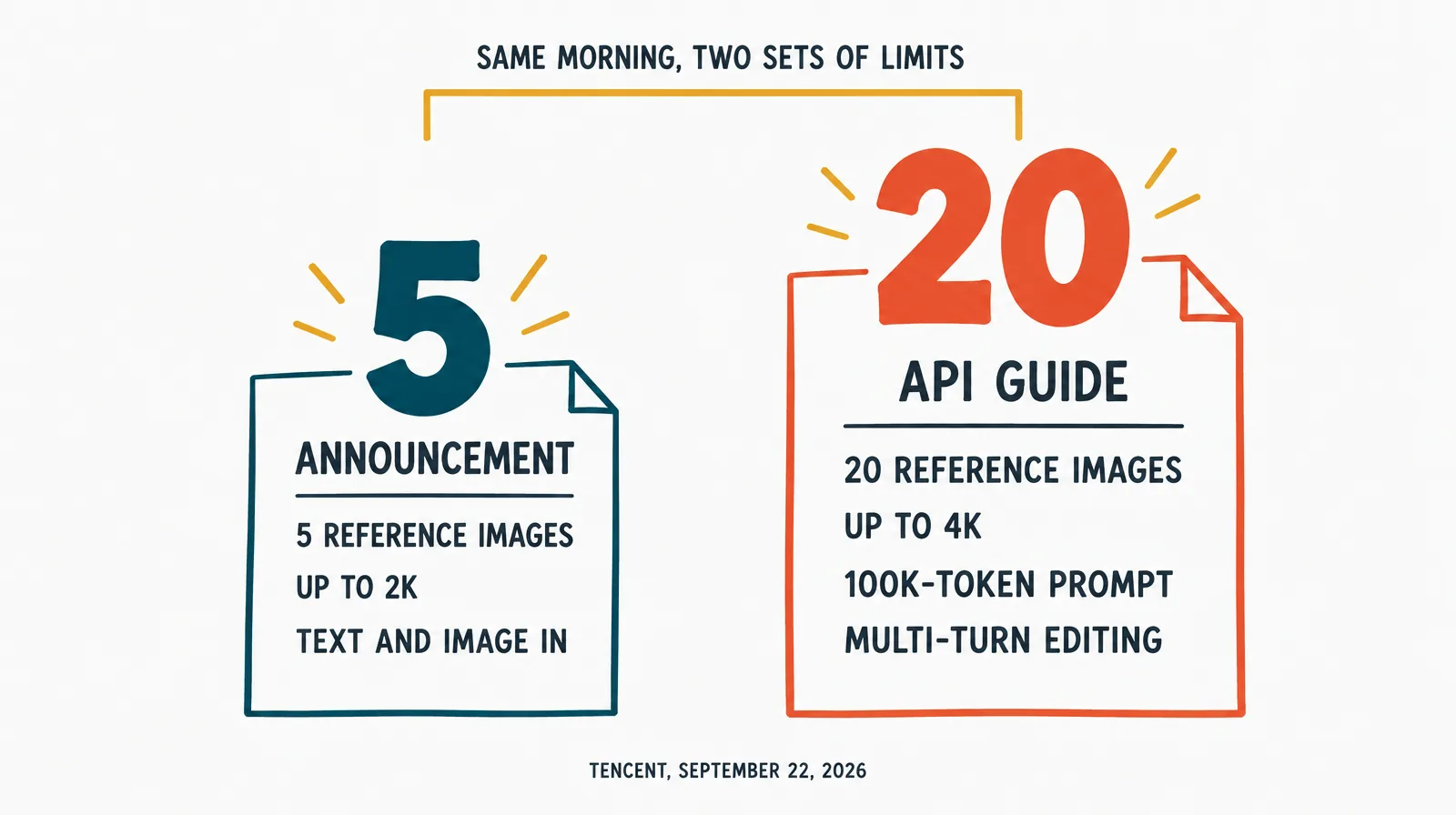
 Two spec sheets disagree. The announcement says up to five reference images and 2K output; the international API guide, stamped the same morning, documents up to 20 input images at 20 MB each, a 100k-token prompt, and explicit sizes up to 4096 by 4096. The API guide is the wider one.
 Nothing about the model itself is published: no parameter count, no architecture, no technical report, and no open-weights plan. Hy Image 3.0 shipped its 80B mixture-of-experts weights in September 2025; the first two questions under the launch post were whether this one will.
 Distribution is the strategy. The model already runs inside Yuanbao, where Tencent says a two-month quiet rollout lifted image requests by more than 50%, and ships day one in WorkRally, OnSolo, Miora, WorkBuddy and ima, plus Tencent Cloud MPS and VOD. Miora, WorkRally and OnSolo carry a two-week free window.
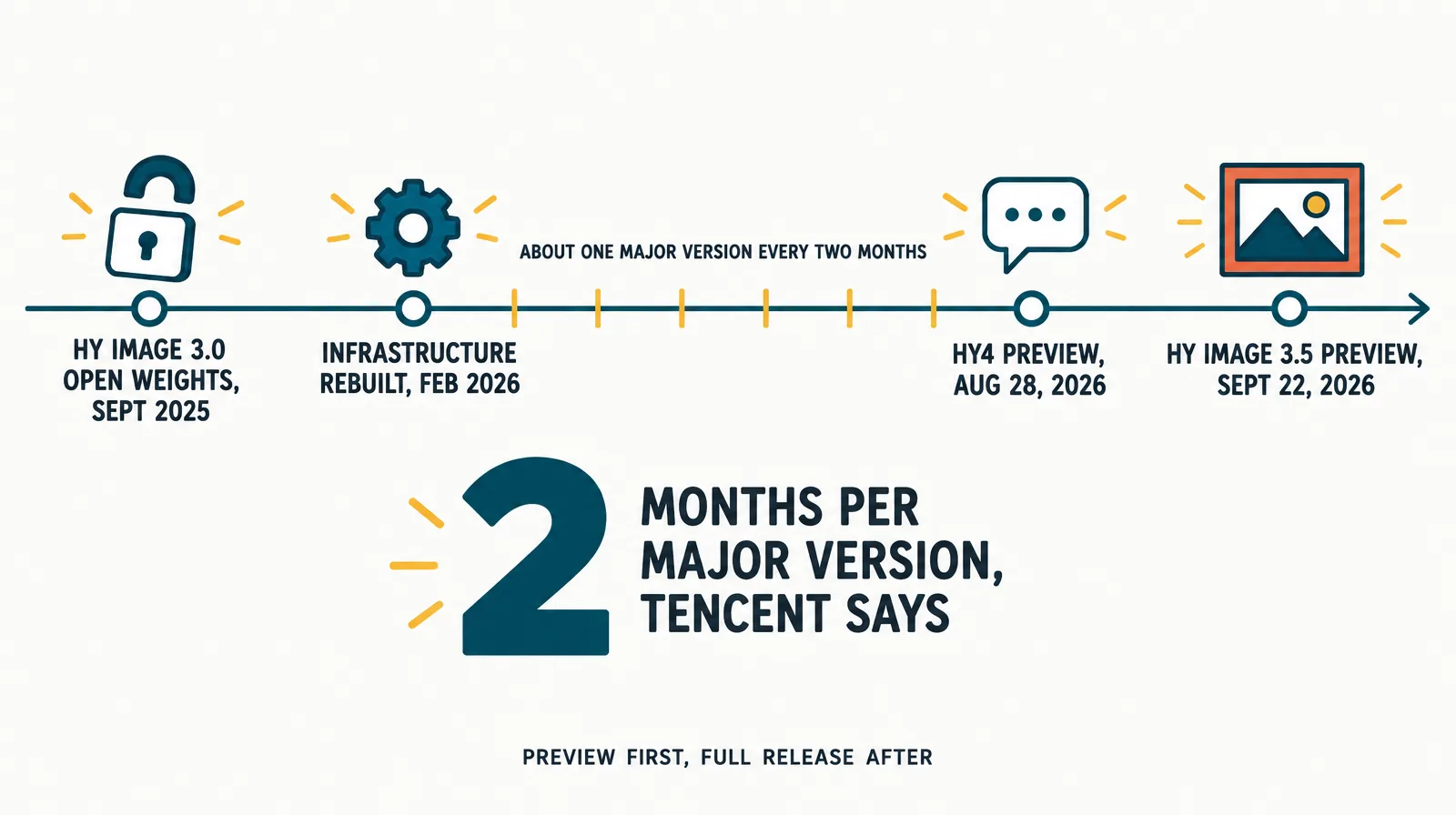
 Tencent says Hunyuan has shipped a major version about every two months since it rebuilt its infrastructure in February, preview first and a full release after. Hy4 preview came August 28; this is the image line’s turn. A full 3.5 release, a technical report and any weights are what this record watches for.
§ 01What Tencent shipped
Two Tencent documents describe the model, and they do not agree on its limits. The announcement is the smaller sheet; the international API guide, stamped 11:26 the same morning, is the larger one.
| Item | Tencent Cloud announcement | International API guide |
|---|---|---|
| Modes | Text-to-image, image-to-image, multi-turn conversational creation | Text-to-image, reference-based generation, multi-turn editing, external search enhancement |
| Reference images per request | Up to 5 | Up to 20, each up to 20 MB |
| Output resolution | Up to 2K | Automatic tiers 1K, 1.5K (default), 2K; explicit sizes up to 4096 by 4096 |
| Prompt limit | Not stated | 100k tokens |
| Model id | hy-image-v3.5-preview | hy-image-v3.5-preview |
| Protocol | Not stated | Chat/Messages, synchronous |
| Architecture, parameters | Not published | Not published |
The gap between five and twenty references, and between 2K and 4K, is probably the difference between a launch note written for consumers and a reference written for developers. Both are Tencent’s, so this page carries both. The first reply under the X post asked whether the model edits as well as generates; the API guide answers yes, with editing context carried across turns.
§ 02The price
Tencent Cloud TokenHub bills images as tokens at a flat 10 RMB per million, then quotes a reference price per image. That makes the ladder exact.
| Model and tier | Tokens per image | Reference price |
|---|---|---|
| Hy Image 3.0 | 20,000 | 0.20 RMB |
| Hy Image 3.5 preview, 1K | 15,000 | 0.15 RMB |
| Hy Image 3.5 preview, 2K | 15,000 | 0.15 RMB |
| Hy Image 3.5 preview, 4K | 20,000 | 0.20 RMB |
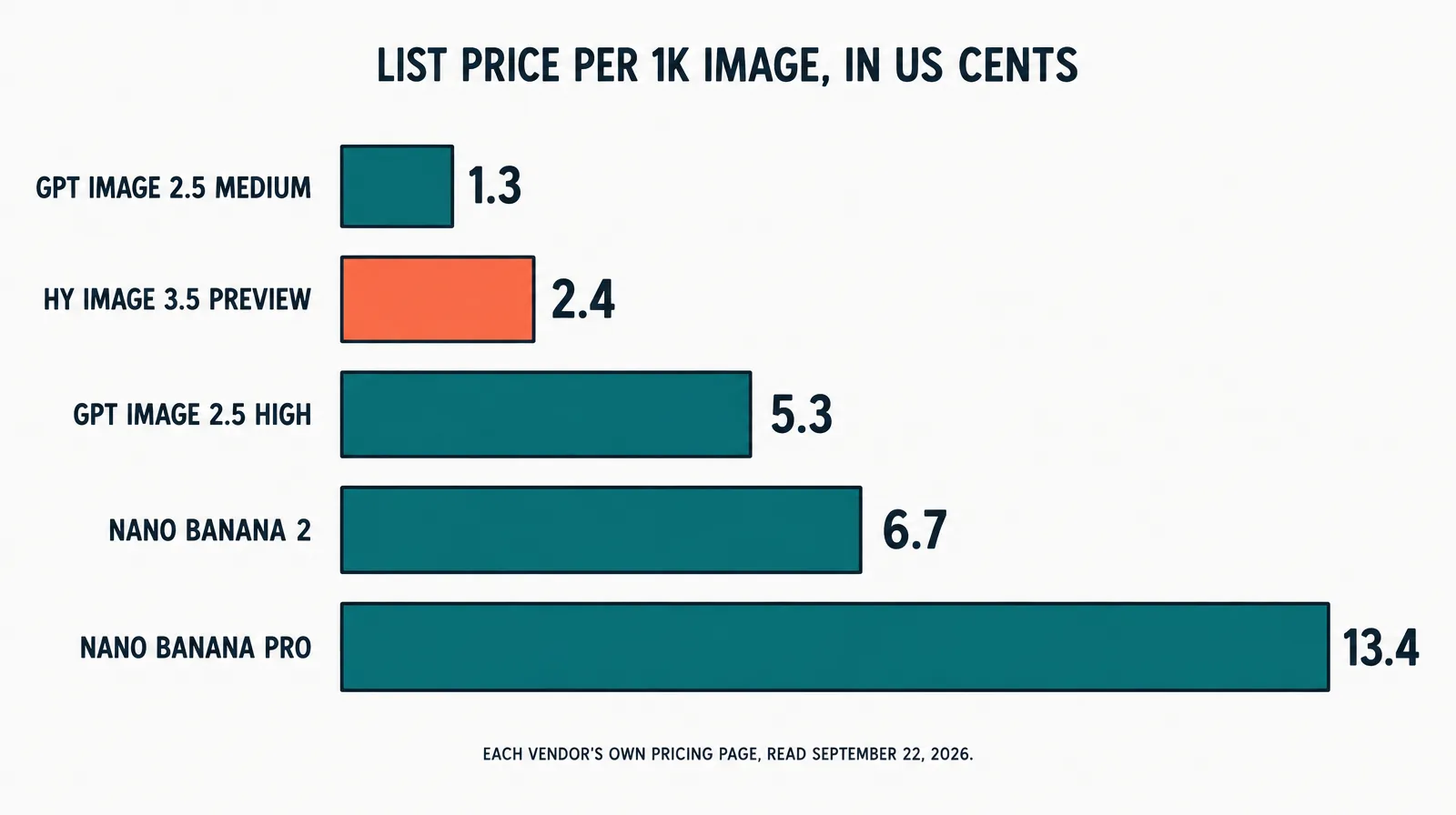
A 2K image costs 25% less than a 3.0 image did, and a 4K image costs what a 3.0 image did. On the international API the announcement quotes $0.024 per image for the 2K tier; the international 4K price is not stated. Tencent charges for output images only: reference inputs and failed generations are free, which the X post put as “your reference images are free”. Against the two Western APIs most buyers will compare it with, at 1K resolution and each vendor’s own list price:
| Model | Price per 1K image | Basis |
|---|---|---|
| GPT Image 2.5, medium quality | $0.013 | $30 per million output tokens; 439 tokens measured by us |
| Hy Image 3.5 preview | $0.024 | Tencent Cloud international API |
| GPT Image 2.5, high quality | $0.053 | $30 per million output tokens; 1,756 tokens measured by us |
| Nano Banana 2 (Gemini 3.1 Flash Image) | $0.067 | $60 per million output tokens; 1,120 tokens per Google’s page |
| Nano Banana Pro (Gemini 3 Pro Image) | $0.134 | $120 per million output tokens; 1,120 tokens per Google’s page |
Nano Banana 2 costs about 2.8 times Tencent’s price at 1K and Nano Banana Pro about 5.6 times; at 2K Google’s list moves to $0.101 while Tencent’s stays at $0.024. GPT Image 2.5 straddles it, cheaper at medium and about 2.2 times dearer at high. Price is the one axis where every number on this page is a list price; quality is the axis where only Tencent has spoken.
§ 03The quality claim, and who made it
Tencent’s announcement says the model was blind-tested by several hundred of its professional designers in a GSB format against Hy Image 3.0 and came out 30% better; the X post compresses this to “+30% win rate in human eval vs Hy Image3.0”. The same paragraph places 3.5 preview level with Seedream 5.0 Pro and slightly ahead of Nano Banana Pro and Qwen-Image-3.0 Pro. Three things to hold beside that. The evaluators are Tencent employees and the prompt set, comparison count, win-tie-loss split and margin are unpublished. No independent leaderboard had a 3.5 entry on launch day; the Arena text-to-image board scores the previous model, hunyuan-image-3.0, at 1151 on 173,099 votes, well below the frontier. And the usage number Tencent offers as its real test, image requests in Yuanbao up more than 50% during a two-month quiet rollout, measures appetite, not quality. It is a plausible launch claim from a lab that has published honest numbers before; it is still a vendor’s claim until someone else runs the prompts.
§ 04What is closed
Hy Image 3.0 was the largest open-weight image model when Tencent released it: a 64-expert mixture of experts with 80B total parameters and 13B active per token, weights on Hugging Face, technical report on arXiv on September 28, 2025. For 3.5 preview, Tencent has published nothing about the model: no size, no architecture, no report, no weights plan. Tencent’s own open-model index still lists HunyuanImage-3.0-Instruct as the newest image entry. The two most-read questions under the launch post were “Did you forget open source” and “is this going open weight?”. Neither had an answer from Tencent when we read the thread at 11:46 UTC. The preview label leaves room: Tencent says Hunyuan has shipped a major version about every two months since it rebuilt its infrastructure in February, preview first and a full release after, and Hy4 preview followed that shape on August 28. Whether the image line follows Hy4 into open weights is the open question this record tracks.
§ 05Where you can use it
| Surface | What it is | Access at launch |
|---|---|---|
| Tencent Cloud TokenHub | Developer API, hy-image-v3.5-preview | Paid, 0.15 RMB per 1K or 2K image; $0.024 international |
| Yuanbao | Tencent’s consumer AI assistant | Free for portrait editing, retouching, travel maps, knowledge cards |
| ima | Knowledge manager with copilot | Free for turning a knowledge base into pages, slides and images |
| Miora | Creative agent | Two weeks free |
| WorkRally | Film and television material platform | Two weeks free |
| OnSolo | Series and game content tool | Two weeks free |
| WorkBuddy | Office agent workbench | Included |
| Tencent Cloud MPS and VOD | Media processing and video on demand | Integrated |
The X post names only OnSolo and Miora for the free window; the announcement adds WorkRally. This is a model shipped into eight products on day one, most of them Tencent’s own. One reply under the post from an international user complained that the Chinese AI Studio now requires a mainland phone number and that earlier generations were lost; the international API is the route for everyone else.
| Item | Status |
|---|---|
| API | Live, Tencent Cloud TokenHub, mainland and international |
| Consumer surfaces | Live in Yuanbao, ima, Miora, WorkRally, OnSolo, WorkBuddy |
| Price | Published, both regions, output-only billing |
| Spec limits | Two documents, 5 vs 20 references and 2K vs 4K; API guide is the wider |
| Quality evidence | Tencent internal GSB only; no independent score |
| Architecture, parameters, report | Not published |
| Weights | Not announced |
| Full (non-preview) release | Not announced |
§ 06Where CellCog stands
Our stake, declared: CellCog runs an image agent on GPT Image 2.5, Flare by default and Sunburst where precision matters, and we chose it on quality with the price as a known cost. Every figure on this page was made by that agent. We do not route to Hy Image 3.5 and had no access to it before this record was written; we have no view on its output yet. What we can read is the price table, and at $0.024 for a 2K image Tencent has set a floor that the high-quality tiers of the models we use do not meet. If Tencent’s parity claim against Seedream 5.0 Pro survives an independent test, a model at this price gets tested on our infrastructure and this page records the result, in either direction.
§ 07What we are watching for
- An independent score. A 3.5 preview entry on the Arena text-to-image leaderboard, or any third-party blind test with a published prompt set.
- The model card. Parameter count, architecture, a technical report, or a statement on weights. Any of the four flips the closed rows in the table above.
- The full release. Tencent’s two-month cadence and preview-first pattern suggest a non-preview 3.5; its price and whether it keeps the 0.15 RMB floor.
- The international 4K price and whether the announcement’s five-reference limit or the API guide’s twenty is the one that ships to consumers.
- Our own test. If we run it against our reference set, the numbers land here.
§ 08Update log
This is a living page; when the story moves, the update lands here.
As of September 22, 2026, 12:00 UTC: page opened. The Tencent Cloud announcement and the TokenHub pricing table read in a browser; the international API guide read at 11:52 UTC (page stamp 2026-09-22 11:26:56); the X post read in a browser at 11:46 UTC and clocked from its id (02:40:42 UTC); Google’s and OpenAI’s pricing pages read at 11:52 UTC; the Hy Image 3.0 repository and the Arena leaderboard read at 11:50 UTC.
§ 09Sources
- Tencent Cloud, Hy Image 3.5 preview release announcement (Chinese), Tencent Cloud official account, September 22, 2026, 10:35 CST.
- Tencent Hunyuan on X, launch post, 02:40:42 UTC, September 22, 2026; time computed from the post id.
- Tencent Cloud, Hy Image Generation API Guide, international edition, page stamp 2026-09-22 11:26:56.
- Tencent Cloud, TokenHub model pricing (Chinese), read September 22, 2026.
- Tencent Hunyuan, open-source model index, read September 22, 2026.
- Tencent Hunyuan, HunyuanImage-3.0 repository, README read September 22, 2026.
- Arena, text-to-image leaderboard, read September 22, 2026.
- Google, Gemini Developer API pricing, read September 22, 2026.
- OpenAI, API pricing, read September 22, 2026; GPT Image 2.5 token counts per image measured for our GPT Image 2.5 record, September 8, 2026.
- Our records: Qwen-Image-2.1 (September 20, 2026), What Is Tencent Hy4? (August 28, 2026).
Q1What is the difference between the announcement and the API guide?
The Tencent Cloud announcement describes up to five reference images per request and output up to 2K. The international API guide, stamped 11:26 on September 22, documents up to 20 input images at 20 MB each, a 100k-token prompt limit, automatic area tiers of 1K, 1.5K and 2K, and explicit sizes up to 4096 by 4096. Both are Tencent’s; the API guide is the later and wider document, and this page carries both until Tencent reconciles them.
Q2How does Hy Image 3.5 compare with Nano Banana 2 and GPT Image 2.5 on price?
At 1K resolution, Google’s page lists Nano Banana 2 at $0.067 per image and Nano Banana Pro at $0.134, about 2.8 and 5.6 times Tencent’s $0.024. OpenAI prices GPT Image 2.5 by output tokens at $30 per million; our own measurement puts a 1024 by 1024 image at $0.013 at medium quality and $0.053 at high, so Tencent lands between the two. Quality is not on this axis; only Tencent’s internal test speaks to it so far.
Q3Will Hy Image 3.5 be open-sourced?
Unknown. Tencent’s open-model index lists HunyuanImage-3.0-Instruct and nothing newer, and the launch materials say nothing about weights. The 3.0 line was open-sourced within days of its September 2025 announcement, which is why the first questions under the launch post asked about weights. A 3.5 release or report would land in the update log below.
Q4What does GSB mean in Tencent's claim?
Good, Same, Bad: a blind pairwise test where evaluators see two outputs for the same prompt and mark one better, equal, or worse. Tencent says several hundred of its professional designers ran it against Hy Image 3.0 and the result was a 30% improvement. Tencent did not publish the prompt set, the number of comparisons, the exact win, tie and loss split, or any confidence interval.
Q5Which Tencent products carry the model?
Yuanbao, Tencent’s consumer assistant, where it rolled out quietly over two months before launch; WorkRally for film and television material; OnSolo for series and game content; Miora, a creative agent; WorkBuddy, an office agent; ima, a knowledge manager; and on the cloud side, Media Processing Service and Video on Demand. Developers reach it through Tencent Cloud TokenHub.