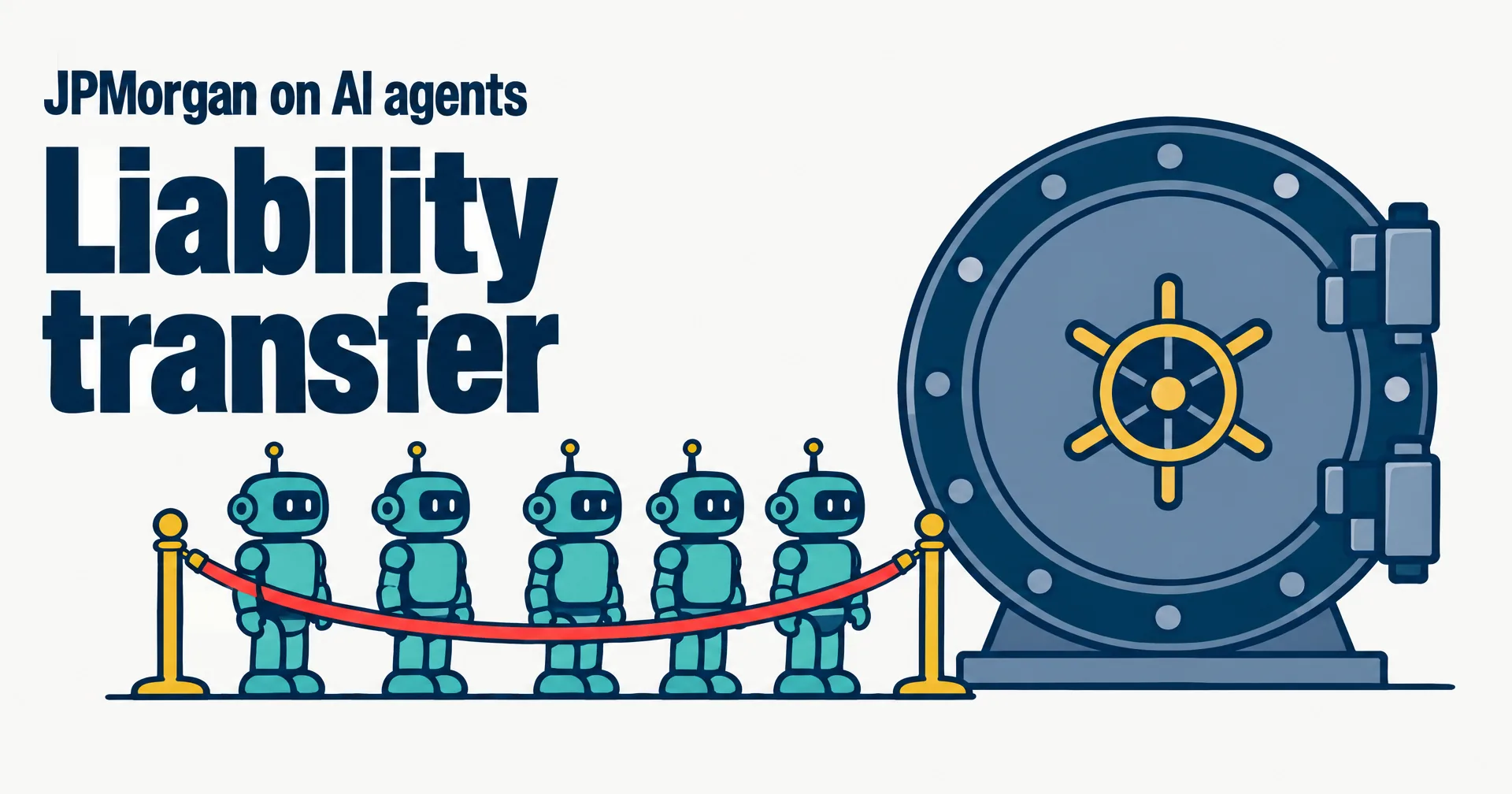
JPMorgan did not ban AI agents on October 13, 2026. Jamie Dimon did something more pointed: he told customers the risk is theirs. Asked on the bank’s third-quarter earnings call about AI agents that manage people’s money, Dimon said that anyone giving an agent access to their account should know “There’s a liability transfer.” In the same answer he said the bank will keep outside agents out of its own systems for now.
A headline that spread on X during the call read it as JPMorgan blocking external AI agents from bank accounts. The record is narrower, and more useful if you are deciding what to let an agent touch.
On this page · 6 sectionsOpen
 On JPMorgan’s third-quarter call on October 13, 2026, Jamie Dimon warned that customers who give AI agents access to their bank accounts take on the risk themselves: “There’s a liability transfer.”
 He said the bank will not let “just any outside agent” inside the company for now, because it is too risky for clients and for JPMorgan. That is a gate on outside agents, not a ban on customers using agents.
 Dimon said JPMorgan is building tools to protect customers from rogue agents, “and there could be thousands of them.”
 JPMorgan’s own agent, Smart Cash, which moves customer money between accounts at the bank to maximize yield, is in pilot, CFO Jeremy Barnum said.
 Barnum put the bank’s yearly AI spending closer to $700 million than the $2 billion figure discussed before, and called it a little stale.
§ 01What Dimon said
The call ran at 8:30 a.m. Eastern on Tuesday, October 13, per JPMorgan’s investor notice. The fullest account of the agent answer is Banking Dive’s, which quotes it at length:
- “You don’t want rogue agents, and there could be thousands of them.”
- “If people are using them, they should understand the risk.”
- “There’s a liability transfer. They should understand the liability transfer. If data is being misused, they should understand it’s being misused.”
- “We have to make sure we protect our customer in the right kind of way. So we’re building tools to do that, too.”
- “In the meantime, we’re not going to allow just any outside agent to come in inside the company because it’s too risky for the clients and for JPMorgan.”
He also turned to the regulators: “If I was a regulator, I’d try to be prepared for that.”
§ 02The headline against the record
| The headline said | The record says | Source |
|---|---|---|
| JPMorgan blocks external AI agents | Not “just any outside agent” gets inside the company, for now | Banking Dive |
| From bank accounts | Customers who give agents account access carry the risk; no ban on customers using them | Banking Dive |
| Over security risks | Too risky for clients and for the bank; cautious about credential sharing | Banking Dive, Investing.com |
| A final decision | “In the meantime”; JPMorgan is building tools to protect customers | Banking Dive |
Investing.com’s transcript summary puts it as the bank being “cautious about outside agents and credential sharing,” and MarketBeat’s as no “unrestricted access” for outside agents. Both fit the narrower reading: a bank deciding which agents it lets in, and warning customers about the ones they let in themselves.
§ 03What else the call said about AI
| Topic | What was said | Who |
|---|---|---|
| Outside agents | Not let inside the company for now | Dimon |
| Customer risk | “There’s a liability transfer” | Dimon |
| Smart Cash | AI tool moving customer money between JPMorgan accounts for yield is in pilot | CFO Jeremy Barnum |
| AI spending | Closer to $700 million a year, not $2 billion; “a little stale at this point” | Barnum |
| Regulators | Should be prepared for problems from bots and agents | Dimon |
The deposit question sits under all of it. McKinsey warned in April that agents moving money for better rates could pull customers away from their banks, and a Bank of America Securities analyst framed it on September 23 as “who owns the agent, the wallet and ultimately the customer relationship.” JPMorgan’s answer, for now, is its own agent inside the walls and a rope for everyone else’s.
§ 04What this means if you run AI agents
Dimon’s warning is the right one, and it applies beyond banking. Whoever grants an agent access owns what it does with it. The useful questions are the boring ones: what can the agent reach, can it move money without you, and what happens if its credentials leak. Our guides to least privilege for AI agents and AI employee permissions and approvals walk through them.
It is also why CellCog’s AI employees do not hold a payment method of their own. When one needs to buy something, the owner approves each purchase in Link at the exact amount and merchant, and the employee gets a single-use card for that checkout only.
§ 05What we are watching
- The tools Dimon said JPMorgan is building to protect customers from rogue agents.
- Whether Smart Cash leaves pilot, and whether the bank opens a door for vetted outside agents.
- Whether other banks reporting this month say the same about agents and deposits.
§ 06Sources
- Banking Dive, JPMorgan CEO Dimon warns customers of ‘liability transfer’ with AI, October 13, 2026.
- Investing.com, Earnings call transcript: JPMorgan Chase Q3 2026, October 13, 2026.
- MarketBeat, JPMorgan Chase Q3 earnings call highlights, October 13, 2026.
- JPMorganChase, third-quarter 2026 earnings call notice, September 17, 2026.
- X, the headline post, October 13, 2026.
Q1When did Jamie Dimon talk about AI agents?
On JPMorgan Chase’s third-quarter 2026 earnings call, Tuesday, October 13, 2026, at 8:30 a.m. Eastern.
Q2Why are banks worried about AI agents?
Two reasons came up on the call: customers being hurt by rogue agents or misused data, and deposits leaving when agents move money in search of better rates. McKinsey warned of the second in April.
Q3What is JPMorgan Smart Cash?
An AI-powered tool that moves customer money between accounts at JPMorgan to maximize yield and manage cash flow. CFO Jeremy Barnum said it is in pilot.
Q4How much does JPMorgan spend on AI?
Barnum said closer to $700 million a year, not $2 billion, and called that figure a little stale. He said AI benefits are not yet visible in quarterly earnings.
Q5Should I give an AI agent access to my bank account?
Only with a limit you control. Dimon’s point is that the risk is yours. Prefer agents that pay with single-use cards or need your approval for each payment over agents that hold your bank login.