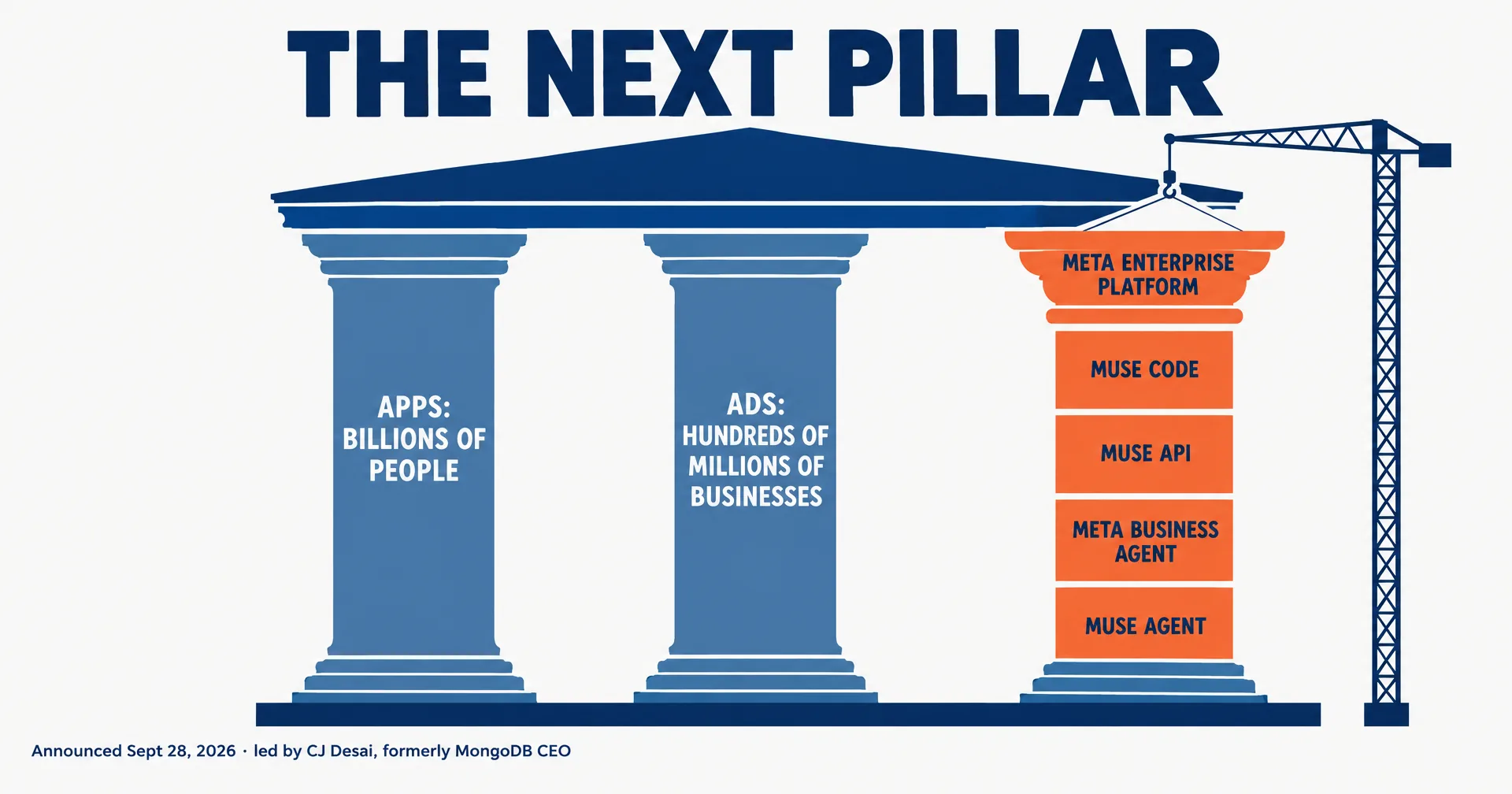
Meta has a third business now. At 12:35 UTC on September 28, 2026, Mark Zuckerberg posted a four-part thread on X, mirrored a minute later in Meta’s newsroom, starting what he called “the next major pillar of our business, Meta Enterprise Platform”. The first products are the agent stack Meta has spent September shipping to consumers, now pointed at companies. The person running it is the chief executive of MongoDB.
This page is read from Meta’s own post and Zuckerberg’s thread. Where Meta did not say something, we say so.
On this page · 7 sectionsOpen
- On September 28, 2026 at 12:35 UTC (8:35 AM Eastern), Mark Zuckerberg announced Meta Enterprise Platform on X and in Meta’s newsroom, calling it the next major pillar of Meta’s business, to help businesses use AI to grow.
- The first products are Meta’s existing agent stack sold to businesses and developers: the Muse agent, Meta Business Agent, Muse API and Muse Code, plus what Meta calls more.
- Chirantan CJ Desai joins Meta as Chief Enterprise Platform Officer, reporting directly to Zuckerberg. He comes from MongoDB, where he was CEO and President, after leading product and engineering at Cloudflare and nearly eight years at ServiceNow.
- Meta published no price, no launch date for enterprise products, no launch customers and no region list. The post is a new business line and a new executive, not a product page.
- It lands twenty days after Muse launched, ten days after the connector platform opened and five days after Connect, in a week when a Muse Marketplace sale shared a seller’s home address with a buyer.
§ 01What Meta announced
Zuckerberg’s opening line sets the frame: “We believe superintelligence will create significant new opportunities for all people and businesses.” Meta, he wrote, “already serves billions of people at scale and helps hundreds of millions of businesses reach customers”, and the new platform is meant “to help businesses use AI to grow and transform in new ways as well”.
The first products are named in the second post: “Initially, we will focus on bringing our full technology stack, including the Muse agent, Meta Business Agent, Muse API, Muse Code, and more to businesses and developers to help them grow.”
| Item | Status on Sept 28 | Meta’s words |
|---|---|---|
| Muse agent | Named as a first product | Part of the full technology stack |
| Meta Business Agent | Named as a first product | Part of the full technology stack |
| Muse API | Named as a first product | For businesses and developers |
| Muse Code | Named as a first product | For businesses and developers |
| Leader | CJ Desai, Chief Enterprise Platform Officer | Reports directly to Zuckerberg |
| Price | Not published | None |
| Launch date | Not published | None |
| Launch customers | Not published | None |
The pitch rests on what Meta says few companies have: “advanced models, leading agents, large-scale infrastructure, and years of working closely with many businesses.”
§ 02Who is running it
Chirantan (CJ) Desai joins as Chief Enterprise Platform Officer, reporting directly to Zuckerberg. Meta’s bio: “He joins us from MongoDB, where he was CEO and President.” Before that he “led product and engineering at Cloudflare and spent nearly eight years at ServiceNow, including as President and COO.”
Desai’s own statement gives the clearest description of the job: “Meta Enterprise Platform will focus on turning its AI stack into products and services that companies can deploy for their own businesses.” On the question every enterprise buyer asks first, he wrote: “As with Muse, security and privacy are built into Meta’s enterprise products from the outset.” The goal, in his words: “to make Meta the place enterprises come to scale their businesses.”
Hiring a sitting public-company CEO who has run enterprise software at ServiceNow and a developer platform at Cloudflare says more about Meta’s intent than the post does. This is a sales and platform organization, not a research team.
§ 03Twenty days of Muse
The announcement is the fifth big Muse moment in three weeks.
| Date | Event |
|---|---|
| Sep 8 | Muse launches |
| Sep 18 | Connector platform opens |
| Sep 20 | Amazon blocks Muse |
| Sep 23 | Connect: glasses, Charm, email |
| *Sep 28 | Meta Enterprise Platform |
The launch put a personal agent on its own secure computer. The connector platform opened Muse to outside services. Amazon’s block showed that not every business wants a visiting agent, and the same record now carries the Marketplace sale in which Muse shared a seller’s home address with a buyer. Connect put Muse on glasses and gave it an email address. Today’s post turns the same stack into something Meta sells to companies.
Desai’s “security and privacy are built in” line lands the same week as the Marketplace address story. Enterprise buyers will read both.
§ 04What Meta did not say
- Price. No figure for any enterprise product, and no word on how it relates to Meta’s existing business subscriptions.
- Dates. No availability date for the enterprise versions of Muse, Muse API or Muse Code.
- Customers. No named companies.
- Regions. No country list.
- Terms. Nothing on data handling, retention or whether business data trains Meta’s models, beyond Desai’s one line on security and privacy.
MongoDB’s side is also missing. Meta’s post is the only primary we found at publication; MongoDB had not posted a statement or named a successor in the sources we checked.
§ 05Where CellCog sits
Meta is selling agents to businesses. CellCog’s AI employees are what a business hires when it wants the work owned: each has a role, memory that carries forward, its own inbox and task board, and a place in a team that other employees manage. Muse can already send work to CellCog today through a custom connector, and Muse Code connects over MCP; the setup is at cellcog.ai/muse. We are not in Meta’s connector directory as of this page.
§ 06What we are watching for
- A pricing page or plan list for Meta Enterprise Platform.
- The first named enterprise customers.
- Muse API documentation and terms for business use.
- A MongoDB statement and a successor.
- Whether the Marketplace address incident gets a Meta response that enterprise buyers can read.
§ 07Sources
- Meta Newsroom, Launching Meta Enterprise Platform, September 28, 2026, 12:36 UTC.
- Mark Zuckerberg on X, thread announcing Meta Enterprise Platform, September 28, 2026, 12:35 UTC, read 13:03 UTC.
Q1Is Meta Enterprise Platform a new model?
No. Meta describes it as a business that brings its full technology stack to companies, starting with products that already exist: the Muse agent, Meta Business Agent, Muse API and Muse Code.
Q2Did CJ Desai leave MongoDB?
Meta says he joins from MongoDB, where he was CEO and President. MongoDB had not posted its own statement or named a successor in the sources we found at publication.
Q3How does this relate to Muse?
Muse is the core of it. Meta names the Muse agent, Muse API and Muse Code among the first products, and Desai says security and privacy are built in as with Muse.
Q4Does it compete with OpenAI and Anthropic?
Meta names no competitor. Selling agents, an API and a coding tool to businesses puts it in the same enterprise market where OpenAI and Anthropic already sell, but Meta has not published pricing or terms to compare.
Q5Can Muse send work to CellCog?
Yes, through a custom connector: Muse takes a CellCog API key and calls our API, and Muse Code connects over MCP. The setup is at cellcog.ai/muse. CellCog is not listed in Meta’s connector directory as of this page.