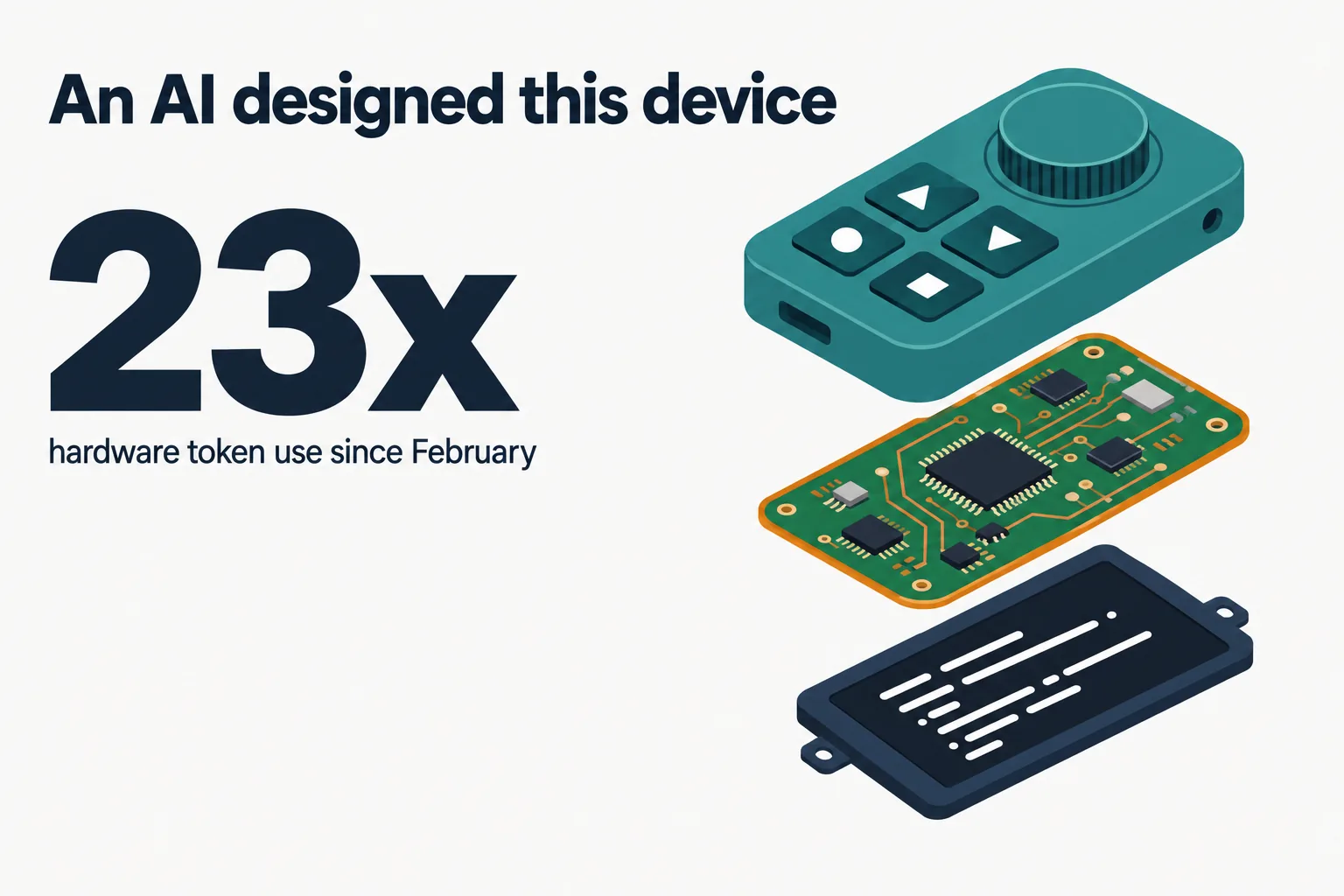
OpenAI said on November 3, 2026 that its models are now helping engineers design, simulate and build physical products. The headline test: two OpenAI team members used GPT-6 Astra to design a device for talking to Codex, enclosure, circuit board and software included, as a side project. OpenAI framed the goal as “seeing if we can create a device without any direct human edits.”
The same post reports a 23-fold rise in token use across OpenAI’s hardware teams since February, a BenchCAD 2.0 score from an unreleased model, and engineering work with Chip Ganassi Racing and Mazda. Here is what Astra did, where it fell short, and how the benchmark numbers compare with Claude Opus 5.5.
On this page · 7 sectionsOpen
 OpenAI says two staff used GPT-6 Astra to design a device for talking to Codex, enclosure, circuit board, interface and firmware included, in under a week as a side project.
 Getting it manufactured took several rounds of review: Astra did not reliably account for production limits, tolerances or assembly details.
 Token use across OpenAI’s hardware teams has grown 23-fold since February, for CAD models, manufacturing drawings and simulation setup.
 On BenchCAD 2.0, OpenAI says a newer internal model scored 0.875 against 0.594 for Astra; BenchCAD’s public table has Astra at 0.59 and Claude Opus 5.5 at 0.57.
 OpenAI is turning 3D scans into editable CAD with Chip Ganassi Racing and starting research on vehicle aerodynamics and crash safety with Mazda.
§ 01What Astra designed
OpenAI split the device work into four disciplines and says Astra handled each one.
| Discipline | What Astra did |
|---|---|
| Look and feel | Developed the design, drawing on OpenAI’s Work Louder collaboration and references from games and toys |
| Mechanical | Designed the enclosure and the internal structures that hold the parts in place |
| Electrical | Selected the components and laid out the printed circuit board to fit the enclosure |
| Software | Designed the interface and generated the firmware and the Codex integrations |
The timeline is the striking part. In OpenAI’s words: “Two team members designed this test device with Astra in under a week while working on it as a side project.” Then: “A contract manufacturer built a small batch of prototypes in under a month.”

§ 02Where it fell short
Getting the device ready for manufacturing still took “several rounds of review and iteration”, OpenAI says. Astra did not reliably account for the manufacturer’s production limits, tolerances or assembly details, and OpenAI says those gaps are showing what future models need to do better.
So the no-edits test covered the design files. The move from a design to something a factory can build still ran through people.
§ 03OpenAI’s own hardware teams
The broader number is about OpenAI itself: “Since February, model usage across our hardware teams, measured in tokens, has grown 23-fold.” Those teams use Codex and ChatGPT to create and revise CAD models, prepare manufacturing drawings, set up simulations and review designs, across robotics and compute infrastructure.
Grace Lam, a Forward Deployed Engineer at OpenAI, put it this way: “Codex has dramatically accelerated how we move from an idea to an engineered part.”
§ 04BenchCAD 2.0: what the scores say
OpenAI also reports a benchmark jump. On BenchCAD 2.0, a newer internal model averaged 0.875, against 0.594 for GPT-6 Astra at its highest reasoning setting, about 47% higher. OpenAI does not name that model or say when it ships, and the figure is OpenAI’s own.
BenchCAD 2.0, published October 12, 2026, tests whether models can build 3D parts and assemblies from engineering drawings or renders and recover circuit wiring from images of boards. Its Core set is 100 held-out cases, scored against references “without an LLM judge”. On its public table, Astra holds the top published score.
| Model | Score | Cost per case | Median time per case |
|---|---|---|---|
| GPT-6 Astra | 0.59 | $11.05 | 62 min |
| Claude Opus 5.5 | 0.57 | $27.58 | 224 min |
| Claude Sonnet 5.5 | 0.41 | $43.33 | 372 min |
| Claude Fable 5.1 | 0.30 | $48.46 | 191 min |
| Claude Haiku 5.5 | 0.18 | $8.69 | 459 min |
Astra and Opus 5.5 are close on score, but Opus 5.5 spent about 2.5 times the cost and 3.6 times the median time per case to get there. The best published score is still well under 1, which is the point of the benchmark: hardware CAD is hard for every model today.
§ 05Chip Ganassi Racing and Mazda
OpenAI is expanding its work with Chip Ganassi Racing’s R&D team to turn 3D scans of existing parts into editable CAD models and 2D manufacturing drawings, useful when the original design files are gone. Matthew Ortman, an R&D engineer there: “The model has been useful for going from raw scan data to a solid body.”
The new partner is Mazda. OpenAI’s research and Forward Deployed Engineering teams are working with Mazda’s aerodynamics and crash-safety engineers, using simulations of airflow and structural behavior to explore vehicle designs while accounting for styling and cost. OpenAI says it will share results in the coming months, and it is asking engineers, engineering firms and software vendors to sign up as collaborators.
§ 06What it means
For engineering teams, the useful part today is the work between ideas: drawings, simulation setup, scan-to-CAD and design review, with an engineer checking every output. The device test shows how fast a model can get to a first design. The manufacturing loop shows where people still carry the work.
Our conflict, declared: CellCog’s AI employees run on Claude Opus 5.5, the second row in the table above. We do not use GPT-6 Astra and have no stake in OpenAI.
§ 07Sources
- OpenAI, Accelerating engineering for the physical world, November 3, 2026, and OpenAI on X.
- BenchCAD, Introducing BenchCAD 2.0, October 12, 2026.
Q1What did OpenAI announce on November 3, 2026?
A research post on how its models help engineers design, simulate and build physical products, including a device GPT-6 Astra designed, a 23-fold rise in hardware-team token use, BenchCAD 2.0 scores, and work with Chip Ganassi Racing and Mazda.
Q2Did GPT-6 Astra really design a device with no human edits?
OpenAI says it tested whether Astra could create a device without any direct human edits, and Astra designed the enclosure, circuit board, interface and software. Readying it for manufacturing still took several rounds of review and iteration.
Q3What is BenchCAD 2.0?
A benchmark for hardware engineering: building 3D parts and assemblies from drawings or renders, and recovering circuit wiring from images of boards. Its Core set is 100 held-out cases scored against references without an LLM judge.
Q4Which model scores highest on BenchCAD 2.0?
On BenchCAD’s public table from October 12, 2026, GPT-6 Astra at max effort scores 0.59 and Claude Opus 5.5 0.57. OpenAI says an unreleased internal model scored 0.875; BenchCAD has not listed it.
Q5What is OpenAI doing with Mazda?
A new research collaboration with Mazda’s aerodynamics and crash-safety engineers, using simulations of airflow and structural behavior to explore vehicle designs. OpenAI says it will share results in the coming months.