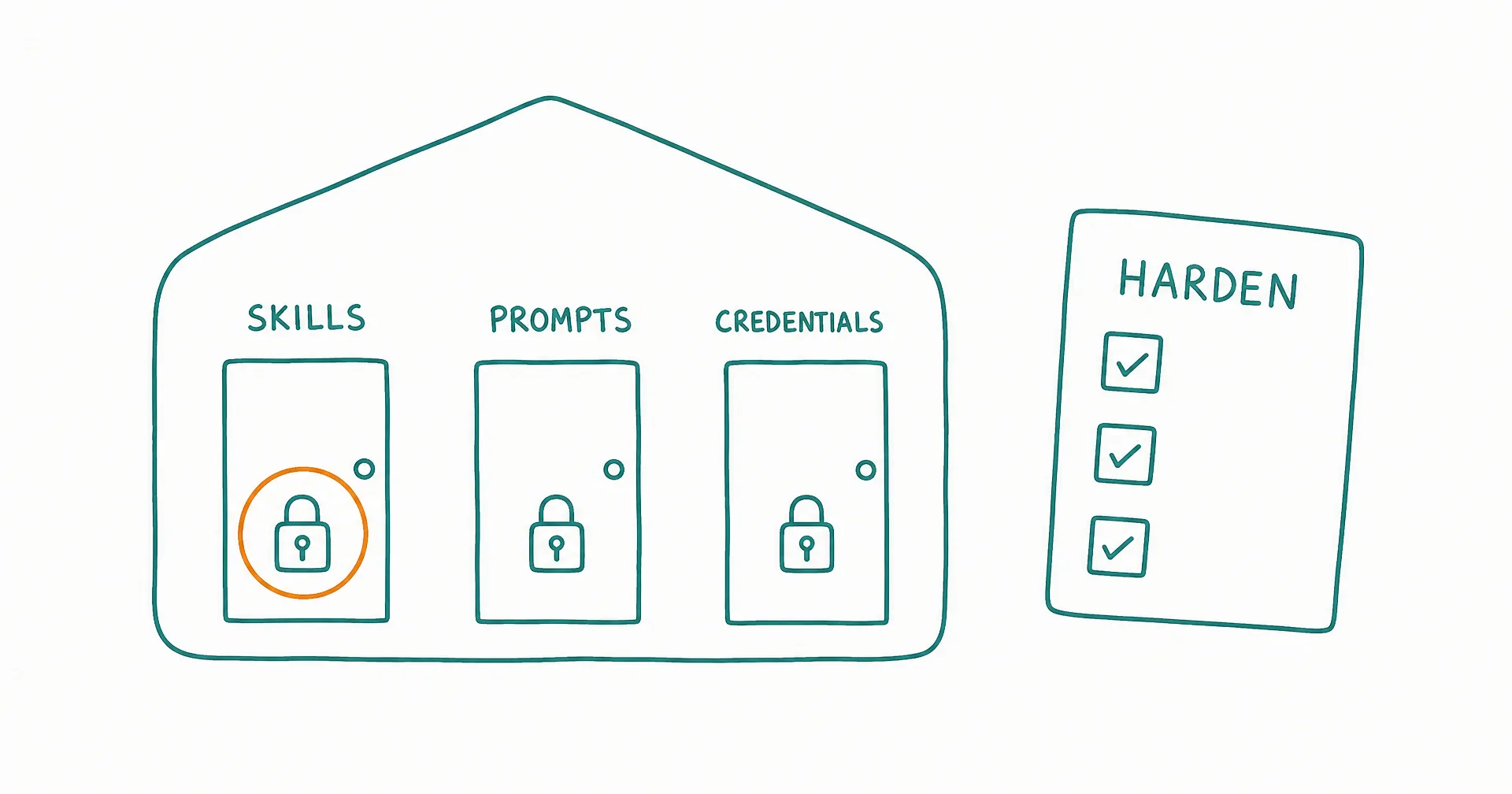
OpenClaw is the most widely deployed open agent runtime, and July 2026 was its biggest security month so far: at least 14 advisories published in a single coordinated batch on July 2, a substantial hardening release on July 13, and new supply-chain research on July 15 showing agents can be steered through resources they hallucinate. Nothing here adds up to a confirmed mass breach. It adds up to something more useful: a clear picture of where the real risks in agent runtimes live.
This guide walks the July record, then turns it into the checklist an operator should actually run. A disclosure before we start: we build CellCog, an AI employee platform, and we also publish 39 skills on ClawHub ourselves. So we sit on both sides of this: as a marketplace publisher, and as a vendor whose product makes the opposite architectural bet. Everything below about OpenClaw is sourced from its own advisories, release notes, and published third-party research as of August 21, 2026.
- On July 2, 2026, a coordinated batch of at least 14 OpenClaw security advisories was published, covering authorization bypasses, allowlist failures, and marketplace payloads that skipped scanning.
- OpenClaw v2026.7.1 (July 13) is a substantial hardening release: sandbox link escapes, credential residue in audit logs, browser permissions, SSRF, and marketplace screening all got fixes.
- The skill supply chain is the sharpest edge: Unit 42 documented five ClawHub skills that evaded blocking, including infostealer delivery and crypto-key exfiltration. A clean antivirus scan is not a safety verdict on a skill.
- Skill environment variables and API keys are injected into the host agent process, not the sandbox, so a malicious skill often needs no exploit at all: it can simply instruct an already-authorized agent.
- OpenClaw’s own security policy treats prompt injection as an assumed condition, not a bug. Real boundaries must come from authentication, tool policies, sandboxing, and execution approvals.
- No confirmed large-scale breach was reported in July or August 2026, but existing installs should upgrade, run the deep security audit, and check historical audit logs for credential residue.
- The practical question is not whether OpenClaw can be run safely (it can) but whether you want to operate the security perimeter yourself or have a platform own it for you.
§ 01What actually happened in July
| Date | Event | Why it matters |
|---|---|---|
| July 2 | Coordinated batch of 14+ advisories | Authorization bypasses, allowlist failures, admin token minting, unscanned marketplace payloads |
| July 10 | ClawHub audit flags a skill with clean antivirus results | Dangerous behavior and undisclosed data transfer despite a clean malware scan |
| July 13 | OpenClaw v2026.7.1 hardening release | Sandbox link escapes, credential residue, browser permissions, SSRF, marketplace screening |
| July 15 | HalluSquatting research published | Remote tool execution via resources the model hallucinates and attackers pre-register |
| Late July | Unit 42 marketplace report circulates | Five skills that evaded blocking, February through May: infostealers, persistence, key exfiltration |
| August 4 | v2026.7.1 packaging follow-ups | Reliability fixes; no comparable new disclosures through August 21 |
The July 2 batch is worth reading as a pattern rather than a list. The recurring theme is that “owner”, “approval”, and “allowlist” checks existed but had not been applied uniformly across every path into the system: a loopback route could skip owner-only tool policy, hook-triggered runs could inherit owner-level authority, and a spoofed locality check could mint a durable administrator token. None of these require exotic exploitation. They are the ordinary boundary bugs every young platform accumulates, surfacing all at once because researchers are now looking hard at agent runtimes.
The v2026.7.1 release, eleven days later, is the encouraging half of the story. It is unusually candid: it names credential residue in historical audit logs, secrets leaking through diagnostics and proxy captures, and sandbox escapes through filesystem links, and it ships fixes plus a deep-audit command to find old residue. Projects that publish this kind of release note are taking the problem seriously.
§ 02The skill supply chain is the sharpest edge
If you internalize one thing from July, make it this: the marketplace is where the theory becomes practice. Unit 42’s report documented five ClawHub skills that evaded blocking between February and May, with techniques including encoded download-and-execute payloads, paste-site redirects that let attackers swap payloads without updating the skill, macOS infostealer delivery, cron persistence, and exfiltration of cryptocurrency private keys.
Two structural facts make agent skills riskier than ordinary packages. First, per OpenClaw’s own documentation, skill-specific environment variables and API keys are injected into the host agent process, not into the sandbox. Second, a skill carries natural-language instructions alongside its code, so it does not need a memory-safety bug to do damage: it can simply instruct an already-authorized agent to read files, run commands, or use signed-in sessions. That is why a ClawHub audit in July could flag a skill as dangerous while every antivirus engine on VirusTotal called it clean. The scan answers “is this known malware?” and the real question is “what will this make my agent do?”
ClawHub has added layered screening, and v2026.7.1 added pre-download checks with explicit acknowledgment for suspicious releases. Those are real improvements. They do not cover publisher compromise, delayed activation, or instructions that look benign until they meet your agent’s specific authority. As publishers ourselves, we would tell you to read our skills before installing them, and we mean that generally: a skill is software you are installing, so review it like software.
§ 03Credentials: the check to run this week
The July release notes confirm several paths by which provider keys and tokens could end up somewhere readable: historical config-audit.jsonl files, payload logs, cache traces, failed cron webhook diagnostics, and session fingerprints. Confirmed exposure paths are not confirmed exploitation, but the response is the same either way:
- Upgrade to the current v2026.7.1 packaging line.
- Run the deep security audit, and read what it finds rather than skimming the summary.
- Know what the fix flag does not do: it does not rotate credentials, disable dangerous tools, or remove unsafe skills. Rotation is on you.
- Inspect old audit logs and diagnostics for secret residue, then redact and rotate anything you find.
- Keep agent credentials task-specific. An agent that only needs read access to one system should hold a key that can only read that one system.
§ 04Prompt injection is assumed, not exceptional
OpenClaw’s security policy is explicit that the model is treated as untrusted: prompt injection alone is not classified as a product vulnerability, because injection is expected to happen. A report becomes a security issue when injected content crosses an authentication, sandbox, allowlist, or approval boundary. The July 15 HalluSquatting research shows how creative the crossing attempts have become: attackers pre-register the packages and resources a model is likely to hallucinate, so the agent walks itself into adversarial content while doing apparently normal work.
This stance is defensible triage, and it has a direct operational consequence: every email, webpage, document, and tool output your agent consumes may be trying to steer it, and the thing standing between an attempt and an incident is not the model’s judgment. It is the boundaries you configured: what the agent can reach, what requires your approval, and what its credentials can actually do. Least privilege for AI agents is the full argument; July is the month that turned it from advice into record.
§ 05Where the responsibility line sits
OpenClaw’s own documentation frames the product honestly: a powerful single-operator automation runtime, not a hardened multi-tenant platform. Run it that way and the July record is manageable: one trusted operator, least-privilege credentials, vetted skills, approvals on anything consequential, and prompt patching. Thousands of people do exactly this and get real work out of it. Our own OpenClaw integration exists because that ecosystem is worth building for.
The honest question July raises is not “is OpenClaw safe?” but “who is your security team?” Self-hosting an agent runtime makes the answer: you. Patching windows, skill review, credential rotation, audit-log hygiene, injection boundaries: all yours, indefinitely, for every agent you run. That is a fine trade for a technical operator automating their own workflows. It is a genuinely bad trade for a business that wanted an assistant and acquired a perimeter.
That second reader is who we built for. On CellCog, the perimeter is the product: each AI employee runs in its own isolated workspace, so one worker’s credentials and files are invisible to another; every action arrives threat-classified before it runs; and anything consequential waits behind an approval rail you control. If the checklist above reads like a part-time job you did not apply for, that is the trade worth pricing.
Either way you land, run the upgrade this week. The gaps July closed are exactly the kind someone eventually automates the search for.
Q1What were the most serious OpenClaw vulnerabilities disclosed in July 2026?
The July 2 batch clustered around authorization boundaries: an MCP loopback path that could skip owner-only tool policy (CVE-2026-53818), Control UI locality spoofing that could mint a durable administrator device token (CVE-2026-53854), message reads that could bypass channel allowlists, and marketplace runtime-extension metadata that could point at unscanned payloads (CVE-2026-53810). Most were fixed in the July releases; the pattern to internalize is that approval and allowlist checks had not been applied uniformly across every invocation path.
Q2Does OpenClaw sandbox skills?
Partially. The July 13 release tightened sandbox file operations against symlink, hard-link, and directory-race escapes. But per OpenClaw’s own documentation, skill-specific environment variables and API keys are injected into the host agent process, not into the sandbox. A skill is code plus instructions running with your agent’s authority: review it like software you are installing, because it is.
Q3What is HalluSquatting?
Research publicized on July 15, 2026: attackers predict package or resource names a model is likely to hallucinate, register those resources first, and plant adversarial instructions in them. When an agent fetches the hallucinated resource, the attacker’s content executes with the agent’s authority. The researchers demonstrated remote tool execution against OpenClaw and several other agent systems.
Q4Has OpenClaw actually been breached?
No confirmed large-scale breach was reported in July or August 2026. Earlier ClawHub marketplace campaigns observed between February and May did steal real credentials, including cryptocurrency private keys, per Unit 42’s analysis. The July release notes also confirm that credentials could linger in historical audit logs and diagnostics, which is exposure, not necessarily exploitation.
Q5What does OpenClaw v2026.7.1 actually fix?
It is a broad hardening release: sandbox escapes through filesystem links, credential residue in config-audit logs, browser permissions moved behind administrator checks, stricter SSRF handling, marketplace pre-download screening, and persistent-approval fixes so approving a package runner no longer implicitly trusts later payloads. If you run OpenClaw, this is the minimum version.
Q6How is an AI employee platform different from running OpenClaw myself?
It is a responsibility trade. Self-hosting OpenClaw gives you full control and makes you the security team: patching, skill vetting, credential hygiene, and injection defense are your jobs. A managed platform like CellCog owns that perimeter: each AI employee runs isolated from the others, every action is threat-classified before it runs, and consequential actions wait behind an approval rail you control.