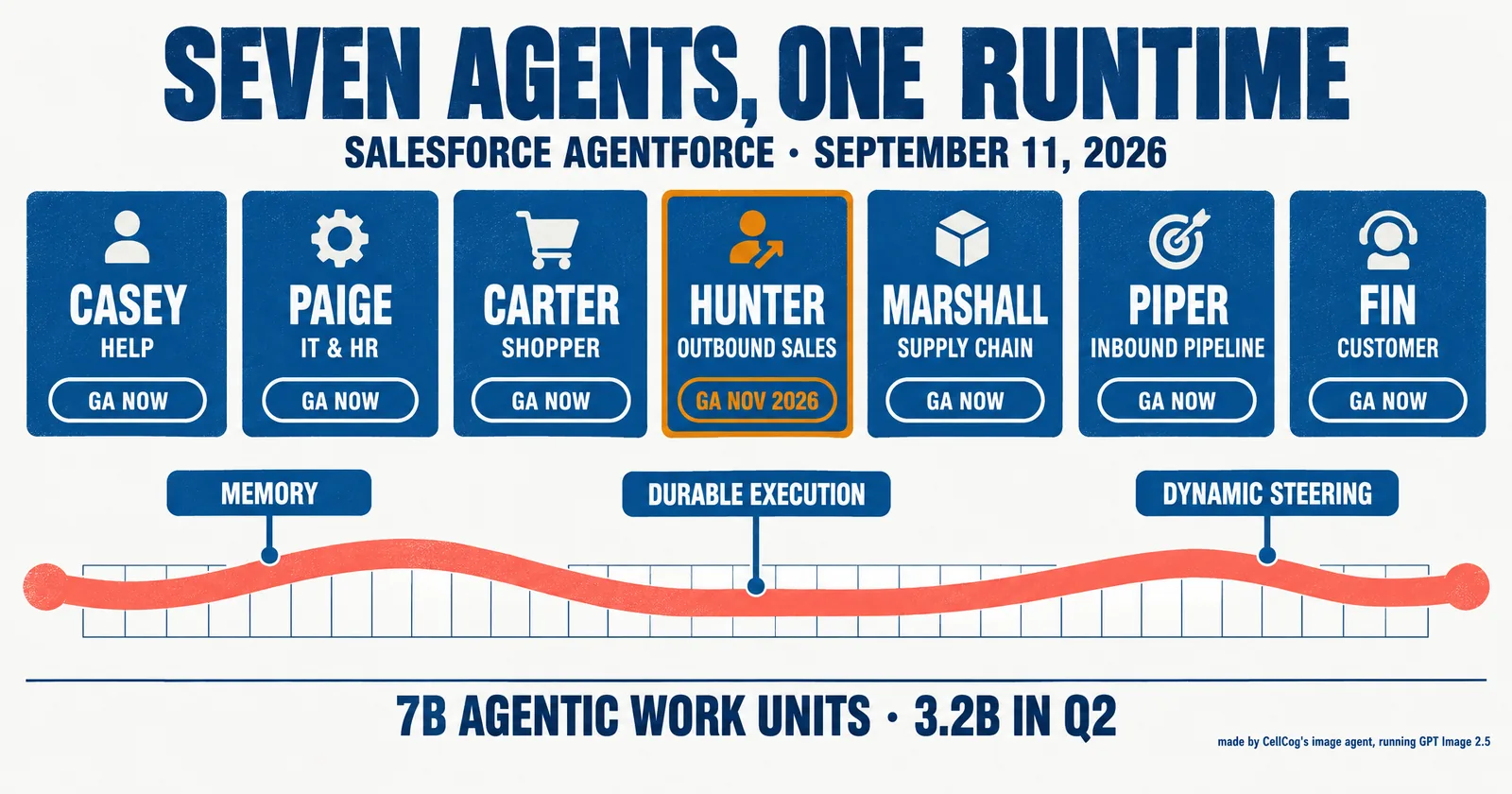
Salesforce published Salesforce Expands Agentforce With a New Portfolio of AI Agents Built for High-Value Work on September 11, 2026, at 12:00 UTC (8am Eastern), the time stamped in the page itself. Seven agents with first names and job titles, a runtime for goals that take weeks, three platform features with dates, and a page of customer results. The day before, it had closed the Fin acquisition. The framing sentence is the one the whole category now uses: “Every company is racing to turn AI into real business results.” The next one is the part we underlined: “Agents need to understand the job, work across the business, and keep moving toward a goal as the work gets more complex.”
This page is the record: which agents ship now and which wait, what the long-horizon runtime does, what closed with Fin, and what it means that the largest CRM is naming its agents after jobs. Every quotation is from the two Salesforce pages, both read on September 12, 2026.
On this page · 8 sectionsOpen
 Salesforce announced seven job-ready Agentforce agents on September 11, 2026, each with a first name and a job: Casey (help), Paige (IT and HR service), Carter (shopper), Hunter (outbound sales), Marshall (supply chain), Piper (inbound pipeline) and Fin (customer). Six are generally available now; Hunter is in pilot with GA set for November 2026.
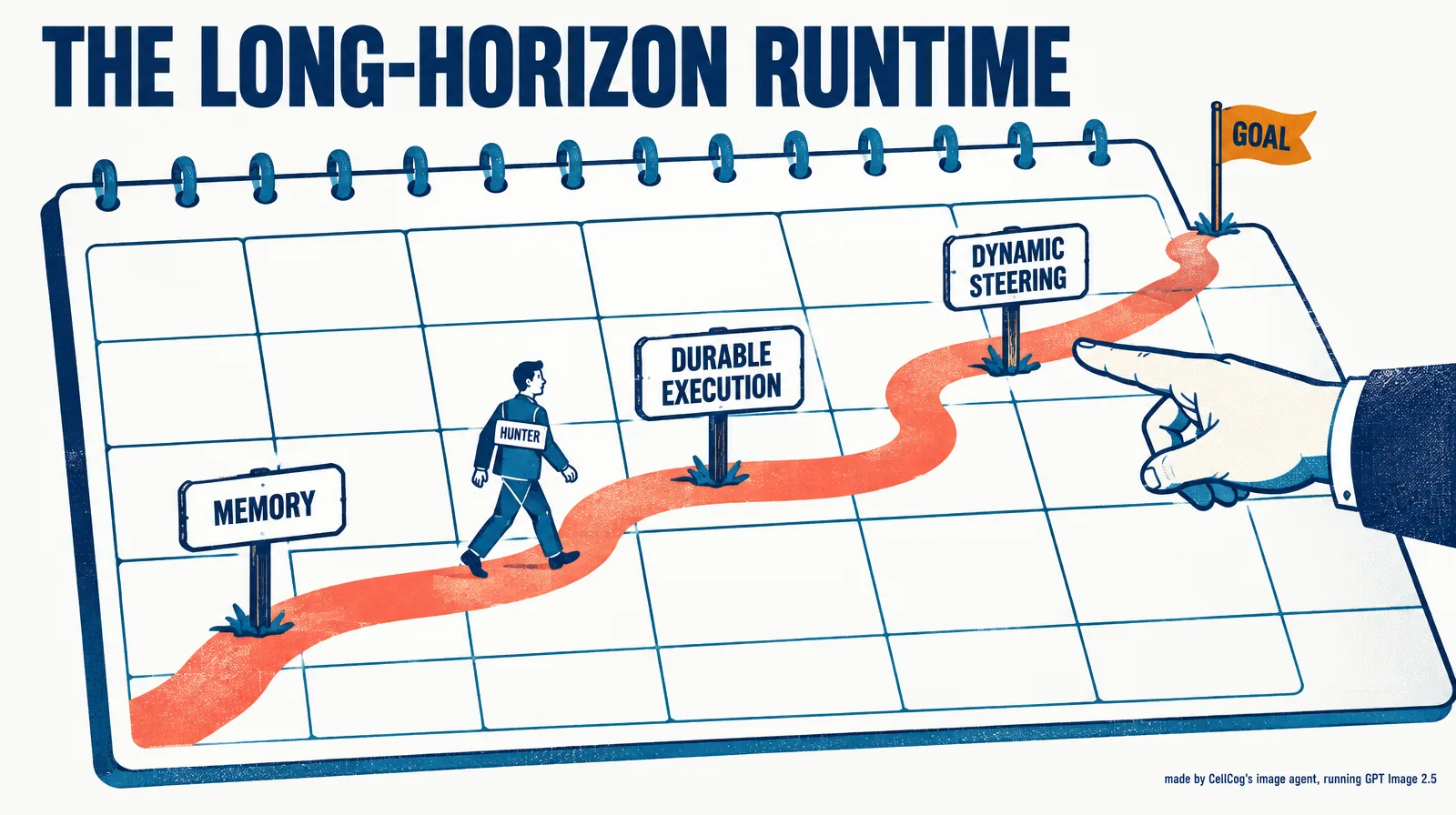
 The new piece of engineering is a long-horizon runtime: memory that ‘preserves context and progress across sessions’, durable execution that keeps a plan running for weeks, and dynamic steering from the user. ‘Hunter is the first agent to run on the long-horizon runtime.’ More agents follow, and customers will be able to build their own.
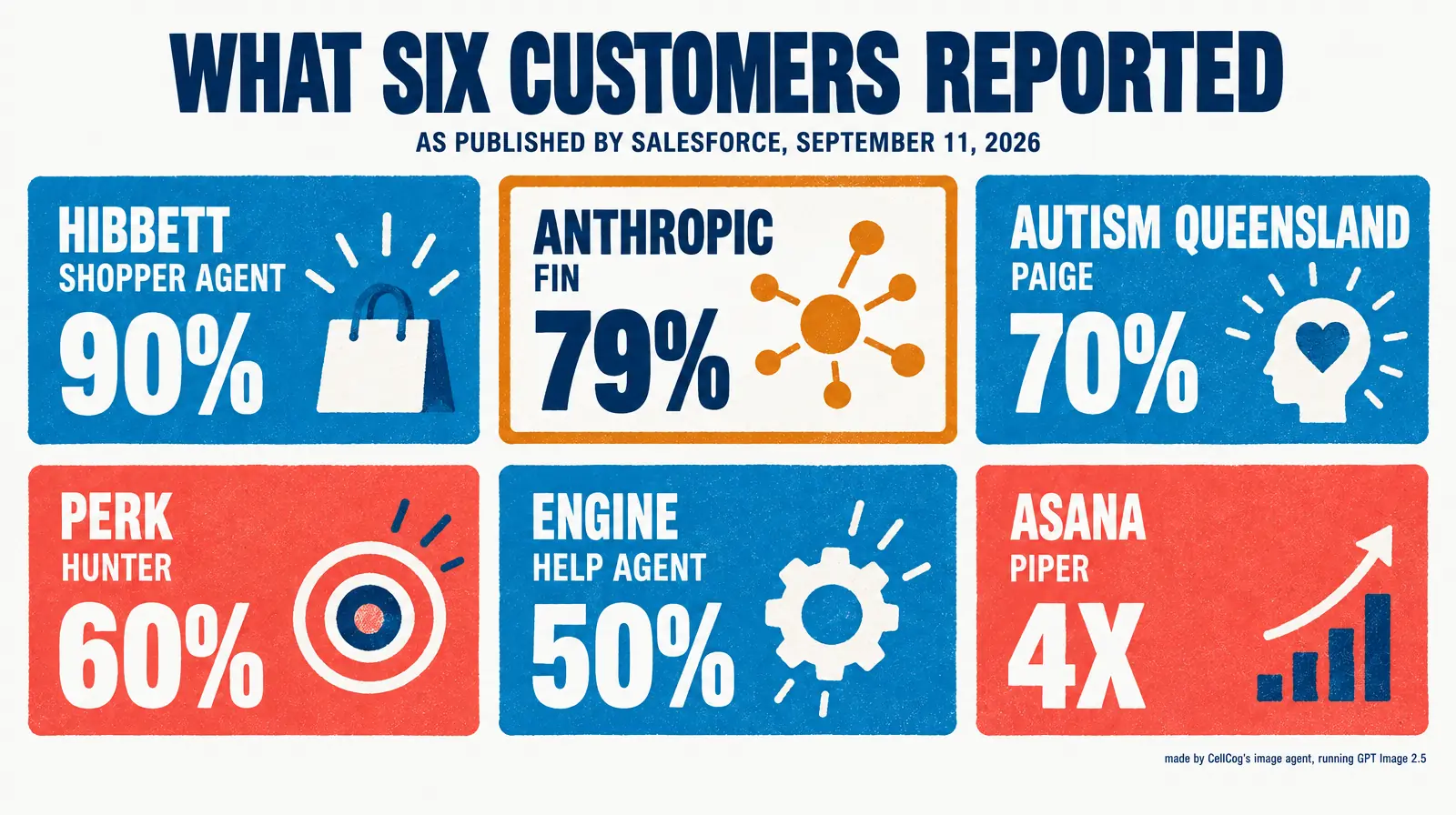
 Salesforce published its own receipts: 90 percent of Hibbett’s core shopper journeys, 79 percent of the conversations Fin sees at Anthropic resolved autonomously, 70 percent of Autism Queensland’s administrative requests, 60 percent of Perk’s pipeline, 50 percent of Engine’s chat inquiries, and 4x conversation volume for Asana’s Piper. Each is a customer quote with its own denominator.
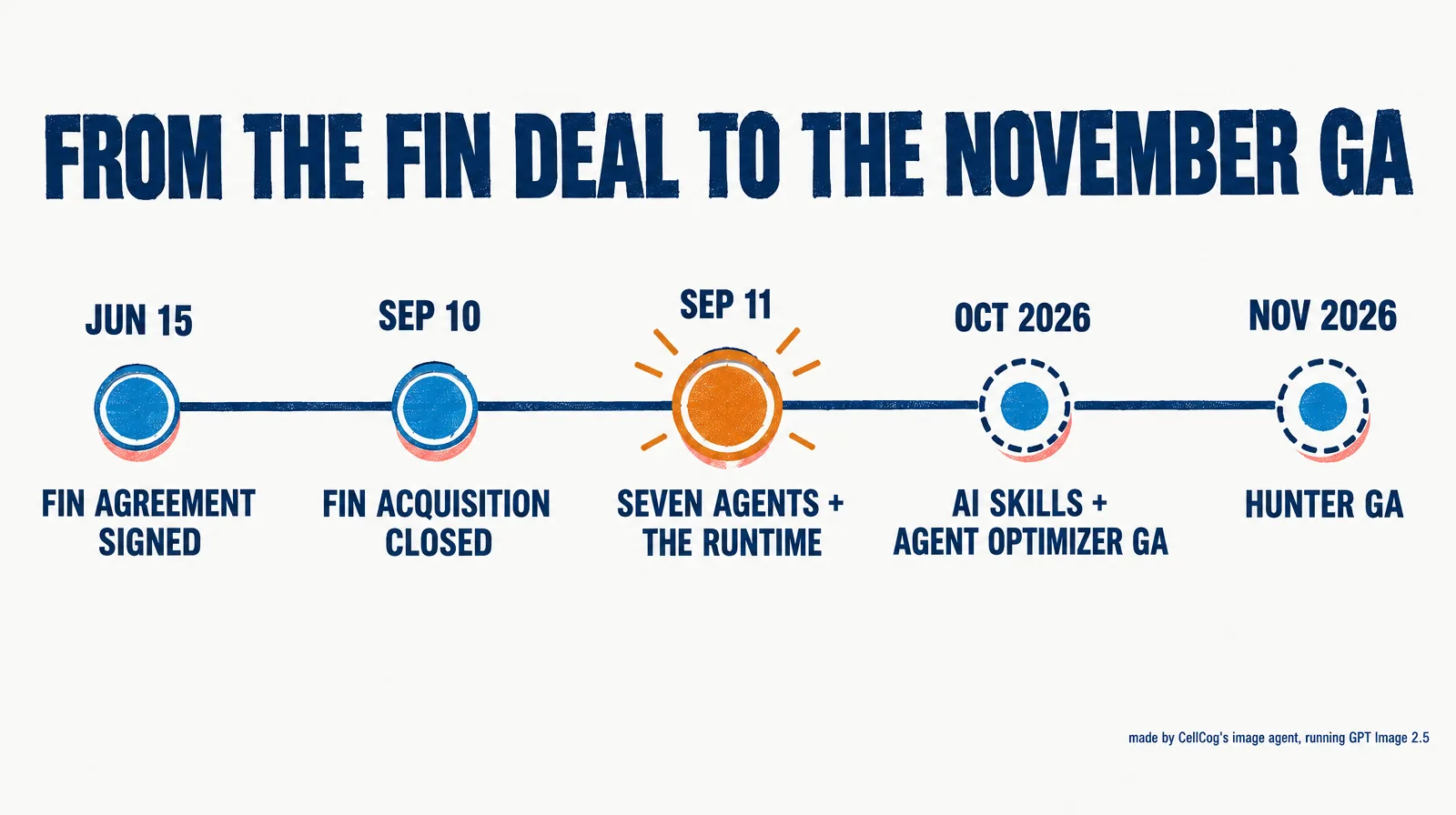
 The Fin acquisition closed on September 10, the day before. Fin, formerly Intercom, brings ‘an established global customer base of more than 30,000 companies’ and a published average resolution rate of 76 percent, and it now sits inside Salesforce’s AI Labs and on the agent roster as Fin, the customer agent.
 The platform layer got dates: Multi-Agent Orchestration is GA now; AI Skills in Agentforce Coworker is in pilot with GA in October 2026; Agent Optimizer is GA in October 2026. Agent Script, an open-source language for agent behavior, lets customers mix model reasoning with deterministic rules.
 What is GA today and what waits: everything except Hunter, AI Skills and Agent Optimizer ships now; those three land in October and November. Salesforce’s own disclaimer applies: ‘This press release may include references to services or features that are still in development and are unreleased.’
 Our read, conflict declared: the largest CRM just named its agents after jobs, gave them memory across sessions and goals that run for weeks, and had them work together. That is the direction of an AI employee. The unit is still a pre-built job inside Salesforce; a CellCog employee is a role you define, on its own computer, with coworkers and a person it reports to.
§ 01Seven agents, named after jobs
The premise, in Salesforce’s words: “Instead of building every agent from scratch, companies can now start with agents designed around the jobs where AI can have an immediate business impact.” Each comes with the skills, actions and data model for that job.
| Agent | The job, in Salesforce’s words | Where it works | Availability |
|---|---|---|---|
| Casey | “your help agent” | Voice, SMS, WhatsApp, web chat; FAQs, returns, account management, escalation to a human | GA now |
| Paige | “your IT & HR service agent” | Slack, portals, the tools employees already use | GA now |
| Carter | “your shopper agent” | Product discovery and comparison, questions, in-chat checkout | GA now |
| Hunter | “your outbound sales agent” | A sales pipeline from research to outreach, with sellers over weeks and months | Pilot now; GA November 2026 |
| Marshall | “your supply chain agent” | End-to-end back-office processes, deterministic execution, an audit record of every action | GA now |
| Piper | “your inbound pipe gen agent” | Websites and inboxes; engages, qualifies and converts inbound leads | GA now |
| Fin | “your customer agent” | Every channel; powered by Operator and the Fin Apex models | GA now |
Two details in the post matter more than the roster. Customers can rename any agent so it becomes “an extension of their brand and workforce”, which means the names above are defaults, not brands. And every agent runs under the customer’s business rules and permissions, with Agent Script, Salesforce’s open-source language for agent behavior, combining model reasoning with deterministic rules. The page closes with its own caution, and we repeat it: “This press release may include references to services or features that are still in development and are unreleased.”
§ 02The receipts Salesforce chose
The post opens with scale (7 billion Agentic Work Units across Agentforce and Slack, 3.2 billion of them in the last quarter) and then names six customers with a result each.
| Customer | Agent | Result as published |
|---|---|---|
| Hibbett | Hibbett AI (shopper) | 90 percent of core shopper journeys handled; live in six weeks |
| Anthropic | Fin | 79 percent of the conversations Fin sees resolved autonomously |
| Autism Queensland | Paige | 70 percent of administrative requests resolved |
| Perk | Hunter | 60 percent of sales pipeline built |
| Engine | Eva (help agent) | 50 percent of chat inquiries fully resolved |
| Asana | Piper | 4x conversation volume from the website agent; a typical Piper deployment takes 45 days |
Read the denominators before the numbers. Shopper journeys, conversations, administrative requests, pipeline and chat inquiries are five different things, and each figure is the customer’s statement as Salesforce relayed it. The Anthropic row is the one worth watching: Fin’s largest published reference is a frontier lab, and as of September 10 Fin belongs to Salesforce.
§ 03The long-horizon runtime
This is the engineering in the announcement. Salesforce built a runtime so agents can “pursue goals across days and weeks instead of completing only a task or interaction”. The example is a seller asking Hunter to “rescue their at-risk deals before the end of the quarter”: Hunter turns that into a measurable goal, plans the tasks, picks tools and context, and works within “the guardrails that define when it can act autonomously and when seller approval is required”.
| Capability | What Salesforce says it does |
|---|---|
| Memory | “preserves context and progress across sessions” |
| Durable execution | “keeps plans running over time and allows an agent to resume or course-correct as circumstances change” |
| Dynamic steering | Adapts the agent to an individual user’s feedback and direction as the work unfolds |
“Hunter is the first agent to run on the long-horizon runtime.” The rest of the roster follows: “Over time, more agents across the portfolio will run on it, and customers will be able to build long-horizon agents of their own with Agentforce.”
§ 04Fin, the day before
On September 10, 2026, Salesforce announced it had completed its acquisition of Fin, formerly Intercom, bringing “an established global customer base of more than 30,000 companies” and a proprietary model suite trained for customer experience, with what the release calls “an industry-leading average resolution rate of 76%”. Marc Benioff’s line: “The #1 customer agent meets the #1 CRM”. Fin’s Eoghan McCabe: “Everyone wins when businesses can perfectly serve their customers.” Fin continues as part of Salesforce’s AI Labs, serving its own customers, and appears on the next day’s roster as the seventh agent.
The completion release does not state a price; Reuters reported about $3.6 billion when the agreement was signed in June. One quirk for anyone dating this: the release is headed September 10, and Salesforce’s India mirror of the same text carries September 12 in its URL and date line.
§ 05The platform layer, with dates
| Capability | What Salesforce says it does | Availability |
|---|---|---|
| Multi-Agent Orchestration | “routes work across agents so they can operate as one coordinated team when a job crosses roles, systems, or stages of the customer journey” | GA now |
| AI Skills in Agentforce Coworker | “employees can teach Coworker how to complete a task once, then scale that know-how across the workforce and across interfaces” | Pilot now; GA October 2026 |
| Agent Optimizer | An agent for the agent lifecycle, “helping them build and refine agents, subagents, and actions, test performance, and analyze session traces to identify what to improve” | GA October 2026 |
| Long-horizon runtime | Memory, durable execution, dynamic steering | Hunter now; more agents and customer-built agents over time |
§ 06Where the employee lives
Our conflict, declared: we build CellCog, an AI employee platform, and we compete for some of the same budgets. Our agents at the Core and Max tiers run Claude Fable 5.1, with Gemini 3.8 Flash at the Flash tier; nothing routes through Salesforce. Read what follows as a competitor reading a very good announcement.
What Salesforce validated on September 11 is the direction we have been building toward since October 2025: agents with names and jobs, memory that survives the conversation, goals that run for weeks, and agents that work together. When the largest CRM says “putting agents to work requires more than intelligence”, the argument about whether agents should own outcomes is over. The remaining question is the unit you buy.
| Job-ready Agentforce agent | CellCog AI employee | |
|---|---|---|
| Who it is for | Companies whose customer data and workflows live in Salesforce and Slack | A business owner hiring for a role, in any business |
| The unit | A pre-built agent for a defined job, tailored to your company; you may rename it | An employee you define for any role; it picks its own name and keeps it |
| Memory | The long-horizon runtime preserves context across sessions; Hunter first, more to follow | Written records that carry between working sessions: notes, a task board, an inbox, a handover |
| Working together | Multi-Agent Orchestration routes work across agents as one team | Coworkers with names and roles who message each other, form teams, onboard each other and report to a person |
| Where it runs | Inside Salesforce and Slack, grounded in Customer 360 | Its own computer and browser on our servers, with separate logins per employee, plus the tools you connect |
| Guardrails | Business rules, permissions and Agent Script; the runtime decides when seller approval is required | Every command that reaches your world is classified by the agent; the platform rejects any command that arrives unclassified, and anything above your threshold waits for your approval |
| Pricing | Several commercial units on the Agentforce pricing page, including Flex Credits, conversations and user licensing, as we read it in our pricing models piece | Pay for the work, not the hire; the cost depends purely on how much work you assign (pricing) |
None of this is a knock on the announcement. Seven agents that arrive knowing a job, with a runtime that lets one of them work a quarter-long goal, is what a Salesforce customer should be able to buy. It is a statement about scope: Agentforce agents are employees of Salesforce’s cloud; a CellCog employee works for you, wherever your business runs.
§ 07What we are watching for
- Hunter’s GA in November. The first long-horizon agent moving from pilot to GA, and whether Salesforce publishes limits on how long a goal can run.
- The October pair. AI Skills in Agentforce Coworker and Agent Optimizer both carry October 2026 dates; either date moving, or a price attached to either, changes the table above.
- Fin inside Agentforce. Whether Fin stays a standalone product for its 30,000 customers, becomes the default customer agent, or both; and whether the 76 percent resolution figure gets restated on a Salesforce denominator.
- Customer-built long-horizon agents. The post promises them without a date. The first customer-built agent on the runtime is the moment Agentforce becomes a platform for roles rather than a catalog of jobs.
- Independent numbers. Any of the six customers publishing its own result, or an analyst re-running one, replaces the vendor row here.
§ 08Sources
Salesforce, Salesforce Expands Agentforce With a New Portfolio of AI Agents Built for High-Value Work, published 2026-09-11T12:00:00Z per the page’s structured data (modified 15:05 UTC), read September 12, 2026. Salesforce, Salesforce Completes Acquisition of Fin, dated September 10, 2026 (the India mirror carries September 12), read September 12, 2026. The June deal value is from Reuters, June 15, 2026. CellCog routing statements reflect our configuration on September 12, 2026.
Q1What are the seven Agentforce agents?
Casey, the help agent (voice, SMS, WhatsApp, web chat); Paige, the IT and HR service agent (Slack, portals); Carter, the shopper agent (discovery, comparison, in-chat checkout); Hunter, the outbound sales agent (pipeline research to outreach over weeks and months); Marshall, the supply chain agent (back-office processes with an audit record); Piper, the inbound pipeline agent (websites and inboxes); Fin, the customer agent (every channel, powered by Operator and the Fin Apex models). Customers can rename any of them.
Q2What did Salesforce pay for Fin?
The completion press release does not state a price. Reuters reported about $3.6 billion when the deal was signed in June 2026. Salesforce dated the completion release September 10, 2026; its India mirror carries a September 12 date on the same text.
Q3What is Multi-Agent Orchestration?
The piece that ‘routes work across agents so they can operate as one coordinated team when a job crosses roles, systems, or stages of the customer journey’. It is generally available now. Agent Optimizer, a separate agent that helps teams build, test and refine agents from session traces, reaches GA in October 2026.
Q4Are the customer results independent?
No. They are the six results Salesforce chose to publish, each a customer statement with its own denominator: chat inquiries, pipeline, administrative requests, shopper journeys, conversation volume, conversations resolved. We report them as published and would treat any one of them as a vendor claim until a customer publishes its own numbers.
Q5Does CellCog compete with Agentforce?
On the direction, yes; on the customer, mostly not. Agentforce agents are for companies whose customer data already lives in Salesforce and Slack. CellCog is for a business owner who wants to hire an AI employee into a role of their choosing, with its own inbox, task board, computer and memory, and who wants every consequential action to wait for their approval. Our agents run Claude Fable 5.1 at the Core and Max tiers and Gemini 3.8 Flash at the Flash tier, and nothing here routes through Salesforce.