Meta and Sierra announced the Personal Agent Protocol on October 6, 2026: an open standard for how a person’s AI agent signs in to a business and gets a task done there. Sierra’s co-founders, Bret Taylor and Clay Bavor, published the announcement during Sierra Summit in San Francisco, with Genesys, Instinct, Rocket, Shopify, Stripe and Walmart named as partners. Meta’s David Singleton posted the news on X with a different partner list. There is no specification yet; Sierra plans to publish version 0.1 later in October. This page reads Sierra’s post, Bret Taylor’s X post, David Singleton’s X post and CNBC’s interviews with both, as of October 7, 2026.
On this page · 8 sectionsOpen
 Personal Agent Protocol is an open standard Meta and Sierra announced on October 6, 2026, at Sierra Summit, for how personal AI agents sign in to businesses and get tasks done for their users.
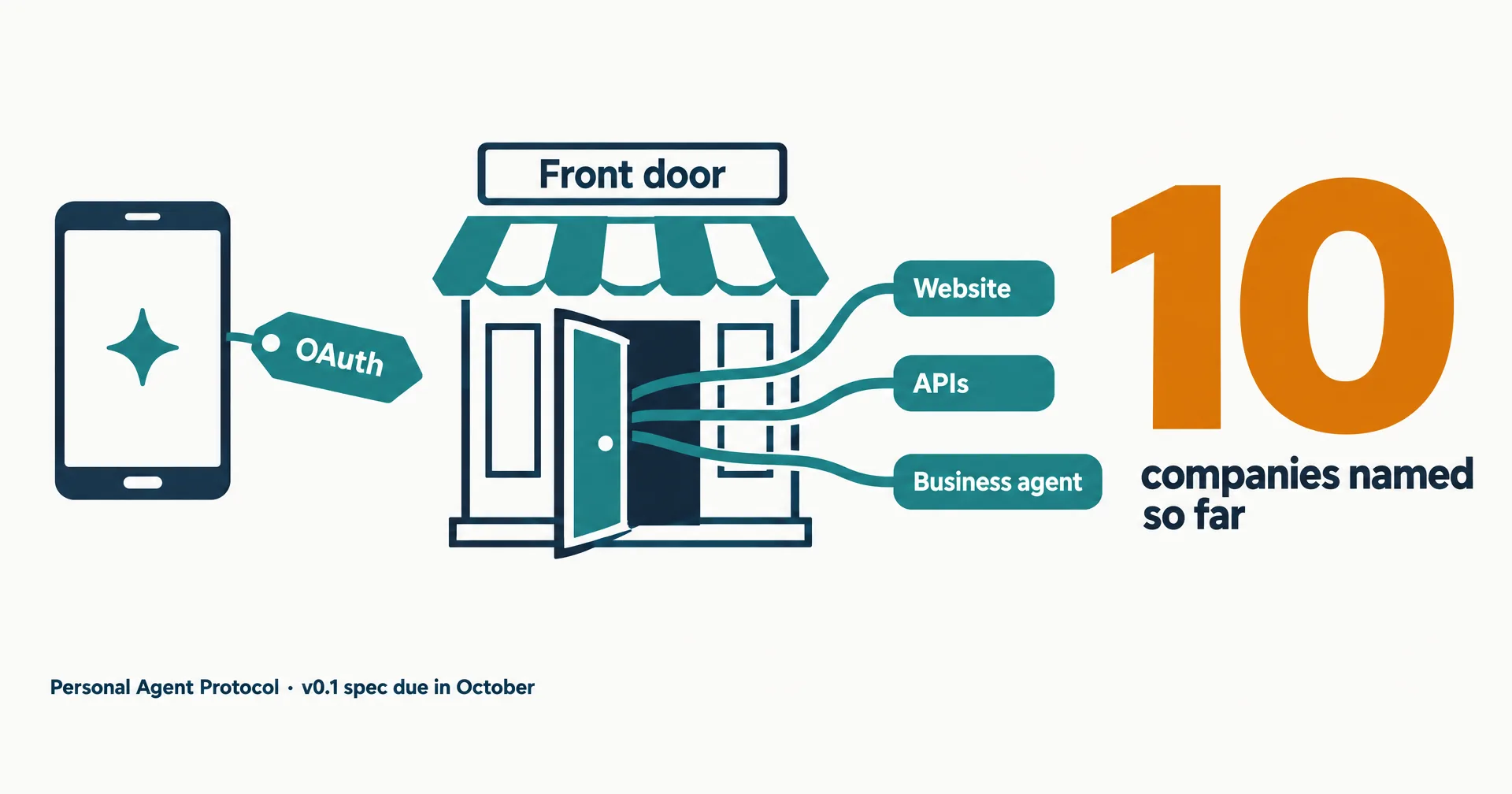
 Sierra’s post names Genesys, Instinct, Rocket, Shopify, Stripe and Walmart as partners; Meta’s David Singleton listed NiCE and Decagon instead of Instinct, so ten companies are named so far.
 Sessions are built on OAuth: an agent can start as a guest, the customer chooses read-only or write access, and the company decides whether agents use its website, its APIs or its own agent.
 There is no specification yet: Sierra plans to publish v0.1 later in October 2026 with design workshops and a reference implementation; payments and push notifications are listed as possible extensions.
 OpenAI and Anthropic are not on board for now, CNBC reports; Bret Taylor, Sierra’s co-founder and OpenAI’s chairman, said he expects them to join.
§ 01Why a standard, and why now
Sierra’s post describes how personal agents deal with companies today. They use websites the way people do, “loading pages and clicking through forms”, and when that fails they call the support line or open the web chat. That is slow for the customer, and the company cannot tell an agent acting for a real customer from a scraper. Taylor told CNBC: “It is kind of chaos until such a standard exists.”
The pressure comes from Meta. Muse, its personal agent, launched in September and, per Singleton, already has millions of users in the US. CNBC also reports that Amazon has blocked Meta’s agents, citing worries about scraping. Singleton framed the protocol as shared plumbing, “We’re defining rails that we hope personal agents and business agents can run over for the future”, and compared it to email.
§ 02How it works
Sierra’s principle is that “consumers decide what access to give their personal agents, and companies set parameters for what those agents can do.” A session runs like this:
| Step | What happens | Who decides |
|---|---|---|
| Discover | The agent reads on the company’s website what it offers and how to reach it | The company |
| Start | The agent opens a session for its user, as a guest at first; enough to check availability or a returns policy | The agent |
| Sign in | For account tasks, the customer signs in on the company’s page or uses credentials already set up with their agent | The customer |
| Grant access | Read-only or write access to the account | The customer |
| Do the task | Through the company’s website, its APIs (built on standards such as MCP and OpenAPI) or its own agent | The company |
| Carry over | The session, built on OAuth, carries across channels, so a question before sign-in and an order change after it are one visit | The protocol |
The three routes matter. A company can keep agents on its existing web pages, open APIs to them, or put its own agent at the door for work that needs a conversation; Sierra’s example is a warranty claim. Through all of it, “The customer is always in control, deciding whether the agent has read-only or write access.”
§ 03Who is in
| Company | In Sierra’s post | In Meta’s post | What it does |
|---|---|---|---|
| Meta | Developing it | Developing it (Muse and Meta Business Agent) | Muse, a personal agent; agents for businesses |
| Sierra | Developing it | Developing it | AI customer-service agents for companies |
| Genesys | Partner | Partner | Contact-center software |
| Rocket | Partner | Partner | Home buying and mortgages |
| Shopify | Partner | Partner | Commerce platform for merchants |
| Stripe | Partner | Partner | Payments |
| Walmart | Partner | Partner | Retail |
| Instinct | Partner | Not listed | Personal AI assistant |
| NiCE | Not listed | Partner | Contact-center software |
| Decagon | Not listed | Partner | AI customer-service agents |
| OpenAI, Anthropic | Not listed | Not listed | Not on board for now, per CNBC |
Across both lists, ten companies are named. The roster has two sides: personal agents (Meta’s Muse, Instinct), and the businesses and contact-center vendors those agents would knock on (Walmart, Shopify, Genesys, NiCE, Sierra, Decagon). Stripe sits where money changes hands.
The partners’ own lines show what each wants. Genesys’s CEO, Tony Bates: “Personal AI is creating a new front door to the enterprise.” Stripe’s head of payments, Kevin Miller: “When customers send an agent, they expect the same service they’d get themselves.” Rocket’s CTO, Shawn Malhotra, says its technology “allows a Muse agent to move across our platform”.
§ 04What is not there yet
No spec, no code. Sierra’s post says the companies “plan to publish the v0.1 specification later this month, host design workshops with interested parties, and publish a reference implementation”. It also lists ideas, not commitments: finer permissions on specific actions, push notifications so a company can tell an agent “the moment a flight is delayed or an order ships”, and a payments extension so an agent could “complete a purchase without sharing credit card information”. When we checked on October 7, Meta’s newsroom had no post about it; Meta’s word so far is Singleton’s X post and his interview.
The biggest gap is the two largest assistant makers. CNBC reports that OpenAI and Anthropic are not on board. Taylor, who is also OpenAI’s chairman, said he expects them to join and would be disappointed if competitors did not use it.
§ 05Next to MCP, A2A and ACP
The protocol is a front door, not a replacement for the agent standards already in use:
- MCP, the Model Context Protocol, connects an AI application to tools and data. Sierra names it as one way a company can open its APIs to personal agents, so it sits under the protocol rather than against it.
- A2A, Google’s Agent2Agent protocol, lets agents talk to each other. A company’s own agent is one of the protocol’s three routes, but Sierra’s post does not mention A2A.
- ACP, the Agentic Commerce Protocol from OpenAI and Stripe, handles checkout inside an agent. The new protocol lists payments only as a possible extension, and Stripe is in both.
§ 06Where AI employees fit
A CellCog AI employee acts for its owner, so at this door it is the personal agent. Today it deals with other companies the long way Sierra’s post describes. It browses sites in its own browser and fills logins you saved for it without seeing the password. It can phone a US business to book a table or an appointment for you. It pays with a one-time card you approve in Link, placed straight into the checkout (how Spend works). A shared front door would make each of those faster, and would let the business see which agent is acting for whom. CellCog has not built anything for this protocol, because there is no specification to build against. When v0.1 is published, this page will carry what it says.
§ 07What we are watching
- The spec. Version 0.1, due later in October, and the reference implementation.
- The holdouts. Whether OpenAI, Anthropic, Google or Amazon sign on.
- Meta’s own launch. A newsroom post, and when Muse and Meta Business Agent use the protocol.
- Payments. Whether the protocol builds its own extension or leans on ACP.
- One list. Whether Sierra’s and Meta’s partner lists converge.
§ 08Sources
- Sierra, Introducing Personal Agent Protocol, by Bret Taylor and Clay Bavor, October 6, 2026: sierra.ai
- Sierra Summit 2026 recap: sierra.ai
- Bret Taylor on X, October 6, 2026, 18:15 UTC: x.com/btaylor
- David Singleton on X, October 6, 2026, 20:17 UTC: x.com/dps
- CNBC, Kate Rooney, October 6, 2026: cnbc.com
- The Verge, Jay Peters, October 6, 2026: theverge.com
- Model Context Protocol specification: modelcontextprotocol.io
- Google, A2A announcement: developers.googleblog.com
- Agentic Commerce Protocol: agenticcommerce.dev
Q1What is the Personal Agent Protocol?
An open standard Meta and Sierra announced on October 6, 2026, at Sierra Summit, that defines how personal AI agents interact with businesses: how an agent finds what a company offers, starts a session, signs in for the customer and completes a task.
Q2Who is developing the Personal Agent Protocol?
Meta and Sierra. Sierra’s post names Genesys, Instinct, Rocket, Shopify, Stripe and Walmart as partners; Meta’s David Singleton listed Genesys, NiCE, Decagon, Rocket, Shopify, Stripe and Walmart. CNBC reports OpenAI and Anthropic are not on board for now.
Q3Is the Personal Agent Protocol available yet?
No specification has been published. As of October 7, 2026, Sierra plans to publish v0.1 later in October, host design workshops and release a reference implementation.
Q4How does the Personal Agent Protocol relate to MCP?
It sits above it. A company can serve personal agents through its website, APIs built on standards such as MCP and OpenAPI, or its own agent; the protocol covers discovery, sign-in and access, and MCP can carry the API calls.
Q5Does CellCog support the Personal Agent Protocol?
Not yet, because there is no specification to implement. CellCog AI employees work with other companies through websites with logins their owner saved, booking calls to US businesses, and one-time cards their owner approves in Link.